Stockwatch: the case for this income share just got sounder
A sound business on a modest rating can offer better risk/reward and downside protection, argues analyst Edmond Jackson, especially when supported by reliable and material yield.
18th September 2026 11:00
by Edmond Jackson from interactive investor

Following my study of Cerillion (LSE:CER) where its growth rating has halved from a price/earnings (PE) around 30x as financial performance softened – the shares are down 60% - it is interesting to compare FTSE 250 retailer Wickes Group (LSE:WIX) as a “value” share in the opposite camp.
- Invest with ii: Share Dealing with ii | Open a Stocks & Shares ISA | Our Investment Accounts
While investors often get preoccupied with trying to find the next spectacular growth share, a sound business on a modest rating can offer better risk/reward and downside protection – especially when supported by reliable and material yield.
Despite significant volatility from around 175p in April 2025 to over 250p in February, then down again by June, Wickes’ chart shows a series of falls that all find support eventually within an overall four-year uptrend:
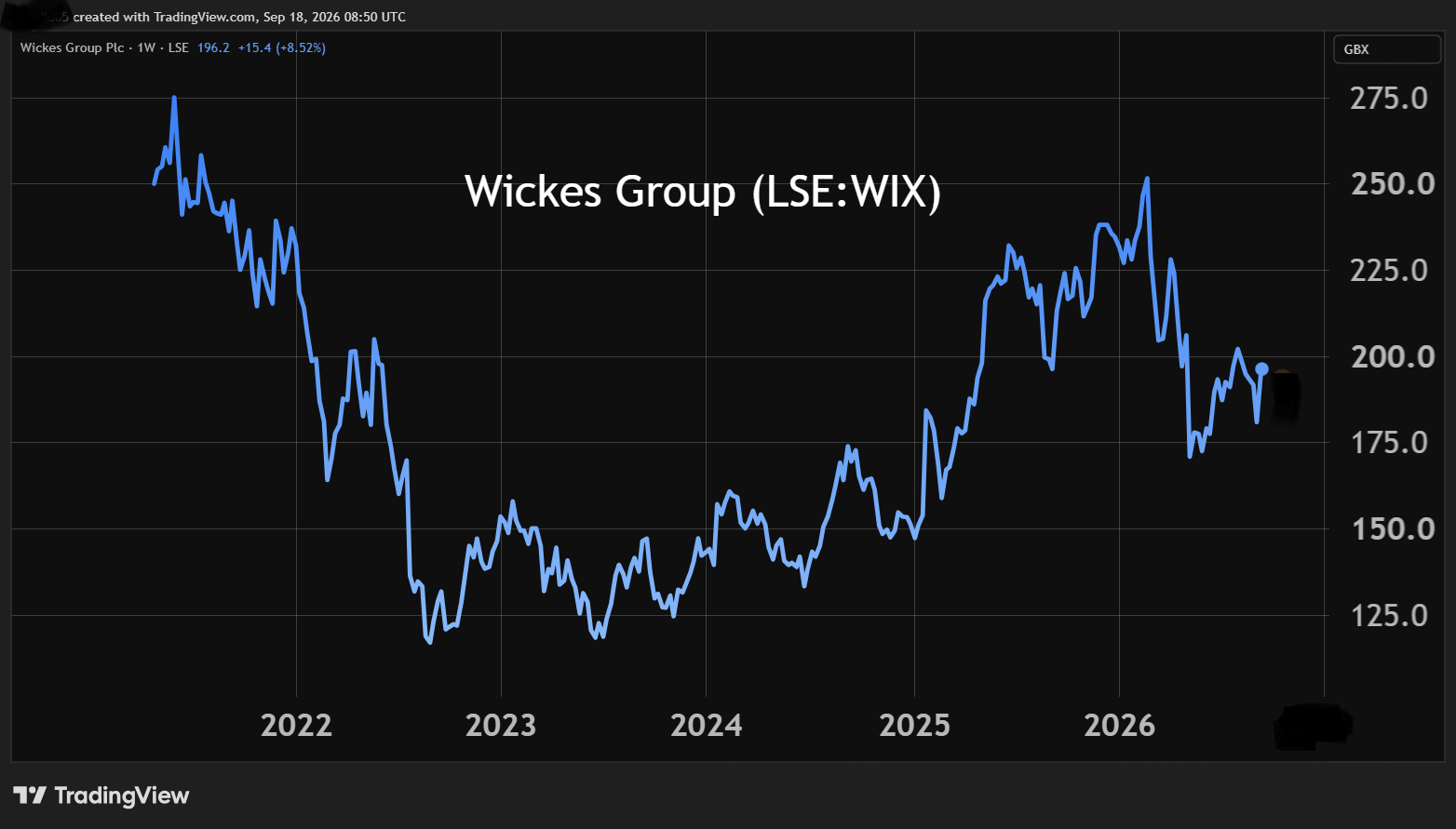
Source: TradingView. Past performance is not a guide to future performance.
Both the chart and fundamentals now seem positive given last Tuesday’s half-year results that asserted “a significantly improving trend” in the third quarter of 2026 despite unexciting numbers.
Total revenue in the 26 weeks to 27 June had edged up 2.1% to £865.3 million which, considering latest UK inflation at 3.1%, can in adjusted terms be seen as a mild slip. Adjusted pre-tax profit also only rose 1.1% to £27.6 million, with productivity actions partially mitigating cost inflation.
The shares have risen 8.5% to 192p since Tuesday’s update ratcheted up prospects, given Wickes’ 12-month forward PE still looks to be in single figures. There’s also a prospective yield over 6% with around 1.75x cover based on consensus estimates for dividend per share and earnings per share (EPS).
A dilemma I noted last time with Cerillion was it falling between two stools of “growth” and “value”: growth has reduced amid competition, but the yield is only 2% (albeit covered over 3x) such that neither growth nor income investors are inspired. But with Wickes’ yield in the region of 6%, the market responds well.
Are home improvement a defensive sector?
If they are, then it mitigates risk with this yield relative to other consumer and industrial shares. Might Wickes’ current upturn hint also at sound if unexciting growth?
Relative to discretionary spending, a wide range of home improvement products at Wickes can in some senses be deemed “essential maintenance”. Its kitchen and bathroom installation side could prosper even in the weak housing market if people decide on re-fits instead of moving or to ready their homes for when they might. Research shows buyers prefer homes that are comfortably ready to move into, “doer-uppers” having less appeal.
In the aftermath years of the 2008 crisis, I recall Howden Joinery HWDN surprising on the upside as a seller of kitchens and joinery products to trade customers, primarily local builders. Its shares rose from 15p to 365p by spring 2014 and 960p in 2021, hence a small cap evolved to enter the FTSE 100 three years ago. I do not imply similar upside at Wickes, just to point out how this area of domestic improvement ought not to be underestimated even when consumer conditions are tight.
- Rising power of the asset management kings
- Global infrastructure: differentiated returns in a tech-driven world
Wickes says its “value-led retail proposition continues to appeal to both DIY and trade customers” with TradePro (a business account for trade customers to get 10% off each time) achieving record levels of active members. There have been “particularly strong sales of Wickes Bespoke Bathrooms and Lifestyle Kitchens, demonstrating the appeal of our broader offer”.
Moreover, the third quarter is said to be experiencing “a significant step-up to mid-single-digit, like-for-like revenue growth in retail”. Obviously, this could be challenged if higher inflation from energy costs weighs on consumer sentiment in due course, but in a retail share context I tend to see Wickes as relatively defensive.
Wickes Group - financial summary
| Years to 1 Jan | Yr to 31 Dec | |||||||
| 2019 | 2020 | 2021 | 2022 | 2022 | 2023 | 2024 | 2025 | |
| Turnover (£ million) | 1,200 | 1,292 | 1,347 | 1,535 | 1,559 | 1,554 | 1,545 | 1,636 |
| Operating margin (%) | 4.7 | 4.4 | 4.5 | 6.3 | 4.3 | 4.1 | 3.0 | 4.3 |
| Operating profit (£m) | 56.6 | 56.2 | 61.0 | 96.7 | 67.1 | 62.9 | 47.0 | 70.6 |
| Net profit (£m) | 14.9 | 12.9 | 26.3 | 58.8 | 31.9 | 29.8 | 18.1 | 38.5 |
| Reported EPS (p) | 5.9 | 5.1 | 10.4 | 23.3 | 12.5 | 11.7 | 7.4 | 16.4 |
| Normalised EPS (p) | 11.0 | 14.1 | 17.8 | 34.6 | 29.2 | 15.5 | 18.5 | 16.9 |
| Earnings per share growth (%) | 28.5 | 26.1 | 94.8 | -15.6 | -47.0 | 19.5 | -8.5 | |
| Return on total capital (%) | 5.2 | 5.3 | 7.2 | 11.8 | 8.6 | 8.3 | 6.1 | 9.2 |
| Operating cashflow/share (p) | 70.1 | 43.0 | 83.8 | 40.2 | 49.4 | 70.2 | 66.3 | 82.6 |
| Capex/share (p) | 17.4 | 9.6 | 8.0 | 10.5 | 15.9 | 15.0 | 10.7 | 10.7 |
| Free cashflow/share (p) | 52.7 | 33.4 | 75.8 | 29.7 | 33.5 | 55.3 | 55.6 | 71.9 |
| Dividend/share (p) | 0.0 | 0.0 | 10.9 | 10.9 | 10.9 | 10.9 | 10.9 | 10.9 |
| Cash (£m) | 16.2 | 25.4 | 6.5 | 123 | 99.5 | 97.5 | 86.3 | 91.7 |
| Net debt (£m) | 879 | 830 | 784 | 619 | 592 | 578 | 619 | 628 |
| Net assets (£m) | 264 | 279 | 130 | 161 | 164 | 163 | 145 | 131 |
Source: flotation prospectus and company accounts
An essential comparison with Greggs
On a 12-month forward PE below 10x and a 6.2% yield covered 1.75x, does Wickes offer better risk/reward than for example Greggs (LSE:GRG) on a 14x PE and 4% yield despite nearly twice cover?
Wickes has a 5% share of a total £35 billion UK home improvement market that is estimated to be growing around 4.5% annually in a general “improve, not move” subdued housing market. It plans to grow its nationwide store network from 230 to around 300 locations.
Greggs has a near 9% share of the near £25 billion UK “food to go” market estimated to be growing around 3.4% this year. Greggs does look to be adapting itself as best it can after a period of exceptional growth from 2020 to 2025, and is now exploiting “express” type smaller premises. I am relatively cautious versus Wickes in the sense that fuel/electricity price increases (cost of food production and transport) imply cost inflation. Similarly, people’s cost of living pressures could affect spending on food and drink when out, although this is not to imply home improvement products and services are immune.
In terms of financial risk however, Greggs is less geared than Wickes, which could become more relevant if interest rates have to rise to contain inflation resulting from higher fuel prices.
- The City analysts tipping AstraZeneca shares to rise again
- Sign up to our free newsletter for investment ideas, latest news and award-winning analysis
Greggs’ first-half 2026 results showed £10.5 million net interest costs taking 12% of reported operating profit. That compares with £12.8 million such costs for Wickes taking 34% of profit. I do not feel gearing measures are necessarily appropriate here because they are assumed to reflect bank debt not leases, but which can be very significant to retailers. Take your cue from interest cover.
More positively, and why gearing omits leases, monthly lease payments should not fluctuate with bank interest rates, although signing a new lease would indeed reflect such change. Unfortunately, note 12 (leases) to Wickes’ interim balance sheet did not offer any guidance as to maturity profiles.
Principal institutional shareholders mostly adding
While director share buying has been absent since material purchases in 2021-22, and their selling has essentially been after options exercises to pay tax arising, six asset management firms (over the disclosure threshold) have recently added to their stakes.
At end-May, Artemis bought 1.3 million to own 10.6 million or 4.7%, and Newton North America bought 4.1 million to own 10.3 million. At end-June, JO Hambro UK Equity Income Fund (affirming my sense of a quality income share) bought 1.5 million to own 14.3 million. In late July, BNY Mellon UK Income Fund bought 419k to own 11.0 million; and earlier this month Newton’s UK office bought 1.4 million to own 11.5 million.
Only JP Morgan has been a disclosed seller, of 2.3 million shares to own 9.1 million as of end-June. Obviously “for every buyer there has to be a seller” but such is the disclosed profile of institutional trading.
Tilts overall to retaining a “buy” stance
I last rated Wickes a “buy” at 152p in January 2025 on a prospective yield of 7.4% respecting strong cash flow cover that looked as if shares were priced too cheaply. Downside risk appeared limited barring a recession, so for investors it was chiefly a case of being patient. I suggested Wickes could also benefit from failures such as Wilko, CTD Tiles and Carpetright, although that seems yet to materially bear out.
Some £705 million lease liabilities are 88% non-current, so a rising interest rate scenario probably would be more significant for consumer spending than company-specific financial risk. This potentially could keep Wickes’ shares volatile but, all things considered, their trend has a good chance of remaining upward, hence I retain “buy”.
Edmond Jackson is a freelance contributor and not a direct employee of interactive investor.
These articles are provided for information purposes only. Occasionally, an opinion about whether to buy or sell a specific investment may be provided by third parties. The content is not intended to be a personal recommendation to buy or sell any financial instrument or product, or to adopt any investment strategy as it is not provided based on an assessment of your investing knowledge and experience, your financial situation or your investment objectives. The value of your investments, and the income derived from them, may go down as well as up. You may not get back all the money that you invest. The investments referred to in this article may not be suitable for all investors, and if in doubt, an investor should seek advice from a qualified investment adviser.
Full performance can be found on the company or index summary page on the interactive investor website. Simply click on the company's or index name highlighted in the article.
Disclosure
We use a combination of fundamental and technical analysis in forming our view as to the valuation and prospects of an investment. Where relevant we have set out those particular matters we think are important in the above article, but further detail can be found here.
Please note that our article on this investment should not be considered to be a regular publication.
Details of all recommendations issued by ii during the previous 12-month period can be found here.
ii adheres to a strict code of conduct. Contributors may hold shares or have other interests in companies included in these portfolios, which could create a conflict of interests. Contributors intending to write about any financial instruments in which they have an interest are required to disclose such interest to ii and in the article itself. ii will at all times consider whether such interest impairs the objectivity of the recommendation.
In addition, individuals involved in the production of investment articles are subject to a personal account dealing restriction, which prevents them from placing a transaction in the specified instrument(s) for a period before and for five working days after such publication. This is to avoid personal interests conflicting with the interests of the recipients of those investment articles.