Stockwatch: time to follow directors and buy this small cap
There’s been significant boardroom buying at this intriguing business, and analyst Edmond Jackson believes the shares probably offer value.
13th October 2026 11:12
by Edmond Jackson from interactive investor

Have the small-cap shares in specialist equipment rental company Vp (LSE:VP.) finally reached an attractive level for risk/reward? Yesterday, the price closed up 2.3% at 524p after a trading update for the six months to 30 September affirmed expectations for the 31 March year, with the second half expected to outperform the first.
- Our Services: SIPP Account | Stocks & Shares ISA | See all Investment Accounts
This is notable in a UK macro sense given equipment hire is often a near-term indicator of the economy. With energy prices having risen and a tough Budget ahead, Vp’s update can seem like a signal of resilience. Mind, this company is significantly geared to water industry upgrading (reliable medium-term revenue), but visibility serving construction and housebuilding can be short, especially if stubbornly high energy prices persist.
For what forecasts from the International Monetary Fund (IMF) are worth, today they upgraded 2026 UK economic growth from 1% to 1.3% while warning of a “slowdown” to 1.2% in 2027 precisely due to higher energy costs and interest rates. This to me is a typical “finger in the wind” approach, showing the risks with extrapolation. In 1989, after the Lawson Boom, I recall consensus was for a UK “soft landing”, but 1990 to early 1991 saw a significant recession.
The five-year chart can look as if Vp is establishing a support level this year from which a classic “bowl” pattern could evolve from apparently cheap earnings and yield criteria. But you could say a new uptrend manifested in the first half of 2024 then failed, so take care with assumptions from charts:
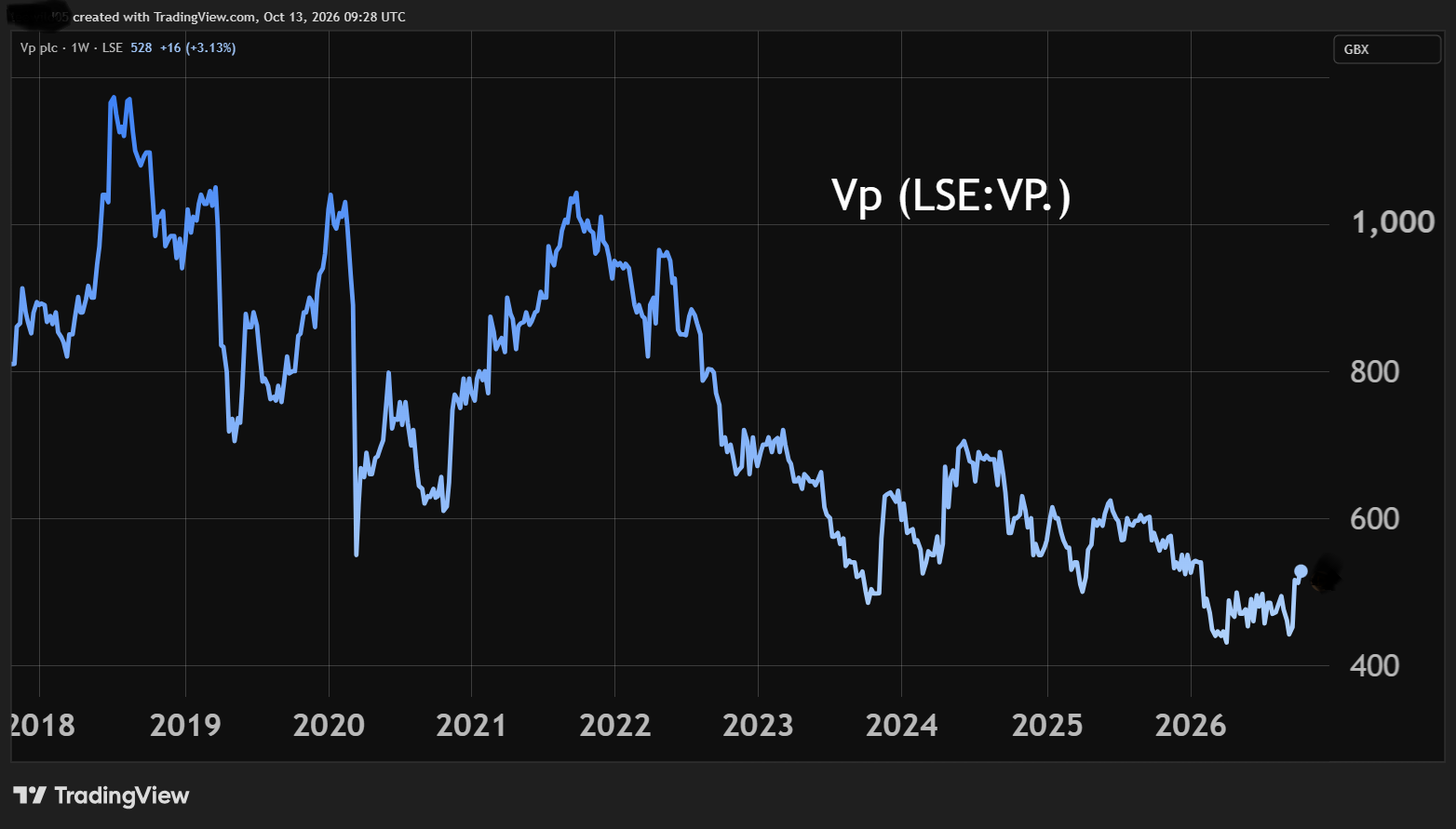
Source: TradingView. Past performance is not a guide to future performance.
Indeed, I succumbed previously, though not altogether to the chart, but it is a reminder how seemingly attractive valuation criteria in a cyclical share has real risks. Two years ago, I took a “buy” stance towards Vp at around 600p but warned: “do not if you already are weighted towards cyclicals”. The yield was 6.6% assuming the 39p per share dividend was maintained – it edged up to 39.5p. But even so the shares only appeared to bottom out at 424p last March having seen 28% downside.
In a true long-term context, however, that could have been an abnormal low, which three directors implicitly believe having just recently bought £278,000 of Vp shares. And it might have been that was the most they could fill their boots with in a tight market for this £210 million company.
Core markets look robust
Industries such as electricity transmission and water are performing well, with AMP8 – eighth five-year regulatory cycle for the water industry – aiding momentum. Vp’s international side (around 20% of turnover) - continues to perform “well” albeit we’ve seen no figures since a 14% growth rate in the March 2025 year.
In some respects, Vp is tagging onto infrastructure spending which I have noted as positive for various listed contractors. Major public works arising from AMP8 and regional development are among its primary markets. There’s also energy by way of global oil & gas exploration, power generation and nuclear stations such as Hinkley Point C. Rail and track maintenance implies further consistent revenues, likewise specialised safety, testing and surveying in telecoms and utilities.
- Insider: heavy buying of this stock after slump to 12-year low
- 10 hottest ISA shares, funds and trusts
This is affirmed by the update citing electricity transmission continuing to perform well, rail remaining stable and encouraging momentum in water as AMP8 activity grew in the second quarter. Perhaps that is the enabler for strength (anticipated so far) in Vp’s second half, rather than the economy helping.
Construction is also involved – from general to fit-outs and earth-moving – and supplying residential housebuilders with telehandlers, tools and site equipment. Brandon Hire Station has improved after last year’s restructure, despite continued challenges in general construction, but I ask whether such “growth” might be a one-off if the operation consolidates at best should the overall market gets tougher in 2027.
In the last financial year, Vp’s international side (20% of group revenue) saw 30% profit growth, but the UK saw challenges especially in general construction, hence a £25 million restructuring charge for Brandon Hire Station and a reported pre-tax loss of £7.0 million.
Vp shares are thus rated modestly due to this uncertainty plus high gearing which amplifies risk in a worst-case scenario.
Balance sheet shows no sign of strain
Management understandably prefers to narrate in terms of net debt of £149 million excluding leases, although including them it was £212.5 million relative to £131 million of net assets. This meant an ongoing circa £10.3 million net finance expense relative to £3.2 million operating profit. If we add back the £25 million Brandon Hire restructuring charge, then interest cover was 2.7x.
Mind how current liabilities were 1.54x current assets, or a current ratio of 0.65. Bank debt is the chief culprit at £78.7 million, or 48% of current liabilities.
At least in terms of near-term operational needs, the cash flow statement showed capital investment easing from £73 million to £59 million, the narrative specified as £51.6 million on the rental fleet. This compared with £61 million net cash from operations, down from £81 million. Dividends were maintained, with a relatively lower cash need of around £15 million.
Vp’s 10-year record is not much to write home about
One reason you could say that I was caught out advocating Vp as a “buy” previously, is the company not demonstrating over time that it offers any meaningful growth – despite meaningful value-accretive acquisitions.
Vp - financial summary
Year-end 31 March
| 2017 | 2018 | 2019 | 2020 | 2021 | 2022 | 2023 | 2024 | 2025 | 2026 | |
| Turnover (£ million) | 249 | 304 | 383 | 363 | 308 | 351 | 372 | 369 | 380 | 358 |
| Operating margin (%) | 13.4 | 11.3 | 10.0 | 10.3 | 1.8 | 12.3 | 10.6 | 3.4 | 8.4 | 0.9 |
| Operating profit (£m) | 33.2 | 34.2 | 38.3 | 37.2 | 5.5 | 43.0 | 39.3 | 12.5 | 32.0 | 3.2 |
| Net profit (£m) | 23.7 | 24.4 | 25.8 | 18.6 | -4.6 | 25.5 | 23.0 | -5.3 | 14.4 | -5.4 |
| EPS - reported (p) | 58.6 | 61.0 | 63.7 | 46.2 | -11.6 | 63.8 | 57.8 | -13.4 | 36.5 | -13.7 |
| EPS - normalised (p) | 47.4 | 52.2 | 66.9 | 48.6 | -1.0 | 63.8 | 67.2 | 30.2 | 42.9 | 20.2 |
| Operating cashflow/share (p) | 155 | 158 | 197 | 211 | 265 | 192 | 166 | 227 | 204 | 155 |
| Capital expenditure/share (p) | 160 | 179 | 184 | 136 | 118 | 172 | 159 | 183 | 186 | 152 |
| Free cashflow/share (p) | -5.0 | -21.0 | 13.0 | 75.0 | 147 | 20.0 | 7.0 | 44.0 | 18.0 | 4.0 |
| Dividends per share (p) | 22.0 | 26.0 | 30.2 | 30.5 | 25.0 | 36.0 | 37.5 | 39.0 | 39.5 | 39.5 |
| Covered by earnings (x) | 2.7 | 2.3 | 2.1 | 1.5 | -0.5 | 1.8 | 1.5 | -0.3 | 0.9 | -0.4 |
| Return on total capital (%) | 13.2 | 9.8 | 10.7 | 9.1 | 2.0 | 11.6 | 10.3 | 3.6 | 8.6 | 1.1 |
| Cash (£m) | 15.1 | 18.2 | 29.0 | 20.1 | 15.9 | 13.6 | 11.1 | 24.5 | 29.9 | 21.3 |
| Net debt (£m) | 98.9 | 179 | 168 | 232 | 183 | 188 | 193 | 187 | 204 | 213 |
| Net assets (£m) | 137 | 154 | 169 | 170 | 153 | 167 | 175 | 153 | 150 | 131 |
| Net assets per share (p) | 342 | 385 | 421 | 423 | 381 | 415 | 436 | 381 | 375 | 327 |
Source: historic Company REFS and company accounts
In due respect, return on capital achieved double digits in four years and operating margins in six. Yet buying the shares now is essentially to trust that a new CEO can mean-revert performance rather than deliver long-term growth.
Alice Woodwark was managing director of the public sector Communities division of MITIE Group (LSE:MTO), and before that held senior positions at Compass Group (LSE:CPG).
Are the valuation and yield attractive or beguiling?
With expectations for the current financial year affirmed, the forward price/earnings (PE) ratio is 8.7x the March 2027 outcome, easing slightly to 8.5x if consensus for 2028 is realistic. On the face of it, a PE-to-growth (PEG) ratio of 0.2 is exceptionally attractive when it is hard to find qualifying shares below the 1.0% threshold for attractiveness. But PEGs properly apply to established growth shares rather than taking a snapshot view of cyclicals on the rebound.
- Fund Focus: what next for Seraphim space trust?
- Sign up to our free newsletter for investment ideas, latest news and award-winning analysis
Given a 39.5p per share dividend since the 2025 year is expected to be held throughout, the prospective yield is 7.5% with around 1.6x cover.
It is as if the market does not trust these forecasts, heeding an adage about how among the worst investments are cyclicals looking cheap ahead of a downturn.
But considering Vp serves some relatively “defensive” industries, and if the IMF’s view of 2027 is fair, the shares probably offer value.
Three directors bought materially ahead of the update
In what seems a close timeframe, Vp’s chairman bought £49.4k worth of shares near 494p on 30 September. Another non-executive director bought a maiden £28.1k worth at 503p on 5 October. But most significantly the CEO, who joined in February, bought a maiden £200k worth, also around 503p.
The timing by the CEO is particularly interesting given she has settled in and should fully understand the business, what fresh actions are underway and their prospects in current market conditions. What we do not know is whether a lumpy buy relates to some clause in her contract like the CEO of B&M European Value Retail (LSE:BME), where a profit warning followed months after very substantial buying, although those shares have risen 70% since last May.
In due respect, I concur with “buy” at 528p, the shares continuing to rise this morning. If the new CEO’s judgment is fair and she takes the right actions, then Vp’s rating is over-cautious.
Edmond Jackson is a freelance contributor and not a direct employee of interactive investor.
These articles are provided for information purposes only. Occasionally, an opinion about whether to buy or sell a specific investment may be provided by third parties. The content is not intended to be a personal recommendation to buy or sell any financial instrument or product, or to adopt any investment strategy as it is not provided based on an assessment of your investing knowledge and experience, your financial situation or your investment objectives. The value of your investments, and the income derived from them, may go down as well as up. You may not get back all the money that you invest. The investments referred to in this article may not be suitable for all investors, and if in doubt, an investor should seek advice from a qualified investment adviser.
Full performance can be found on the company or index summary page on the interactive investor website. Simply click on the company's or index name highlighted in the article.
Disclosure
We use a combination of fundamental and technical analysis in forming our view as to the valuation and prospects of an investment. Where relevant we have set out those particular matters we think are important in the above article, but further detail can be found here.
Please note that our article on this investment should not be considered to be a regular publication.
Details of all recommendations issued by ii during the previous 12-month period can be found here.
ii adheres to a strict code of conduct. Contributors may hold shares or have other interests in companies included in these portfolios, which could create a conflict of interests. Contributors intending to write about any financial instruments in which they have an interest are required to disclose such interest to ii and in the article itself. ii will at all times consider whether such interest impairs the objectivity of the recommendation.
In addition, individuals involved in the production of investment articles are subject to a personal account dealing restriction, which prevents them from placing a transaction in the specified instrument(s) for a period before and for five working days after such publication. This is to avoid personal interests conflicting with the interests of the recipients of those investment articles.