Stockwatch: why I’d buy these two cyclical shares
The Iran conflict and the prospect of interest rate rises loom over these UK firms, but analyst Edmond Jackson explains the rationale behind his rating.
17th July 2026 12:28
by Edmond Jackson from interactive investor

It has been a significant week for housebuilders. A robust trading update on Wednesday from FTSE 100-listed Barratt Redrow (LSE:BTRW) and interims from Crest Nicholson Holdings (LSE:CRST) yesterday, which reminded investors of risks.
- Our Services: SIPP Account | Stocks & Shares ISA | See all Investment Accounts
Barratt Redrow shares have risen 6.5% to 294p versus a 5.1% overall short position (trades over the 0.5% disclosure threshold) with two hedge funds decreasing and two increasing in June and July.
In common with other housebuilders, this shorting took off from late February coinciding with the US/Iran war given that this has affected UK consumer confidence and inflation/interest rates.
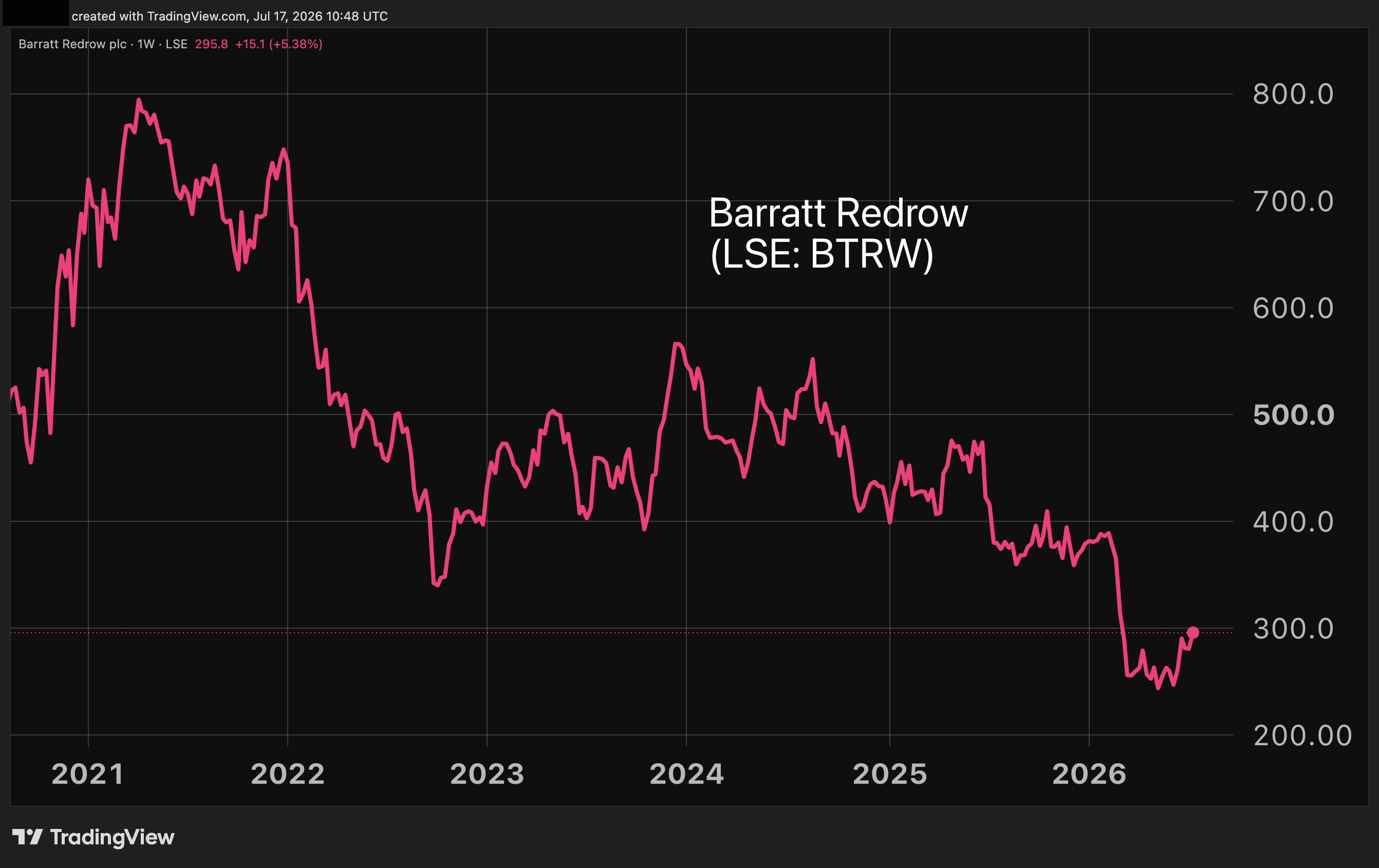
Source: TradingView. Past performance is not a guide to future performance.
While stock markets seem muted in response to fresh hostilities, there is the possibility that the US/Iran is becoming a conflict of attrition – which have a habit of grinding on for years. Iran is ideally placed in relation to the Strait of Hormuz to play the long game but US President Donald Trump is short of time as the US mid-term elections approach. His U-turn over initially proposing a 20% toll on shipping in return for US protection despite his Secretary of State condemning Iran for this only last month, comes across as lashing out erratically without a plan.
Even if this latest conflict abates to a ceasefire, a working agreement over Hormuz and Iran’s nuclear programme seems elusive and certainly June’s memorandum of understanding is dead. Last Tuesday, money markets priced in a rise in UK interest rates from 3.75% to 4% in September, with talk of a second increase to 4.25% by year-end.
A festering scenario is not great for housebuilders and can be seen as justifying short selling, if only as a means for hedge funds to manage equity risk versus long positions elsewhere.
Barratt Redrow’s update is pertinent to how the industry is managing
Despite challenging conditions and approaching five months into this conflict, the net private reservation rate (average net homes reservations per active sales unit per week) improved very slightly to 0.64 in the fiscal year to 28 June versus 0.63 for 2025; including a 0.08 contribution from the private rental sector and other multi-unit sales. However, forward sales at end-June were 3.6% lower based on the number of homes 1% lower, implying price-cutting.
- Barratt Redrow swaps dividends for share buybacks
- Stockwatch: a major inflection point for these two shares?
Adjusted profit this latest year is still guided in line with expectations where consensus actually looks for net profit to more than double to £384 million albeit £368 million pencilled in to June 2027. Earnings per shares (EPS) up 14% to 27p easing to 25.5p - implying a 12 months’ forward price/earnings (PE) of 11.5x and consensus for dividend per share (DPS) around 14p easing to 13.5p, a yield of 4.6%.
Barratt Redrow - financial summary
Year-end 28 Jun
| 2020 | 2021 | 2022 | 2023 | 2024 | 2025 | |
| Turnover (£ million) | 3,419 | 4,812 | 5,268 | 5,321 | 4,168 | 5,578 |
| Operating margin (%) | 14.4 | 16.9 | 12.3 | 13.3 | 4.2 | 5.1 |
| Operating profit (£m) | 493 | 811 | 647 | 707 | 175 | 286 |
| Net profit (£m) | 400 | 660 | 515 | 530 | 114 | 186 |
| EPS - reported (p) | 38.9 | 64.0 | 49.8 | 52.6 | 11.6 | 13.3 |
| EPS - normalised (p) | 47.9 | 68.4 | 81.5 | 64.2 | 23.7 | 23.8 |
| Operating cashflow/share (p) | -11.8 | 105 | 40.4 | 46.2 | 9.8 | 2.1 |
| Capital expenditure/share (p) | 0.7 | 0.7 | 2.9 | 2.3 | 0.7 | 1.5 |
| Free cashflow/share (p) | -12.5 | 104.0 | 37.5 | 43.9 | 9.0 | 0.6 |
| Dividends per share (p) | 0.0 | 29.4 | 36.9 | 33.7 | 16.2 | 17.6 |
| Covered by earnings (x) | 0.0 | 2.2 | 1.4 | 1.6 | 0.7 | 0.8 |
| Return on total capital (%) | 9.1 | 13.5 | 9.9 | 10.8 | 2.7 | 3.1 |
| Cash (£m) | 620 | 1,519 | 1,353 | 1,269 | 1,065 | 970 |
| Net debt (£m) | -254 | -1,273 | -1,098 | -1,019 | -822 | -714 |
| Net assets (£m) | 4,839 | 5,451 | 5,631 | 5,596 | 5,439 | 7,873 |
| Net assets per share (p) | 475 | 535 | 551 | 574 | 558 | 547 |
Source: company accounts.
Total home completions are up 5% at the upper end of guidance, with “affordable” homes constituting 21% of total. For the current year to June 2027, total completions are targeted up 3% to 18,200 in a context of build cost inflation of 3% to 4% expected with minimal house price inflation.
Meanwhile, and from integrating the 2024 acquisition of Redrow, £73 million cumulative cost synergies have been achieved out of £100 million targeted, the balance (mostly procurement) to be delivered this year possibly into 2028.
This was an all-share takeover with Redrow shareholders ending up owning a third of the enlarged group. At end-2025 there was £172 million net cash, debt is minimal.
The group’s last balance sheet also had £6,183 million net tangible assets equivalent to 438p per share, hence at 294p currently the market price is at a 33% discount – why Barratt’s distribution policy to return 50% of net income is being implemented £386 million via share buybacks and £14 million via a 1p per share dividend.
- The Income Investor: why I back Sainsbury’s to deliver the goods
- DIY Investor Diary: shifting from 25 holdings to 50
I therefore think Barratt Redrow’s financials are plenty more robust than implied by a 5.1% disclosed short position. Shorting ideally focuses on shares where the business model is seriously compromised but here the bet looks chiefly on a deteriorating housing market. While a possible scenario, despite the Middle East war I am not convinced a downturn is likely, and were it to happen the group should manage through.
The risk/reward profile could already be favourable given this element of “artificial” selling in the current share price; hence I consider a “buy” stance overall appropriate.
Two non-executive directors have been accumulating shares. Nigel Webb, ex-head of development at British Land and appointed in October 2023, bought £49,000 worth at 329p last March, and Katie Bickerstaff has been a regular buyer. For example, £19,000 worth at 374p in September 2025, £11,000 worth at 375p last November, £19,000 worth at 323p last March and £15,000 worth at 262p in April.
Crest Nicholson remains in discussions to amend debt covenants
In June, I drew attention to a 73% discount to net tangible assets of 268p per share (as of last October) in small-cap Crest Nicholson, priced then at 73p per share. The market had turned cautious over serial profit downgrades due to higher interest rates and build costs. A new CEO has shifted strategy towards quality-build via “Project Elevate” (from March 2025 throughout 2027) but Thursday’s interims, showing a 21% decline in revenue for the six months to 30 April, implies affluent people are now feeling pressured like most.
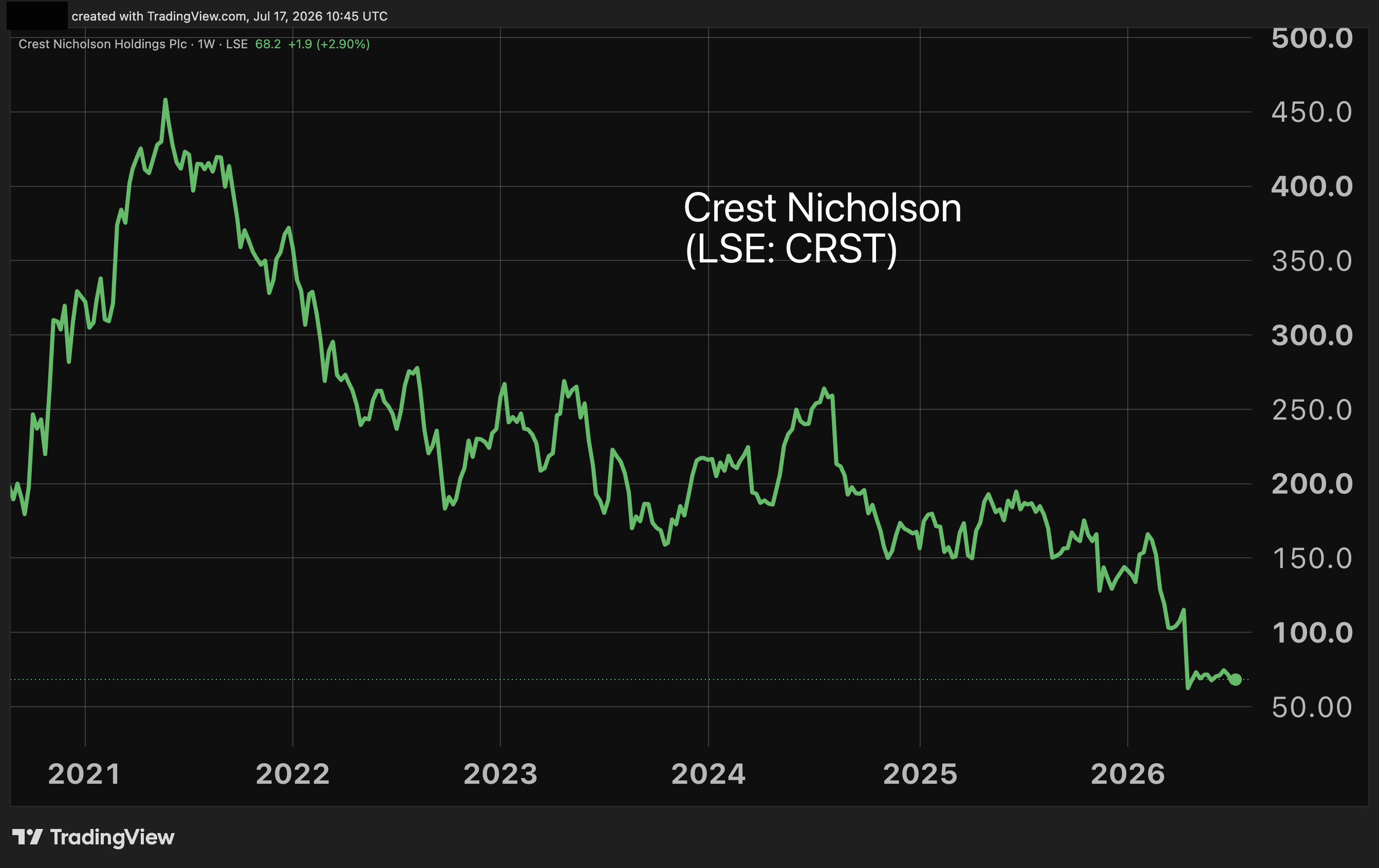
Source: TradingView. Past performance is not a guide to future performance.
Crucially, the stock market has feared that pressure on bank covenants – as a result of net debt rising from £47 million at the end of October to guidance for £100 million to £120 million this October year-end – could force a dilutive low-priced equity issue. Short selling over the 0.5% disclosure threshold soared from 0.5% last March to 8.1% currently, with six hedge funds increasing and only two trimming.
I still concluded with a speculative “buy” stance on an averaging-in basis (barring an industry slump), given that I believe a muddling-through to recovery scenario is more likely despite bankers likely to extract a cost for a reset of covenants on certain parts of a Revolving Credit Facility (RCF).
Yesterday, the shares closed down 5% around 70p in response to the results narrative saying “lender discussions remain well advanced...” although “our lending group remains supportive...we have agreed further temporary waivers (to 30 September) to allow us time to document and complete a covenant amendment.”
A £11.9 million adjusted operating loss was struck versus an £11.9 million like-for-like profit as the margin reversed from 4.8% to minus 6.0%. The interim pre-tax loss was £17.3 million. Net debt has continued to rise at £141.8 million although guidance is re-iterated for £100 million to £120 million at end-October.
- The ISA strategy I used to build nest eggs for my kids
- Sign up to our free newsletter for investment ideas, latest news and award-winning analysis
Note 1 “Going concern” to the statement includes a “Severe But Plausible” (SBP) downside scenario of a covenant breach, concluding that “if the RCF is restricted to £175 million, with respect to the ability to secure additional liquidity to repay the £50 million senior loan notes due in August 2027 (this) may cast significant doubt on the group’s ability to continue as a going concern.”
There is meat for short sellers and recovery buyers alike according to what scenario plays out for the housing market. All considered, I think Crest Nicholson can manage through barring a materially worst-case.
Its trading update last April cited the expectation of earnings before interest and tax (EBIT) of £5 million to £15 million with interest costs around £15 million. This is now downgraded to the “lower half of the EBIT range” albeit with the same interest cost and net debt range.
The latest outlook is cautious: “Since April, pricing has generally remained resilient, but customer enquiries, visitor levels and land market sentiment have softened.” Land buying has thus been reduced and non-core marketed for sale, new site starts moderated and work in progress aligned with revised sales expectations.
I retain a speculative “buy” stance for those of risk appetite.
Edmond Jackson is a freelance contributor and not a direct employee of interactive investor.
These articles are provided for information purposes only. Occasionally, an opinion about whether to buy or sell a specific investment may be provided by third parties. The content is not intended to be a personal recommendation to buy or sell any financial instrument or product, or to adopt any investment strategy as it is not provided based on an assessment of your investing knowledge and experience, your financial situation or your investment objectives. The value of your investments, and the income derived from them, may go down as well as up. You may not get back all the money that you invest. The investments referred to in this article may not be suitable for all investors, and if in doubt, an investor should seek advice from a qualified investment adviser.
Full performance can be found on the company or index summary page on the interactive investor website. Simply click on the company's or index name highlighted in the article.
Disclosure
We use a combination of fundamental and technical analysis in forming our view as to the valuation and prospects of an investment. Where relevant we have set out those particular matters we think are important in the above article, but further detail can be found here.
Please note that our article on this investment should not be considered to be a regular publication.
Details of all recommendations issued by ii during the previous 12-month period can be found here.
ii adheres to a strict code of conduct. Contributors may hold shares or have other interests in companies included in these portfolios, which could create a conflict of interests. Contributors intending to write about any financial instruments in which they have an interest are required to disclose such interest to ii and in the article itself. ii will at all times consider whether such interest impairs the objectivity of the recommendation.
In addition, individuals involved in the production of investment articles are subject to a personal account dealing restriction, which prevents them from placing a transaction in the specified instrument(s) for a period before and for five working days after such publication. This is to avoid personal interests conflicting with the interests of the recipients of those investment articles.