Stockwatch: this share’s discount is simply too steep
There’s a spicier risk/reward profile here than others in this sector, but analyst Edmond Jackson explains why he thinks this is a speculative buy.
12th June 2026 11:39
by Edmond Jackson from interactive investor

When screening UK housebuilders it is intriguing how, at 73p, the small-cap shares in Crest Nicholson Holdings (LSE:CRST) have fallen to a whopping 73% discount to net tangible assets (NTA) of 268p per share as of last October. This compares with listing at 220p in early 2013 and an all-time high of 625p in May 2017.
- Our Services: SIPP Account | Stocks & Shares ISA | See all Investment Accounts
The market is understandably cautious given serial profit downgrades due to higher interest rates and build costs, but is a fall of this size justified? Crest is the 11th most-shorted London share, which may have accentuated downside.
The shares appeared to find a floor at a 61p all-time low after a 21 April update implied a housing market downturn is accelerating, in contrast with a more reassuring AGM update on 25 March. Bellway (LSE:BWY) has also just changed its tune to a sombre outlook in a 9 June update.
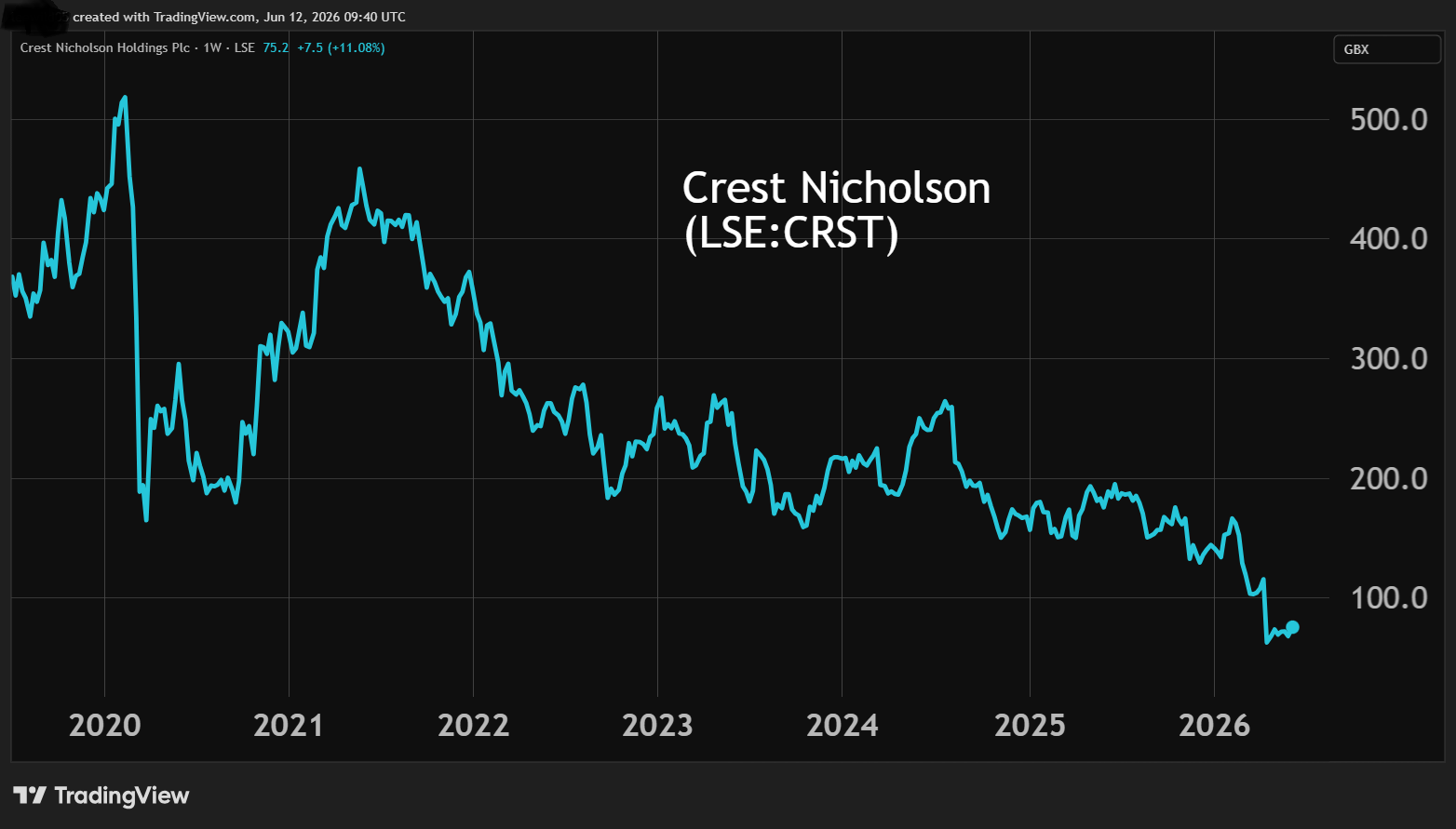
Source: TradingView. Past performance is not a guide to future performance.
Since this compares with Persimmon (LSE:PSN) trading at a slight premium to NTA (as examined in my 5 June piece) and Crest has shifted strategy from volume to more bespoke housebuilding, it makes an interesting compare-and-contrast when evaluating the sector.
The shares have plunged since mid-2024, lately from around 100p due to discussions with lenders on temporary relaxation of banking covenants. This is despite renewing a £250 million revolving credit facility to October 2029 and, on the face of it, bankers should be tolerant – possibly at higher fees – than dramatically wiping out shareholders. Yet half-year results to 30 April have been delayed until 16 July, and the market hates such uncertainty.
- Have stock markets kept pace with World Cup final ticket boom?
- Analyst predicts FTSE 100 break above 12,000
Versus £47 million net debt at the 31 October year-end, due to all-round pressures in housebuilding, the company has leapt to guidance of £100 million to £120 million this October. This implicitly would reduce NTA per share to 225p, albeit still a big 68% discount. Net gearing would be around 20%, hence it doesn’t necessarily follow that a dilutive equity issue is needed. However, it is a risk given the need for debt covenant relaxation.
Revenue from land sales has been downgraded from around £100 million to £40 million yet, barring a steep recession, that doesn’t imply a major further loss of asset value, this is more a cash-flow timing issue.
Is a strategic reset to bespoke housing valid?
In an intriguing twist, this £174 million builder is taking a new direction, led by Persimmon’s ex-commercial director who became CEO of Crest two years ago.
Project Elevate was announced from March 2025 throughout 2027, aiming to pivot from volume-led housebuilding towards higher-margin “mid-premium” homes targeted at (supposedly) less price-sensitive buyers. A new Timeless Collection aims to deliver exceptional quality and design, and the land bank will be restructured to deliver this.
But are aspirational buyers now compromised by tax rises as well as rising mortgage costs? Would Labour really help this social segment ahead of the next general election?
One argument I made in favour of Persimmon was its exposure to lower-cost building in the North of England, whereas Crest is mostly in southern England, which seems to be fairing worse in a UK context, and also the Midlands. It is, however, actively reducing exposure to London and the South East.
- How much do you need to secure a comfortable retirement?
- Why Prudential shares are undervalued by 59%
Management contends that the mid-premium housing market “has consistently demonstrated greater resilience and stronger performance than the traditional volume-led house-building market, particularly through periods of economic uncertainty”.
It adds that “demand is supported by more affluent, less price-sensitive buyers, resulting in stronger sales rates and firmer pricing. Crest Nicholson is well-positioned to capitalise on this change in focus, with land holdings in the right locations across its divisions, typically characterised by stronger local market conditions and brand heritage that people associate with quality…”
But this is not affirmed by a recent twist in updates.
A sudden downturn in the housing market
The 25 March AGM was told that sales had experienced a sustained improvement from mid-January after weak trading in the second half of calendar year 2025. Crest was yet to see any material impact from the Iran war.
A 21 April update then cited higher macro uncertainty due to “the ongoing conflict in the Middle East contributing to the prospect of a more prolonged higher interest rate environment, renewed cost pressures and a deterioration in consumer confidence”.
More positively, reservations had continued in line with improved levels seen since mid-January, with weakness chiefly in the South. But new enquiries and visitor levels had fallen, hence guidance on sales was reduced from 1,550-1,700 units to 1,400-1,500. There was also a sharp reduction in land sales, with revenue guidance cut from £75-100 million to around £40 million.
Consequently, guidance for earnings before interest and tax (EBIT) was cut by 79% and 31 October financial year-end net debt guided up from £38 million last October to £100 million to £120 million.
Despite all this, investment manager Janus Henderson doubled its stake from 5.0% to 10.0% on 29 April and Artemis Investment Management declared a 5.7% stake on 20 May. With the disclosure threshold nowadays 5.0% rather than 3.0%, it is impossible to say if loss-making positions have been averaged down.
A short sellers’ favourite again
6.9% of the issued share capital is loaned out and such disclosures over 0.5% may underestimate the total. Yet it has reduced from 7.9% in the last fortnight.
Disclosures soared in early 2018 from zero to 7.5% by end-January 2019 but had unwound by end-2020. That proved an astute call: from early 2018 the shares fell from around 550p to 308p by that October, then traded sideways before rallying to 470p in February 2020 before Covid struck. They slumped to 178p that March.
- The Income Investor: a FTSE 100 stock with dividend potential
- Sign up to our free newsletter for investment ideas, latest news and award-winning analysis
After recovering to over 440p by June 2021, a five-year downtrend began but shorting did not reappear until early 2024. At end-2025 it was zero, then notably rocketed from 0.5% last 11 March after the Iran war took off, to 7.9% as of 27 May. Again, this has proven timely given the share price fall from 118p over the last three months.
Yet it is possible that this marks a turning point, with shares now being bought back. Short sellers must decide whether to push their luck – no Middle East peace settlement, upward pressure on interest rates and a forced equity issue – or if Crest’s discount to NTA is now lending support.
Subdued earnings prospects may be priced in
After a £105 million net loss in the October 2024 year and £2.2 million profit in 2025, consensus anticipates a gradual recovery to over £6 million this fiscal year and over £20 million in 2027 for normalised earnings per share (EPS) around 7p. With the shares at 73p, that implies a forward price/earnings (PE) ratio just over 10x, although Crest has achieved normalised EPS of 40-60p pre-2025, hence it is intriguing as to whether the new strategy reinvigorates business enough to truly recover EPS (assuming no dilution).
A caveat regarding such forecasts is consensus for a 4p per share dividend, which would be surprising while bank covenants are requested relaxed.
Crest Nicholson Holdings - financial summary
Year end 31 Oct
| 2020 | 2021 | 2022 | 2023 | 2024 | 2025 | |
| Turnover (£ million) | 678 | 787 | 914 | 658 | 618 | 611 |
| Operating profit (£m) | -2.3 | 94.3 | 37.4 | 25.3 | -137 | 14.8 |
| Net profit (£m) | -10.7 | 70.9 | 26.4 | 17.9 | -105 | 2.2 |
| Operating margin (%) | -0.3 | 12.0 | 4.1 | 3.9 | -22.1 | 2.4 |
| Reported earnings/share (p) | -4.2 | 27.5 | 10.2 | 7.0 | -41.0 | 0.9 |
| Normalised earnings/share (p) | 23.5 | 37.3 | 60.0 | 19.7 | 42.9 | 10.7 |
| Operational cashflow/share (p) | 44.5 | 49.1 | 20.1 | -64.5 | -26.4 | -4.6 |
| Capital expenditure/share (p) | 0.1 | 0.1 | 0.0 | 0.7 | 0.5 | 0.0 |
| Free cashflow/share (p) | 44.4 | 49.0 | 20.1 | 65.2 | 26.9 | -4.6 |
| Dividend per share (p) | 0.0 | 13.6 | 17.0 | 17.0 | 2.2 | 3.1 |
| Covered by earnings (x) | 0.0 | 2.0 | 0.6 | 0.4 | -18.6 | 0.3 |
| Return on total capital (%) | -0.2 | 8.3 | 3.4 | 2.3 | -13.2 | 1.6 |
| Cash (£m) | 240 | 352 | 375 | 164 | 74.8 | 126 |
| Net debt (£m) | -136 | -249 | -274 | -59.6 | 19.5 | 47.2 |
| Net assets (£m) | 825 | 902 | 883 | 856 | 723 | 718 |
| Net assets per share (p) | 321 | 351 | 344 | 333 | 281 | 279 |
Source: company accounts.
Inventories do not appear to capitalise costs
In a 29 May piece on Taylor Wimpey (LSE:TW.) , I noted its inventories (buildings, land, work-in progress) were constituted 40% by capitalised build costs. This can seem like over-egging but is in line with accounting standard IAS2, which values at the lower of cost and net realisable value.
Whether Crest has fully disclosed on this matter is unclear: note 17 to last October’s balance sheet did not state any build costs within £1,056 million inventories. They comprised £619 million land, £335 million work-in-progress, £79 million completed buildings and £23 million part exchange inventories. Since total inventories were 147% of net assets, it is obviously important how they comprise, and this looks reasonable to me.
Crest has a spicier risk/reward profile than Persimmon, chiefly in the near term if bankers force some extent of equity issue, hence dilution. I still conclude with a speculative “buy” stance, on an averaging-in basis.
Edmond Jackson is a freelance contributor and not a direct employee of interactive investor.
These articles are provided for information purposes only. Occasionally, an opinion about whether to buy or sell a specific investment may be provided by third parties. The content is not intended to be a personal recommendation to buy or sell any financial instrument or product, or to adopt any investment strategy as it is not provided based on an assessment of your investing knowledge and experience, your financial situation or your investment objectives. The value of your investments, and the income derived from them, may go down as well as up. You may not get back all the money that you invest. The investments referred to in this article may not be suitable for all investors, and if in doubt, an investor should seek advice from a qualified investment adviser.
Full performance can be found on the company or index summary page on the interactive investor website. Simply click on the company's or index name highlighted in the article.
Disclosure
We use a combination of fundamental and technical analysis in forming our view as to the valuation and prospects of an investment. Where relevant we have set out those particular matters we think are important in the above article, but further detail can be found here.
Please note that our article on this investment should not be considered to be a regular publication.
Details of all recommendations issued by ii during the previous 12-month period can be found here.
ii adheres to a strict code of conduct. Contributors may hold shares or have other interests in companies included in these portfolios, which could create a conflict of interests. Contributors intending to write about any financial instruments in which they have an interest are required to disclose such interest to ii and in the article itself. ii will at all times consider whether such interest impairs the objectivity of the recommendation.
In addition, individuals involved in the production of investment articles are subject to a personal account dealing restriction, which prevents them from placing a transaction in the specified instrument(s) for a period before and for five working days after such publication. This is to avoid personal interests conflicting with the interests of the recipients of those investment articles.