Stockwatch: why it’s time to pay serious attention to this share
Having first covered this company during the summer, analyst Edmond Jackson pays a return visit following some interesting developments.
25th September 2026 12:21
by Edmond Jackson from interactive investor

Yesterday, the FTSE 250 shares in Victrex (LSE:VCT), a manufacturer of high-performance polymers, fell 10% to 878p after its 2026 dividend was halved to 30p. The news was contained within an innocuous “capital markets event” announcement.
- Invest with ii: Share Dealing with ii | Open a Stocks & Shares ISA | Our Investment Accounts
Held at Investec later in the afternoon, its vast meeting room was packed out – as if institutions and analysts sense it is time to pay serious attention to Victrex. So is this a buying opportunity in a new uptrend since May’s low of 550p?
I drew attention in July at 667p, initially with a “hold” stance given the May half-year results had included a profit warning. I wanted more evidence about how the situation was evolving under a new chief executive from 1 January. This share can be spiky-volatile and a drop to 550p in response to the interims tempted me to buy despite a near-60p per share debt-assisted dividend looking unsustainable.
It appears the earnings guidance shifts are somewhat short-term “noise” given the September 2026 outcome now seems similar to what was expected earlier in the year - May guided down, then a 9 September pre-close update guided back up.
From a comment perspective it became frustrating how, while I was trying to act responsibly, the shares leapt to 1,020p after the 9 September update cited strong momentum continuing into the fourth quarter to 30 September. This was a real surprise on the upside and probably triggered short-closing. The company said: “We are seeing good growth across all regions, with particularly strong growth in Asia Pacific.” A profit improvement plan had also seen initial benefits in Q4, with at least £10 million annualised savings due in the September 2027 financial year.
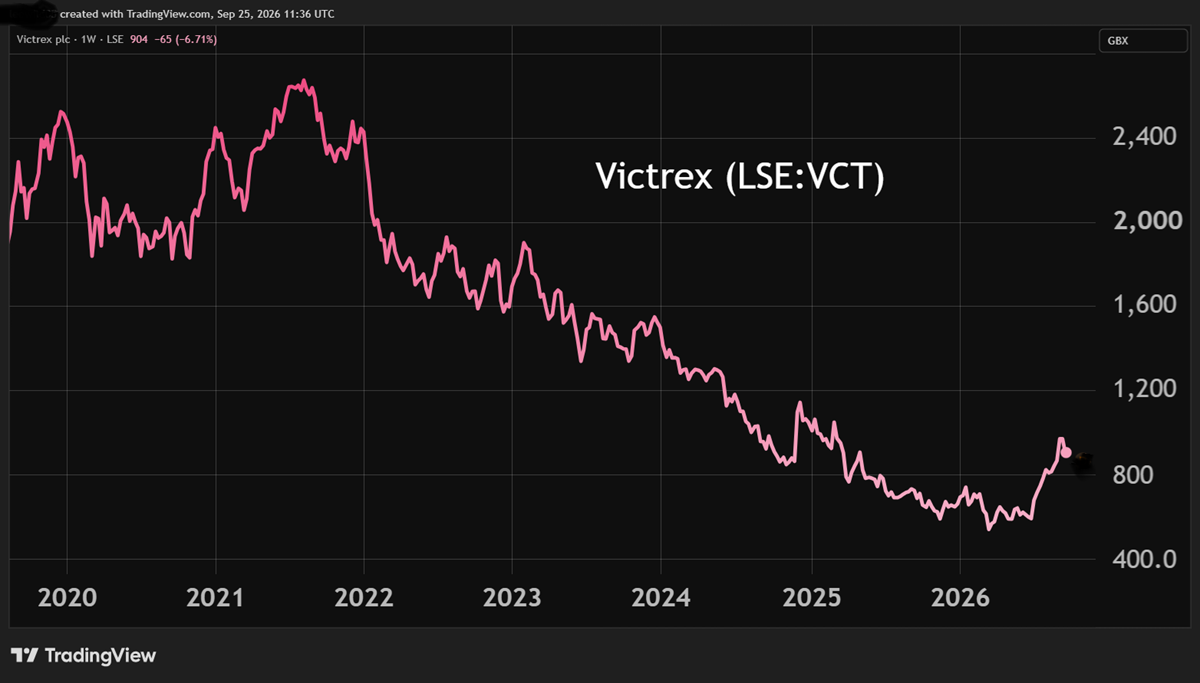
Source: TradingView. Past performance is not a guide to future performance.
At this level, and assuming a moderate recovery in earnings per share (EPS) into a 40p range – though still down on 80p and higher only a few years ago – the forward price/earnings (PE) ratio at around 1,000p was roughly 23x and, assuming a dividend cut, a yield only around 3%.
I have referenced various times how shares can “fall between two stools”, where earnings growth is respectable yet unexciting enough for true growth investors, the yield likewise insufficient to attract income-seekers. That is my explanation for this latest drop, although an overall uptrend remains.
It does however assume the CEO and his newly recruited top team can deliver improved performance such that the PE falls in time. An adage says not to fuss overly about PE’s in turnaround situations, and recruiter Hays (LSE:HAS) recently more than doubled to a forward PE currently around 28x at 63p.
- Anthropic IPO: what UK investors need to know
- 20 hottest tech stocks of the week: Strategy, Meta, Micron Tech
Yesterday’s presentation came across as near perfect as they get - management with a firm grip on where Victrex is heading and believing firmly they can deliver. It should be published in due course via the Victrex website. Essential details were in the morning announcement. Over the next five years, the company targets mid-single digit revenue growth on an annual, organic and compounded basis, with a circa 50% gross margin and mid-20% operating margin by the September 2031 year.
This would recover the pre-2024 margin after a slowdown in recent years in higher margin medical applications led to de-stocking. This meant volume growth looked acceptable but revenue less so.
Victrex - financial summary
Year-end 30 Sep
| 2020 | 2021 | 2022 | 2023 | 2024 | 2025 | |
| Turnover (£ million) | 265 | 311 | 338 | 299 | 296 | 296 |
| Operating margin (%) | 24.2 | 30.0 | 26.2 | 24.4 | 15.5 | 13.4 |
| Operating profit (£m) | 64.0 | 93.4 | 89 | 73.2 | 45.8 | 39.8 |
| Net profit (£m) | 54.2 | 73.2 | 76.2 | 61.7 | 17.2 | 27.8 |
| EPS - reported (p) | 62.6 | 84.1 | 87.3 | 70.5 | 19.7 | 31.7 |
| EPS - normalised (p) | 75.1 | 83.2 | 98.1 | 81.4 | 45.6 | 44.1 |
| Operating cashflow/share (p) | 80.1 | 146 | 91.7 | 47.7 | 96.1 | 81.1 |
| Capital expenditure/share (p) | 28.7 | 48.1 | 52.2 | 44.0 | 37.3 | 24.9 |
| Free cashflow/share (p) | 51.4 | 97.9 | 39.5 | 3.7 | 58.8 | 56.2 |
| Dividends per share (p) | 46.1 | 59.6 | 59.6 | 59.6 | 59.6 | 59.6 |
| Covered by earnings (x) | 1.4 | 1.4 | 1.5 | 1.2 | 0.3 | -0.4 |
| Return on total capital (%) | 12.5 | 16.7 | 15.9 | 12.6 | 8.4 | 7.9 |
| Cash (£m) | 73.1 | 112 | 68.8 | 33.5 | 29.3 | 24.2 |
| Net debt (£m) | -66.0 | -96.5 | -36.7 | 16.7 | 21.1 | 24.8 |
| Net assets (£m) | 478 | 509 | 489 | 499 | 461 | 434 |
| Net assets per share (p) | 552 | 585 | 562 | 573 | 530 | 498 |
Source: company accounts
Myriad applications for PEEK advanced polymer material
Growth is expected in key existing markets: aerospace & defence, electronics, energy & industrial, and medical. PEEK’s exceptional quality over a wide range of temperatures and extreme conditions means it is used for things like deep-sea piping, a much wider range of aircraft parts, within electric vehicles and in due course humanoid robots. When you handle a far lighter and not cold artificial knee joint made from PEEK versus metal, medical adoption seems a no-brainer. Management is not including various high-potential products in its base-case revenue guidance.
Moreover, Victrex enjoys a 45% global share by volume – over twice the next largest competitor – proclaiming unique properties such as higher load bearing, faster processing and higher durability.
While the Chinese PEEK market is increasingly crowded with lower-cost manufacturers, these are not of the same calibre as production from a joint venture with Yingkou Xingfu Chemical (owning 25% versus Victrex Hong Kong with 75%). Mind, this plant remains loss-making albeit on an improving trend.
- Portfolio Dilemma: what yield should I target?
- Must read weekly preview: JD Wetherspoon, US jobs report
90% of group revenue is said to be protected against Asian competition focused on domestic lower-grade applications.
While Victrex’s technology was patented in 1978 by Imperial Chemical Industries (ICI), I do still wonder about the ability of China to somehow to challenge Western technology in the long run.
If I have a key scepticism, it is that why, if Victrex PEEK has been in production nearly half a century, extending to a wide range of compelling applications, and being the undisputed global leader, is annual revenue only around £300 million?
Its story has included mobile phone and other mass-market electronic products. Obviously comparing parts versus chips is “apple and pears”, but since ARM Holdings ADR (NASDAQ:ARM) was a similar spin-off (from Acorn Computers in the late 1990s) it has leveraged £3.75 billion sterling equivalent annual revenue.
This does however seem a “glass half empty” view that potentially underestimates what Victrex can achieve after 2024-25 underperformance led to the board changing CEO who has swiftly implemented radical change.
A dedicated chief operating and transformation officer
The role of the chief operating officer has been extended, and during yesterday’s presentation he expressed his shock upon joining in February 2025 that there was no real-time production visibility within Victrex plants.
A digital transformation is thus underway, where one site alone has achieved circa £250,000 efficiencies which can spread to others.
The “unlocking Victrex’s potential” programme is however emphasised as capital-light, with capital expenditure to constitute 5-8% of annual revenue going forward. Free cash flow of £250 million is targeted by September 2031, returning at least 75% of this to shareholders over the next five years under an ultimate 2x earnings cover target for the ordinary dividend.
While a 3.4% prospective yield currently looks unexciting, long-term buyers might consider that Victrex paid special dividends variously from 2011 to 2019.
The potential prize here in shareholder terms looks to be a significant recovery in Victrex’s capability of past years while also achieving a leaner more responsive organisation. The CEO is adamant that past problems were due to execution and are being fixed. I feel that the improved performance so far partly affirms this.
- Why Raspberry Pi shares just surged 20%
- Sign up to our free newsletter for investment ideas, latest news and award-winning analysis
A vertically integrated operation is said to beget “high and durable barriers to entry” via a de-centralised, agile operating model. While the presentation was thus rich in management jargon, eliminating bureaucracy that previously arose should also drive financial performance.
High-margin applications are to be prioritised where Victrex has the strongest moat and is best positioned to lead the next phase of development with customers. Listening to them is another key priority for the chief transformation officer.
If margins recover to pre-2024 levels when EPS was around 80p, and given disappointment in recent years has not involved dilution, at around 885p currently the forward PE could thus be in low double digits.
Guidance based on the predictable
One aspect that puzzled me, which I took up after the presentation with the interim CFO (a replacement is yet to be decided on) and his colleague, was how Victrex was able to report such sudden positive change.
It appears that yes, end-markets did improve despite macro uncertainties, hence a fair chance we are looking at early cyclical upturn after industry de-stocking (which has applied to medical especially). While visibility is somewhat limited, they are basing guidance on what is relatively predictable rather than factoring in hope value from new projects.
If knee replacements took off in an ageing global population, it could however potentially be icing on the cake.
The aggregate net short position has reduced to 1.44%. And as I judged a circa 5% position as nonsensical versus a new CEO taking charge of a business enjoying a dominant share of sound markets, this looks likely to fully unwind.
Relative to other analysts targeting a share price of around 1,000p recently, I envisage scope for at least 1,200p on a three-year view. In fairness to them, a game of catch-up does arise when you are trying to be prudently cautious. At 875p I upgrade to “buy” in the sense of a starter position and see what evolves.
Edmond Jackson is a freelance contributor and not a direct employee of interactive investor.
Edmond owns Victrex shares.
AIM stocks tend to be volatile high-risk/high-reward investments and are intended for people with an appropriate degree of equity trading knowledge and experience.
These articles are provided for information purposes only. Occasionally, an opinion about whether to buy or sell a specific investment may be provided by third parties. The content is not intended to be a personal recommendation to buy or sell any financial instrument or product, or to adopt any investment strategy as it is not provided based on an assessment of your investing knowledge and experience, your financial situation or your investment objectives. The value of your investments, and the income derived from them, may go down as well as up. You may not get back all the money that you invest. The investments referred to in this article may not be suitable for all investors, and if in doubt, an investor should seek advice from a qualified investment adviser.
Full performance can be found on the company or index summary page on the interactive investor website. Simply click on the company's or index name highlighted in the article.
Disclosure
We use a combination of fundamental and technical analysis in forming our view as to the valuation and prospects of an investment. Where relevant we have set out those particular matters we think are important in the above article, but further detail can be found here.
Please note that our article on this investment should not be considered to be a regular publication.
Details of all recommendations issued by ii during the previous 12-month period can be found here.
ii adheres to a strict code of conduct. Contributors may hold shares or have other interests in companies included in these portfolios, which could create a conflict of interests. Contributors intending to write about any financial instruments in which they have an interest are required to disclose such interest to ii and in the article itself. ii will at all times consider whether such interest impairs the objectivity of the recommendation.
In addition, individuals involved in the production of investment articles are subject to a personal account dealing restriction, which prevents them from placing a transaction in the specified instrument(s) for a period before and for five working days after such publication. This is to avoid personal interests conflicting with the interests of the recipients of those investment articles.