Stockwatch: a turnaround play for both capital upside and yield
A new boss at this FTSE 250 company brings hope of a turnaround, and an update in September could be crucial. Analyst Edmond Jackson gives his view on prospects.
10th July 2026 13:10
by Edmond Jackson from interactive investor

In recent pieces on housebuilders and Tuesday’s article on brick manufacturer Ibstock (LSE:IBST), I have characterised short-selling targets as a distinct asset class. That may sound perverse, but not only is shorting information useful to considering equity risk, the funds involve may also get their timing wrong and show herd-like behaviour that depresses market value too far from intrinsic value. The challenge is to spot where such a disconnect may lie.
From 13 July, the Financial Conduct Authority (FCA) is changing disclosure rules such that individual short-selling institutions with positions over 0.5% will not declare them. Instead, we get to see an aggregate total of short positions. I find this a step backward for stock-picking given it has been possible to identify shrewd short sellers (from their listing of targets) versus duffers liable to join a party late. However, data should still be a useful feature to check when a share is falling.
- Invest with ii: Top UK Shares | Share Tips & Ideas | Cashback Offers
While housebuilders and related materials suppliers have plenty to prove going forwards, my sense is they probably will muddle through rather than incur a worst-case scenario that the short sellers are betting on. Obviously, resumption of the US/Iran war potentially makes things tougher if interest rates and input costs stay high, and with consumer confidence also hurting.
Victrex (LSE:VCT) is another example of such a thesis. This manufacturer of polyetheretherketone (PEEK) – a high-performance polymer used in a wide range of applications from knee and spine replacements to aircraft parts – has seen its share price fall substantially as rivals move into its space. Its operating margins have been eroded from over 30%, with the excuse given that markets have became commoditised and high-margin medical has seen prolonged destocking.
Eight years ago, the shares briefly exceeded 3,400p, but despite several bear market rallies, had fallen to lows ostensibly around 580p albeit below 520p and 550p on an intraday basis on two occasions this year.
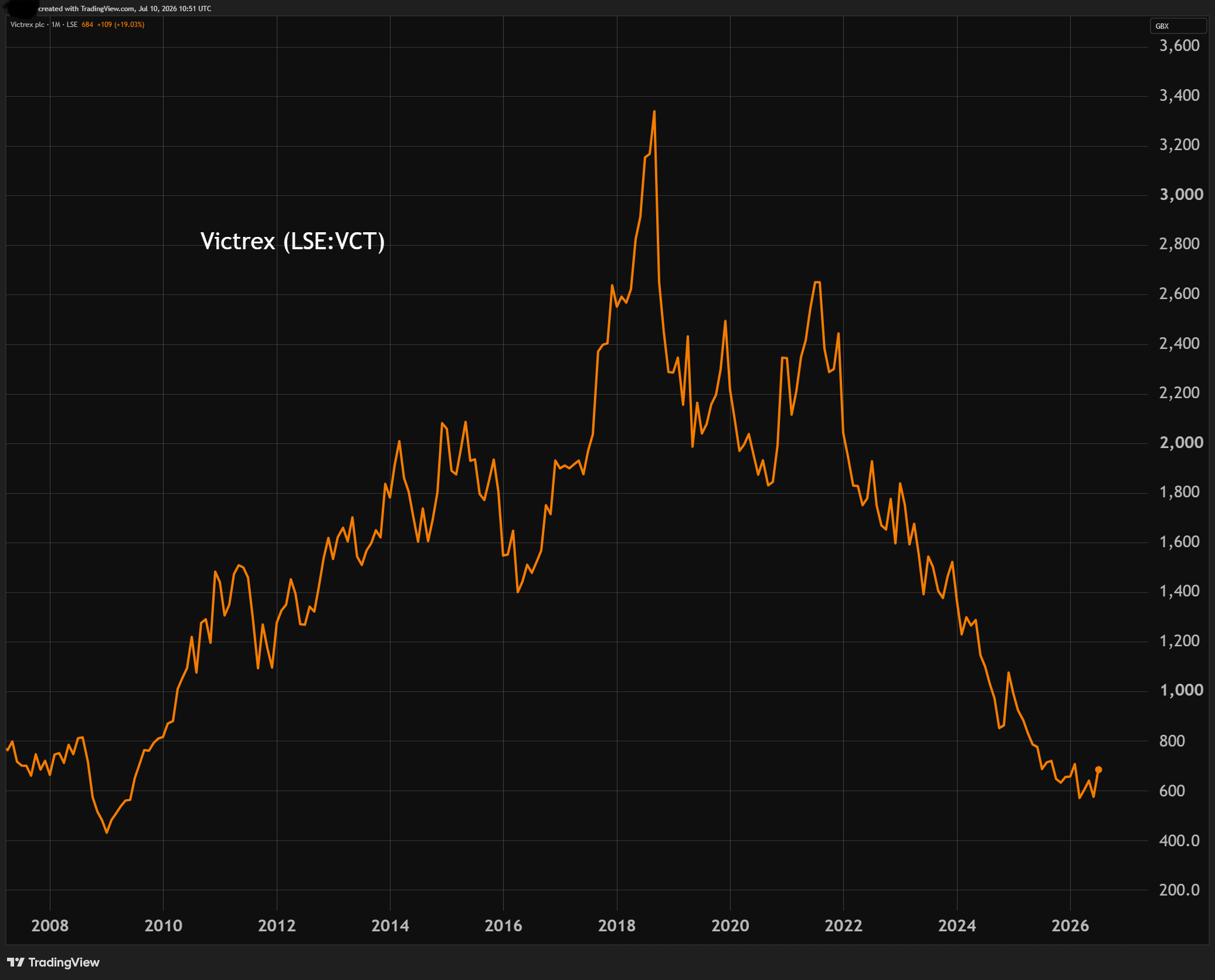
Source: TradingView. Past performance is not a guide to future performance.
New CEO potentially heralds better performance
I am a tad wary given the new chief executive’s essential strategy – to find new applications for PEEK – is the same as the CEO from September 2017 to end-2025; it’s just that the new boss, Dr James Routh, considers overall execution needs improving. For example, a Chinese manufacturing plant was initiated from 2023 but proved more challenging than anticipated, resulting in a £61 million non-cash impairment after discounted cash flow evaluation cut the facility’s value to just £10 million.
Short selling rose this year from 0.75% of the issued share capital to 4.5% by mid-March – probably with more below the 0.5% disclosure threshold – which exacerbated the shares fall. This had some logic given oil prices are significant to variable manufacturing costs, although Victrex does hedge and has cited discussions with customers over price increases.
Comparing AB Dynamics (LSE:ABDP) where Routh became CEO in October 2018, its chart had soared from around 150p in 2014 to near 2,000p, reaching 2,760p in September 2019. But if the share price is what counts, AB’s has since been volatile-sideways, falling to 1,058p currently.
- Six stocks that could double their dividend quickly
- Is the state pension triple lock on borrowed time?
I still think a fresh perspective and actions merit following Victrex, although a crux for sentiment will be a capital markets event “unlocking Victrex’s potential” on 24 September to flesh out Routh’s recovery-to-growth plan.
After the shares were shorted and dropped briefly below 550p in initial response to the 11 May interims, I felt this just was too low and bought at 552p, but have not wanted to write until presented with more evidence about how the second half of its financial year to 30 September is evolving. Interim results had involved a profit warning, and normally the rule is not to buy on such as more may follow, but I do not see this as set in stone.
Trading update defies recent short selling
Happily, last Tuesday’s update affirmed annual guidance, which compares with JP Morgan Asset Management and Citadel Advisors raising their short positions respectively to 0.93% on 4 June and to 0.50% on 19 June. Around this time, Victrex shares traded at 600p or so, but the update created a jump to over 700p (currently 667p), hence these were duff short trades unless Routh fails to deliver. Citadel even raised its short last Monday to 0.60% when the market price was around 580p, plainly wrong in the near term and why shorting should not necessarily be feared.
Strong like-for-like performance in the third quarter showed revenues up 18% and volumes up 17%. This is reassuring given that Victrex’s revenues have tended to lag volumes due to a weaker margin mix. Versus previous destocking on the medical side, “some stabilisation” is now seen, while aerospace and electronics applications did well albeit with aerospace benefiting from “a much weaker prior year comparator following industry supply chain backlogs in 2025”.
An average PEEK selling price of £68/kg is in line with the prior year, and year-to-date revenue is up 7% versus volumes up 10% (hence lower-margin sales earlier in the year).
Good progress is cited with a profit improvement plan, a circa 10% headcount reduction starting to see initial benefits in the July to September final quarter. Annualised cost savings of at least £10 million will be fully realised in the September 2027 year albeit at a cash exceptional cost of around £10 million this fiscal year.
- SpaceX: what Wall Street thinks the shares are really worth
- Sign up to our free newsletter for investment ideas, latest news and award-winning analysis
It is, however, a classic first effort by an incoming CEO where profits are falling. More critical will be the extent of marketing success in the years ahead. But the situation shows how, after short selling has exacerbated a price fall in this £600 million company, it may only need an “in-line” update to generate a 20%-plus intraday bounce in the shares.
Risk factors albeit potential yield prize
Another of my key concerns is whether Routh persists with a dividend payout policy linked to debt remaining below 1.0x EBITDA (the earnings measure close to operating profit). Since 2024 this has meant the dividend was uncovered (see table) and, despite a strong free cash flow profile, there is now the £10 million cost of the profit improvement plan.
The last final dividend was paid with the help of debt – a no-no for me – so might Routh do similar or break with this come the early December annual results?
I was therefore sceptical of a 10.3% yield at 552p based on consensus for dividend per share of 57.3p this financial year, equating to 8.6% at the current share price. But even if the dividend is cut, if Routh’s plan works then there could be scope to lock in a useful yield plus capital upside over the long term, as earnings and payouts recover. Victrex has paid several special dividends additional to ordinary, throughout its history.
Victrex - financial summary
Year-end 30 Sep
| 2020 | 2021 | 2022 | 2023 | 2024 | 2025 | |
| Turnover (£ million) | 265 | 311 | 338 | 299 | 296 | 296 |
| Operating margin (%) | 24.2 | 30.0 | 26.2 | 24.4 | 15.5 | 13.4 |
| Operating profit (£m) | 64.0 | 93.4 | 89 | 73.2 | 45.8 | 39.8 |
| Net profit (£m) | 54.2 | 73.2 | 76.2 | 61.7 | 17.2 | 27.8 |
| EPS - reported (p) | 62.6 | 84.1 | 87.3 | 70.5 | 19.7 | 31.7 |
| EPS - normalised (p) | 75.1 | 83.2 | 98.1 | 81.4 | 45.6 | 44.1 |
| Operating cashflow/share (p) | 80.1 | 146 | 91.7 | 47.7 | 96.1 | 81.1 |
| Capital expenditure/share (p) | 28.7 | 48.1 | 52.2 | 44.0 | 37.3 | 24.9 |
| Free cashflow/share (p) | 51.4 | 97.9 | 39.5 | 3.7 | 58.8 | 56.2 |
| Dividends per share (p) | 46.1 | 59.6 | 59.6 | 59.6 | 59.6 | 59.6 |
| Covered by earnings (x) | 1.4 | 1.4 | 1.5 | 1.2 | 0.3 | -0.4 |
| Return on total capital (%) | 12.5 | 16.7 | 15.9 | 12.6 | 8.4 | 7.9 |
| Cash (£m) | 73.1 | 112 | 68.8 | 33.5 | 29.3 | 24.2 |
| Net debt (£m) | -66.0 | -96.5 | -36.7 | 16.7 | 21.1 | 24.8 |
| Net assets (£m) | 478 | 509 | 489 | 499 | 461 | 434 |
| Net assets per share (p) | 552 | 585 | 562 | 573 | 530 | 498 |
Source: company accounts.
With September 2026 forecasts affirmed, the prospective price/earnings (PE) ratio is 17x the expectation for £33 million net profit and earnings per share (EPS) around 39p, easing to 14x if £42 million is made in 2027. If the CEO’s belief in “a significant improvement in medium-term profitability” is credible, then at current share prices the PE can reduce to single figures.
The 7 July update cited net debt of £43.0 million as of 30 June, with £27.5 million cash after payment of the 13.42p per share interim dividend, which cost around £12 million.
Net assets of £344 million with just 5% intangibles – equivalent to 395p per share – affirm a supportive balance sheet lest the trading environment deteriorates again.
I therefore regard Victrex as a potentially attractive situation to average into, although mind how its shares can jerk in response to news. Given oil price risk looks on the upside again and for longer, the jump from 580p could come under pressure, but it does appear to have support around 667p, hence I rate the shares a “hold” for now. The 24 September teach-in could be significant.
Edmond Jackson is a freelance contributor and not a direct employee of interactive investor.
Edmond Jackson owns shares in Victrex.
These articles are provided for information purposes only. Occasionally, an opinion about whether to buy or sell a specific investment may be provided by third parties. The content is not intended to be a personal recommendation to buy or sell any financial instrument or product, or to adopt any investment strategy as it is not provided based on an assessment of your investing knowledge and experience, your financial situation or your investment objectives. The value of your investments, and the income derived from them, may go down as well as up. You may not get back all the money that you invest. The investments referred to in this article may not be suitable for all investors, and if in doubt, an investor should seek advice from a qualified investment adviser.
Full performance can be found on the company or index summary page on the interactive investor website. Simply click on the company's or index name highlighted in the article.
Disclosure
We use a combination of fundamental and technical analysis in forming our view as to the valuation and prospects of an investment. Where relevant we have set out those particular matters we think are important in the above article, but further detail can be found here.
Please note that our article on this investment should not be considered to be a regular publication.
Details of all recommendations issued by ii during the previous 12-month period can be found here.
ii adheres to a strict code of conduct. Contributors may hold shares or have other interests in companies included in these portfolios, which could create a conflict of interests. Contributors intending to write about any financial instruments in which they have an interest are required to disclose such interest to ii and in the article itself. ii will at all times consider whether such interest impairs the objectivity of the recommendation.
In addition, individuals involved in the production of investment articles are subject to a personal account dealing restriction, which prevents them from placing a transaction in the specified instrument(s) for a period before and for five working days after such publication. This is to avoid personal interests conflicting with the interests of the recipients of those investment articles.