Is the tie-up trend over for investment trusts?
A period of unusually wide discounts helped trigger a wave of mergers and wind-ups over the past four years. A Kepler analyst considers the numbers by sector and manager, and asks whether the trend has peaked.
31st July 2026 13:51

This content is provided by Kepler Trust Intelligence, an investment trust focused website for private and professional investors. Kepler Trust Intelligence is a third-party supplier and not part of interactive investor. It is provided for information only and does not constitute a personal recommendation.
Material produced by Kepler Trust Intelligence should be considered a marketing communication, and is not independent research.
With the 2026 season in full swing, we consider the impact that investment trust weddings (and funerals) are having on the sector. Over the last few years, the pace of mergers between trusts has been intense, but so too has the number of trusts giving up the ghost and converting to other structures. In our view, this story starts in 2022, which saw macro events in Ukraine lead to a significant rise in inflation and interest rates around the world. Stock markets struggled, and bond markets felt a lot of pain.
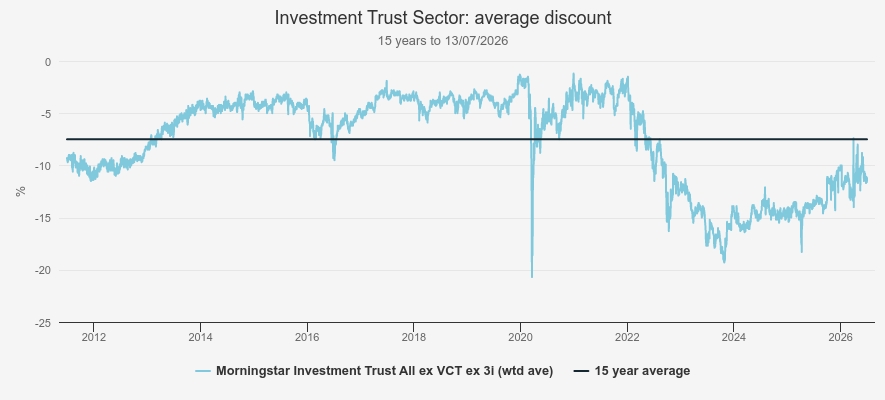
Since then, active managers have found it hard to beat equity markets – first with equities being led by the Magnificent Seven and latterly a relatively narrow band of AI stocks driving markets. A combination of this and many other factors led to the investment trust sector’s average discount widening significantly, moving from a weighted average discount of circa 2% at the start of 2022 to nearly 20% in the latter stages of 2023. In our view, it was these discounts and the sense that non-core strategies seemed less relevant in an increasingly concentrated stock market that has led to a period of intense corporate activity within the investment trust sector.
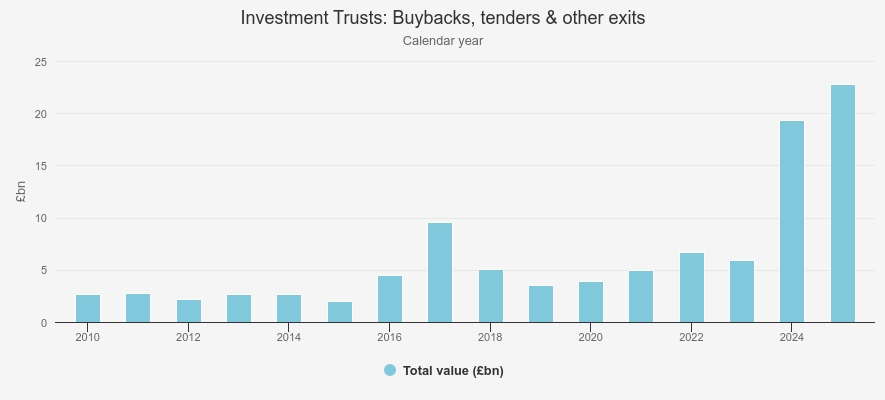
Some trusts, mainly in alternative asset classes, have managed to attract knock-out cash bids which shareholders have generally welcomed. The immediate fix of corporate activity is attractive, especially when set against the possibility of a drawn-out liquidation process and uncertain valuations within private markets. Within conventional asset classes, trust boards have been much more active in proactively addressing discounts than they have historically, both in terms of the level of buybacks and also deeper soul-searching over the long-term viability of their trusts. As a result, cash returned to shareholders via share buybacks, tenders, and liquidations reached a new record high of £22.7 billion in 2025 (according to data from JPMorgan Cazenove). As we show below, this is a new all-time record for the investment trust sector.
CAPITAL RETURNED TO SHAREHOLDERS FROM INVESTMENT TRUSTS
Source: JPMorgan Cazenove
What’s love got to do with it?
In some cases, perhaps depending on the shape and type of share registers, boards that see the writing on the wall have two courses of action: to merge their trust with another, or offer a wind-up with the option to roll over into another structure. The catalysts for mergers or wind-ups vary but include poor relative performance from a manager, a trust reaching an unviable size either through performance or through buybacks (or a recognition that achieving scale isn’t a realistic proposition), or a desire to simplify the structure (the last four years has seen three of the four ‘multi-share class’ trusts collapse their innovative structures into one share class, leaving just CT Global Managed Portfolio (CMPG/CMPI)).
According to our analysis, since the start of 2022, the median net asset of a trust which has chosen to merge with another is c. £280 million (at the point of merger). This seems quite high in our view, notwithstanding the current popular narrative that trusts need to achieve ever-greater scale to appeal to wealth managers. In terms of wind-ups, our analysis shows that the median net assets of a trust which has chosen to wind up is £116 million, indicating that a certain scale is required for a trust to be a merger candidate, perhaps because of the significant corporate finance and legal fees that mergers command – often running into seven figures.
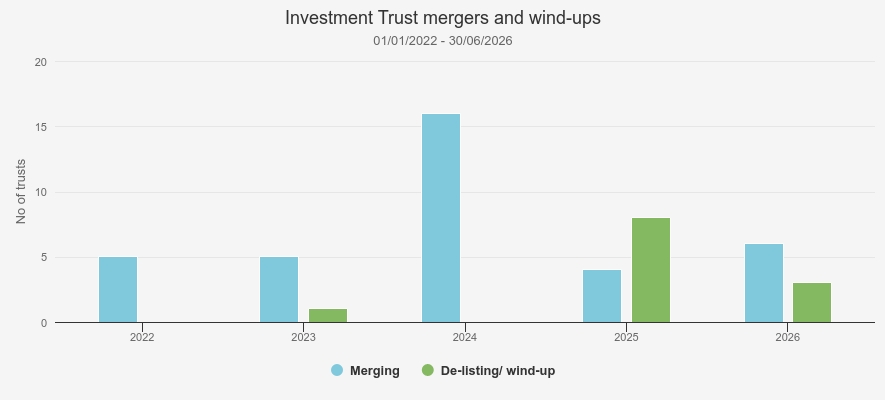
According to our analysis of the Association of Investment Companies (AIC)’s data, 36 trusts have been married to another trust since 2022, while 12 have committed hara-kiri, delisting, or winding up and in the process offering the option of rolling a holding into an exchange-traded fund (ETF) or OEIC. Not quite the four-to-one ratio that the title suggests, but not far off.
As the graph below shows, 2024 represented the peak of mergers, and 2025 saw more trusts winding up than merging. Year to date, the pace of activity remains strong, but with average discounts having narrowed by around two percentage points over the last 12 months, perhaps the urgency for continued corporate activity will lessen?
WEDDINGS & FUNERALS TALLY
Source: AIC, Kepler Partners.
The decade leading up to 2022 was one characterised by a burgeoning investment trust sector, which saw huge growth in the number of trusts offering exposure to alternative asset classes, but also to specialist areas of equity markets. Corporate activity is to be welcomed, being a crucial part of the sector addressing a cyclical imbalance of supply and demand for investment trust shares. Over time, as supply reduces, average discounts should narrow, and the sector will once again be in a position to launch new trusts or raise capital through issuing shares. That said, there is a potential danger that the trust sector reduces to such a size, or has too few options within each main asset class, that it becomes a niche. Over the period of our analysis, trusts with assets of £14 billion have been merged, but shareholders opting for cash has meant ‘leakage’ of assets from the trust sector of £2.2 billion. This is a negative not only for managers, but for investors in investment trusts too.
Love is in the air
The table below shows that the pairing off has been frenetic in some sectors. Europe has seen the number of trusts reduce significantly, and assuming that shareholders vote for European Opportunities Trust (LSE:EOT)to merge with JPMorgan European Growth & Income Ord (LSE:JEGI), then the sector will have seen the number of trusts fall by 50%. Similarly, Asia Pacific has seen a 43% reduction in the number of trusts, which will be reduced yet further assuming shareholders of Pacific Assets Ord (LSE:PAC) vote to combine with Schroder Asian Total Return Inv. Company (LSE:ATR). One area which has seen less merger activity than one might have expected is the UK Smaller Company sub-sector, which has seen only three trusts merge or wind up, still leaving a wide range of trusts for investors to choose from. With an average discount of c. 10%, further consolidation in this sub-sector cannot be ruled out. We have also seen meaningful attrition to the UK All Companies sector, which has always stood as a slight ‘second fiddle’ to the UK Equity Income sector, but has seen its constituents fall from eight to five trusts.
Breakdown of trust mergers/wind-ups by sector: 2022 to 30/06/2026
Trusts merged | Trusts wound up | Total | No. Trusts left * | % reduction |
| Global | 5 | 1 | 6 | 9 |
| Europe | 4 | 4 | 4 | |
| Property - UK Direct | 4 | 4 | 6 | |
| UK Equity Income | 3 | 1 | 4 | 16 |
| Asia Pacific | 3 | 3 | 4 | |
| Flexible Investment | 2 | 1 | 3 | 17 |
| UK All Companies | 2 | 1 | 3 | 5 |
| UK Smaller Companies | 2 | 1 | 3 | 16 |
| Japan | 2 | 2 | 4 | |
| Japanese Smaller Companies | 2 | 2 | 3 | |
| Healthcare & Biotechnology | 1 | 1 | 7 | |
| China / Greater China | 1 | 1 | 3 | |
| Debt – Loans & Bonds | 1 | 1 | 5 | |
| Debt – Structured Finance | 1 | 1 | 5 | |
| European Smaller Companies | 1 | 1 | 3 | |
| Global Equity Income | 1 | 1 | 5 | |
| Liquidity Funds | 1 | 1 | 0 |
Source: AIC, Kepler Partners, *= excluding very small trusts, and those already in wind-up/merger.
Management groups have clearly been proactively engaging with boards, sometimes merging trusts under the same stable. Overall, JPMorgan Global Growth & Income Ord (LSE:JGGI)holds the consolidator heavyweight belt, having absorbed four trusts over the period since 2022 and adding £1.2 billion of assets as a result. Its strong track record of outperforming the benchmark, considerable size, and high dividend yield have put it at a distinct advantage for boards looking for a partner with whom to pledge their troth.
Happily ever after?
Consolidators do not necessarily avoid being consolidated, with Henderson European Focus having merged with Henderson EuroTrust, then finding itself being absorbed by Fidelity European Trust Ord (LSE:FEV), which has emerged as the Europe sector behemoth with a market capitalisation of c. £2.5 billion. FEV has established a long track record of outperformance under co-managers Sam Morse and Marcel Stötzel’s tenure, which has established its credentials as a ‘core’ European equity trust. Although the team describe their approach as risk averse, the portfolio is highly active, and the strategy is not about absolute levels of dividend; rather, it is about what the ability to pay and grow a dividend says about a company’s strength.
Asia Dragon absorbed Abrdn New Dawn, only to find itself being absorbed by Invesco Asia to formInvesco Asia Dragon Trust Ord (LSE:IAD), now the largest trust in the Asia Pacific Equity Income sector and run with a contrarian mindset which has delivered strong performance over time. IAD’s dividend is also attractive; the trust should appeal to both income and growth investors. Finally, Shires Income absorbed abrdn Smaller Companies Income, which was then merged a couple of years later into Aberdeen Equity Income Trust (LSE:AEI). This merger brought greater scale, lower costs, and a potentially broader toolkit, without altering the high-quality, valuation-driven UK equity income philosophy that has delivered strong income and capital growth under Thomas Moore’s tenure. The addition of Iain Pyle’s expertise in preference shares, selected fixed income, and overseas equities should modestly diversify income streams and temper volatility at the margin. AEI’s clearest differentiator remains its income durability. A 25-year record of consecutive dividend growth, with a further rise guided for 2026, reflects a diversified portfolio of cash-generative businesses and prudent reserve management across multiple cycles. As the table below highlights, Aberdeen and Janus Henderson have seen the most trusts absorbed by others (either by trusts in their own stables or by those outside them).
Trust mergers/wind-ups by manager: 2022 to 30/06/2026
Merged | Wind-up | Total |
| Aberdeen | 7 | 0 |
| Janus Henderson | 4 | 1 |
| JPMorgan | 3 | 0 |
| Premier Miton | 0 | 3 |
| Columbia Threadneedle | 2 | 0 |
| Jupiter | 1 | 1 |
Source: AIC, Kepler Partners.
Consciously coupling
Trusts getting bid for are one thing, but mergers and wind-ups are an active decision by a board. The combination of two trusts should result in lower charges, a more balanced share register, perhaps and hopefully, better liquidity. These are all predictable and definable benefits of consolidation. However, there are no guarantees that a new manager of a merged trust will do any better than the previous one. Too much choice isn’t usually a good thing. However, in their rush to the altar, boards need to increasingly think whether the combination with another trust will really solve their short-term troubles. In some cases, the status quo and a long-term strategy may be a better option for long-term shareholders.
From an industry, as well as from an investor, standpoint, there is little value in having only one trust in any sub-sector – it is in everyone’s interests to have a reasonable number of choices to keep investors’ interest and attention. For example, Scottish Mortgage Ord (LSE:SMT)is sometimes held up as the Global sector’s poster child, given its differentiated approach, low fees, and ability to harness many of the structural benefits of investment trusts for its shareholders. However, its concentration, willingness to go all-in on growth, and exposure to private companies mean it is not for everyone. For the Global sector to remain relevant, there needs to continue to be a number of other complementary trusts available for investors.
Last-minute jitters
As we highlighted in a previous article, investment trusts are ideal structures for truly active stock pickers and with plenty of structural tools to enhance their attractions for investors, there is something for everyone in the investment trust space. Consolidation can be a good thing, but it is worth considering how much of the desire for ‘scale’ has been driven by shareholders who are departing the sector anyway (such as wealth management groups which are themselves consolidating). In our view, retail investors care more about choice than scale. As we have highlighted above, some of the sub-sector peer groups are tiny now.
Does future consolidation amongst trusts in those sectors help? We think not, irrespective of size. And in some cases, significant size is actually a potential hindrance. Take the example of Rockwood Strategic Ord (LSE:RKW), which has delivered stellar returns at a time when apparently mega caps are the only place to have been. Its nimble size enables it to take meaningful portfolio positions in under-rated micro-cap companies, and the results speak for themselves. Would these returns have been generated if the trust had assets of £2 billion? Almost certainly not.
Closing remarks and recessional
Ladies and Gentlemen, I present the bride and groom! However much investment trusts may be admired, they are just a structure, so it’s important not to get sentimental about marriages and one of the parties losing their (sur)name. Consolidation was overdue, and so far has been a positive for the sector as well as for shareholders of trusts within it.
A period of unusually wide discounts and changing market dynamics has triggered a historic wave of investment trust mergers and wind-ups since 2022. This has improved sector efficiency, but it will potentially reduce investor choice if consolidation goes too far.
With discounts having narrowed from more extreme levels, now closer to the long-term average (see below), consolidation seems to be having an effect. After a long procession of weddings and the occasional funeral, the church warden may be justified in expecting a quieter time of it henceforth.
AVERAGE DISCOUNTS ACROSS THE SECTOR
Source: Morningstar, Kepler Partners
Kepler Partners is a third-party supplier and not part of interactive investor. Neither Kepler Partners or interactive investor will be responsible for any losses that may be incurred as a result of a trading idea.
These articles are provided for information purposes only. Occasionally, an opinion about whether to buy or sell a specific investment may be provided by third parties. The content is not intended to be a personal recommendation to buy or sell any financial instrument or product, or to adopt any investment strategy as it is not provided based on an assessment of your investing knowledge and experience, your financial situation or your investment objectives. The value of your investments, and the income derived from them, may go down as well as up. You may not get back all the money that you invest. The investments referred to in this article may not be suitable for all investors, and if in doubt, an investor should seek advice from a qualified investment adviser.
Full performance can be found on the company or index summary page on the interactive investor website. Simply click on the company's or index name highlighted in the article.
Important Information
Kepler Partners is not authorised to make recommendations to Retail Clients. This report is based on factual information only, and is solely for information purposes only and any views contained in it must not be construed as investment or tax advice or a recommendation to buy, sell or take any action in relation to any investment.
This report has been issued by Kepler Partners LLP solely for information purposes only and the views contained in it must not be construed as investment or tax advice or a recommendation to buy, sell or take any action in relation to any investment. If you are unclear about any of the information on this website or its suitability for you, please contact your financial or tax adviser, or an independent financial or tax adviser before making any investment or financial decisions.
The information provided on this website is not intended for distribution to, or use by, any person or entity in any jurisdiction or country where such distribution or use would be contrary to law or regulation or which would subject Kepler Partners LLP to any registration requirement within such jurisdiction or country. Persons who access this information are required to inform themselves and to comply with any such restrictions. In particular, this website is exclusively for non-US Persons. The information in this website is not for distribution to and does not constitute an offer to sell or the solicitation of any offer to buy any securities in the United States of America to or for the benefit of US Persons.
This is a marketing document, should be considered non-independent research and is subject to the rules in COBS 12.3 relating to such research. It has not been prepared in accordance with legal requirements designed to promote the independence of investment research.
No representation or warranty, express or implied, is given by any person as to the accuracy or completeness of the information and no responsibility or liability is accepted for the accuracy or sufficiency of any of the information, for any errors, omissions or misstatements, negligent or otherwise. Any views and opinions, whilst given in good faith, are subject to change without notice.
This is not an official confirmation of terms and is not to be taken as advice to take any action in relation to any investment mentioned herein. Any prices or quotations contained herein are indicative only.
Kepler Partners LLP (including its partners, employees and representatives) or a connected person may have positions in or options on the securities detailed in this report, and may buy, sell or offer to purchase or sell such securities from time to time, but will at all times be subject to restrictions imposed by the firm's internal rules. A copy of the firm's conflict of interest policy is available on request.
Past performance is not necessarily a guide to the future. The value of investments can fall as well as rise and you may get back less than you invested when you decide to sell your investments. It is strongly recommended that Independent financial advice should be taken before entering into any financial transaction.
PLEASE SEE ALSO OUR TERMS AND CONDITIONS
Kepler Partners LLP is a limited liability partnership registered in England and Wales at 9/10 Savile Row, London W1S 3PF with registered number OC334771.
Kepler Partners LLP is authorised and regulated by the Financial Conduct Authority.