UK bank Q3 results preview: favourite stocks named
As the domestic banking sector prepares to publish quarterly results, Graeme Evans reveals what’s expected and which stocks the City likes most.
15th October 2026 13:53
by Graeme Evans from interactive investor
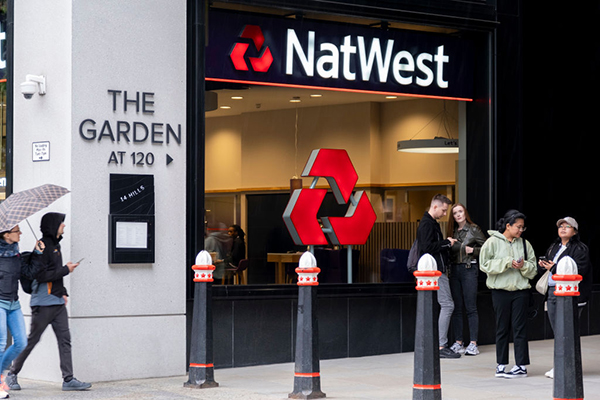
A NatWest bank branch in the City of London. Photo: Mike Kemp/In Pictures via Getty Images.
A preference for NatWest Group (LSE:NWG), alongside Buy recommendations on Lloyds Banking Group (LSE:LLOY) and HSBC Holdings (LSE:HSBA), has been revealed by a City bank ahead of the sector’s upcoming results season.
Bank of America expects a solid third quarter by domestic banks but with their guidance beyond 2026 likely to be limited and conservative against a backdrop of the Autumn Budget on 28 October.
- Invest with ii: SIPP Account | Stocks & Shares ISA | See all Investment Accounts
The dates of the Lloyds and NatWest updates on Thursday 29 October and Friday 30 October respectively will mean a swift response to any changes to the bank tax framework.
UK lenders currently pay the 25% standard rate of corporate tax, plus a surcharge of 3% on UK banking profits over £100 million and a levy imposed on balance sheet liabilities.
The inclusion of changes to employers’ National Insurance contributions has taken 2025’s total tax rate to 46.4%, which UK Finance points out is higher than other leading financial centres such as Frankfurt at 38.9% and New York’s 27.9%.
Lloyds and NatWest have about 85% of their total group profits eligible for the UK corporation tax surcharge compared with 33% for Barclays (LSE:BARC) and only 20% for HSBC.
UBS estimates that doubling the current 3% banking surcharge would have a 3% or 4% profit impact for the domestic banks, which was “not enough to make these stocks expensive”.
It added today: “Our sense is that investors expect a higher banking surcharge on the basis that banks are arguably less popular than some other industries and that return on equities are higher than they used to be.”
However, UBS said taxes of this kind were an input cost which will be passed to customers in the form of very marginally more expensive loans and less remunerative deposits.
It adds that such changes were likely to bring in less money than moves the needle on the provision of public services or extent of the budget deficit the country runs. In addition, they disincentivise inward investment.
- Party conference round-up: what the major parties propose for your money
- Autumn Budget preview and triple lock change explained
- Aviva and M&S shares tipped to go even higher
The risk of additional bank taxes in the chancellor’s Budget comes as the sector continues to return significant amounts to shareholders, including last month’s distribution of £4.25 billion of dividend payments by the five main FTSE 100-listed players.
The tax speculation, alongside interest rate-driven worries about credit conditions, weaker loan demand and funding costs, have weighed on shares in recent weeks.
Lloyds fell from August’s multi-year high of 117.1p to near 100p by last Thursday, while NatWest has dipped from 722.8p to 639.8p over the same period. Both stocks have rallied in recent days to 106.95p and 682.4p respectively, while Bank of America continues to see further upside through price targets of 140p and 850p.
It is most positive on NatWest heading into the third-quarter results, which it said reflected the company’s loan growth track record and potential for a 2026 income guidance upgrade.
BofA said it had been a resilient quarter for the domestic banks, aided by higher-for-longer interest rates as maturing structural hedges are reinvested at current swap rates.
The use of structural hedges to smooth out interest rate volatility has already provided a significant sector-wide income boost, although with average hedge durations of three to 3.5 years it will take time for the impact of the recent rise in industry swap rates to be realised.
BofA said UK loan growth remained resilient, although mortgage approvals have fallen in recent months and the deposit market continues to be competitive.
The bank has a Neutral stance on Barclays, which kicks off the reporting season with third-quarter figures on Thursday 22 October. The shares were as high as 522p in August after forecast-beating second-quarter results included an upgrade to its 2026 income target.
- Stockwatch: another chance to buy this UK bank share?
- Funds and trusts four pros are buying and selling: Q4 2026
- Sign up to our free newsletter for investment ideas, latest news and award-winning analysis
However, shares ended the third quarter as the worst performing of the sector amid concern over the company’s exposure to the US economy and softer period of fee income from investment banking activity.
The quarterly decline of 9.7% included September’s 7.9% reverse in a month when the Federal Reserve hiked interest rates. The shares today traded at 433.1p, which compares with BofA’s price target of 580p.
In relation to the Asia-focused banks, BofA said strong Hong Kong deposit growth continued to be supportive alongside evidence of a recovery in loan growth and positive wealth flows.
BofA thinks HSBC is well positioned in the current environment, but expects a tougher third quarter on 27 October. This reflects the capital impact on share buybacks due to a change in the value of debt instruments used as part of HSBC’s interest rate hedging strategy.
The bank has a price target of 1,720p, which represents an upside of more than 20% over today’s level of 1,421p and compares with early August’s peak of 1,597p.
It expects the results of Standard Chartered (LSE:STAN) on 28 October to be cleaner, with continued strong growth in wealth flows and potential for upgraded 2026 income guidance.
BofA rates Standard at Neutral with a price target of 2,485p. The shares climbed from 1,518p in March to last month’s 2,329p before falling back to today’s 2,121p.
These articles are provided for information purposes only. Occasionally, an opinion about whether to buy or sell a specific investment may be provided by third parties. The content is not intended to be a personal recommendation to buy or sell any financial instrument or product, or to adopt any investment strategy as it is not provided based on an assessment of your investing knowledge and experience, your financial situation or your investment objectives. The value of your investments, and the income derived from them, may go down as well as up. You may not get back all the money that you invest. The investments referred to in this article may not be suitable for all investors, and if in doubt, an investor should seek advice from a qualified investment adviser.
Full performance can be found on the company or index summary page on the interactive investor website. Simply click on the company's or index name highlighted in the article.