What the oil spike means for portfolios
Saltydog Investor mulls a recent surge in the oil price – and the impact for energy funds.
26th October 2026 14:03
by Douglas Chadwick from ii contributor

This content is provided by Saltydog Investor. It is a third-party supplier and not part of interactive investor. It is provided for information only and does not constitute a personal recommendation.
Oil prices rose sharply last week, with Brent crude climbing above $115 a barrel and reaching its highest level for nearly six months.
It closed on Friday at $116.72, a gain of 6.2% over the week.
Renewed tensions in the Middle East have raised concerns about global energy supplies. Attacks on Saudi Arabian energy infrastructure, disruption around important shipping routes and reports of possible further military action against Iran have all added to the uncertainty.
- Invest with ii: SIPP Account | Stocks & Shares ISA | See all Investment Accounts
The cost of transporting oil has also risen dramatically, with tanker operators charging significantly more to move crude between different parts of the world.
The rising cost of petrol and diesel
For motorists in the UK, the effects of higher oil prices are already being felt.
At the beginning of January, the average price of unleaded petrol was 134.9p a litre. By the third week of October, it had risen to 174.6p, an increase of almost 30%.
Diesel prices have risen even more sharply, climbing from 144.2p to 199.3p a litre, an increase of more than 38%.
The national average briefly exceeded £2 earlier this month, and prices remain above that level at some filling stations.
Of course, a substantial proportion of what motorists pay goes to the Treasury.
- Ian Cowie: inflation-beating trust yielding 6% is going cheap
- 200 episodes: 11 golden rules we keep coming back to
Fuel duty currently stands at 52.95p per litre for both petrol and diesel. VAT is then charged at 20% on the total selling price, including the fuel duty itself. A tax on a tax.
At the latest national average petrol price, approximately 82p per litre goes in tax, representing around 47% of the pump price.
With the Autumn Budget taking place on Wednesday, fuel duty is particularly topical.
The temporary 5p reduction in fuel duty is due to expire at the end of December. Under the current arrangements, duty would increase by 3p per litre in January, followed by another 2p in March.
Because VAT is charged on top, the January increase alone would add 3.6p to pump prices if passed on in full.
Given the substantial increases motorists have already experienced this year, it will be interesting to see whether the Chancellor decides to proceed.
Traditional energy funds make impressive gains
While rising energy prices are creating difficulties for consumers and businesses, they can present opportunities for companies producing oil and gas.
Higher selling prices can improve revenues and profits, particularly for producers whose operating costs remain relatively stable.
However, the relationship is not straightforward. Production levels, operating costs, taxation, investment requirements and expectations about future prices can all influence company valuations.
At Saltydog Investor, we monitor the performance of Investment Association (IA) sectors and the individual funds within them.
We have been looking at three funds investing primarily in traditional energy companies, and all have made substantial gains this year.
| Fund | 4 weeks | 12 weeks | 26 weeks | YTD |
| BGF World Energy D4 (B3Y9G49) | 7.6% | 14.2% | 18.7% | 51.8% |
| Schroder ISF Global Energy C Dis GBP AV (B2QM296) | 3.7% | 8.9% | 8.6% | 49.0% |
| WS Guinness Global Energy I Acc (B56FW07) | 4.8% | 9.9% | 12.8% | 47.8% |
Source: Morningstar. Performance to 23 October 2026. Past performance is not a guide to future performance.
All three funds have gained approximately 50% since the beginning of the year.
Their shorter-term performance has also been encouraging, with all three making gains over the last four weeks.
BGF World Energy D4 (B3Y9G49) has performed particularly well, rising 7.6% over that period.
Could renewables be the longer-term winners?
Although higher fossil fuel prices can benefit traditional energy producers, they may also strengthen the longer-term case for alternative sources of energy.
As petrol and diesel become more expensive, electric vehicles can look increasingly attractive, particularly for drivers who can charge at home on cheaper overnight electricity tariffs.
Rising wholesale natural gas prices in the UK and Europe may also improve the relative economics of electricity generated from wind and solar power.
There is also the wider question of energy security. Recent events have highlighted the risks of relying heavily on imported fossil fuels.
Developing domestic renewable energy, improving electricity networks and investing in energy storage could help reduce that dependence, while also supporting longer-term environmental objectives.
However, the performance of sustainable energy funds has been very different.
We have been looking at BGF Sustainable EnergyD4 (B62H2K4) and Guinness Sustainable Energy Y GBP Acc (BFYV9L7), neither of which has come close to matching the returns delivered by traditional energy funds.
| Fund | 4 weeks | 12 weeks | 26 weeks | YTD |
| BGF Sustainable EnergyD4 (B62H2K4) | -8.5% | -10.2% | -14.1% | 1.8% |
| Guinness Sustainable Energy Y GBP Acc (BFYV9L7) | -6.3% | -8.0% | -8.9% | -0.2% |
Source: Morningstar. BGF Sustainable Energy figures to 23 October 2026; Guinness Sustainable Energy figures to 22 October 2026. Past performance is not a guide to future performance.
Both funds have struggled recently, losing between 6% and 9% over the last four weeks. However, looking at their performance over the whole year tells a more interesting story.
Earlier in the year, both traditional and sustainable energy funds were making strong gains.
- Portfolio Dilemma: how do I invest for ‘good’?
- Sign up to our free newsletter for investment ideas, latest news and award-winning analysis
By June, BGF Sustainable Energy had gained more than 27%, while Guinness Sustainable Energy had risen by almost 20%.
Since then, their fortunes have diverged significantly.
The traditional energy funds have continued to make progress, while the sustainable energy funds have given back most or all of their earlier gains.
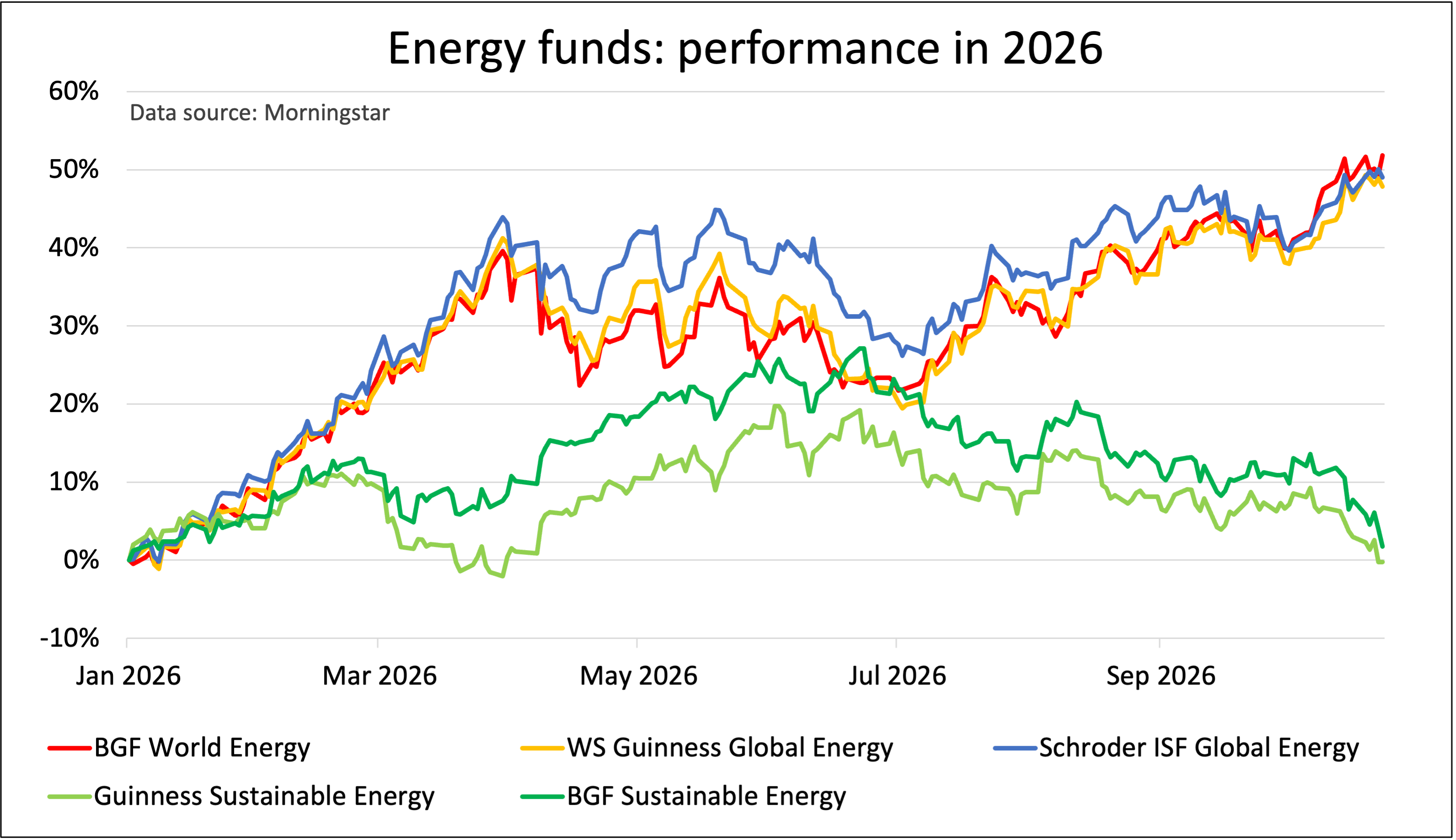
Past performance is not a guide to future performance.
There are several factors that might be influencing this divergence.
Renewable energy projects often require substantial upfront investment, making financing costs and interest rates important considerations. Government policy, competition and company valuations may also play a part.
Regional differences in natural gas prices could be another influence. While European prices have risen significantly, US natural gas prices have been relatively weak recently, potentially affecting the competitiveness of renewable electricity.
The US midterm elections on 3 November are also worth watching. Any change in the balance of power in Congress could influence expectations for future support for renewable energy.
- US midterms 2026: what election could mean for your portfolio
- Core funds and trusts for seven regions
Higher fossil fuel prices, energy security concerns and environmental objectives could all encourage further investment in alternative energy sources.
That would not necessarily translate into stronger returns for sustainable energy funds, whose performance also depends on the profitability and valuations of their holdings.
For now, the three traditional energy funds we monitor have delivered much stronger returns this year.
At Saltydog Investor, we will continue monitoring both groups for signs of a change in their relative fortunes.
For more information about Saltydog, or to take the two-month free trial, go to www.saltydoginvestor.com
These articles are provided for information purposes only. Occasionally, an opinion about whether to buy or sell a specific investment may be provided by third parties. The content is not intended to be a personal recommendation to buy or sell any financial instrument or product, or to adopt any investment strategy as it is not provided based on an assessment of your investing knowledge and experience, your financial situation or your investment objectives. The value of your investments, and the income derived from them, may go down as well as up. You may not get back all the money that you invest. The investments referred to in this article may not be suitable for all investors, and if in doubt, an investor should seek advice from a qualified investment adviser.
Full performance can be found on the company or index summary page on the interactive investor website. Simply click on the company's or index name highlighted in the article.