Wild’s Winter Portfolios 2026-27: seeking a 10th year of profits
It’s back to winning ways for Wild’s Winter Portfolios, making money for a ninth year out of 12. Lee Wild explains the strategy’s rationale and performance of the new portfolios.
22nd October 2026 09:30
by Lee Wild from interactive investor

Our six-month seasonal strategy has navigated all sorts of headwinds in its 12 years, from Budgets and Brexit to presidents, pandemics, politics and warfare. Covid may have ended a 100% record of positive returns since launch, but Wild’s Winter Portfolios bounced back last time to secure a ninth winter of profits and a 75% success rate.
The 2025-26 portfolios staged one of the most impressive recoveries in this strategy’s history. Lagging the FTSE 350 benchmark index for much of the six months, a handful of stocks turned the tables in spectacular fashion during April’s revival after the Iran war crash, with gains of almost 10% for the consistent basket of shares and 5% for the aggressive portfolio.
- Invest with ii: SIPP Account | Stocks & Shares ISA | See all Investment Accounts
When markets shut on 30 April, Wild’s Consistent Winter Portfolio 2025-26, made up of the five FTSE 350 companies that have risen the most winters (1 November to 30 April) over the past decade, had returned 6.3%, or 6.6% if you include dividend income.
Wild’s Aggressive Winter Portfolio, where constituents must have risen at least 80% of winters over the past decade but which have demonstrated higher annual returns, grew by 6.7%, or 7.7% with dividend income. The FTSE 350 index rose by 6.2% and 7.5% respectively.
While the pandemic had previously taken the steam out of the winter strategy, the resurgence has put the aggressive portfolio in a strong position compared with the benchmark index. Reinvesting proceeds from the first winter portfolio in 2014 into the 2015 edition and so on has generated a return of 115.6% for “aggressive” investors. That’s more than the 102.2% by the FTSE 350. Doing the same with the consistent portfolio would have left you with 66.9%.
You can see the results in the chart below:
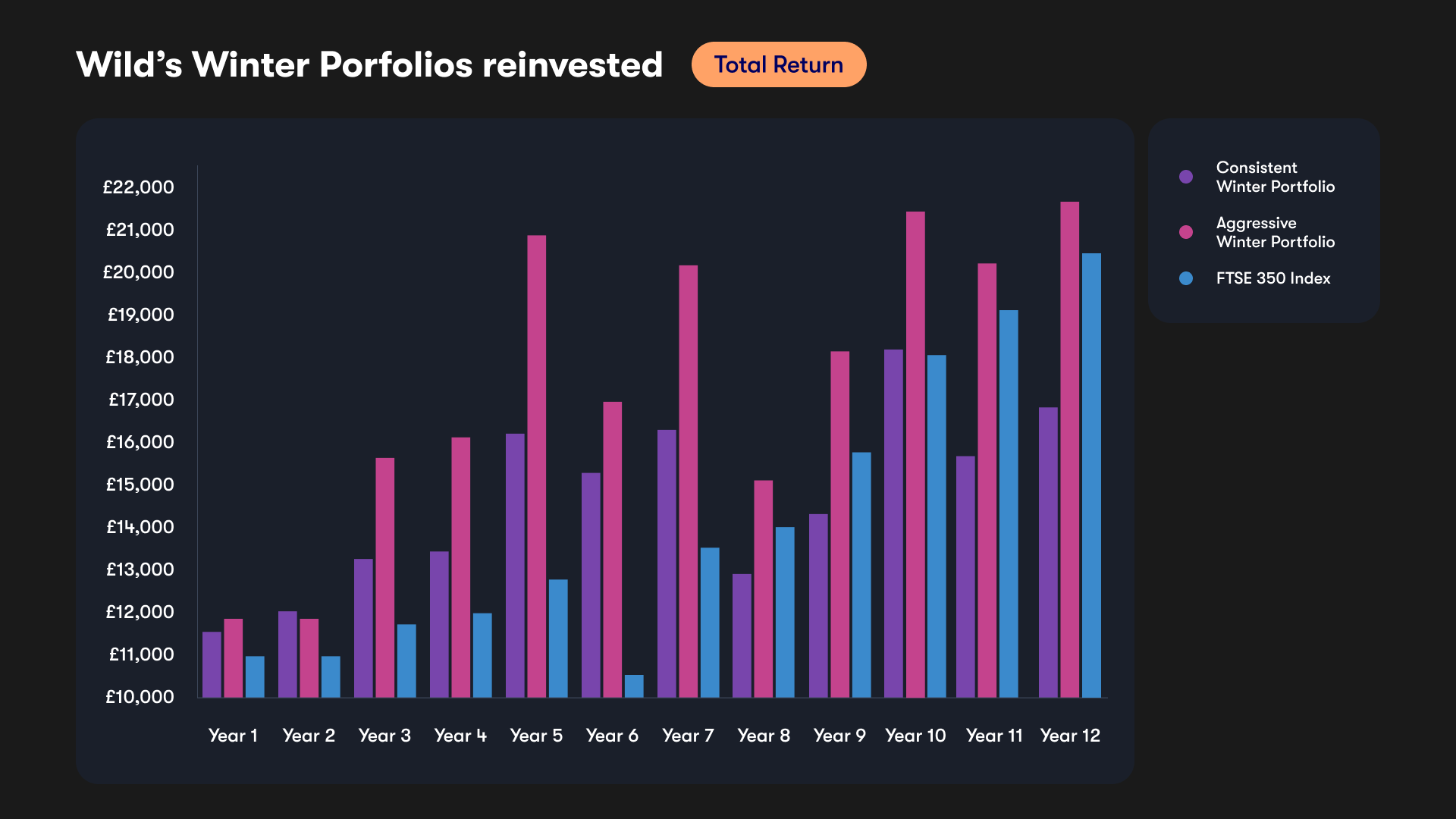
Source: interactive investor. Shows £10,000 invested in the first winter portfolio (2014-15) with original stake and proceeds reinvested into the following year’s portfolio, and so on. Consistent Winter Portfolio has generated a total return of 66.9% and Aggressive portfolio 115.6%. Benchmark FTSE 350 index is up 102.2%. Winter portfolios and FTSE 350 include dividends but not buying/selling fees or stamp duty. Past performance is no guide to future performance. Investments and the income from them can go down as well as up and you may not get back the original investment.
How we do it
The objective is to create two portfolios that best exploit stock market seasonality. These are data-driven portfolios, so there is no manual intervention.
Screening only stocks listed in the FTSE 350 index for a greater level of liquidity, the five most reliable winter performers of the past 10 years make up Wild’s Consistent Winter Portfolio. A basket of five higher-risk/higher-return stocks which still exhibit impressive consistency over the winter months become Wild’s Aggressive Winter Portfolio.
All five stocks in Wild’s Consistent Winter Portfolio 2026-27 have each risen in nine of the previous 10 winters. The average return between November and April over the past decade, excluding dividends, is 13.9% versus an average gain of just 5.1% for the FTSE 350 benchmark index.
To access even greater potential returns, we relax the entry criteria for the aggressive portfolio for 2026-27. That makes it a little riskier, but even now it also has two stocks with a 90% winter win rate and three with eight positive winters out of the past 10. The average winter return for the 2026-27 aggressive portfolio since 2017 is 20.1%.
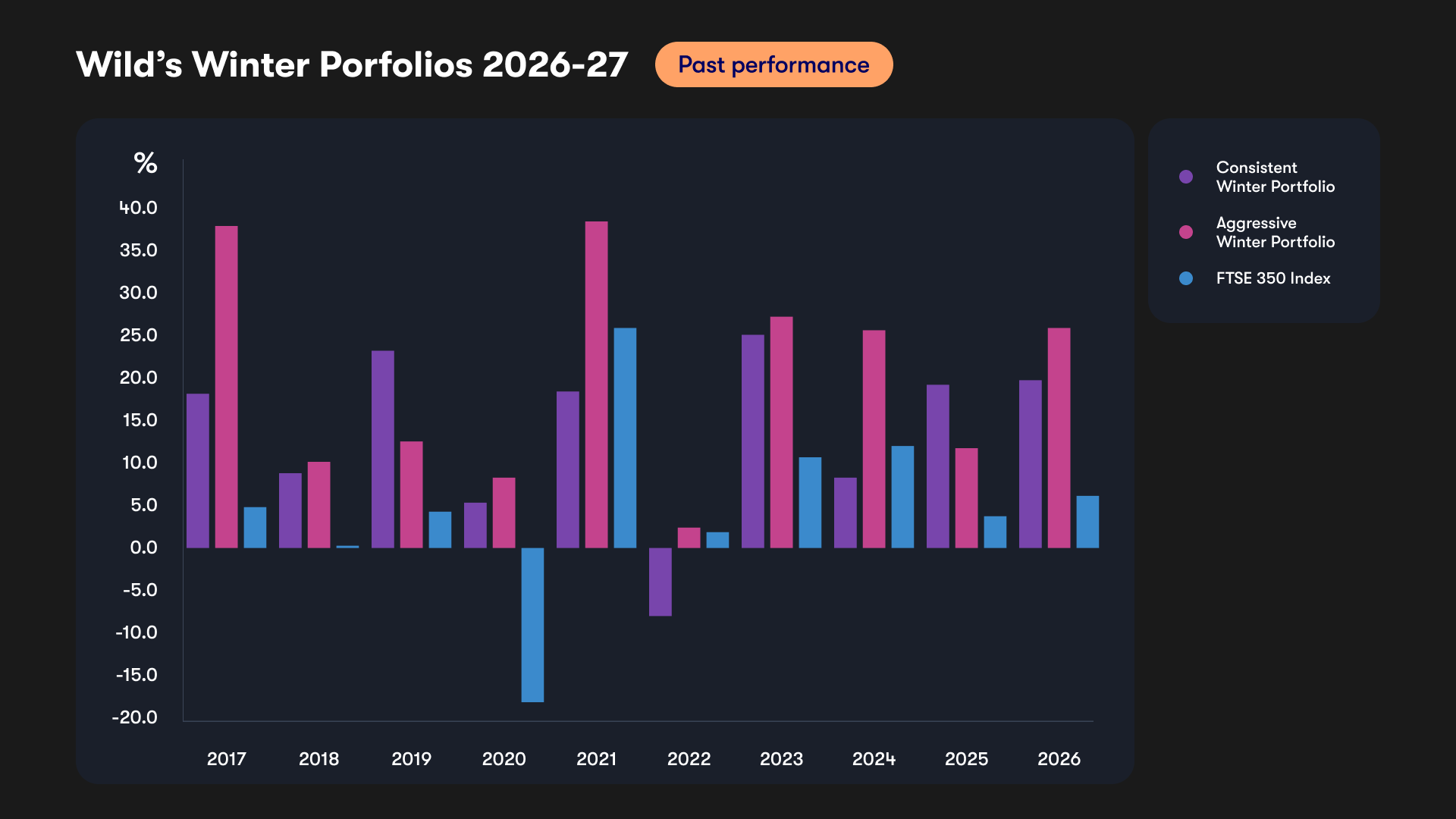
Source: interactive investor and Stephen Eckett. Shows performance of stocks included in the 2026-27 winter portfolios had they been owned for the 10 years between 2017 and 2026, and for the FTSE 350 benchmark index over the same period. Performance is between 1 November and 30 April. Past performance is no guide to future performance. Investments and the income from them can go down as well as up and you may not get back the original investment.
What we want to hear is that stocks underperform during the summer and outperform in the winter months; that’s what this trading strategy is all about.
But last year, momentum from late winter spilled over into the summer and, in some cases, accelerated. As happened in 2024-25, it meant share prices were already factoring in a lot of good news, robbing us of potential winter gains. And, similarly, three portfolio companies have achieved double-digit gains this summer from 30 April to 20 October. The FTSE 350 index is up 3.9%. Four portfolio constituents are currently registering summer losses.
The five stocks in each of the 2025-26 winter portfolios will be announced at lunchtime on Friday 30 October.
The rationale
Our interest was originally piqued by an anomaly in the stock market which demonstrates that buying and selling at two specific dates of the year has historically generated better returns than if you had stayed invested all year round.
Buying a portfolio of shares on 1 November, or late on 31 October, and selling them on 30 April the following year, has significantly outperformed the wider stock market over more than a quarter of a century. It provides investors with a clear strategy that’s simple to execute and enjoys a successful performance history.
- Case study: managing a £1.25m pension and ISA portfolio in midlife
- Party conference round-up: what the major parties propose for your money
Data provided by Stephen Eckett, mathematician and co-founder of Harriman House, publisher of The UK Stock Market Almanac, shows that £100 invested in the UK stock market (as measured by the FTSE All-Share Index) in 1994 and held continuously for the past 32 years, would have grown to £352 (excluding dividends). However, if they had only invested in the market between 1 November and 30 April every year, then that £100 would be worth £486. Conversely, if they had chosen to invest only over the summer months, they would have lost money; their original £100 would be worth just £66.
“This anomaly, sometimes called the Sell in May Effect, describes the tendency of equities to perform better in the winter (November to April) than the summer (May to October). And this anomaly has been known about for a long time,” explains Mr Eckett, “there is even some evidence that dates knowledge of this effect back to 1694.”
“After the Covid-influenced stock turbulence in 2020, markets seemed to have settled down somewhat, with previous trends such as the Sell in May effect re-asserting themselves. However, this last year saw the market in the summer outperform that in winter for only the eighth time since 1982, although this summer strength was heavily doped by the bounce back in stocks after Trump’s announcement of tariffs on imports to the US. In other words, this was most likely a one-off event rather than a significant change in trend.”
Why does the winter portfolio strategy work?
No conclusive studies neatly explain the historic outperformance of stock markets during the winter months, but there are plenty of theories, some more plausible than others.
Perhaps most likely is that far more money flows into the market over the winter months. This typically happens when big players at financial institutions on Wall Street and the Square Mile return from their summer breaks. The City doesn’t shut down these days for the cricket, horse racing and rowing at Henley, but plenty of decision makers are out of the office on holiday, so it is probable that some of the big trading decisions are left until everyone is back in the office. Investment strategies deployed in the following months increase liquidity and boost sentiment.
Most investors will have heard of the Santa rally, when equity markets historically have done well in the weeks leading up to Christmas. You could attribute this to seasonal optimism, or, more likely, end of calendar-year window dressing of portfolios by funds and investment houses. Selling losers and buying successful stocks flatters the numbers that determine City bonuses.
- Stockwatch: possibly the best risk-adjusted yield in UK equities
- US midterms 2026: what election could mean for your portfolio
Then, in the spring, at the end of the financial winter, investors take advantage of tax-efficient products in the run up to tax year-end. In what is often referred to as ISA season, many investors rush to use their tax-free allowance in the final days, weeks and months of the tax year. So-called early birds then use their ISA allowance as soon as the new tax year begins.
Events to monitor over the next six months
The launch of this year’s winter portfolios is sandwiched by the UK Budget on Wednesday 28 October and US midterm elections on 3 November. The market impact of each is debatable, but speculation in the lead up to these events has the potential to move stock prices. So does a possible Bank of England (BoE) interest rate hike a couple of days later.
I was talking about rates this time last year, but then it was that “lower borrowing costs seem inevitable”. More accurate was that “central bankers will remain very much under the spotlight”. Since then, a fresh conflict in the Middle East has brought chaos to oil exports out of the Strait of Hormuz and, to a lesser extent, the Red Sea. Houthi attacks on Saudi energy infrastructure have only made things worse, while the war in Ukraine will enter its fifth year in February.
An oil price stubbornly above $100 a barrel and way above historical norms has put greater pressure on not just the cost of running the family car, but also on freight costs, food prices, airline tickets and all sorts of manufactured goods.
- UK Budget latest
- Sign up to our free newsletter for investment ideas, latest news and award-winning analysis
Latest UK inflation data shows an increase in the headline rate to a higher-than-expected 3.5%, up from 3.1% a month ago and way above the BoE’s 2% target. It now makes a quarter-point hike in borrowing costs very likely when the Bank of England’s Monetary Policy Committee (MPC) announces its next decision on 5 November.
Interest rate rises here and expected increases in the US, will make borrowing more expensive and increasingly force consumers to curtail spending. It will also be a problem for companies looking to grow their business, including the big AI operators in the States. These massive businesses, which are currently borrowing tens of billions of dollars to fund rapid expansion, are under real pressure to generate a return on this investment. Failure to do so could have serious repercussions for share prices.
Rising costs mean quarterly results in the US will remain a major focus. Will corporate America be able to sustain recent rapid profit growth into 2027?
Major world events can and will affect market direction over the next six months. We’ll have to wait and see which way. All we can do is believe in the market anomaly which shows, historically, that stocks generate their best returns over the winter months.
These articles are provided for information purposes only. Occasionally, an opinion about whether to buy or sell a specific investment may be provided by third parties. The content is not intended to be a personal recommendation to buy or sell any financial instrument or product, or to adopt any investment strategy as it is not provided based on an assessment of your investing knowledge and experience, your financial situation or your investment objectives. The value of your investments, and the income derived from them, may go down as well as up. You may not get back all the money that you invest. The investments referred to in this article may not be suitable for all investors, and if in doubt, an investor should seek advice from a qualified investment adviser.
Full performance can be found on the company or index summary page on the interactive investor website. Simply click on the company's or index name highlighted in the article.
Disclosure
We use a combination of fundamental and technical analysis in forming our view as to the valuation and prospects of an investment. Where relevant we have set out those particular matters we think are important in the above article, but further detail can be found here.
Please note that our article on this investment should not be considered to be a regular publication.
Details of all recommendations issued by ii during the previous 12-month period can be found here.
ii adheres to a strict code of conduct. Contributors may hold shares or have other interests in companies included in these portfolios, which could create a conflict of interests. Contributors intending to write about any financial instruments in which they have an interest are required to disclose such interest to ii and in the article itself. ii will at all times consider whether such interest impairs the objectivity of the recommendation.
In addition, individuals involved in the production of investment articles are subject to a personal account dealing restriction, which prevents them from placing a transaction in the specified instrument(s) for a period before and for five working days after such publication. This is to avoid personal interests conflicting with the interests of the recipients of those investment articles.