Important information: Investment value can go up or down and you could get back less than you invest. If you're in any doubt about the suitability of a Stocks & Shares ISA, you should seek independent financial advice. The tax treatment of this product depends on your individual circumstances and may change in future. If you are uncertain about the tax treatment of the product you should contact HMRC or seek independent tax advice.
What you'll learn in this guide
- A breakdown of the 2026/27 ISA allowance and the different types of ISA available.
- Insights into the benefits of using your ISA allowance and how it can help grow your savings.
- A look at historical ISA allowances and answers to common ISA questions.
What is the 2026/27 Stocks and Shares ISA allowance?
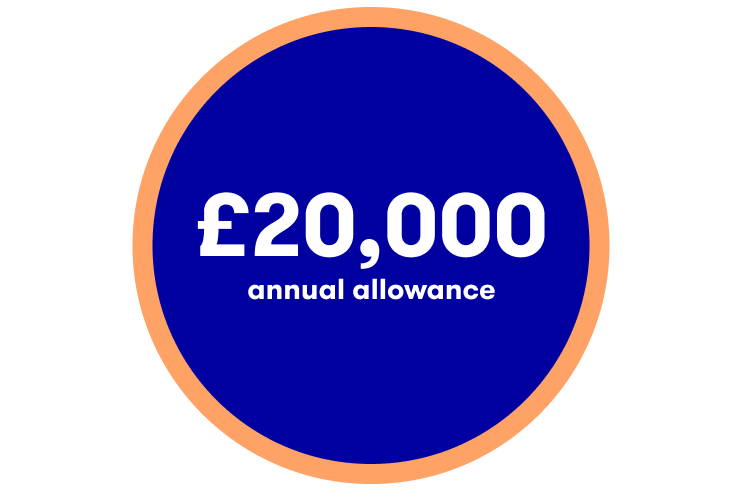
The 2026/27 ISA allowance is £20,000. This is the total amount you can pay into ISAs during this tax year.
You can split your allowance between any allowed combination of ISAs. For example, you could pay into a cash ISA and a Stocks and Shares ISA in the same tax year. But the total can’t exceed £20,000.
The current tax year runs from 6 April 2026 to 5 April 2027.
Types of ISA allowance: an overview
Type of ISA | What is it? | Maximum contribution allowance (current tax year) | Eligibility criteria |
Stocks and Shares ISAs | A Stocks and Shares ISA (Individual Savings Account) is a tax-free investment account, allowing you to invest in shares, funds, ETFs, bonds and gilts and investment trusts. | £20,000 |
|
Cash ISA | A Cash ISA is a savings account which allows you to earn tax free interest on your savings. | £20,000 |
|
Innovative finance ISA | An Innovative Finance ISA is a type of ISA that uses your tax-free allowance while investing in peer-peer lending and crowdfunding. | £20,000 |
|
Lifetime ISA | A Lifetime ISA has different rules regarding allowances. Lifetime ISAs assist with retirement, or purchasing your first home and come in two types: Cash and Stocks and Shares. Alongside the yearly allowance, there is the benefit of a 25% government top-up, but also strict withdrawal rules. | £4,000 per year until age 50 |
|
Junior ISA | A Junior Stocks and Shares ISA, also known as a JISA, is a tax-efficient savings and investment account for under 18s. | £9,000 |
|
What happens if you accidentally exceed your ISA allowance?
At the end of each tax year, your ISA provider will report to HMRC how much you’ve contributed. Any investment gains or dividends you earn are tax-free and don’t count towards your allowance. Only money you pay into your ISA counts as a contribution.
If you notice that you have exceeded your allowance, you can contact the HMRC helpline, and they can provide further guidance. If you do not notice that you have exceeded your annual allowance, HMRC will receive these details by the end of the tax year.
You may have to pay tax on the excess, so it’s a good idea to check how much of your allowance you’ve used before adding more.
Why should you take advantage of your ISA allowance each year?
When your money is held in an ISA, you don’t pay UK tax on anything that money earns – be that in the form of interest, dividends or capital gains.
In addition to the tax advantages, ISAs offer investors flexible access to their savings. It’s important to use as much as you can of your annual £20,000 ISA allowance before the end of the tax year on 5 April, or you will lose it.

What happens if I do not use my ISA allowance?
You don’t have to use your full allowance, but you can’t carry over unused allowance from previous years.
As of 6 April 2024, if you have not contributed to your ISA at all during the previous tax year, under the new rules you will no longer need to reactivate it.
How does the ISA allowance work?
The allowance can be split between different ISA accounts, including a Cash ISA, Stocks and Shares ISA, Lifetime ISA (up to £4,000 per year) and Innovative Finance ISA. As of 6 April 2024, the ISA rules changed so you can contribute to as many ISAs as you want - including different types - in a tax year (except for Lifetime ISAs and Junior ISAs)
There is a separate allowance for Junior ISAs for under 18s, which is £9,000 for this tax year.
Historical ISA allowances
Since ISAs were launched, allowances have gradually increased, meaning more tax-free growth. There has never been a better time to invest in an ISA.
The following table shows how rates have changed over time.
Tax Year | Share ISA / Total Allowance | Cash ISA | Junior ISA | Lifetime ISA |
2025/26 | £20,000 | £20,000 | £9,000 | £4,000 |
2024/25 | £20,000 | £20,000 | £9,000 | £4,000 |
2023/24 | £20,000 | £20,000 | £9,000 | £4,000 |
2022/23 | £20,000 | £20,000 | £9,000 | £4,000 |
2021/22 | £20,000 | £20,000 | £9,000 | £4,000 |
2020/21 | £20,000 | £20,000 | £9,000 | £4,000 |
2019/20 | £20,000 | £20,000 | £4,368 | £4,000 |
2018/19 | £20,000 | £20,000 | £4,260 | £4,000 |
2017/18 | £20,000 | £20,000 | £4,128 | £4,000 |
2016/17 | £15,240 | £15,240 | £4,080 | The lifetime ISA was introduced in 2017 |
2015/16 | £15,240 | £15,240 | £4,080 | |
2014/15 | £15,000 | £15,000 | £4,000 |
Share ISA refers to what is now called Stocks and Shares ISA.
ISAs are a tax-efficient way to invest for long-term savers. Your savings grow from interest, dividends and stock market performance while being sheltered from capital gains tax. Using your ISA allowance each tax year can lead to higher returns in the future. Saving in an ISA can even benefit in retirement. Withdrawals from personal pensions may be subject to tax, however, any withdrawals from an ISA are tax-free.
Ways to invest in an ii ISA
Are you more of a hands-on investor? Or simply prefer to leave it to the experts? Either way, we have the ISA for you. And all for our same low, flat monthly subscription.

ii ISA
Do it myself
A Self-managed ISA puts the control firmly in your hands.
Build your investment portfolio from our full range of UK and international shares, funds and bonds.
Then manage your investments yourself, with our expert insights and ideas always there if you need them.

ii Managed ISA
Do it for me
Sit back, relax and leave it to the experts with a Managed ISA.
We'll match you to a tailored investment portfolio, that reflects the risk level you're comfortable with.
Then our experts will look after your investments for you - so you can rest easy, knowing your money is managed.