Bond Watch: how 2026 is shaping up for gilt investors
With the Bank of England raising rates, fiscal headroom under pressure, and the outlook heavily dependent on energy prices and geopolitical tensions, the balance between risk and reward is finely poised for gilt investors.
6th November 2026 11:21
by Alex Watts from interactive investor

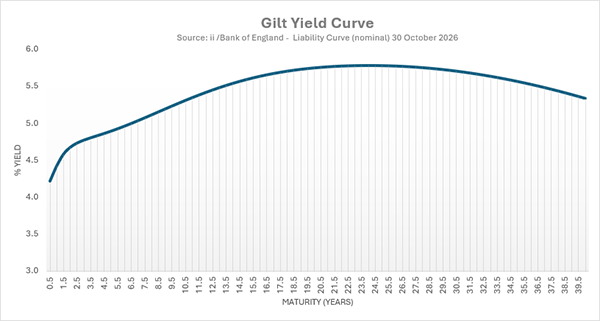
It hasso far been a rocky one for many gilt investors. In the first three quarters of the year, yields across maturities rose. For short-dated bonds, yields rose in anticipation (since proven correct) of a rate hike from the Bank of England.
While the expected hike has also been a factor in rising yields for longer maturities, other headwinds have contributed, including a tenuous fiscal position, sticky inflation and geopolitical tumult.
- Invest with ii: How Bonds & Gilts work | Free Regular Investing | Open a Stocks & Shares ISA
The widely followed 10-year gilt yield rose from 4.5% at the start of 2026 to enter the fourth quarter at 5.4%.
Except for the shortest maturity gilts (those with lifespans of less than five years returning a modest +0.8%), returns throughout the first three quarters were negative. Total returns for indices representing index-linked gilts (-1%) and conventional gilts (-2.4%) were negative, and more so for gilts with maturities of above 15 years (-7.2%).
However, October and the start of November saw a marked reversal of fixed-income returns globally, but particularly so for UK government bonds (and particularly rewarding duration – sensitivity to changes in interest rates). Markets reacted to a slew of key domestic and global fiscal, monetary and political events, with likely longer-term implications.
Underlying fiscal and monetary policy setting, as well as long-term growth, inflation and borrowing projections, is the unrelenting energy price pressure stemming from the Middle East, for which no imminent conclusion is in sight.
Rising interest rates – temporary adjustment or new cycle?
This week, the Bank of England raised rates by 25 percentage points to 4%, the first increase in three years. Eight Monetary Policy Committee (MPC) members supported the decision, with one favouring a larger increase.
September’s CPI inflation reached 3.5%, with much of the overshoot attributable to higher energy prices, particularly motor fuels. Overseas conflicts were cited as the principal reason for inflationary uncertainty, with (yet to materialise in earnest) second-round effects an assumption in projections.
With CPI now expected to reach around 5% by mid-2027, the Bank judged that the prolonged energy shock, coupled with somewhat resilient economic activity and a stabilising labour market, warranted action to guard against second-round effects on wages and prices.
- Three ways interest rate hike to 4% could affect your finances
- Sign up to our free newsletter for investment ideas, latest news and award-winning analysis
Evidently, whether this proves a temporary adjustment or the beginning of further tightening will depend heavily on the trajectory of energy prices and the conflict in the Middle East.
Autumn Budget
John Healey’s first Budget as Chancellor reduced the government’s fiscal headroom from £23.6 billion at the March forecast to £15 billion in 2029-30, leaving the chancellor with a smaller buffer against his fiscal rules.
The market reaction was quelled by an anticipated improvement of that position in the subsequent years, and by the degree of fiscal discipline shown. Supportive also for long-end yields is the Debt Management Office’s planned reduction in long-dated bond issuance, despite an overall increase in gilt issuance of £4.4 billion to £250.6 billion in 2026-27.
But while the Office for Budget Responsibility (OBR) forecasts of a stronger fiscal picture come 2031 may be positive, gilt investors ought to assess the achievability of these targets.
The OBR ascribes a 56% probability of fiscal targets being met (down by 3% since last year). The plan very much is to “spend now, consolidate later”, contingent on substantial savings materialising (like large downward revisions in departmental spend).
It also hinges on external factors, such as the trajectory of borrowing costs and inflationary outcomes which, as the Bank of England attests, depend on outcomes in the Middle East.
The OBR has revised down the UK’s 2027 growth by circa 0.5% to 1%, citing the drag associated with higher global energy prices and borrowing costs. This demonstrates how exposed the UK’s fiscal plans are to exogenous shocks.
In terms of fiscal impact (estimated by the OBR at an average of £1.3 billion throughout the policy period), the Autumn Budget can at least be considered “small”.
Spending measures included household energy support, fuel duty freezes and reaffirmed defence commitments. Revenues will come from (to name a few) a doubling of bank tax surcharges (a temporary measure), tax on gambling companies, and an uplift of 2% to property and savings taxes.
- Autumn Budget 2026: what it means for your money
- Autumn Budget 2026: how UK stocks reacted
- Three key takeaways from the Autumn Budget 2026
The result (per the OBR) is a net increase in near-term borrowing – both driven by policy decision and by economic conditions defining interest costs – until 2029 when fiscal consolidation should materialise.
Iran war and US midterms
The reoccurring theme evidently in monetary and fiscal considerations in the UK currently is the geopolitical landscape – particularly the supply side shock to oil prices associated with the Iran war.
With minimal progress visibly made in negotiations, and strikes continuing, oil sits near $90 per barrel (crude) and refined product production is stilted. This precarious scenario threatens a second round of inflation and shocks to global growth – reflected in substantial term premia of US, European and UK (and other) government bonds.
While the Democrat sweep of the US midterms may bring further war-scepticism to the Senate and House in America, presidential powers can go far in vetoing an end to the conflict. In short, there’s no clear runway to an end to hostilities and return to normal oil prices – not least due to the damage inflicted on relevant infrastructure.
Where this leaves UK bond investors
Following the Autumn Budget, the UK’s fiscal headroom remains thin. The OBR’s forecasts and the Bank’s latest rate hike illustrate how much of the outlook for UK fixed income is being shaped by developments beyond UK borders.
Uncertainty is evident in how inflation forecasts have changed. The OBR anticipates CPI averaging 3.4% in 2027, having put that number at 2% in their March 2026 forecast. The Bank of England (with a more recent view than the OBR’s mid-August data cut-off) now expects inflation to reach around 5% by the middle of that year (up from “slightly above 4%” in the last MPC meeting).
Both underline the difficulty and dynamism of forecasting inflation while the duration, outcome and aftermath of the foremost contributor – the Iran conflict - remain unknowable.
- Bond Boss: why ChatGPT might be affecting your bond fund
- Where four experts are investing towards end of 2026
Whether the latest rate hike proves a temporary adjustment or the beginning of a longer tightening cycle is therefore difficult to judge. Longer-dated bonds offer higher yields, and greater potential upside should yields fall but – given a higher sensitivity to long-term growth and inflation - also carry considerably greater capital risk if inflation proves persistent.
For now, we continue to favour investment grade, shorter-duration bonds, offering attractive starting yields without requiring investors to predict when interest rates or gilt yields might peak. In addition, the relatively tight credit spreads lessen the appeal of lower-quality credit.
Sustained evidence of easing energy prices – which is hard to envisage without some cessation of conflicts in the Gulf - and subsequent disinflation could provide an opportunity to reconsider longer-duration exposure.
These articles are provided for information purposes only. Occasionally, an opinion about whether to buy or sell a specific investment may be provided by third parties. The content is not intended to be a personal recommendation to buy or sell any financial instrument or product, or to adopt any investment strategy as it is not provided based on an assessment of your investing knowledge and experience, your financial situation or your investment objectives. The value of your investments, and the income derived from them, may go down as well as up. You may not get back all the money that you invest. The investments referred to in this article may not be suitable for all investors, and if in doubt, an investor should seek advice from a qualified investment adviser.
Full performance can be found on the company or index summary page on the interactive investor website. Simply click on the company's or index name highlighted in the article.