Where four experts are investing towards end of 2026
Our asset allocation panel share their views on the areas where they are bullish and bearish.
4th November 2026 08:40
by Jim Levi from interactive investor

Recent events in France, Brazil and South Korea demonstrate the usefulness of having a diversified global view of stock markets.
French equities have unsurprisingly been in the doldrums in the past couple of months prompted by the riots in Paris and other major cities. The CAC index of top 40 French stocks has lately been almost 1,000 points down from its August peak of 8,755.
- Invest with ii: SIPP Account | Stocks & Shares ISA | See all Investment Accounts
By contrast, the Brazilian stock market has been soaring - prompted of late by the first round of the presidential election where the right-wing pro-business candidate Flavio Bolsonaro unexpectedly pipped the incumbent left-wing President Luiz Inácio Lula da Silva at the post. In the past year, Brazil’s equity market has risen by almost 50%.
Meanwhile, leading South Korean stocks like Samsung Electronics Co Ltd DR (LSE:SMSN) have been suffering a shake-out, erasing a lot of the gains of earlier this year - all over concerns about the profitability of artificial intelligence (AI).
In France, there are signs already of investors being tempted back into the leading local stocks - many of them prominent players on the global stage - L'Oreal SA (EURONEXT:OR), Airbus SE (EURONEXT:AIR), Schneider Electric SE (EURONEXT:SU), Lvmh Moet Hennessy Louis Vuitton SE (EURONEXT:MC) and Sanofi SA (EURONEXT:SAN) among them - and therefore cushioned against recent upheavals on the streets.
Mixed views on Europe
“Europe is very much a stock pickers’ market,” says Craig Hoyda, investment director at Aberdeen. “While we can see both positive and negative factors, many of these leading companies have lots of exposure outside Europe.” But then Europe has a major war on its doorstep and Hoyda even worries about what rising ocean temperatures prompted by El Nino might do to winter weather in Europe. He ends up lowering his score from six to five.
Rob Burdett at Negroup Investments was bullish of Europe back in July but his hopes of outperformance have failed to materialise so far and so he edges his score lower by one point to seven.
At Rathbones, David Coombs keeps his score for European equities at a lowly three. “It has been a pretty turgid third quarter for Europe,” he claims although he does concede that there are companies in the region with sizeable international earnings that are worth investing in.
At Schroders, Dorian Carrell dashes any hope of any consensus among our four-strong panel of global asset allocators. He has decided to do the opposite of Burdett by boosting his European score from seven to eight. He argues: “Disorder in France means we are less likely to get an extreme left administration in France at the next presidential elections. Marine Le Pen looks the likely winner.”
- Nick Train tops the fund leaderboard in October
- Portfolio Dilemma: how do I build a ‘forever’ income portfolio?
- Core funds and trusts for seven regions
Central to his view of markets is Carrell’s hope that once the US midterm elections are over there may be a fall in oil and gas prices, which will help European equities in particular. “We think the situation in the Middle East may calm down a bit after those elections and a fall in the gas price would help European equities,” he says.
Geopolitical factors “have become even more complicated in recent months”, notes Burdett. However, despite this, he adds that “financial markets’ resilience in the face of bad news has been quite remarkable”.
Earnings growth brushing aside US valuation concerns
US equities were the best performer in major markets during the third quarter, powered largely by technology stocks. But the mood on Wall Street is changing with worries about the cost of funding the huge roll-out of AI and its data centres causing quite a shake-out of the major high-flyers.
Despite these worries, the average score for US equities has crept up to six. Only Burdett remains cautious with a score of five. “The Magnificent Seven have dominated their chosen sectors - Apple Inc (NASDAQ:AAPL) for mobile phones, Alphabet Inc Class A (NASDAQ:GOOGL) (Google) for search engines, Meta Platforms Inc Class A (NASDAQ:META) for social media - but they won’t be seeing the same returns in the age of AI.”
Coombs has his concerns about AI and the eccentricities of the Donald Trump White House. Nevertheless, he insists: “The US is the only market that has performed lately and is safest place to be at the moment. I raised my score from six to eight back in July and I am going to keep it there.”
He adds: “If I was giving a score for the White House, it would be very different.”
- Stockwatch: buy Alphabet’s crash or chase Microsoft’s momentum?
- Polar Capital Technology: the AI stocks I’m excited about in cognitive era
- Sign up to our free newsletter for investment ideas, latest news and award-winning analysis
Burdett agrees: “Donald Trump seems to be determined to upset the world order but earnings growth by US companies seems to be brushing this aside.”
Hoyda and Carrell are confirming the Coombs argument by both increasing their US equities score. “The key question as far as we are concerned is: over what level of US interest rates does the American economy crack?” Hoyda asks. “We don’t really know the answer but bond yields of 6% might be the breaking point, and we are not there yet.”
Carrell’s thinking on Wall Street is short term. “We expect earnings figures from US companies to remain quite strong, and we do not expect a further rise in interest rates from the Federal Reserve until December so I think we will go from a score of four to six for the short term.”
Carrell argues that there has already been quite a shake-out in AI-related stocks, so he has become more positive although he regards US equities as “still very expensive”.
Ahead of John Healey’s Autumn Budget none of the panel changed scores on UK equities. Only Burdett shows any enthusiasm. He says: “I still think the UK is one of the better places to invest because we are getting slightly better economic growth and performance has lagged behind other markets.”
Why Japan is the most favoured equity region
Japan’s equity market has now emerged as the most favoured sector with all four panel members now overweight, although Hoyda has trimmed his score. The three other panel members have all increased their scores and the average score of seven is comfortably the highest in any sector.
Carrell has quite an impressive list of reasons to favour Japanese equities: “It has been the best-performing major market for the past year, yet valuations still remain attractive,” he says. “Interest rates are higher but still negative in real terms. The yen has recovered some ground, but not enough to discourage exporters, and the policy of increasing buybacks and dividends for shareholders is ongoing.”
In emerging markets, South Korea, a front runner in technology with stocks like Samsung and SK hynix Inc ADR (NASDAQ:SKHY), has become too volatile for some. But Carrell favours China, Taiwan and Latin America to take up the running. However, as a precaution he lowers his score from eight to seven. Other scores remain unchanged.
- High-yielding stocks and big ideas in our income portfolio
- Three key takeaways from the Autumn Budget 2026
- Ian Cowie: a new frontier for my investment trust portfolio
Coombs has moved some cash into government bonds on rising yields. His score for both UK and global bonds goes up a notch. But Burdett is cutting back his score for global bonds because of the threat to French government bonds from the country’s current crisis. “If one bond market starts to wobble, others might be affected,” he says.
Yield attractions have started to improve scores for corporate bonds slightly but only Burdett is overweight (in scoring above five).
Two panel members - Coombs and Hoyda - have edged their property scores lower. Coombs frets that the Bank of England might raise interest rates too much. “That would really damage the property market,” he claims.
Finally, continued central bank buying prompts Hoyda to lift his gold score to seven.
Often, the key to fund manager strategy is their outlook on interest rates and the overall scores suggest rates have not yet peaked, but they hope a rate of interest that pushes the world into recession can still be avoided.
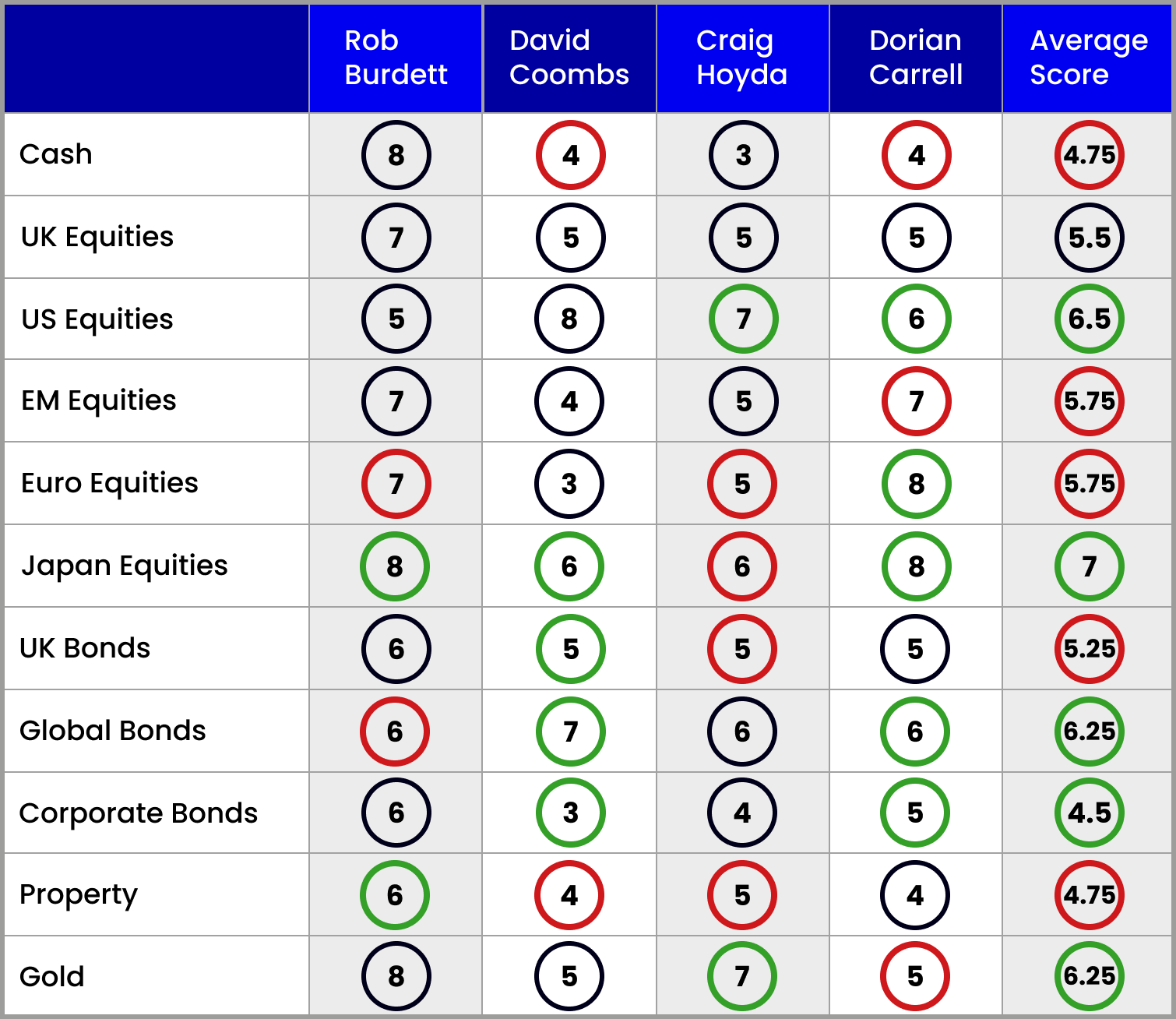
Note: the scorecard is a snapshot of views for the fourth quarter of 2026. How the panellists’ views have changed since the third quarter of 2026: red circle = less positive, green circle = more positive. Key to scorecard: EM equities = emerging market equities. 1 = poor, 5 = neutral and 9 = excellent.
Panellist profiles
Rob Burdett is head of multi-manager with Nedgroup Investments.
Dorian Carrell is head of multi-asset income at Schroders.
David Coombs is head of multi-asset investments at Rathbones.
Craig Hoyda is Investment Director at Aberdeen.
These articles are provided for information purposes only. Occasionally, an opinion about whether to buy or sell a specific investment may be provided by third parties. The content is not intended to be a personal recommendation to buy or sell any financial instrument or product, or to adopt any investment strategy as it is not provided based on an assessment of your investing knowledge and experience, your financial situation or your investment objectives. The value of your investments, and the income derived from them, may go down as well as up. You may not get back all the money that you invest. The investments referred to in this article may not be suitable for all investors, and if in doubt, an investor should seek advice from a qualified investment adviser.
Full performance can be found on the company or index summary page on the interactive investor website. Simply click on the company's or index name highlighted in the article.