Budget 2026: what might Burnham and Healey have in store?
With the chancellor set to step up to the despatch box in less than a month’s time, the rumour mill’s gears are starting to grind.
1st October 2026 14:44
by Rachel Lacey from interactive investor
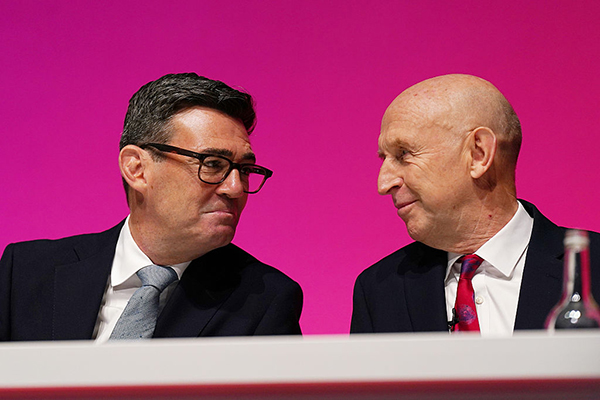
Prime Minister Andy Burnham and Chancellor John Healey at the Labour Party Conference in Liverpool. Photo by Ian Forsyth/Getty Images.
On 28 October, John Healey will deliver the first Budget under the premiership of Andy Burnham.
But while the chancellor and the prime minister might be remaining tight-lipped about what’s in store, speculation and rumours are circling against an increasingly tense backdrop.
- Our Services: SIPP Account | Stocks & Shares ISA | See all Investment Accounts
The latest borrowing figures make for grim reading. As a nation we owe just under £3 trillion. In August alone, we borrowed a staggering £18.3 billion - £3.5 billion more than anticipated.
And higher borrowing costs in combination with slower economic growth and the fallout from the war in Iran, are putting the chancellor in a tricky position – to put it mildly.
The government’s fiscal headroom – its financial buffer before it breaches its own rules for spending and borrowing – was recorded at £23.6 billion in spring earlier this year. But, since then it has plummeted and, by autumn, the chief economist at KPMG suggests that it could have halved to somewhere around the £12 billion mark.
That leaves the chancellor with very little wiggle room and means tax rises are likely to be very high on the agenda. But bound by a commitment not to increase taxes for working people, he’ll have to look beyond our pay packets and quite possibly towards our savings, property and investments.
With around a month to go, we look at some of the rumoured options Burnham and Healey will be weighing up.
Capital gains tax
The tax we pay on gains made on the likes of investments and second properties are an easy target for any chancellor.
The Telegraph recently reported that Labour donor, Dale Vince, was calling on the government to ease cost-of-living pressures by equalising capital gains tax (CGT) rates with income tax.
Vince’s submission suggests the move would raise as much as £14 billion a year – money that could be used to fund a £3,000 increase to the personal allowance and take the amount we can earn before we pay income tax to £15,570.
Former Labour leader Neil Kinnock, and Wes Streeting, the defence secretary, have also both previously signalled their support for aligning CGT with income tax.
The hike would see the tax paid on gains for basic-rate taxpayers jump from 18% to 20%, while higher and additional rate taxpayers would see their rates jump from 24% to 40% and 45% respectively.
But sceptics have pointed out that such a move would likely backfire as CGT revenues are heavily influenced by human behaviour; if tax rates increase too much, people are less likely to sell taxable assets.
- Will Burnham hike CGT to fund personal allowance rise?
- Record CGT receipts: what you need to know ahead of the Budget
In fact, even the government’s own workings have previously suggested that a significant increase to CGT rates would actually reduce the tax take.
But there could be a way to soften the blow.
The Telegraph has also reported that a big CGT hike could be countered with the reintroduction of indexation relief.
This would mean the impact of inflation on gains would be taken into account and reduce the size of the gain that’s subject to tax.
Property taxes
Since Burnham became prime minister in July, there has also been a lot of speculation around tax on property.
In 2025, former Chancellor Rachel Reeves announced the introduction of a new mansion tax in England. From April 2028, the levy will trigger a council tax surcharge for people with homes worth £2 million or more.
The charge would be linked to the value of your property and start at a fixed rate of £2,500 a year on properties valued between £2 million and £2.5 million.
Tax Policy Associates has predicted that the measure would raise in the region of £400 million.
However, over the last year, it has been mooted that Burnham could lower the threshold for the mansion tax to £1.5 million. According to Tax Policy Associates this would roughly double the number of homes affected from 123,000 to 245,000. It also estimates that revenue would double to £800 million.
Burnham has also been considering wider reforms to property tax, notably stamp duty and council tax.
It was thought that he might seek to replace both of these with a single flat rate of tax, based on a property’s value. However, it’s since been reported that the idea has been shelved – at least for the time being.
Pensions
Pensions have been clobbered in recent Budgets. In 2024, it was announced that unspent pension funds would become subject to inheritance tax (IHT) on death (assuming the total value of the estate, including pensions, exceeds the tax-free allowance).
Then in 2025, plans to limit salary sacrifice benefits on pension contributions from April 2029 were announced.
Further pension changes haven’t been grabbing headlines in the run up to this Budget, but those with big pensions may still be worried about the fate of their tax-free cash.
Currently savers can take 25% of their pension tax-free, up to a maximum of £268,275, and in recent years there’s been significant concern that this cap could be lowered.
- Wealth warning: when acting on rumours can cost you a fortune
- Burnham’s triple lock shake-up and what it could mean for pensioners
According to FCA data, in 2025-26, the value of tax-free lump sums taken out of pensions surged to £22,071 billion – an increase of over 20% on the previous year. And that increase has been widely attributed to fears that tax-free cash rules could be tightened.
But while taking tax-free cash a little earlier than planned may not be a big deal for some, those who wouldn’t otherwise have made a withdrawal have lost vital tax protection on their money and robbed themselves of the ability to take a larger slice in the future.
When recently quizzed by a Citywire reporter about potential changes to tax-free cash, Pension Minister Torsten Bell offered reassurance to savers, criticising the media in the process: “Some pension savers have been very badly let down by newspapers writing garbage and they should stop it because it has caused a lot of problems over the last few years. Some people have lost serious money.”
Inheritance tax
As mentioned above, from April next year unspent pension funds will be factored into IHT calculations.
It may be that we get more details on just how this will work in the next Budget, including the responsibilities of the deceased’s personal representatives who will need to handle the admin and arrange for the bill to be paid.
- The conversations that could slash your inheritance tax bill
- Pensions and IHT: the countdown to new tax rules has started
There is also the possibility of more tinkering around business property relief and agricultural property relief.
But while wholesale reform to IHT may not be on the cards just yet, Burnham has indicated that death duties are something he would like to look at.
ISAs
Significant changes to ISA rules have already been announced and are set to come into force in April next year.
Although the overall allowance will remain at £20,000, there will be new restrictions on how savings are allocated.
As part of plans to encourage investment, the maximum amount that can be held in cash ISAs will be capped at £12,000 unless you’re 65 or over. And, to try and stop people getting around the rule, uninvested cash paid in stocks and shares ISAs will be taxed at 22%. Savers will also not be able to invest their whole portfolio in a cash-like money market fund.
- What you need to know about ISAs and how they’ll soon change
- Sign up to our free newsletter for investment ideas, latest news and award-winning analysis
Further change is expected in 2028 when the Lifetime ISA looks set to be replaced by a first-time buyer ISA. Details are expected in due course (but not necessarily in the Budget) following a public consultation that ended in August
Staying calm
From increases to employer national insurance contributions and capital gains tax hikes to IHT on pensions and an extension the freeze on tax thresholds, Budgets in recent years have been particularly painful.
Gone are the days when you expect the chancellor to pull a rabbit out of their hat, and there are bigger things to worry about than what “sin” taxes will rise.
But making rash decisions – like selling investments or making pension withdrawals - based on what might be announced on 28 October could backfire.
The Budget, and all the tax talk that inevitably surrounds it, should instead be a timely reminder to focus on long-term tax planning. Making the most of ISA and pension allowances and thinking about how you structure your finances can, over time, substantially reduce the amount of tax that you need to pay.
And, if you have any immediate concerns, it makes sense to talk to a regulated financial adviser.
These articles are provided for information purposes only. Occasionally, an opinion about whether to buy or sell a specific investment may be provided by third parties. The content is not intended to be a personal recommendation to buy or sell any financial instrument or product, or to adopt any investment strategy as it is not provided based on an assessment of your investing knowledge and experience, your financial situation or your investment objectives. The value of your investments, and the income derived from them, may go down as well as up. You may not get back all the money that you invest. The investments referred to in this article may not be suitable for all investors, and if in doubt, an investor should seek advice from a qualified investment adviser.
Full performance can be found on the company or index summary page on the interactive investor website. Simply click on the company's or index name highlighted in the article.