How to protect your portfolio if the AI bubble bursts
Given many investors have tech exposure through investment trusts such as Polar Capital Technology and Allianz Technology Trust, a Kepler analyst suggests contrasting exposures to diversify your portfolio.
7th August 2026 14:00

This content is provided by Kepler Trust Intelligence, an investment trust focused website for private and professional investors. Kepler Trust Intelligence is a third-party supplier and not part of interactive investor. It is provided for information only and does not constitute a personal recommendation.
Material produced by Kepler Trust Intelligence should be considered a marketing communication, and is not independent research.
Ever since the roll-out of ChatGPT-3.5 in 2022, global equity markets have been heavily influenced by stocks seen as AI beneficiaries. This has resulted in markets with high-tech industry exposure, such as the US and Asia, delivering exceptional returns over the past few years.
However, this frenetic stock market rise has also led to increased speculation as to whether this is a stock market bubble, or whether the potential of AI is real. As a result, investors are torn as to whether to take some risk off the table from markets, or to stay the course and avoid missing out on future gains.
As most market commentators believe it is “time in the market”, rather than timing the market, that is the real determinant of long-term returns, we have considered several options for investors who wish to maintain their market exposure, while potentially finding some protection should this AI rally prove a bubble.
Stop me if you’ve heard this one before
One of the reasons for the bubble concern over this latest rally is the proximity of the most recent tech-led crash. Soon after the commercial internet boom in the late 1990s, the market went through what is now known as the dotcom bubble, where tech valuations rose dramatically as enthusiasm over future earnings potential grew massively, despite little evidence of profit. This hit fever pitch in early 2000, before going on to fall dramatically for over two years, as it became apparent many companies were trading at highly speculative valuations that future revenues would struggle to justify.
That said, many of those firms described as speculative are today’s industry leaders, including Amazon.com Inc (NASDAQ:AMZN) and Google (Alphabet Inc Class A (NASDAQ:GOOGL)), hence why some investors are keen to stay on board. Regardless, on a calendar-year basis, the tech-heavy Nasdaq index increased by over 20% in every year from 1995, culminating in a c. 86% climb in 1999 alone, before nearly losing 80% of its value in the two and a half years from the March 2000 peak.
There are clearly parallels with the current rally. Investor enthusiasm for AI and its potentially transformative impact has been strong, with rallies seen across multiple areas ranging from those deep in the supply chain to the owners of the front-end large language models (LLMs). In addition, the largest tech companies have been borrowing heavily to pay for the build-out required to support AI products and services, raising questions over its viability.
However, while there have been some areas of clear speculation, such as companies adding AI to their name and seeing an immediate jump in their share prices, many of the key beneficiaries are established firms with diversified business lines. The poster child for the AI rally is NVIDIA Corp (NASDAQ:NVDA), which has seen a share price total return of c. 1,000% over the past five years (to 26 July 2026). However, prior to this, the firm was highly profitable and growing. In the five years to 2021, before the AI rally hit the mainstream, the firm saw revenue growth of c. 30% per annum (pa), and profit growth of 48% pa, thanks in part to the strength of its gaming and home computing businesses.
Considering this, and the fact tech usage is unlikely to fall in the coming years, investors might want to stay invested in a tech fund run by an active manager alert to the valuation issues. This is true of both the two specialised trusts in the AIC Technology & Technology Innovation sector, Polar Capital Technology Ord (LSE:PCT) andAllianz Technology Trust Ord (LSE:ATT).
Ben Rogoff, lead manager of PCT, has leant heavily into the AI trade, positioning the trust to capitalise on its accelerated adoption, which has been very positive for returns. The trust has delivered one-year NAV total returns of c. 54%, and five-year returns of c. 150%, considerably ahead of its benchmark, the Dow Jones Global Technology Index, which returned c. 31% and 128% respectively, all to 28 July 2026. Ben has warned that the tech sector could see a spike in volatility as it has in the past, but remains convinced AI has demonstrated its potential to do real work and transform many sectors.
Meanwhile, Mike Seidenberg of ATT has been more circumspect on his large-cap AI exposure at times, not owning Amazon at all for the first time in decades and underweight six of the Magnificent Seven when we last updated our research on the trust in March. Instead, he has rotated into some mid-cap and off-benchmark positions in other areas, including many AI stocks with potential that hasn’t yet been recognised.
Some of these firms are the second-order beneficiaries of the AI spend, which is where many investors are now turning their attention, into the companies that are likely to capture the spending from the AI hyperscalers. This approach has paid off in the near term, with ATT having delivered a NAV TR of 40.8% over one year to 28 July 2026, versus 31.2% for the index. Mike’s wariness of valuations in the mega-caps may appeal to investors wanting to remain invested in the AI trade, while tilting away from the most expensive stocks.
ATT & PCT PERFORMANCE
| 1yr | 5yr | |
| ATT | 40.8 | 123.3 |
| PCT | 53.9 | 149.5 |
| Index | 31.2 | 128.3 |
Source: Morningstar. Past performance is not a reliable indicator of future results.
AI diversifiers
With the experts having different views about the next leg of the AI rally, the decision whether to stick or twist is challenging. However, rotating exposure within technology may have an air of shuffling deck chairs on the Titanic should the bubble burst on the AI rally have a serious effect, meaning investors may wish to look elsewhere for diversification.
One option could be to pair tech exposure with a trust where the manager is sceptical on AI valuations. An example of this is Nitin Bajaj and Ajinkya Dhavale, managers of Fidelity Asian Values Ord (LSE:FAS). Their process includes a strong focus on the price paid for a stock, aiming to buy good companies at a valuation that provides a margin of safety.
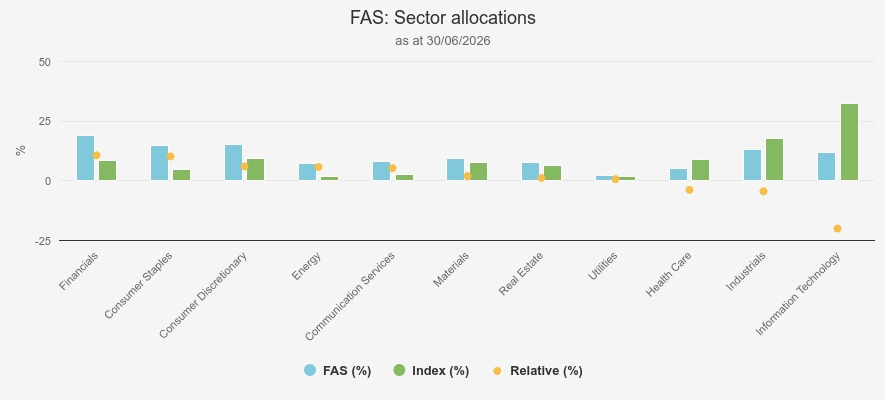
Following the strong run of AI-related tech companies, they note valuations are elevated and see limited attraction and, due to their highly flexible approach, have very little allocated to the tech sector. In fact, their stock picks here total just 11.8%, of which 6.7% is one holding, compared to 32% for their benchmark. As such, the positioning of FAS could almost be considered anti-tech, meaning it could offer investors the opportunity to stay invested in markets while steering away from the potential bubble of AI-related names.
FAS RELATIVE POSITIONING
Source: Fidelity.
While AI has pushed markets upwards for much of the past four years, there have also been some areas that have sold off sharply as investors have become fearful over the potential impact on revenues. The highest profile of these was the “SaaS-pocalypse” in early 2026, when the release of a new AI plug-in led to concerns that many software firms were at risk of disruption from AI.
However, a more overlooked area that has been impacted is India, due to its sizeable IT services industry. While the Indian growth story has stumbled for several reasons, as we discussed in a previous article, the potential impact of AI has pushed down the values of the country’s numerous IT servicing firms. Furthermore, the drivers of the Indian market are otherwise domestically focused, meaning the market is likely to offer portfolio-diversification benefits versus a tech holding, as well as potentially offering something of a hedge against the AI bubble, as AI’s diminishing prospects would likely see a relief rally in the country’s IT servicing names.
Full market diversifiers
While the options so far have offered specific diversification potential, there are several specialist trusts that could offer more protection from the AI bubble bursting, should this have contagion on wider markets.
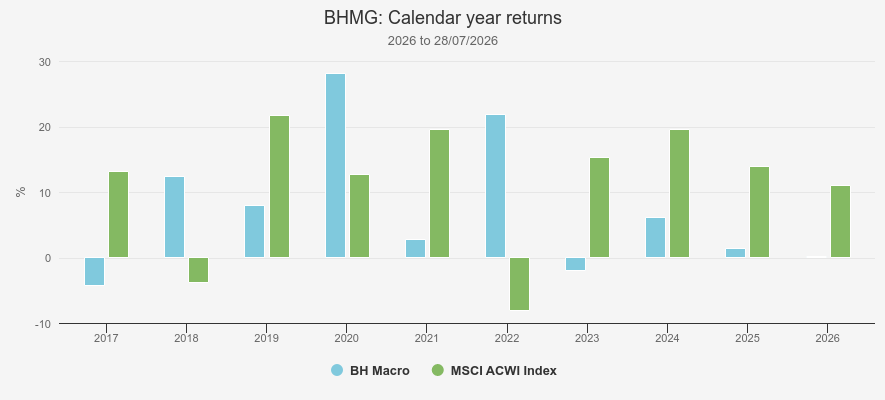
A key offering could be BH Macro GBP Ord (LSE:BHMG), with its track record having made it one of the go-to trusts for those looking for portfolio diversification. Some of the trust’s best performance periods have been when equity markets are struggling, and there is volatility, making it arguably very well suited as a way to protect and possibly profit from any wider market missteps that an AI pullback might cause. To this end, BHMG has delivered positive absolute returns in seven of the past nine calendar years, including a c. 22% return in 2022 when the market fell by 8%.
BHMG CALENDAR-YEAR RETURNS
Source: Morningstar. Past performance is not a reliable indicator of future results
The trust is a feeder fund into the flagship macro hedge fund strategy managed by Brevan Howard, one of the most successful firms in this space globally. Rather than investing specifically in equities or bonds, the strategy involves trading derivatives linked to global fixed-income and FX markets, as well as equity, credit, commodities, and digital assets. As such, the portfolio is designed to provide very low correlation to equity markets, which may prove very attractive for investors looking to diversify away from a potential AI-related pullback, while maintaining market exposure.
Despite the long-term track record of capital protection and absolute returns, the trust’s shares currently trade at a discount to NAV of c. 6%, meaning not only can investors access this unique strategy at a cheap price, but also potentially benefit from this discount narrowing should its qualities become more sought after by investors. We note that the trust traded at a premium in 2022, when the capital protection qualities proved highly attractive, further adding to the investment case as a potential option should there be an AI-led market pullback.
Bear beneficiaries
While the prospect of a tech-led market sell-off may invoke considerable fear amongst investors, it is worth noting that not all stocks fall in bear markets. In fact, between 20% and 50% of companies have historically risen in market sell-offs. It is in these areas where our next option, Global Opportunities Trust Ord (LSE:GOT), is focused. The three managers, Alan Bartlett, Dr Sandy Nairn, and James Sym, aim to generate real returns of c. 5% pa over the long term, with a strong focus on generating very low correlation to global markets, especially in market downturns.
The managers look at a number of themes to help them identify the types of stocks that can offer downside protection in tough environments, including those that can benefit from geopolitical or cyclical situations, such as defence firms, as well as those with the resilience to see them through the most challenging periods, such as Unilever (LSE:ULVR). Crucially, the managers have a strong focus on valuations, meaning they won’t overpay for these stocks, which means in the event of a market downturn, they should also offer valuation protection.
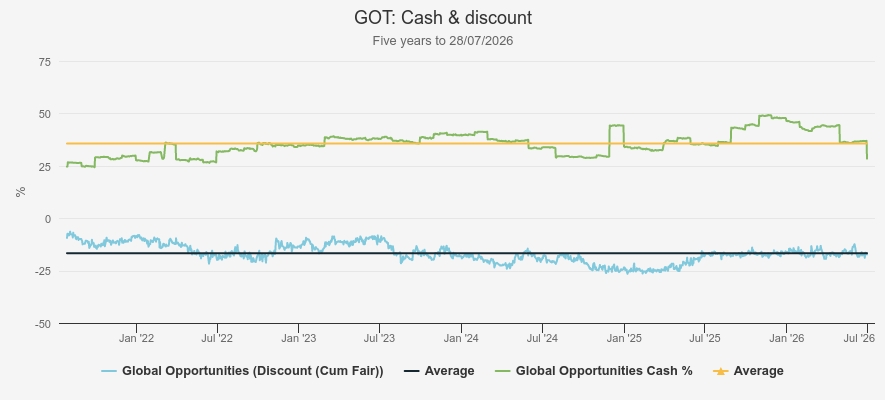
In addition to the portfolio’s defensive characteristics, the managers have considerable flexibility in their portfolio allocations. This is best demonstrated by GOT’s c. 28% in cash and equivalents at the moment, which would not only help buffer the NAV in any sell-off, but also give the managers flexibility to add to the market when it is considerably cheaper, so long as the characteristics they look for in stocks are present. This high cash level makes the trust’s discount to NAV of c. 20% as at 29 July 2026 look even more attractive at this point, providing investors a particularly compelling portfolio diversifier at very good value, in our view.
GOT DISCOUNT & CASH
Source: Morningstar.
Conclusion
Clearly, the latest AI-led tech rally has provided contrasting signals as to which direction the next leg could take, with the nagging desire to stay invested contrasting with the want to avoid a similar sell-off to what was seen in the dotcom bubble at the beginning of the century.
Fortunately, there are a number of investment trusts which can either offer diversification to existing exposures, or provide considerable portfolio protection through capitalising on the benefits of the closed-ended structure. It would be a brave investor to bet against the tech sector’s innovation, and managers in the space remain convinced there is huge potential for AI to deliver excellent financial returns.
However, valuations argue in favour of taking an active approach, in our view, while looking for some contrasting exposures to diversify could prove prudent given the rising volatility.
Kepler Partners is a third-party supplier and not part of interactive investor. Neither Kepler Partners or interactive investor will be responsible for any losses that may be incurred as a result of a trading idea.
These articles are provided for information purposes only. Occasionally, an opinion about whether to buy or sell a specific investment may be provided by third parties. The content is not intended to be a personal recommendation to buy or sell any financial instrument or product, or to adopt any investment strategy as it is not provided based on an assessment of your investing knowledge and experience, your financial situation or your investment objectives. The value of your investments, and the income derived from them, may go down as well as up. You may not get back all the money that you invest. The investments referred to in this article may not be suitable for all investors, and if in doubt, an investor should seek advice from a qualified investment adviser.
Full performance can be found on the company or index summary page on the interactive investor website. Simply click on the company's or index name highlighted in the article.
Important Information
Kepler Partners is not authorised to make recommendations to Retail Clients. This report is based on factual information only, and is solely for information purposes only and any views contained in it must not be construed as investment or tax advice or a recommendation to buy, sell or take any action in relation to any investment.
This report has been issued by Kepler Partners LLP solely for information purposes only and the views contained in it must not be construed as investment or tax advice or a recommendation to buy, sell or take any action in relation to any investment. If you are unclear about any of the information on this website or its suitability for you, please contact your financial or tax adviser, or an independent financial or tax adviser before making any investment or financial decisions.
The information provided on this website is not intended for distribution to, or use by, any person or entity in any jurisdiction or country where such distribution or use would be contrary to law or regulation or which would subject Kepler Partners LLP to any registration requirement within such jurisdiction or country. Persons who access this information are required to inform themselves and to comply with any such restrictions. In particular, this website is exclusively for non-US Persons. The information in this website is not for distribution to and does not constitute an offer to sell or the solicitation of any offer to buy any securities in the United States of America to or for the benefit of US Persons.
This is a marketing document, should be considered non-independent research and is subject to the rules in COBS 12.3 relating to such research. It has not been prepared in accordance with legal requirements designed to promote the independence of investment research.
No representation or warranty, express or implied, is given by any person as to the accuracy or completeness of the information and no responsibility or liability is accepted for the accuracy or sufficiency of any of the information, for any errors, omissions or misstatements, negligent or otherwise. Any views and opinions, whilst given in good faith, are subject to change without notice.
This is not an official confirmation of terms and is not to be taken as advice to take any action in relation to any investment mentioned herein. Any prices or quotations contained herein are indicative only.
Kepler Partners LLP (including its partners, employees and representatives) or a connected person may have positions in or options on the securities detailed in this report, and may buy, sell or offer to purchase or sell such securities from time to time, but will at all times be subject to restrictions imposed by the firm's internal rules. A copy of the firm's conflict of interest policy is available on request.
Past performance is not necessarily a guide to the future. The value of investments can fall as well as rise and you may get back less than you invested when you decide to sell your investments. It is strongly recommended that Independent financial advice should be taken before entering into any financial transaction.
PLEASE SEE ALSO OUR TERMS AND CONDITIONS
Kepler Partners LLP is a limited liability partnership registered in England and Wales at 9/10 Savile Row, London W1S 3PF with registered number OC334771.
Kepler Partners LLP is authorised and regulated by the Financial Conduct Authority.