ii view: Microsoft makes strong start to fiscal year
Already the corporate go-to for desk software and now selling use of its data centres to host their AI data. Buy, sell, or hold?
29th October 2026 16:30
by Keith Bowman from interactive investor
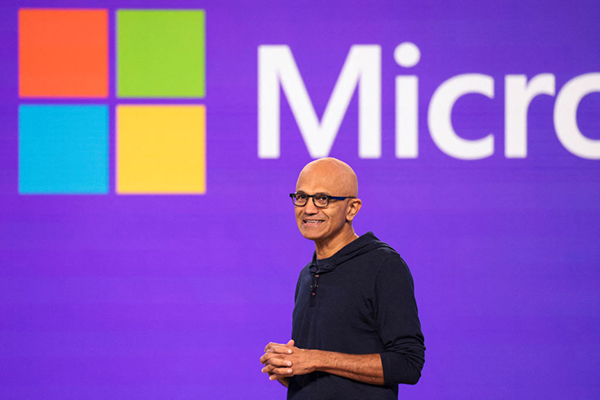
Microsoft CEO Satya Nadella. Photo: JASON REDMOND/AFP via Getty Images.
First-quarter results to 30 September
- Revenue up 19% to $92.28 billion (£69.2 billion) year-over-year
- Adjusted earnings per share (EPS) up 18% to $4.89
- Returned $10.2 billion to shareholders, unchanged from Q4
Chief Executive Satya Nadella said:
“We are delivering greater capability, choice, control, and cost efficiency for customers across our entire stack."
“By helping organizations build and own their own intelligence, and earning trust through agent safety and security, we are translating our innovation into growing adoption and real-world impact across every industry.”
- Invest with ii: Buy US Stocks from UK | Most-traded US Stocks | Cashback Offers
ii round-up:
Microsoft Corp (NASDAQ:MSFT) has reported quarterly sales and earnings that beat Wall Street hopes, with the tech giant forecasting accelerating growth for its cloud data centre business, hosting AI software for customers.
First-quarter sales up 19% to $92.28 billion (£69.2 billion) delivered earnings growth of 18% to $4.89 per share. Analysts had forecast outcomes of $90.7 billion and $4.73 per share. Growth for the Magnificent Seven company’s core Azure cloud data hosting business is expected by management to hit 49% to 50% during the current quarter, up from 48% in Q1.
Shares in the Dow Jones and Nasdaq 100 company rose 4% in post results trading, but then drifted into the red, having come into these latest numbers up around a tenth so far in 2026. That’s similar to fellow cloud data hosting business Amazon.com Inc (NASDAQ:AMZN) as well as the Dow Jones itself year-to-date. The Nasdaq 100 index is up 18%.
Microsoft operates across the two divisions of Agents & Infrastructure, which largely serves corporate customers and includes the data centre cloud business, and Devices & Consumer, covering individuals and the Xbox gaming business.
Sales for the largely corporate business rose 25% year-over-year to $76.8 billion including a 30% gain for the wider cloud operation to $63.9 billion.
Devices & Consumer sales fell 3% to $15.5 billion, with currency adjusted Xbox sales down 1% and Windows software and devices falling 22%.
Group-wide capital expenditure of $45.2 billion was up 30% from a year ago, with roughly three-quarters spent on computer chips. Analysts had forecast spend of $50.7 billion. Microsoft predicts the figure will exceed $50 billion in Q2.
The group returned $10.2 billion to shareholders during the period, unchanged from the fourth quarter.
Broker Morgan Stanley reiterated its ‘overweight’ stance on Microsoft shares and raised its fair value estimate to $650 per share from $600.
ii view:
Started in 1975 by Bill Gates and Paul Allen, Microsoft today competes against rivals like Google owner Alphabet Inc Class A (NASDAQ:GOOGL). Its home US market continued to account for most sales in its financial year to late July at 51.5%, with overseas sales the balance.
For investors, competition to host AI software on data centre servers for corporations is intense, with many players competing including International Business Machines Corp (NYSE:IBM) and Oracle Corp (NYSE:ORCL). The exact impact of AI on the Microsoft’s Windows software business remains difficult to predict. Supply constraints for items to build data centres were previously highlighted and likely hinder current capital expenditure, while adequate returns on this heavy spending are far from guaranteed.
- Polar Capital Technology: the AI stocks I’m excited about in cognitive era
- Fund Focus: what next for Seraphim space trust?
- Anthropic IPO: what UK investors need to know
On the upside, growth at the core Azure cloud data business continues to accelerate. Microsoft’s domination of corporate software via Windows and Office gives it an ongoing foot in the corporate door to sell other services such as cloud and security provision. Product and geographical diversity exist, while shareholder returns are made up of share buybacks and dividend yield near 1%.
On balance, and while risks remain, existing corporate software dominance and a consensus analyst fair value estimate above $600 per share look to give grounds for ongoing optimism.
Positives:
- Windows operating system holds a dominant market position
- Growing cloud business
Negatives:
- Uncertain economic outlook
- Political concern remains regarding the size and power of tech companies
The average rating of stock market analysts:
Buy
These articles are provided for information purposes only. Occasionally, an opinion about whether to buy or sell a specific investment may be provided by third parties. The content is not intended to be a personal recommendation to buy or sell any financial instrument or product, or to adopt any investment strategy as it is not provided based on an assessment of your investing knowledge and experience, your financial situation or your investment objectives. The value of your investments, and the income derived from them, may go down as well as up. You may not get back all the money that you invest. The investments referred to in this article may not be suitable for all investors, and if in doubt, an investor should seek advice from a qualified investment adviser.
Full performance can be found on the company or index summary page on the interactive investor website. Simply click on the company's or index name highlighted in the article.