ii view: Tesla Q2 profit misses forecasts by miles
Shares in this iconic electric vehicle maker have underperformed the Nasdaq tech index so far this year. Analyst Keith Bowman assesses prospects.
23rd July 2026 11:24
by Keith Bowman from interactive investor
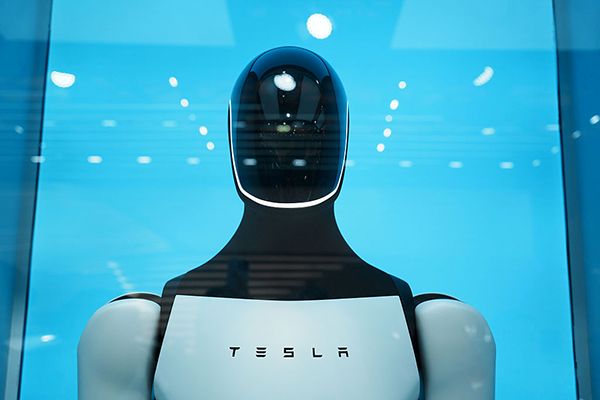
A Tesla Optimus humanoid robot at a Tesla store in China. Credit: CFOTO/Future Publishing via Getty Images.
Second-quarter results to 30 June
- Total revenue up 26% $28.23 to billion (£21.16 billion)
- Auto revenue up 23% to $20.5 billion
- Energy generation and storage revenue up 13% to $3.13 billion
- Services and other revenue up 50% to $4.75 billion
- Adjusted earnings down 18% to $0.33 per share
- Capital expenditure up 142% to $5.79 billion
ii round-up:
Tesla Inc (NASDAQ:TSLA) has reported mixed second-quarter results as Elon Musk’s electric vehicle (EV) manufacturer also continued to try and fortify its position as the leading robotics AI play.
Revenue in the three months to late June was up 26% from a year ago to $28.23 billion (£21.16 billion), exceeding analyst forecasts of $25.7 billion. Adjusted earnings fell 18% to $0.33 per share, weighed down by a 142% hike in capital expenditure and shy of Wall Street estimates of $0.51 per share.
Shares in the Nasdaq 100 company fell 5% in post US trading having come into these latest results down 17% so far in 2026. Only fellow Magnificent Seven company Microsoft Corp (NASDAQ:MSFT) has fallen more this year, retreating 19%. The Nasdaq 100 index is up almost 15% year-to-date with Mag7 firm Apple Inc (NASDAQ:AAPL) up 20%.
- Invest with ii: Buy US Stocks & Shares | US Earnings Season | Interactive investor Offers
As well as EVs, Tesla also makes a self-driving robotaxi, a self-driving lorry cab known as the Tesla Semi, as well as a humanoid-style robot called Optimus.
Robotaxi production began at the group’s Texas Gigafactory in April. The building of Optimus recently started at its California Freemont plant after it stopped producing Tesla ‘S’ and ‘X’ car models there. Production of Semi lorry cabs is due to begin later this year at its new Nevada factory.
Tesla highlighted increasing customer take-up of supervised but Full Self-Driving (FSD) abilities of Tesla cars during the quarter. Some 55% of customers across North America buying a new Tesla were opting to pay the required subscription. That’s ahead of analyst estimates of around 30%.
Tesla recently reported second-quarter vehicle deliveries (the nearest number the company gives to sales) of 480,126, a one-quarter increase from a year ago.
Revenues for things like vehicle servicing and charging rose 50% during the period to $4.75 billion. Sales of the group’s energy generation and storage systems climbed 13% from a year ago to $3.13 billion.
Broker Morgan Stanley reiterated its ‘overweight’ stance on the shares post the results but lowered its price target to $400 from $417.
ii view:
Started in 2003 by Martin Eberhard and Marc Tarpenning, Tesla today competes against automotive giants like Volkswagen AG (XETRA:VOW) and Ford Motor Co (NYSE:F). Geographically, the US dominated in 2025 with 50% of all revenues, followed by China at 22% and other markets including the UK the balance of 28%.
For investors, they'll want to see Tesla generate big returns on expected capital expenditure of $25 billion this year, including from robotaxis and robots. Rivals such as China’s BYD are now actively pushing their own competitively priced EVs, with BYD sales in 2025 outpacing Tesla. A forecast price-to-net asset value (NAV) of around 17 times compares to estimates for automotive rivals at under two times, suggesting the shares are not obviously cheap, while there's competition in the autonomous vehicles sector from the likes of Google owner Alphabet Inc Class A (NASDAQ:GOOGL) Waymo business.
- Where to invest in Q3 2026? Four experts have their say
- Have delayed mega-IPOs intensified pressure on AI funding?
- SpaceX: what Wall Street thinks the shares are really worth
- Top stocks to insulate your portfolio from AI volatility
More favourably, Tesla summarises its ambition as revolutionizing transportation, energy and productivity with products such as self-driving taxis and robots potentially generating significant profits in future. Concerns about climate change remain, with soaring energy prices following the war in the Middle East potentially underlining the cost benefits of driving EVs. Diversity of factories geographically and innovation in manufacturing techniques are aimed at reducing costs, while revenue generated from things other than cars has risen to 27% in Q2 from 14% in early 2023.
On balance, falling sales of the group’s core automotive products last year and increased investment in areas yet to make a profit offers caution. That said, investors are likely to remain interested in Tesla as a long-term play on physical AI, or robotics.
Positives:
- Climate change concerns persist
- Expanding network of superfast charging stations
Negatives:
- Rising competition from other manufacturers
- Potential regulatory hurdles for self-driving vehicles
The average rating of stock market analysts:
Strong hold
These articles are provided for information purposes only. Occasionally, an opinion about whether to buy or sell a specific investment may be provided by third parties. The content is not intended to be a personal recommendation to buy or sell any financial instrument or product, or to adopt any investment strategy as it is not provided based on an assessment of your investing knowledge and experience, your financial situation or your investment objectives. The value of your investments, and the income derived from them, may go down as well as up. You may not get back all the money that you invest. The investments referred to in this article may not be suitable for all investors, and if in doubt, an investor should seek advice from a qualified investment adviser.
Full performance can be found on the company or index summary page on the interactive investor website. Simply click on the company's or index name highlighted in the article.