Leading banks upgraded ahead of results season
With earnings season about to begin, will the UK banking sector finally close its valuation gap to European peers? Newly released price estimates point to City optimism.
14th July 2026 13:25
by Graeme Evans from interactive investor
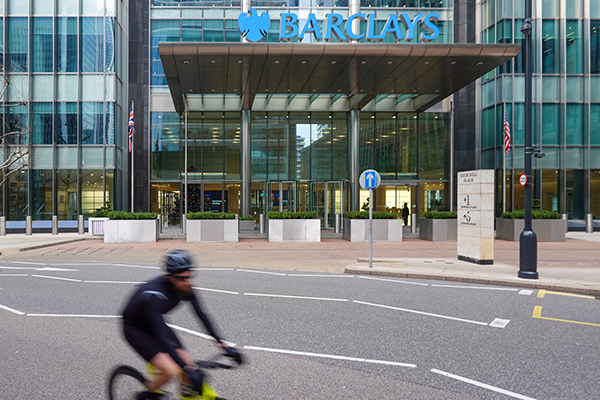
The entrance of the global headquarters of Barclays in Canary Wharf, London. Photo: Michael Nguyen/NurPhoto via Getty Images.
Price targets for Barclays (LSE:BARC) and Lloyds Banking Group (LSE:LLOY) were today sweetened by a City firm after its preview of the forthcoming earnings season highlighted an attractively valued sector.
UBS points out that UK domestic banks are generally cheaper and growing faster than the European sector average, boosted by low risk structural hedge tailwinds and good volumes.
- Our Services: SIPP Account | Stocks & Shares ISA | See all Investment Accounts
Although the bank does not expect second-quarter results to trigger material upgrades to near-term estimates, it thinks the season due to begin with Barclays on 28 July will highlight the appeal of growth prospects in relation to earnings and free cash flow.
It notes that UK domestic banks trade on an attractive multiple of 7.6 times forecast 2028 earnings, which is a 16% discount to the wider sector and 39% to the FTSE 100/Stoxx 600.
UBS said this explains why investors have been significantly overweight UK banks, with NatWest Group (LSE:NWG) and Barclays featuring alongside Rolls-Royce Holdings (LSE:RR.) and Next (LSE:NXT) among the top 10 most crowded stocks within the institution’s 2,000-strong European stock universe.
The City firm sees further 15% upside for Barclays shares after it lifted its price target from 570p to 590p. The shares have rallied by 30% since the end of March, boosted by expectations of a strong quarter for the company’s US investment banking operation.
Lloyds is seen adding 16% to 130p, which follows UBS’s upgrade from 115p after shares rallied from 92p at the end of March. Barclays shares trade with a forecast dividend yield of 2.9%, compared with 3.7% for Lloyds.
The Black Horse-branded lender reports second-quarter results on 30 July, when chief executive Charlie Nunn will also unveil the lender’s strategic targets up to 2030.
A step change in efficiency amid AI investment is likely to be the focus as Lloyds attempts to narrow the current 5% cost/income gap to its main listed domestic competitor NatWest.
UBS said: “We like the positive optionality we see in Lloyds going into this event given valuation, existing forecast earnings per share growth and the high degree of credibility we think investors assign to management's capacity to deliver on strategic targets.”
- Stockwatch: a major inflection point for these two shares?
- Valuable lessons learned from my 2026 share tip performance
- ii view: BP details $1bn write-down from low-carbon business
- eyeQ: UK mid-cap triggers bullish signal
Lloyds and the other lenders have been boosted in recent years by their use of structural hedges, which provide earnings visibility as maturing hedges are reinvested at current swap rates.
Investors will be looking to see how product spreads have been impacted by an increase in competitive intensity and the refinancing of Covid-era five year mortgage fixes.
UBS added that downside risks in the sector are predominantly around sovereign-level issues, like government tax and spend policies and the UK’s highest exposure to energy price shocks.
The bank also has a Buy position on NatWest, which is due to report results on 31 July. A price target of 770p represents an upside of 16%, with a forecast 2026 dividend yield of 5.4%.
Bank of America rates NatWest shares at 800p and Barclays at 615p, having recently increased its price targets across the sector by 3-5%. Asia-focused HSBC Holdings (LSE:HSBA) moved to 1,650p and Standard Chartered (LSE:STAN) to 2,250p, while Lloyds was kept at 130p following an earlier upgrade.
In its results preview published last week, the bank said it expects another good quarter for UK domestic banks after Bank of England data showed strong lending volumes in April.
It adds that the structural hedge will benefit from the higher-for-longer interest rate environment and that underlying trends for impairments are likely to remain benign.
BofA expects a relatively quiet quarter for NatWest, having completed a major acquisition in the wealth management sector at the end of the quarter.
- Six stocks that could double their dividend quickly
- Sign up to our free newsletter for investment ideas, latest news and award-winning analysis
- What’s going on in private markets and why it matters
- Top stocks to insulate your portfolio from AI volatility
The Lloyds strategy update will include new medium-term targets but BofA thinks it will be challenging for the UK’s largest retail bank to grow its balance sheet by materially above the market. “We see better opportunities in non-interest income, which has been growing at 8-10% per year in the last few years.”
On Barclays, BofA said it was impressed by the detail of February’s strategy update for the period up to 2028. “It has only been four months since the plan was announced, but arguably the operating environment is shaping up to be better than expected already.”
HSBC, which is due to report results on 4 August, is preferred over Standard Chartered.
BofA said: “We continue to think HSBC is well positioned in the current environment. Net interest income should continue to benefit from the strong deposit flows, and wealth should continue to perform strongly.
“In addition, we think there is upside from loan growth - given the latest data from Hong Kong suggesting a substantial pickup in loan demand.”
These articles are provided for information purposes only. Occasionally, an opinion about whether to buy or sell a specific investment may be provided by third parties. The content is not intended to be a personal recommendation to buy or sell any financial instrument or product, or to adopt any investment strategy as it is not provided based on an assessment of your investing knowledge and experience, your financial situation or your investment objectives. The value of your investments, and the income derived from them, may go down as well as up. You may not get back all the money that you invest. The investments referred to in this article may not be suitable for all investors, and if in doubt, an investor should seek advice from a qualified investment adviser.
Full performance can be found on the company or index summary page on the interactive investor website. Simply click on the company's or index name highlighted in the article.