New target for Rolls-Royce and dividend surprise from M&S
A FTSE 100 fightback enters a second session, this time led by two very popular stocks. City writer Graeme Evans explains what’s triggered the rally.
10th November 2026 12:57
by Graeme Evans from interactive investor
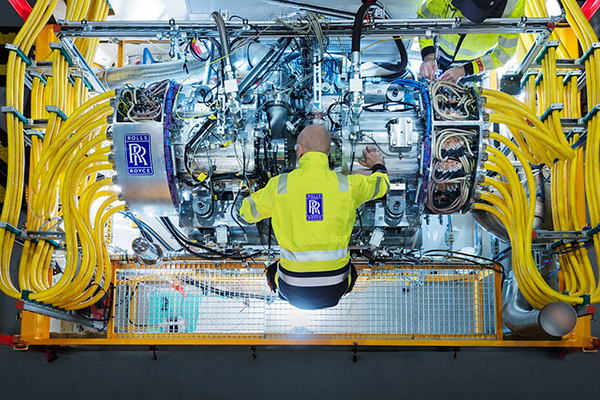
A Rolls’ employee beside a Power Generation System 1 (PGS1) hybrid-electric aerospace propulsion demonstrator. Credit: Rolls-Royce via Flickr.
A dividend surprise and 11-year high for Marks & Spencer Group (LSE:MKS) shares today cheered 100,000 retail investors as Rolls-Royce Holdings (LSE:RR.) also returned to form at the top of the FTSE 100 index.
M&S rallied 13.4p to 451p after the high street chain laid out its medium-term ambitions, including plans to double the 2026-27 dividend to a bigger-than-expected 8.4p a share.
- Invest with ii: Top UK Shares | How to Start Trading Stocks | Open a Trading Account
The highest price for M&S shares since December 2015 came as a largely positive session for blue-chip investors left the FTSE 100 index 3% higher than Friday lunchtime.
Rolls-Royce shares have risen 10% over that period after the outlook for engine flying hours was boosted by a sharp fall back in the Brent crude price to $90 a barrel.
The run was also influenced by the rebound of tech valuations as Rolls’ strongly performing Power Systems division has been the beneficiary of strong data-centre demand.
Shares were as high as 1,586p in early August, but Bank of America sees the potential for a fresh record of 1,625p after updating its projections ahead of a trading update on Thursday.
The bank’s new estimates include a more cautious forecast on this year’s large engine flying hours at 113% of 2019’s level, which is below the company’s 115-120% guidance.
It has also increased its retirement assumptions across the RB211, Trent 700, Trent 800 and Trent 900 fleets to about 150 engines per annum over 2026-31. However, the bank still sees the large engine base growing at a compound rate of 5.3% over that period.
The bank said on Monday: “Despite the softer 2026 due to the Iran war, we see a young and growing fleet of engines that will support a recovery in flying-hour growth from 2027 despite accelerating legacy retirements.”
It is also more cautious about the outlook in Power Systems, given the risk of pricing pressures caused by a slower data-centre buildout.
The bank lowered its free cash flow estimates by 6.9% for 2028-2030 and trimmed its price target from 1,850p, driven by the de-rating of aftermarket peers on the back of high oil prices.
- Vodafone upgrades boost confidence in transformation strategy
- eyeQ: Antofagasta, Rio Tinto, BMW, Diageo
- Insider: directors predict recovery at Lloyds Bank and Haleon
Rolls last updated investors at half-year results on 30 July, when guidance for 2026 underlying operating profit rose to £4.7 billion-£4.9 billion and free cash flow to £3.8 to £4 billion. It also announced a 6p a share dividend, which was paid to shareholders on 18 September.
The latest Marks & Spencer dividend was declared at last week’s half-year results, when the retailer said the award due for payment on 8 January will increase by 16.7% to 1.4p a share. This is equivalent to one-third of the prior year’s total.
However, M&S today signalled at a presentation in the City that next summer’s annual distribution will be 7p, up from the 3p a share paid on 10 July.
The big increase has been made possible by the restoration of the M&S balance sheet to an investment-grade rating.
It said today: “With free cash flow expected in each of the next three years, M&S has the resilience and flexibility to invest for growth while increasing returns to shareholders.
“Maintaining a strong balance sheet and investment-grade credit rating remain priorities.
“Within this context, the full year 2026-27 dividend will double to 8.4p from 4.2p. Thereafter, it is intended that dividends will grow at least in line with earnings over time.”
Morgan Stanley said the proposed figure was better than City expectations of 6.7p and suggested an approximate 25% payout ratio versus earnings per share.
It added: “The overall yield is still symbolic at about 2%, but in our view the announcement signals free cash flow/balance sheet confidence and should be helpful in narrowing the risk premia of the stock, considering the price/earnings multiple for 2028 is still below 11 times.”
The bank said that other targets at today’s Capital Markets Day were “characteristically conservative” and in line with its expectations.
Building on the stronger foundations of recent years, M&S reiterated its ambition to deliver mid-to-high single-digit sales growth over the medium term.
Headline margin guidance came in lower than the City’s 2028 consensus, with M&S looking for 5% in Food and more than 10% in the Fashion, Home and Beauty division.
However, Morgan Stanley said this needed to be set against the need to retain flexibility for future growth.
- Stockwatch: why I’d buy the drop in this FTSE 250 share
- Sign up to our free newsletter for investment ideas, latest news and award-winning analysis
- Share Sleuth: two firms, one decision, and a surprise
At last week’s interim results, the Food arm’s adjusted operating margin came in at 5.6% as like-for-like sales growth of 11.7% helped to power an operating profit of £288.6 million.
The Fashion, Home and Beauty margin of 7.5% contributed to a profit of £150.5 million, below 2024’s £243.4 million when the margin was 12%.
The shares have recovered strongly since last year’s cyber-attack disruption, including a 36% rise so far in 2026.
Morgan Stanley has a price target of 488p, while Deutsche Bank moved to 470p in the wake of last week’s results.
Dividend payments resumed in January 2024 after a four-year absence when M&S handed over 1p a share worth £20 million.
However, M&S loyalists among the 100,000 or so retail investors will recall shares being above 500p in 2015 and sharing a dividend pot worth £375 million the following year.
The total payout had been 18.7p in the 2017 and 2018 financial years before the decision in February 2019 to reduce the award by 40% to a more “sustainable” level.
These articles are provided for information purposes only. Occasionally, an opinion about whether to buy or sell a specific investment may be provided by third parties. The content is not intended to be a personal recommendation to buy or sell any financial instrument or product, or to adopt any investment strategy as it is not provided based on an assessment of your investing knowledge and experience, your financial situation or your investment objectives. The value of your investments, and the income derived from them, may go down as well as up. You may not get back all the money that you invest. The investments referred to in this article may not be suitable for all investors, and if in doubt, an investor should seek advice from a qualified investment adviser.
Full performance can be found on the company or index summary page on the interactive investor website. Simply click on the company's or index name highlighted in the article.