Share Sleuth: two firms, one decision, and a surprise
With a small cash pile, Richard Beddard examines two shares his Decision Engine’s flagging as contenders to exit the portfolio.
6th November 2026 15:01
by Richard Beddard from interactive investor

Last month, I topped up Share Sleuth’s holding in (Hollywood Bowl Group (LSE:BOWL), simultaneously emptying the portfolio of cash.
Last Monday, when I was considering what, if anything, to trade, the portfolio’s cash balance was £899. The minimum trade size (2.5% of the portfolio’s total value) was £5,862.
Consequently, I needed to reduce or liquidate a holding before I could make any additions.
- Invest with ii: Open a Low Cost SIPP | What is a SIPP | Interactive investor Offers
Cohort: overweight by a sliver
The Decision Engine was nudging me to reduce my holding in Cohort (LSE:CHRT).
| # | company | score | qual | price | ih% | ss% | ih%-% | Last trade | AR date |
| 10 | Cohort | 6.2 | 7.5 | -1.3 | 2.5% | 5.1% | -2.6% | 06/01/26 | 15/07/26 |
Click on a share's score to see a breakdown (scores may have changed due to movements in share price). Key: qual is the share’s score out of 9 for the three quality factors (capabilities, risks, and strategy), price is the price score from -3 to +1, ih% is the suggested ideal holding size as a percentage of the total value of a diversified portfolio, ss% is the actual size of Share Sleuth’s holding, and ih%-% is the difference between ideal and actual sizes. Annual report dates may not have been confirmed by the company.
Cohort has a quality score of 7.5, which is above the median quality score of 7. Its price score of -1.3 drags its total score down to 6.2, which equates to an ideal holding size of 2.5%.
Share Sleuth’s holding is worth 5.1% of its total value. My algorithm tells me to consider reducing a holding if it is more than 2.5% of the portfolio’s total value (the minimum trade size) greater than the ideal holding size, so at 2.6%, the nudge was triggered by the smallest of margins.
I was not in a particular hurry to offload Cohort. I have long been impressed by the company. It is a gaggle of defence technology businesses, and we can all see the pressure on governments to lift defence spending.
I added more shares only last January.
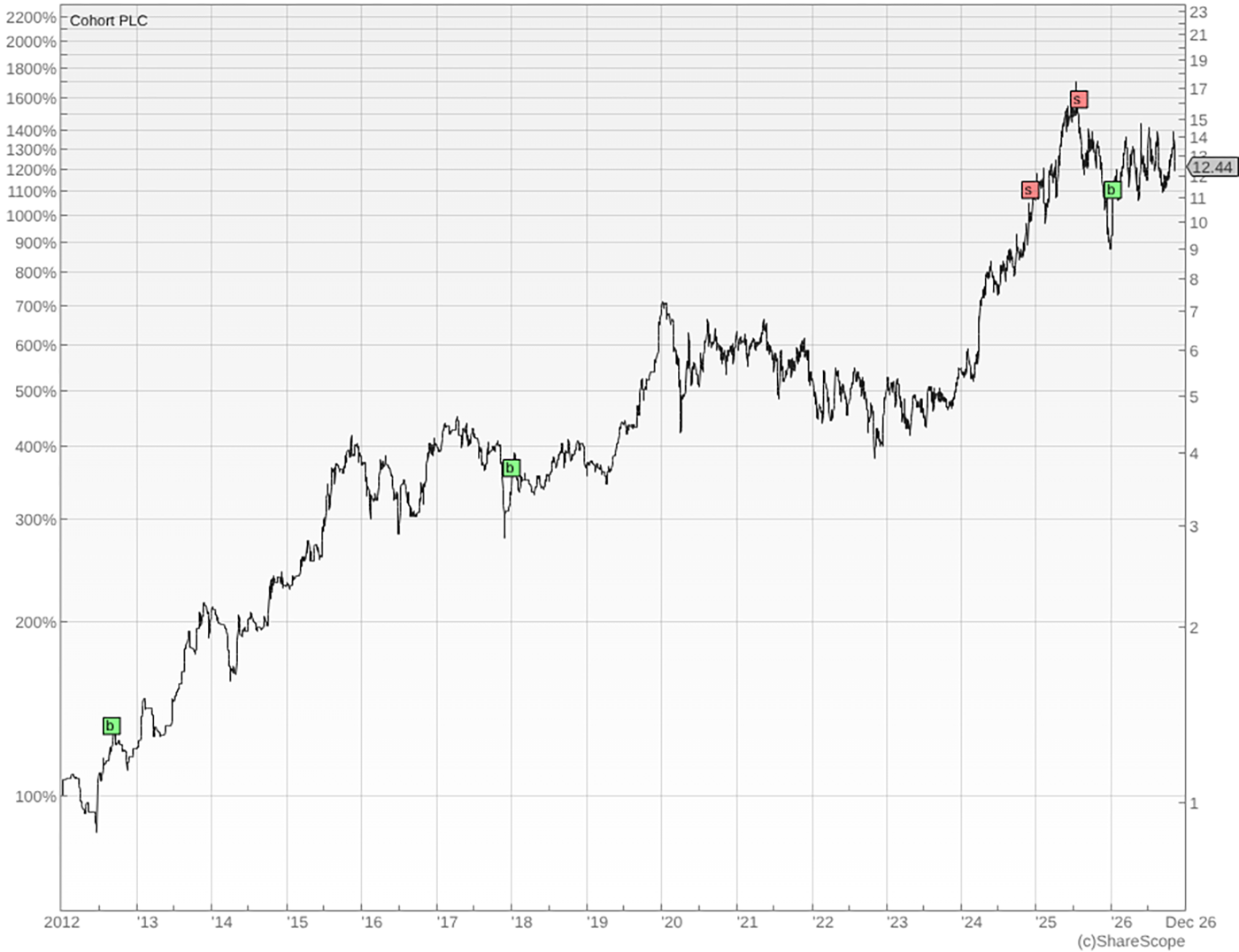
Share Sleuth has held Cohort shares continuously since 2012. “b” indicates the initial purchase or top-up, “s” indicates a reduction in the holding. Past performance is not a guide to future performance.
Although Cohort was the only over-represented share in the portfolio, there was another category of holding I could tap first: shares that perhaps should not be members of the portfolio at all.
Liquidation candidates
These are the businesses that I am least confident in. Those that have the lowest quality scores.
Share Sleuth includes eight shares with quality scores below the median:
| # | company | score | qual | price | ih% | ss% | ih%-% | Last trade | AR date |
| 20 | Advanced Medical Solutions | 6.2 | 6.5 | -0.3 | 2.5% | 2.4% | 0.1% | 19/07/23 | 18/03/26 |
| 21 | Softcat | 6.2 | 6.5 | -0.3 | 2.5% | 2.7% | -0.2% | 29/07/26 | 14/10/26 |
| 22 | Renishaw | 4.5 | 6.5 | -2.0 | 2.5% | 2.7% | -0.2% | 24/04/26 | 23/09/26 |
| 23 | Churchill China | 7.0 | 6.0 | 1.0 | 4.0% | 2.4% | 1.6% | 14/06/24 | 13/04/26 |
| 24 | Jet2 | 7.0 | 6.0 | 1.0 | 4.0% | 5.0% | -1.0% | 25/09/25 | 08/07/26 |
| 28 | Goodwin | 5.2 | 6.0 | -0.8 | 2.5% | 2.3% | 0.2% | 21/01/26 | 28/08/26 |
| 29 | Macfarlane | 6.5 | 5.5 | 1.0 | 3.0% | 2.7% | 0.2% | 30/06/25 | 26/02/26 |
| 30 | Focusrite | 6.0 | 5.0 | 1.0 | 2.5% | 2.0% | 0.5% | 01/02/24 | 29/06/26 |
Click on a share's score to see a breakdown (scores may have changed due to movements in share price). Key: qual is the share’s score out of 9 for the three quality factors (capabilities, risks, and strategy), price is the price score from -3 to +1, ih% is the suggested ideal holding size as a percentage of the total value of a diversified portfolio, ss% is the actual size of Share Sleuth’s holding, and ih%-% is the difference between ideal and actual sizes. Annual report dates may not have been confirmed by the company.
Liquidation is painful, and consequently I avoid thinking about it. But, to improve the portfolio I must consider that however much I once liked these businesses, my opinions, as quantified by their quality scores, have changed. Perhaps some of them are no longer fit for purpose.
That purpose is to buy and hold shares that I am confident will make money through thick and thin for the benefit of everyone.
Instinctively, I was drawn to the top and the bottom of the list.
Advanced Medical Solutions Group (LSE:AMS) is, in one sense, the least attractive of the eight because it has the highest score. But it is almost certainly exiting the portfolio regardless of my deliberations.
Shareholders agreed to sell the company to HB Fuller in August and the newsflow since then has confirmed that the deal is on track to complete before the end of the financial year in December. The share price has crept up in microscopic increments as it gets closer to the offer price of 285p.
- Stockwatch: can this housebuilder overcome sector challenges?
- The Income Investor: the dividend outlook for BP
The spread on Monday 2 November was 282.5-283p. By holding on to AMS for up to two months, I will save the portfolio about £59 (3p spread multiplied by 1,965 shares) plus the £10 per trade I deduct in lieu of broker fees.
It is not much of a saving but selling AMS felt like a non-decision, since in all probability the holding will be liquidated anyway.
Focusrite (LSE:TUNE) was a much meatier decision. Crystalised by liquidation, it would be my biggest error since Metalrax went bust in 2013. Perhaps it would be an even bigger error, considering I invested three times in Focusrite during its prolonged share price crash.
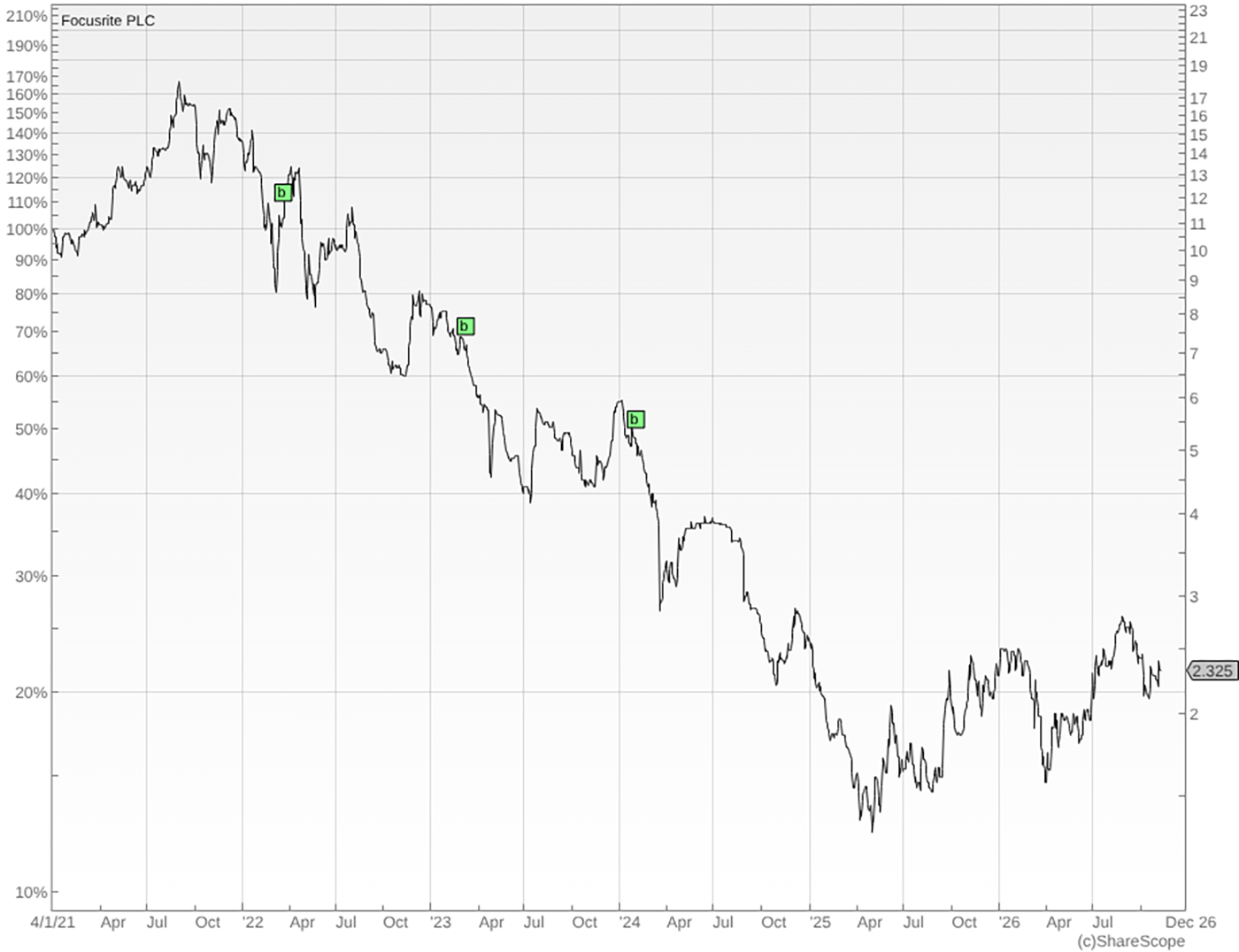
Share Sleuth has held Focusrite shares continuously since 2023. “b” indicates the initial purchase or top-ups. There have been no reductions. Past performance is not a guide to future performance.
Re-reading my write-up in July, I could see why I buried my head in the sand. To me, the company had turned into something beyond sufficient comprehension.
The pandemic, subsequent geopolitical turmoil, and a simultaneous slew of acquisitions had made a mess of the numbers before the company rendered them even more inexplicable by changing its year end.
At the new year end in February 2026, Focusrite was a much less profitable business than it was before the pandemic in terms of return on capital. I questioned management’s handling of admittedly extreme events.
Yet four things kept me from liquidating the share.
- The company’s biggest product, the Scarlett audio interface, remains very popular, and the company’s reputation with musicians and its own staff remains high
- Focusrite eased off acquisitions before it had ruined itself with debt and new strategic initiatives focus the company internally
- The pro-forma results for the new financial year showed Focusrite may have stabilised. After-tax return on capital was 10%, which just about exceeds my minimum threshold for prospering through thick and thin
- The company had appointed Ian Barkshire to replace its founder as chair.
Ian Barkshire impressed me when he was chief executive of Oxford Instruments, another portfolio member, because his tenure stabilised the business after an acquisitive period and grew it organically.
Perhaps his selection is an indication of Focusrite’s direction. Encouragingly, he bought shares worth £175,000 in June.
Sitting on my hands
My decision was delayed by events. On 3 November, Focusrite published its half-year results.
There were no surprises. The company is confident it will achieve analysts’ forecasts for the year to February 2026. The consensus implies some growth, perhaps 4% in revenue and a 10% increase in adjusted operating profit growth at the mid point of the range of forecasts.
- Three ways interest rate hike to 4% could affect your finances
- Sign up to our free newsletter for investment ideas, latest news and award-winning analysis
I surprised myself. On 3 November I gave Focusrite a reprieve. The trouble with delaying decisions is marginal trades like Cohort can disappear in small price movements. The Decision Engine was no longer nudging me to reduce Cohort (but only by a smidgen). I could have traded it anyway, but as I said, I’m not in a hurry.
After all the deliberations, I’m sitting on my hands. Next month if I want to acquire shares, I have laid the groundwork. Cohort may be in the frame again, I may have other options, and failing all else I can dump AMS early at little cost.
Share Sleuth performance
At the close on 3 November, Share Sleuth was worth £235,089, 684% more than the £30,000 of pretend money we started with in September 2009.
The same amount invested in accumulation units of a FTSE All-Share index tracking fund would be worth £118,913, an increase of 296%.
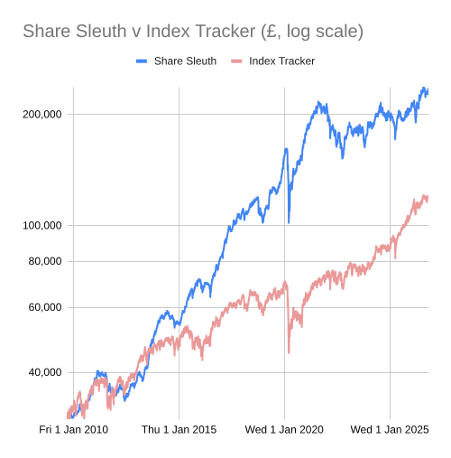
Past performance is not a guide to future performance.
After dividends paid during the month from Churchill China (LSE:CHH), Goodwin (LSE:GDWN), Jet2 Ordinary Shares (LSE:JET2), Keystone Law Group Ordinary Shares (LSE:KEYS), and Macfarlane Group (LSE:MACF), Share Sleuth’s cash pile is £899.
The minimum trade size, 2.5% of the portfolio’s value, is £5,877.
| Share Sleuth, 03 Nov 2026 | Cost (£) | Value (£) | Return (%) | ||
| Cash (0% of portfolio) | 899 | ||||
| Current holdings (27 shares) | 234,190 | ||||
| Total, and performance since 9 September 2009 | 30,000 | 235,089 | 684 | ||
| Benchmark: FTSE All-Share index tracker (acc) | 30,000 | 118,913 | 296 | ||
| Companies | Shares | Cost (£) | Value (£) | Return (%) | |
| AMS | Advanced Medical Solutions | 1,965 | 4,503 | 5,551 | 23 |
| ANP | Anpario | 1,124 | 4,057 | 5,923 | 46 |
| BMY | Bloomsbury | 1,007 | 5,002 | 6,656 | 33 |
| BNZL | Bunzl | 417 | 9,798 | 11,943 | 22 |
| BOWL | Hollywood Bowl | 6,303 | 16,102 | 18,090 | 12 |
| CBOX | Cake Box | 3,041 | 5,879 | 5,215 | -11 |
| CHH | Churchill China | 1,495 | 17,228 | 5,532 | -68 |
| CHRT | Cohort | 836 | 6,315 | 11,386 | 80 |
| FAN | Volution | 830 | 5,151 | 5,370 | 4 |
| FOUR | 4Imprint | 116 | 2,251 | 5,234 | 132 |
| GAW | Games Workshop | 66 | 4,116 | 10,421 | 153 |
| GDWN | Goodwin | 36 | 871 | 5,465 | 528 |
| HWDN | Howden Joinery | 1,476 | 10,371 | 12,177 | 17 |
| JET2 | Jet2 | 822 | 5,211 | 11,944 | 129 |
| KEYS | Keystone Law | 1,024 | 5,550 | 7,864 | 42 |
| LTHM | James Latham | 1,150 | 14,437 | 12,190 | -16 |
| MACF | Macfarlane | 7,689 | 10,011 | 6,213 | -38 |
| OXIG | Oxford Instruments | 505 | 10,044 | 13,120 | 31 |
| PRV | Porvair | 906 | 4,999 | 7,937 | 59 |
| QTX | Quartix | 1,618 | 3,988 | 3,600 | -10 |
| RNWH | Renew Holdings | 1,310 | 9,804 | 13,886 | 42 |
| RSW | Renishaw | 117 | 3,698 | 6,166 | 67 |
| SCT | Softcat | 382 | 5,508 | 6,158 | 12 |
| SOLI | Solid State | 5,009 | 6,033 | 8,515 | 41 |
| TFW | Thorpe (F W) | 6,153 | 14,861 | 17,044 | 15 |
| TSTL | Tristel | 1,432 | 5,509 | 5,742 | 4 |
| TUNE | Focusrite | 2,020 | 14,128 | 4,848 | -66 |
Notes
Costs include £10 broker fee, and 0.5% stamp duty where appropriate
Cash earns no interest
Dividends and sale proceeds are credited to the cash balance
Objective: To beat the index tracking fund handsomely over five year periods
Source: ShareScope.
Richard Beddard is a freelance contributor and not a direct employee of interactive investor.
Richard owns all the shares in the Share Sleuth portfolio.
For more on the Decision Engine and Share Sleuth, please see Richard’s explainer.
Contact Richard Beddard by email: richard@beddard.net or on Twitter: @RichardBeddard
AIM stocks tend to be volatile high-risk/high-reward investments and are intended for people with an appropriate degree of equity trading knowledge and experience.
These articles are provided for information purposes only. Occasionally, an opinion about whether to buy or sell a specific investment may be provided by third parties. The content is not intended to be a personal recommendation to buy or sell any financial instrument or product, or to adopt any investment strategy as it is not provided based on an assessment of your investing knowledge and experience, your financial situation or your investment objectives. The value of your investments, and the income derived from them, may go down as well as up. You may not get back all the money that you invest. The investments referred to in this article may not be suitable for all investors, and if in doubt, an investor should seek advice from a qualified investment adviser.
Full performance can be found on the company or index summary page on the interactive investor website. Simply click on the company's or index name highlighted in the article.
Disclosure
We use a combination of fundamental and technical analysis in forming our view as to the valuation and prospects of an investment. Where relevant we have set out those particular matters we think are important in the above article, but further detail can be found here.
Please note that our article on this investment should not be considered to be a regular publication.
Details of all recommendations issued by ii during the previous 12-month period can be found here.
ii adheres to a strict code of conduct. Contributors may hold shares or have other interests in companies included in these portfolios, which could create a conflict of interests. Contributors intending to write about any financial instruments in which they have an interest are required to disclose such interest to ii and in the article itself. ii will at all times consider whether such interest impairs the objectivity of the recommendation.
In addition, individuals involved in the production of investment articles are subject to a personal account dealing restriction, which prevents them from placing a transaction in the specified instrument(s) for a period before and for five working days after such publication. This is to avoid personal interests conflicting with the interests of the recipients of those investment articles.