Stockwatch: why I’d buy the drop in this FTSE 250 share
A four-month rally worth 50% has partially reversed, but analyst Edmond Jackson continues to back this mid-cap company amid talk of an inflection point.
10th November 2026 10:07
by Edmond Jackson from interactive investor

In a trading update on 5 November, Harbour Energy (LSE:HBR) raised its 2026 free cash flow expectation by a massive 44% to $2.6 billion (£1.9 billion) aided by high oil prices and a 9% increase in production to 501,000 barrels of oil equivalent per day (boepd) in the third quarter.
Yet the FTSE 250 shares actually fell 5% in response on Friday as Brent crude oil fell below $97 a barrel and stock markets turned red, perhaps showing how oil & gas investors need a favourable commodity tailwind besides operational progress.
- Invest with ii: Open a Low Cost SIPP | What is a SIPP | Interactive investor Offers
With the obvious caveat about whether forecasts are sound in this kind of environment, at 265p currently, Harbour is on a forward price/earnings (PE) ratio of just over 4x, and implied free cash flow per share of 173 cents (129p) gives a cash flow multiple of about 2x. A prospective yield of 6.5% would be covered nearly 7.5x on a cash flow basis.
Divining oil price prospects is tricky
Yesterday, Harbour shares actually firmed 1.4% to 266p despite a near 4% fall in Brent to about $93 a barrel, as if helped by the wider stock market rebound. Oil is down to about $90 this morning as traders react to fresh diplomatic efforts between the US and Iran. Quite what they will achieve is unclear, but US President Donald Trump also dialled down his rhetoric, saying he was “highly unlikely” to order new strikes on Iran should talks progress, including around the re-opening of the Strait of Hormuz.
Anyway, Harbour shares have at least stopped falling in the very short term despite another drop in oil, as if the market senses the oil drop is priced in.
If charting is meaningful, a decline from 308p since late October brings Harbour shares back to an upward trend line since April 2025, although you could also say they have traded volatile-sideways since 2023:
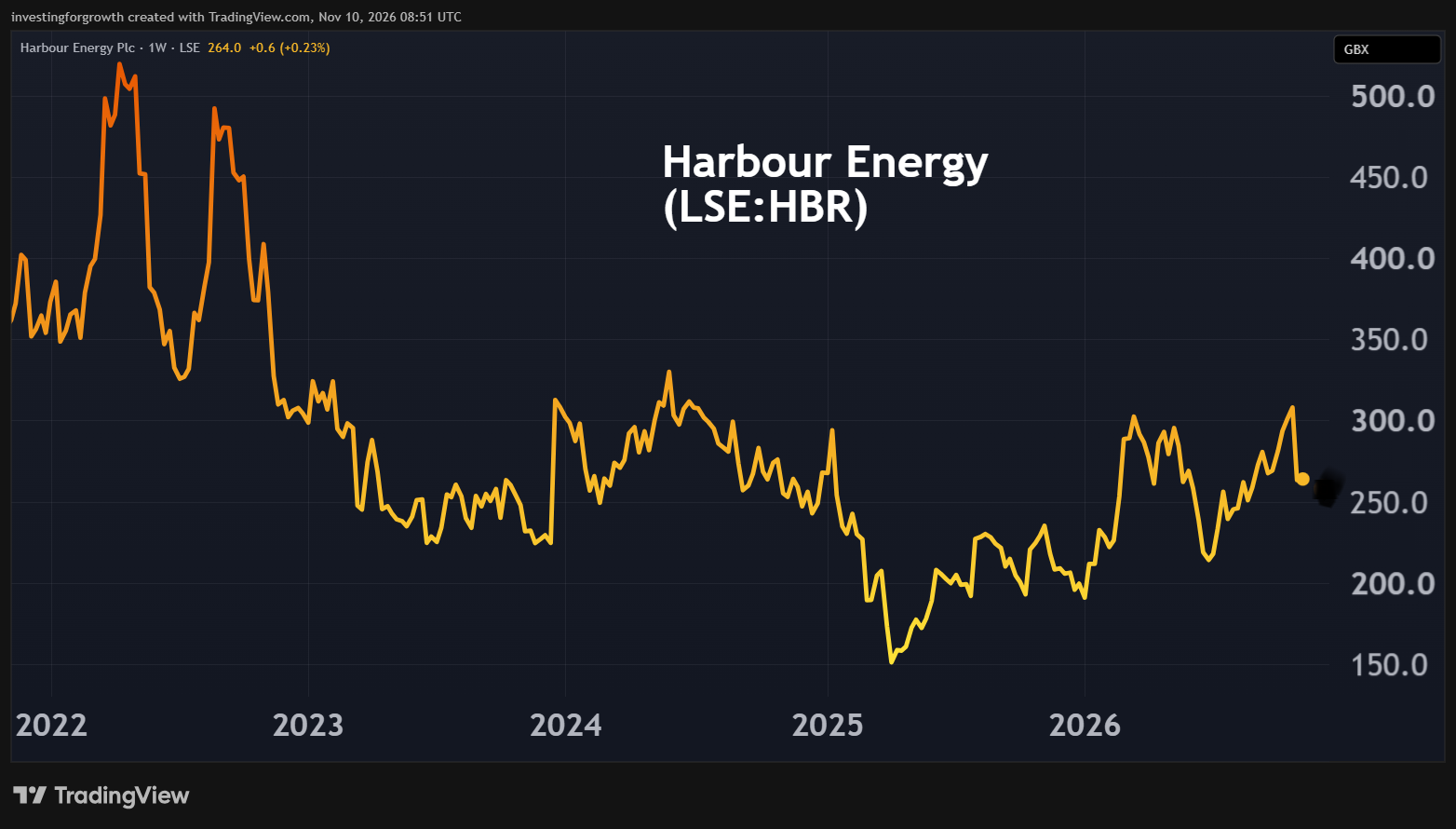
Source: TradingView. Past performance is not a guide to future performance.
If the Democrat sweep of Congress in the US midterm elections means war with Iran is likely to wane, that would leave the Strait of Hormuz with steep tolls.
The hope would be that Gulf state oil exporters can continue to shift to overland pipelines (and avoid sabotage) by which means about 40% of oil exported from there now bypasses the strait compared with 17% before the escalation. Some 29% of liquefied petroleum gas (LPG) passes the strait, and 90% of India’s LPG imports rely on this route, so it’s unclear where prices will settle.
The current drop in oil prices seems to reflect a break in prior consensus that the US was likely to resume strikes on Iran post the elections. But if the latest diplomatic tease comes to nought, consider how President Trump can be mercurial.
Meanwhile, the business model looks sound
I argued a “buy” case for Harbour at 228p in early 2024, liking its “scavenger” approach, having followed it from the 1990s. Harbour appeared to have greater strategic clarity than BP (LSE:BP.) yet lower financial risk than Tullow Oil (LSE:TLW). It is also lower risk given that it focuses on producing assets rather than exploration, but does not own “downstream” assets such as refineries or filling stations.
The UK accounts for about a third of group production with an average 155,000 boepd. Acquisitions, especially Wintershall Dea’s upstream assets in 2023, boosted Norway and Argentina, and acquiring LLOG a year ago for $3.2 billion established the Gulf of Mexico as a new region.
Average production costs this year were guided at about $14.5 per boe, yet in the first half were $13.3 with nine months averaging $13.9 – an 8.6% like-for-like rise albeit still a strong operating model able to withstand oil price volatility.
Harbour typically targets rolling two-year hedging with 50% exposure in year one and 30% in the second, which seems a fair compromise to benefit from relatively high oil prices without making profits extra-volatile. In the second half of 2026, however, about 50% is hedged.
- What’s ahead for BP, Shell and smaller oil players?
- Share Sleuth: two firms, one decision, and a surprise
- AIM in 2026: exciting new stocks and what’s still to come
There remains a risk over how divested North Sea assets have limited lifespans of about six years and, when originally drawing attention to Harbour as a “buy” at 228p in early 2024, I noted $7.4 billion de-commissioning liabilities where a substantial portion is tax-deductible and current consensus is a more realistic $2.2 billion. A total short position of 0.70% of issued share capital, as of 6 October, would probably be higher were this a major downside risk.
At 285p in March, I retained a speculative long-term “buy” stance, the shares reaching 308p at the end of last October, yet their current fall asks for another kick of the tyres. Basf SE (XETRA:BAS), the world’s largest chemical producer and Harbour’s biggest shareholder, reported on 20 October that it had reduced its stake implicitly by 3.1% to 16.0%, as if it saw reasons to sell into strength.
Regarding the 9% third-quarter production increase, consider how the completion of the LLOG acquisition on 11 February will have had a material effect. Meanwhile, Harbour’s free cash flow boost means “we are accelerating debt reduction and delivering material shareholder returns, with at least $1.2 billion now expected returned to shareholders, including a further $150 million buyback announced today”. Net debt has reduced to $5.1 billion, with about $1.0 billion repaid since LLOG completed.
It still implies high net gearing near 77% on $6.65 billion net assets with $5.0 billion goodwill and $5.9 billion intangibles, as of 30 June. The $407 million interim net finance charge did, however, take only 15% of operating profit, hence Harbour’s debt looks amply manageable while reducing.
Why the apparent discount to fair value then?
Around 0.8x net asset value can feel hard to swallow given nearly $11 billion goodwill/intangibles, but Harbour certainly is attractive on cash flow, PE and yield criteria. I have, however, contended this effectively since August 2025 at 228p and the chart has been substantially volatile-sideways despite wars in Ukraine and Iran boosting energy prices. This does depend on timescale, the last 12 months seeing a 20% rise including dividends.
Execution appears good by the CEO since 2021, following the reverse takeover of mid-cap Premier Oil by privately held Chrysaor, which was founded in 2007 as an acquisitive consolidator of North Sea assets.
I interpret the discount as resulting from two years of being hit hard by UK windfall taxes – the energy profits levy (EPL) – and regulatory headwinds on domestic oil & gas production.
In 2024, Harbour recorded a $93 million net loss on a $1.22 billion pre-tax profit, due to a 108% effective tax rate exacerbated by the windfall tax. This widened to a $182 million net loss on a $2.8 billion net profit under a 106% effective tax rate.
Harbour Energy - financial summary
year end 31 Dec
reporting in US$
| 2019 | 2020 | 2021 | 2022 | 2023 | 2024 | 2025 | |
| Turnover ($ million) | 1,585 | 2,414 | 3,479 | 5,390 | 3,715 | 6,158 | 10,091 |
| Operating margin (%) | 28.7 | -28.5 | 18.4 | 47.1 | 25.1 | 26.8 | 34.6 |
| Operating profit ($m) | 455 | -687 | 640 | 2,541 | 932 | 1,648 | 3,490 |
| Net profit ($m) | 164 | -778 | 101 | 8.2 | 45.0 | -93.0 | -182 |
| Reported earnings per share (cents) | 343 | -2,208 | 11.6 | 162 | 5.6 | -10.0 | -15.0 |
| Normalised earnings per share (cents) | 397 | 34.4 | 39.3 | 150 | 24.5 | 33.0 | 31.0 |
| Operating cash flow per share (cents) | 2,455 | 3,896 | 185 | 343 | 266 | 148 | 214 |
| Capital expenditure per share (cents) | 535 | 1,697 | 73.8 | 70.1 | 99.1 | 122 | 115 |
| Free cash flow per share (cents) | 1,921 | 2,199 | 111 | 273 | 167 | 26.0 | 99.0 |
| Cash ($m) | 198 | 668 | 741 | 581 | 456 | 950 | 1,331 |
| Net debt ($m) | 2,704 | 1,655 | 2,800 | 1,482 | 821 | 5,071 | 4,454 |
| Net asset value ($m) | 1,132 | 1,067 | 474 | 1,021 | 1,553 | 6,251 | 6,206 |
| Net assets per share (cents) | 2,721 | 2,306 | 51 | 121 | 202 | 370 | 393 |
Source: company accounts.
The company also took a $700 million charge for impairments and exploration write-offs across its portfolios in North Africa, Mexico and carbon capture and storage activities – partly due to consolidating acquisitions into production but also, some would say, it is an inherent industry risk.
October’s Autumn Budget saw the windfall tax – said to be an effective tax rate of 78% on oil & gas profits – remaining in place until 1 April 2030. If the current government remains, it intends to move to a permanent, price-activated tax mechanism rather than eliminate profit-related windfall taxes. This makes shares in North Sea operators quite a political play and the inverse to energy renewables.
I think Harbour shares have an aspect of poor sentiment in the wake of big charges and until a better track record is proven. However, this latest update implies rising odds of an inflection point despite oil’s retreat. It therefore is appropriate to retain “buy”.
Edmond Jackson is a freelance contributor and not a direct employee of interactive investor.
These articles are provided for information purposes only. Occasionally, an opinion about whether to buy or sell a specific investment may be provided by third parties. The content is not intended to be a personal recommendation to buy or sell any financial instrument or product, or to adopt any investment strategy as it is not provided based on an assessment of your investing knowledge and experience, your financial situation or your investment objectives. The value of your investments, and the income derived from them, may go down as well as up. You may not get back all the money that you invest. The investments referred to in this article may not be suitable for all investors, and if in doubt, an investor should seek advice from a qualified investment adviser.
Full performance can be found on the company or index summary page on the interactive investor website. Simply click on the company's or index name highlighted in the article.
Disclosure
We use a combination of fundamental and technical analysis in forming our view as to the valuation and prospects of an investment. Where relevant we have set out those particular matters we think are important in the above article, but further detail can be found here.
Please note that our article on this investment should not be considered to be a regular publication.
Details of all recommendations issued by ii during the previous 12-month period can be found here.
ii adheres to a strict code of conduct. Contributors may hold shares or have other interests in companies included in these portfolios, which could create a conflict of interests. Contributors intending to write about any financial instruments in which they have an interest are required to disclose such interest to ii and in the article itself. ii will at all times consider whether such interest impairs the objectivity of the recommendation.
In addition, individuals involved in the production of investment articles are subject to a personal account dealing restriction, which prevents them from placing a transaction in the specified instrument(s) for a period before and for five working days after such publication. This is to avoid personal interests conflicting with the interests of the recipients of those investment articles.