Stockwatch: can this housebuilder overcome sector challenges?
Investors have rarely been able to buy this stock any cheaper, and while it’s certainly higher risk, analyst Edmond Jackson remains hopeful.
6th November 2026 12:37
by Edmond Jackson from interactive investor

Last June, I entertained the risky stance of tilting towards a “buy” for Vistry Group (LSE:VTY) at 248p, the FTSE 250 housebuilder partnering with housing associations and the like to provide affordable homes.
I was also intrigued to counter a crowded short trade, Vistry being the second most-shorted London share with 14.7% of issued share capital out on loan – when reported disclosures were over 0.5% of issued share capital. Now the Financial Conduct Authority (FCA) reports a single total figure which has declined from 20.9% in July to 12.8% as of 30 October, coinciding with the shares currently at 274p.
- Invest with ii: SIPP Account | Stocks & Shares ISA | See all Investment Accounts
In response to yesterday’s trading update, the price barely moved at around 280p, but as a narrative of continuing tough macro conditions sank in, and the Bank of England raised interest rates 0.25% to 4%. Vistry shares closed down 6%. Given that it is a restructuring situation, this share tends to be more volatile than the sector. And even if it’s not your cup of tea, it still has use as a litmus indicator.
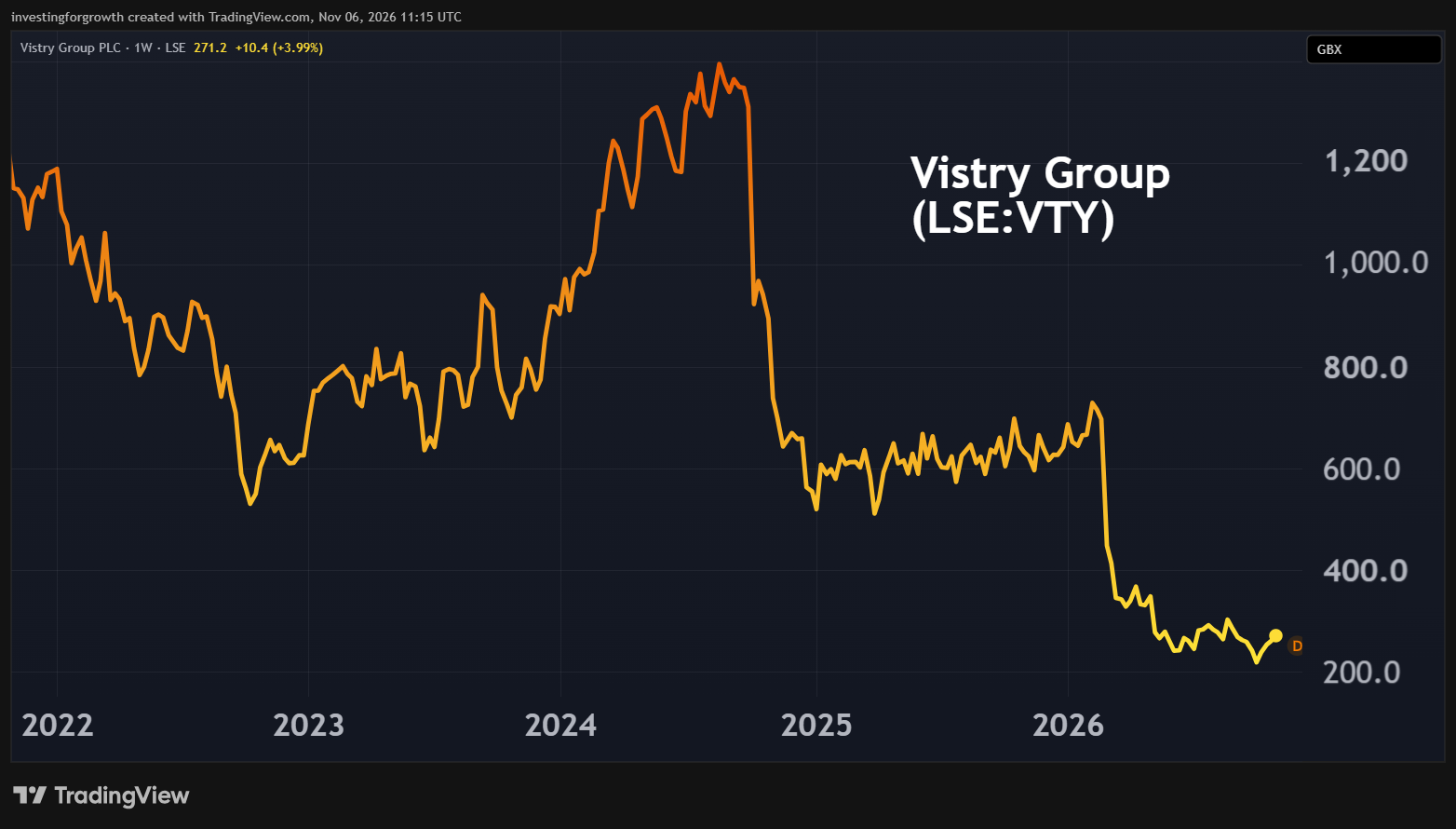
Source: TradingView. Past performance is not a guide to future performance.
How effective can changes in top management be?
CEO Adam Daniels is not exactly a fresh pair of hands. He was promoted last April having been various geographic UK divisional chairs since 2022, coming into the group via its acquisition of Countryside Partnerships. At the 24 September half-year results, he projected how Vistry is effectively downsizing its operations, but firmly believes in its model as a specialist mixed-tenure housebuilder given the shortage of affordable and rented homes in the UK.
Some £70 million of cost savings are targeted over the next two years, at a cost of about £40 million in 2026, with average daily net debt to reduce from around £500 million in 2027 to £300 million by 2029.
A key question out of management’s hands is whether UK housing demand enables delivery.
Implicitly believing so is Helen Miles, appointed new permanent finance director with effect from 2027. Since July 2023, she has been CFO of Severn Trent (LSE:SVT) where the share price rose from 2,300p that October to 3,375p currently, although as a water utility, it has enjoyed a long bull market from 975p in late 2009. Her moving to Vistry is still a significant act of confidence that the situation is salvageable.
The short-selling case has included shareholders to be diluted by creditors, but that seems a worst-case scenario. Yesterday’s update cited the refinancing of a £900 million term loan and revolving credit facility, with second-half average net debt of about £800 million.
- The Income Investor: the dividend outlook for BP
- Where four experts are investing towards end of 2026
Warren Buffett has argued that “when a manager with a reputation for brilliance tackles a business with a reputation for bad economics, it is the reputation of the business that remains intact”. I do not believe that wholly applies to Vistry. More objectively, it over-expanded under a previous CEO and does, like many builders, face difficult economics. They are not inherently bad.
Buffett’s folksy humour also warns about kissing toads lest they continue to croak. Well, that is possible in 2027 if interest rates rise further, and it’s unclear what the US midterm elections may mean for war in the Middle East.
Yet he has admitted to getting involved with the occasional “cigar butt” share trade because “one puff alone is pure profit”. On such rationale, in the medium term Vistry shares could benefit from an overall de-risking that improves their discount to net tangible asset value (NTAV).
At 274p, it trades at 0.42x NTAV compared for example with Barratt Redrow (LSE:BTRW) at 0.73x and Taylor Wimpey (LSE:TW.) at 0.71x although Crest Nicholson Holdings (LSE:CRST) is at just 0.26x given near-term financial challenges greater than Vistry’s.
Vistry Group - financial summary
year-end 31 Dec
| 2016 | 2017 | 2018 | 2019 | 2020 | 2021 | 2022 | 2023 | 2024 | 2025 | |
| Turnover (£ million) | 1,055 | 1,028 | 1,061 | 1,131 | 1,812 | 2,407 | 2,729 | 3,564 | 3,779 | 3,614 |
| Operating margin (%) | 15.2 | 11.8 | 16.4 | 15.8 | 5.1 | 11.9 | 7.8 | 7.9 | 3.7 | 5.9 |
| Operating profit (£m) | 160 | 121 | 174 | 179 | 91.7 | 285 | 212 | 281 | 138 | 215 |
| Net profit (£m) | 121 | 91.3 | 137 | 138 | 76.8 | 254 | 204 | 215 | 74.5 | 138 |
| EPS - reported (p) | 84.2 | 63.5 | 95.0 | 97.7 | 34.7 | 114 | 86.3 | 61.3 | 21.8 | 42.0 |
| EPS - normalised (p) | 84.2 | 67.3 | 94.7 | 107 | 43.1 | 118 | 143 | 72.1 | 46.5 | 45.9 |
| Operating cashflow/share (p) | 43.1 | 109 | 90.9 | 153 | 82.2 | 119 | 29.9 | -20.6 | 40.7 | 56.5 |
| Capital expenditure/share (p) | 1.2 | 1.0 | 1.3 | 0.4 | 1.2 | 0.7 | 0.7 | 0.8 | 2.0 | 3.4 |
| Free cashflow/share (p) | 41.9 | 108 | 89.6 | 153 | 81.0 | 118 | 23.2 | 21.4 | 38.7 | 53.1 |
| Dividends per share (p) | 42.1 | 44.4 | 53.3 | 19.2 | 20.0 | 60.0 | 55.0 | 0.0 | 0.0 | 0.0 |
| Covered by earnings (x) | 2.0 | 1.4 | 1.8 | 5.1 | 1.7 | 1.9 | 1.6 | 0.0 | 0.0 | 0.0 |
| Return on total capital (%) | 13.5 | 10.3 | 13.6 | 12.7 | 3.4 | 10.0 | 4.8 | 6.3 | 3.1 | 4.6 |
| Cash (£m) | 38.6 | 170 | 163 | 362 | 341 | 399 | 677 | 418 | 320 | 354 |
| Net debt (£m) | -38.6 | -145 | -127 | -339 | 4.3 | -201 | -31.6 | 508 | 601 | 242 |
| Net assets (£m) | 1,016 | 1,057 | 1,061 | 1,272 | 2,195 | 2,391 | 3,250 | 3,304 | 3,236 | 3,325 |
| Net assets per share (p) | 727 | 756 | 760 | 828 | 988 | 1,075 | 940 | 956 | 977 | 1,038 |
Source: historic company REFS and company accounts.
Trading update falls short on clarity about current trading
Vistry begins citing progress towards “a smaller, more focused and disciplined business” – with a predictable loss of headcount and restructuring to reduce operating regions from 25 to 12. But will this achieve a level that is value-accretive or essentially what is necessary to tick over in a difficult housing market?
One seeks more insight than comments that “Current trading continues to reflect a challenging open market backdrop and a slow but gradual build-up in partner-funded transaction activity...” At least one bearish analyst has downgraded in response to Vistry citing elsewhere that its open-market (private) sales rate slowed to 0.3 reservations per outlet per week over the summer months, reflecting economic constraints. Another short-selling pitch was heavy discounting to cut build stock from about £600 million at the start of 2026 to under £300 million by end-June.
It grates how without citing numbers, “market conditions continue to give rise to some timing uncertainty in Q4”. Opacity really is not helpful at a time like this. Progress on “self-help initiatives” does, however, underpin profit guidance for 2026, apparently.
- ii view: National Grid earnings impress amid record investment
- Sign up to our free newsletter for investment ideas, latest news and award-winning analysis
I remain wary of consensus for net profit of £106 million this year, rising to £126 million in 2027, hence adjusted earnings per share (EPS) of about 33p rising to 39p – a forward price/earnings (PE) ratio of about 7.2x. Even a 0.6p per share dividend is anticipated in respect of 2026 and 2027. While that would only mean a 0.2% yield, more significant is the sense that Vistry’s finances are sufficiently robust to pay out at all.
I cannot reconcile this with interim results showing a £70.7 million gross loss. Even when adding back £19.8 million amortisation and £475 million goodwill impairment, the operating loss was £147.4 million. Then there’s a £32.8 million net finance charge. Under “five-year targets” it was said that “shareholder distributions [are] to be reconsidered once sufficient progress has been made on deleveraging and capital reduction objectives”.
The update concludes by citing a forward order book of £3.1 billion, but looking back, this compares with £3.3 billion cited only last September and £3.7 billion a year previous.
Analyst consensus is fudged with ‘hold’ stances
These “hold” ratings have come after the extent of write-downs and restructuring required, yet implicitly the CFO-in-waiting thinks it’s a rear-mirror view.
Mind that if some analysts have recommended when shares were higher up and were now to double down – only for events to prove them wrong – they could lose their jobs. “Hold” becomes wise, yet Vistry is effectively a binary call.
Analysts at Davy – before this update but after the CFO news – downgraded from “neutral” to “underperform”, slashing their target price from 325p to 216p. The rationale is that the private reservation rates is stagnating at summer lows despite heavy incentives such as perks, discounts, financial contributions or upgrades. There are structural downside risks to Vistry’s projections – it is a “show, don’t tell” story that needs to deliver on its target to shrink and simplify its footprint before investors can trust the narrative.
- Three ways interest rate hike to 4% could affect your finances
- ii view: why BT shares just rallied to 8-year high
I can empathise, but unless the company become a Crest Nicholson, the restructuring has a decent chance to raise the shares towards NTAV of 645p as of 30 June. Interims included the comment: “Our banking group has demonstrated their support for cover covenants for 2026 and first-half 2026 that were subject to impact from the sizeable charges being taken in connection with the CEO review”.
Obviously, this is speculative, but if Vistry broadly delivers, then by the time we get proof its shares will be higher anyway. You decide your risk appetite.
I am going to stick my neck out, retaining “buy”, respecting long-term affordable housing demand and government catalysts.
Edmond Jackson is a freelance contributor and not a direct employee of interactive investor.
These articles are provided for information purposes only. Occasionally, an opinion about whether to buy or sell a specific investment may be provided by third parties. The content is not intended to be a personal recommendation to buy or sell any financial instrument or product, or to adopt any investment strategy as it is not provided based on an assessment of your investing knowledge and experience, your financial situation or your investment objectives. The value of your investments, and the income derived from them, may go down as well as up. You may not get back all the money that you invest. The investments referred to in this article may not be suitable for all investors, and if in doubt, an investor should seek advice from a qualified investment adviser.
Full performance can be found on the company or index summary page on the interactive investor website. Simply click on the company's or index name highlighted in the article.
Disclosure
We use a combination of fundamental and technical analysis in forming our view as to the valuation and prospects of an investment. Where relevant we have set out those particular matters we think are important in the above article, but further detail can be found here.
Please note that our article on this investment should not be considered to be a regular publication.
Details of all recommendations issued by ii during the previous 12-month period can be found here.
ii adheres to a strict code of conduct. Contributors may hold shares or have other interests in companies included in these portfolios, which could create a conflict of interests. Contributors intending to write about any financial instruments in which they have an interest are required to disclose such interest to ii and in the article itself. ii will at all times consider whether such interest impairs the objectivity of the recommendation.
In addition, individuals involved in the production of investment articles are subject to a personal account dealing restriction, which prevents them from placing a transaction in the specified instrument(s) for a period before and for five working days after such publication. This is to avoid personal interests conflicting with the interests of the recipients of those investment articles.