Stockwatch: this FTSE 250 share remains on my buy list
Having reversed from its August high, analyst Edmond Jackson believes this growth company continues to demonstrate long-term potential.
17th November 2026 10:27
by Edmond Jackson from interactive investor

Latest annual results to 31 July distinguish athletic supplements group Applied Nutrition (LSE:APN) with beefy numbers, yet its FTSE 250 shares slipped 3% to 305p despite 2027 guidance affirmed.
Is this just a near-term reaction, with the company still offering strong prospects on a multi-year view? The global “wellness” economy is projected - albeit by the industry - to expand by 7.6% annually from 2024 to 2029.
- Invest with ii: SIPP Account | Stocks & Shares ISA | See all Investment Accounts
I examined Applied Nutrition in August at 315p, being somewhat sceptical of food supplements and wary over how creatine and whey powders seem fads attracting competition. But I respected the company’s marketing adeptness since 2014 when its current 42-year-old owner acquired what was a declining local brand in Liverpool, turned it around and listed it in October 2024 at 140p.
After the shares traded flat during their first 10 months, I missed their rally to 350p by early August but noted, within a long-term “buy” stance, that they tended to drop back after impressive updates. Possibly this reflected a mix of high rating and no dividend, inviting active trading by those in tax-free wrappers. Such a pattern continued with a drop to 265p by early October, then a rally back to 315p just before these results.
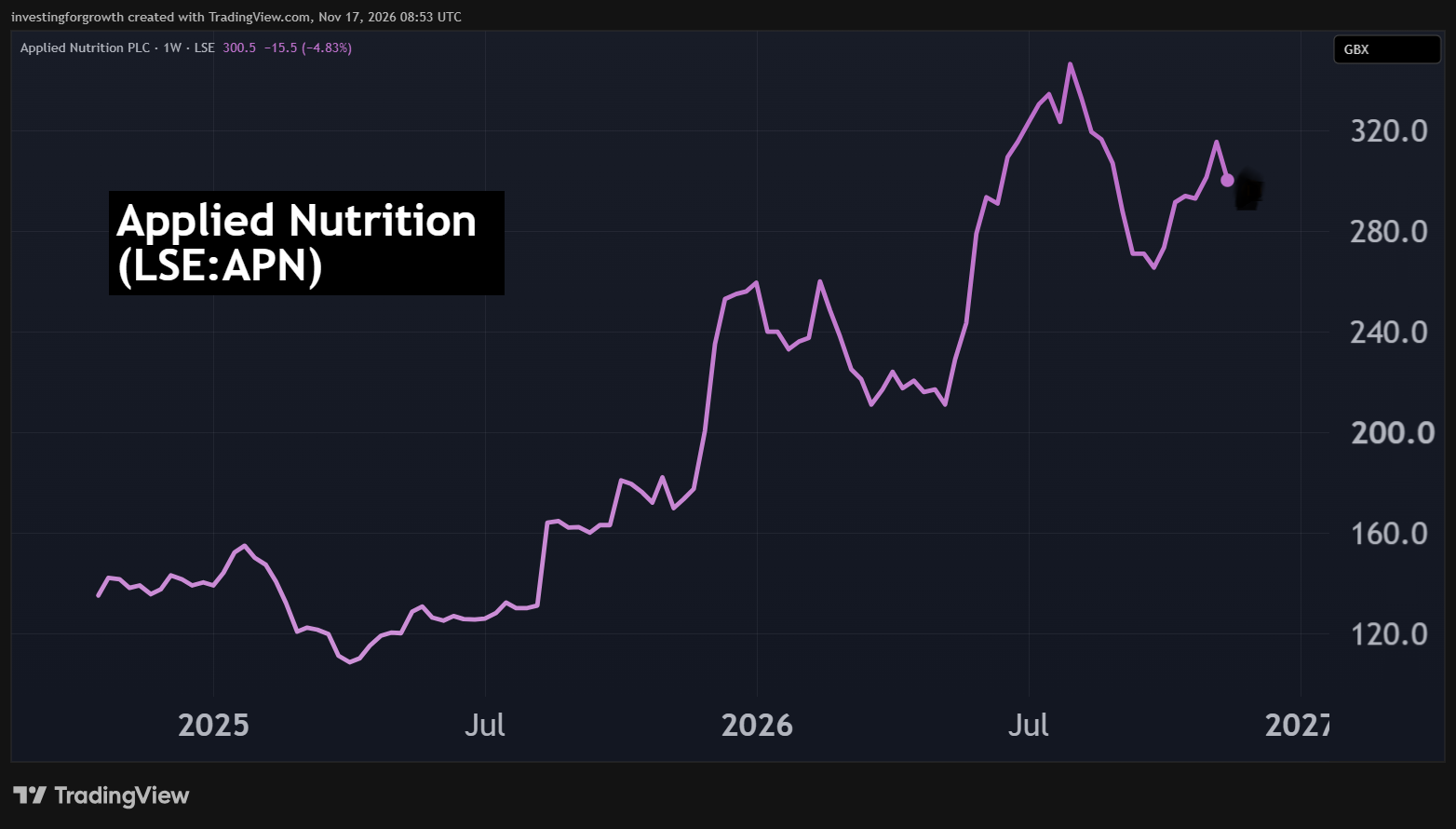
Source: TradingView. Past performance is not a guide to future performance.
Top-line compound average growth of 45%
This is the figure that growth investors should prioritise, in this case near wholly organic given the acquisition of Nutrablend Group in New York only completed last June for an equivalent £12 million.
In the last year, revenue is up 51% to £162 million and pre-tax profit by 45% to £42 million, helped arithmetically by a still quite low base. There has been a boost from the relaunch of Critical Whey, a flagship product where sales leapt 142%. With earnings per share (EPS) similarly up 45% to 12.2p, the trailing price/earnings (PE) ratio is 25x, but its growth is expected to slow this year to nearer 15%, hence pushing the PEG (PE/growth) ratio over 1.4 when a forward PE of 21.6x is divided by 15%.
Properly you seek a PEG below 1.0, hence in the short term this appears pricey. Meanwhile, there is no dividend, which is justifiable when the intrinsic return on capital runs at 34%, even if that’s down from 61% in 2022 (see table).
Applied Nutrition - financial summary
Year-end 31 July
| 2022 | 2023 | 2024 | 2025 | 2026 | |
| Turnover (£m) | 35.0 | 60.8 | 86.2 | 107 | 162 |
| Operating margin (%) | 28.4 | 29.5 | 27.6 | 26.2 | 25.1 |
| Operating profit (£m) | 10.0 | 17.9 | 23.7 | 28.1 | 40.6 |
| Net profit (£m) | 8.2 | 13.8 | 18.7 | 21.1 | 30.6 |
| Reported earnings/share (p) | 3.3 | 5.5 | 7.5 | 8.4 | 12.2 |
| Normalised earnings/share (p) | 3.3 | 5.5 | 7.1 | 7.9 | 11.8 |
| Operating cashflow/share (p) | 2.6 | 3.4 | 2.7 | 6.7 | 4.8 |
| Capital expenditure/share (p) | 0.1 | 0.4 | 0.4 | 0.4 | 5.5 |
| Free cashflow/share (p) | 2.5 | 3.0 | 2.3 | 6.3 | -0.7 |
| Dividend/share (p) | 0.0 | 0.0 | 0.0 | 0.0 | 0.0 |
| Return on capital (%) | 61.2 | 57.6 | 47.7 | 49.0 | 34.2 |
| Cash (£m) | 5.4 | 12.7 | 18.7 | 18.5 | 15.9 |
| Net debt (£m) | -4.3 | -10.7 | -16.9 | -15.5 | -11.9 |
| Net assets/share (p) | 6.0 | 11.5 | 19.2 | 21.7 | 34.2 |
Source: company accounts.
Management says “very strong momentum” has continued into the first quarter of the new financial year and has affirmed guidance for the July 2027 year. But a dilemma is that this involves a slowing of growth rates - revenue to about 27% and EPS to about 14%. This is despite the Nutrablend acquisition, which the story had implied was partly as a platform for US development, hence it can come across as a jolt.
Management cites being strongly positioned to capitalise on trends for higher protein intake among active people, and also women who are now engaging in more strength training via weights and/or gym membership. Conversely, a high-protein diet is not necessarily a healthier one if it means a reduction in fibre, which can, for example, mitigate the risk of cancer and heart disease.
We are also told to eat less processed food, but the reality for gym bunnies is that mixing a protein shake afterwards is a lot more convenient than fixing a complex plant-based meal, or involving the cost of downing a load of eggs or steak.
Practical appeal aside, it still strikes me as very odd how a company purporting to be in the health industry is collaborating with Slush Puppie and Sour Patch Kids, high-sugar confectionery.
So, there are contradictions here, but I still respect how Applied Nutrition shows adept marketing both in terms of product development, and with sales reach across supermarkets and digital channels.
Why margins are diluted now and into 2027
The latest reduction in gross margin from 46% to 44.1% is explained by an increase in staff costs as a percentage of revenue, apparently based on wage increases to ensure competitive pay.
Offsite storage capacity is being used until a new global HQ and distribution centre completes. There has also been a slight increase in advertising and depreciation/amortisation amid investment in manufacturing and warehousing facilities.
The acquired US business is expected to have lower margins than the existing group, hence there’s an aspect of dilution that management needs to overcome, for example by sales synergies. For 2027, however, they caution that the operating margin will decrease slightly due to the US involving a greater proportion of “white label” sales (where Applied Nutrition-made produce is re-labelled and sold by another company as its own) and also higher whey protein costs.
- Insider: a ‘very high conviction’ £1m director deal
- eyeQ: investors are buying the Nvidia dip. Should you?
It’s a reminder how growth companies face their own challenges and how the US market may not be straightforward. Indeed, decades ago the cynical quip was of it being a graveyard for UK-listed companies, especially smaller ones. Yet this view has been rubbished by Sanderson Design Group Ordinary Shares (LSE:SDG), for example, which has significant sales in the US, which is its highest-margin and most profitable region according to the 12 October half-year results.
Despite the prime minister’s Mansion House speech last night asserting the failures of Brexit, Applied Nutrition has just got on with establishing partnerships in France, Spain, the Netherlands, Germany and Poland, such that European sales grew 34% to £20.8 million. This compares with 45% growth to £70.3 million in the UK and 63% to £70.4 million for rest-of-world.
I feel as if a hang-up over 2027 margin issues can miss a key point about how Applied Nutrition looks to be shaping up as a nascent multinational. Distributor changes in the Middle East have helped progress in Latin America, a key target area, and doubled sales. Asia Pacific rose 60%, helped by successful product listings in the region through partners, especially in China, Singapore and Hong Kong.
No financial debt beyond £4 million lease liabilities
Two further key attractions include a clear trend of balance-sheet net cash showing rapid growth as self-funded from cash flow, and by a business where the CEO, and effectively the founder, still owns 32.5%.
A niggle is over how the annual cash flow statement shows operating cash flow before working capital movements up 43.5% to £41.9 million, but which is compromised by an £18 million increase in inventories and a £15.4 million increase in trade and other receivables. That means net cash generated from operations actually slipped 15% to £18.6 million. Hopefully this jump in working capital unwinds as the Nutrablend acquisition beds in.
- Stockwatch: my view on five share tips as interest rates rise
- Sign up to our free newsletter for investment ideas, latest news and award-winning analysis
On the investing side of the statement, £13.8 million was spent in total. Since the £6.6 million income tax charge rose 5% to £6.6 million, this compromised operating cash flow such that the net free cash flow outcome was -0.7p per share. This makes clear the reason for the lack of dividend just now.
Interest rate rises also temper growth multiples
Since I wrote in August, the Iran war’s persisting inflationary pressures mean the expectation is for further interest rate rises towards 5.0%. Higher rates are inherently compromising for “growth” ratings.
In early dealings today, Applied Nutrition is down another 5p to 300p albeit on the back of a weak US market with its own worries over AI shares.
I should add that I am sceptical of food supplements, even for an athletic lifestyle, and that I got drawn into Applied Nutrition amid a sense of “missing out”. It can also look silly downgrading a tip that is now underwater.
I am still going to retain a long-term “buy” stance given key factors here weigh positively, implying a period ahead to accumulate stock.
Edmond Jackson is a freelance contributor and not a direct employee of interactive investor.
These articles are provided for information purposes only. Occasionally, an opinion about whether to buy or sell a specific investment may be provided by third parties. The content is not intended to be a personal recommendation to buy or sell any financial instrument or product, or to adopt any investment strategy as it is not provided based on an assessment of your investing knowledge and experience, your financial situation or your investment objectives. The value of your investments, and the income derived from them, may go down as well as up. You may not get back all the money that you invest. The investments referred to in this article may not be suitable for all investors, and if in doubt, an investor should seek advice from a qualified investment adviser.
Full performance can be found on the company or index summary page on the interactive investor website. Simply click on the company's or index name highlighted in the article.
Disclosure
We use a combination of fundamental and technical analysis in forming our view as to the valuation and prospects of an investment. Where relevant we have set out those particular matters we think are important in the above article, but further detail can be found here.
Please note that our article on this investment should not be considered to be a regular publication.
Details of all recommendations issued by ii during the previous 12-month period can be found here.
ii adheres to a strict code of conduct. Contributors may hold shares or have other interests in companies included in these portfolios, which could create a conflict of interests. Contributors intending to write about any financial instruments in which they have an interest are required to disclose such interest to ii and in the article itself. ii will at all times consider whether such interest impairs the objectivity of the recommendation.
In addition, individuals involved in the production of investment articles are subject to a personal account dealing restriction, which prevents them from placing a transaction in the specified instrument(s) for a period before and for five working days after such publication. This is to avoid personal interests conflicting with the interests of the recipients of those investment articles.