Shares for the future: why I’ve marked this stock down
Despite being more confident in this tech business than he was a year ago, analyst Richard Beddard has reduced his score. Here’s why and what it means for its ranking.
13th November 2026 15:00
by Richard Beddard from interactive investor

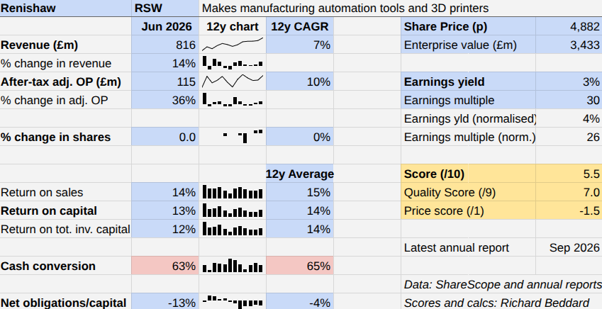
When I scored Renishaw (LSE:RSW) last year, many of the numbers were flashing pink. In the year to June 2026 a semiconductor boom and £20 million in cost savings have turned the numbers blue.
- Invest with ii: SIPP Account | Stocks & Shares ISA | See all Investment Accounts
From go-slow to go-go
Renishaw mainly makes tools that automate manufacturing equipment.
Its biggest division, Industrial Metrology, makes sensors and measurement systems that help calibrate and control machines, and check the quality of parts.
By growing modestly, Industrial Metrology had the least remarkable year of Renishaw’s three divisions. It grew revenue by 4% in the year to June 2026 and operating profit by 2%, generating 57% of total revenue and 50% of profit.
Revenue from the Position Measurement division grew 25%, contributing 32% of total revenue. A sharp rise in profit margin from the already more profitable division meant it almost achieved parity with Industrial Metrology in terms of its contribution to profit (47% of the total).
Position Measurement makes position encoders, which are fitted on machine tools to control their movement.
- FTSE 100 vs FTSE 250 – which one just triggered a buy signal?
- Why this investing strategy thrives in winter
A third division, Specialised Technologies, is a gaggle of separate businesses that make additive manufacturing machines (industrial 3D Printers), spectroscopes, and surgical robots.
Proportionally, Specialised Technologies grew revenue most in 2026. It also moved into profit, but by nowhere near enough to save it from being the least profitable division. A profit margin of 4% contributed 3% profit from 13% of total revenue.
Overall, Renishaw grew revenue 14% and adjusted profit 36%. Return on capital was a healthy 13%, close to the company’s long-term average.
Renishaw is unusual because of the accumulated know-how acquired over more than 40 years of automating manufacturing. One of its co-founders invented the touch-trigger probe in 1973, which automated three-dimensional co-ordinate measurement.
The company manufactures using its own position measurement tools, giving it valuable insights and credibility. Although spending on engineering new and improving existing products contracted in 2026, it remains considerable (over 13% of revenue).
Consistent strategy often comes from consistent ownership and management. The majority of Renishaw shares are controlled by the two founding families, who occupy three non-executive seats on the board. The company has had only two chief executives, inventor Sir David McMurtry, and onetime graduate trainee, Will Lee, who succeeded him in 2018.
This self-sufficient culture appeals to me, and it seems to appeal to staff. Voluntary staff turnover is low, and if the restructuring executed mostly in H1 has had a negative impact on morale, it is not obvious in the numbers. For the second year running, voluntary staff turnover (excluding redundancies) was less than 6%.
- Nick Train: Diageo’s prospects and the firm I hope will quintuple in value
- Nick Train: performance, AI ‘victims’, and navigating a bear market
Growth is accelerating in the new financial year. In the first quarter of 2027, comprising July, August and September 2026, revenue in all three divisions grew very strongly compared to weak comparatives in the same period in the previous year (2025).
With competitive advantages and momentum on its side, you might expect Renishaw to keep growing, but sharp contractions have interrupted strong growth in the past, tarnishing the long-term trend.
The challenges of the present and near future also require a nuanced interpretation.
Bubble risk, China risk
In 2026, Renishaw performed well, but its numbers in 2025 were humdrum. Over the previous 12 years it had grown revenue at a compound annual growth rate (CAGR) of 6% and adjusted profit at only 3%. After tax return on capital was 10%.
The year before in 2024, return on capital was only 9%, challenging my definition of prospering through thick and thin.
Volatility is inevitable given Renishaw’s end markets in manufacturing. Manufacturers build factories and invest in automation when demand is high and they need to increase efficiency and capacity. They make do with what they’ve got when it is not.
Renishaw is enjoying high demand for position encoders from semiconductor manufacturers caught up in the AI chip-buying spree. Demand from the aerospace and defence sectors is also increasing.
In 2026, it was not just revenue from semiconductors that jumped higher, profit margins did too. This performance may not be sustainable. The mind-boggling scale of the data centre building boom raises fears of overspending and a correspondingly epic bust.
Consequently, I do not believe that Renishaw’s results will be any more predictable in the future than they were in the past. They may be even less predictable.
A more gradual, but perhaps more permanent threat to Renishaw’s profitability is low-cost competition in China, the world’s biggest manufacturer.
Renishaw’s warnings about local competition are increasingly overt, and the risk level is increased again in this year’s annual report.
For now, Renishaw says low-cost competition is mostly restricted to the domestic market, but it’s easy to imagine these companies becoming international competitors.
In any case, local competition could dent Renishaw. Unsurprisingly, given its manufacturing prowess, China is Renishaw’s biggest individual country market. It contributed 27% of revenue in 2026.
To compete more effectively, Renishaw said last year that it is developing entry level products and reducing manufacturing costs through automation. It has also mooted moving some work to low-wage economies.
Renishaw’s divisional structure is new. It is a result of the restructuring, and shows Renishaw’s intent to focus on its most significant manufacturing technologies.
The large Industrial Metrology and Position Measurement divisions each make similar products, and sell them to similar customers, primarily machine manufacturers and distributors.
To speed up product development Renishaw has adopted a minimal viable product approach. It says the first product to emerge is ASTRiA, an inductive encoder for use in harsh environments, which is winning new customers in aerospace and defence.
The businesses in the Specialised Technologies division have little in common, except that they are mostly sold to end-users and they may not yet have reached their commercial potential. Renishaw sells spectroscopes to laboratories, AM machines to industry, and neurological surgical robots to hospitals.
After the closure of its drug delivery business last year, the division will be rationalised further if Renishaw finds a buyer for the surgical robot business. It has been touting neuromate for over a year.
In 2026, AM produced the division’s growth. Renishaw says AM is becoming a volume manufacturing technology in aerospace, defence and medical markets. Although the relatively high cost per part is a barrier to entry in more price sensitive markets like consumer electronics, interest is growing.
Scoring Renishaw: Good business, higher price
The annual report talks of a simpler, more focused Renishaw, and that appears to be emerging. The two principal risks, cyclicality and low-cost competition may be intensifying too.
| Renishaw | RSW | Makes manufacturing automation tools and 3D printers | 11/11/2026 | 5.5/10 |
| How capably has Renishaw made money? | 2.0 | |||
| Under consistent management, Renishaw has grown revenue and profit by developing and patenting tools that automate manufacturing processes and quality control. Even long-term growth rates vary markedly from year to year because performance is so volatile. Loyal employees embody unique know-how. | ||||
| How big are the risks? | 2.0 | |||
| Demand depends on capital spending in cyclical manufacturing industries, which is volatile. The scale of the current semiconductor boom may increase that volatility and emerging low-cost competitors in China may erode profit margins. | ||||
| How fair and coherent is its strategy? | 3.0 | |||
| Renishaw is disposing of its neurology business to focus on highly profitable manufacturing technologies. By introducing entry-level products, bringing products to market more quickly, and selling more systems, it expects to stay ahead of competitors. | ||||
| How low (high) is the share price compared to normalised profit? | -1.5 | |||
| High. A share price of 4,882p values the enterprise at £3,433 million, about 26 times normalised profit. | ||||
| NB: Bold text indicates factors that reduce the score. Bold and italicised text doubly so. The maximum score is 3 for each criterion except price, which has a maximum of 1 (explained here) | ||||
| Previous score (October 2025): 5.9 | ||||
My confidence in Renishaw has increased slightly since last year, when I feared tariffs might drag on profitability. Their impact has been limited and largely mitigated by price rises.
The score is lower this year because the share price has risen strongly, depressing the price score.
30 Shares for the future
Here is the ranked list of Decision Engine shares. I review the scores at least once a year, soon after each company has published its annual report. The price scores are calculated using the share price prior to publication.
Generally, I consider shares that score more than 5 out of 10 to be worthy of long-term investment in sizes determined by the ideal holding size (ihs%).
Volution Group (LSE:FAN), Softcat (LSE:SCT) and YouGov (LSE:YOU) have published annual reports and are due to be re-scored.
| company | description | score | qual | price | ih% | |
| 1 | FW Thorpe | Makes lighting systems for commercial, industrial and public settings | 9.4 | 8.5 | 0.9 | 8.9% |
| 2 | Hollywood Bowl | Operates tenpin bowling centres | 8.3 | 8.0 | 0.3 | 6.6% |
| 3 | James Latham | Distributes imported panel products, timber, and laminates | 8.0 | 7.0 | 1.0 | 6.0% |
| 4 | Solid State | Manufactures electronic systems and distributes components | 7.9 | 7.0 | 0.9 | 5.9% |
| 5 | Cake Box | Cake shop (Cake Box) and sweet shop (Ambala) franchisor | 7.9 | 7.0 | 0.9 | 5.7% |
| 6 | Howden Joinery | Supplies kitchens and joinery to builders and online to DIYers | 7.6 | 7.0 | 0.6 | 5.3% |
| 7 | Porvair | Manufactures filters and laboratory equipment | 7.5 | 8.0 | -0.5 | 5.1% |
| 8 | Anpario | Manufactures natural animal feed additives | 7.5 | 7.0 | 0.5 | 5.0% |
| 9 | Oxford Instruments | Makes imaging and semiconductor manufacturing systems | 7.5 | 7.0 | 0.5 | 4.9% |
| 10 | Renew | Maintains and improves road, rail, water, and energy infrastructure | 7.4 | 7.5 | -0.1 | 4.9% |
| 11 | Games Workshop | Designs, makes and distributes Warhammer. Licences IP | 7.4 | 9.0 | -1.6 | 4.8% |
| 12 | Bunzl | Distributes essential everyday items consumed by businesses | 7.2 | 7.0 | 0.2 | 4.4% |
| 13 | Quartix | Supplies vehicle tracking systems to small fleets | 7.1 | 7.0 | 0.1 | 4.3% |
| 14 | Churchill China | Manufactures tableware for restaurants etc. | 7.0 | 6.0 | 1.0 | 4.0% |
| 15 | Jet2 | Flies people to holiday locations, often on package tours | 7.0 | 6.0 | 1.0 | 4.0% |
| 16 | Judges Scientific | Acquires and grows businesses that manufacture scientific instruments | 7.0 | 6.0 | 1.0 | 4.0% |
| 17 | Volution | Manufacturer of ventilation products | 7.0 | 8.5 | -1.5 | 3.9% |
| 18 | Auto Trader | Online marketplace for motor vehicles | 6.9 | 6.0 | 0.9 | 3.8% |
| 19 | YouGov | Surveys public opinion and conducts market research online | 6.8 | 6.0 | 0.8 | 3.6% |
| 20 | Bloomsbury Publishing | Publishes books and educational resources | 6.7 | 7.5 | -0.8 | 3.3% |
| 21 | Macfarlane | Distributes and manufactures protective packaging | 6.5 | 5.5 | 1.0 | 3.0% |
| 22 | Cohort | Manufactures/supplies defence tech, training, consultancy | 6.4 | 7.5 | -1.1 | 2.8% |
| 23 | Softcat | Sells software and hardware to businesses and public sector | 6.3 | 6.5 | -0.2 | 2.5% |
| 24 | Advanced Medical Solutions | Manufactures surgical adhesives, sutures and dressings | 6.2 | 6.5 | -0.3 | 2.5% |
| 25 | Focusrite | Designs recording equipment, synthesisers and sound systems | 6.0 | 5.0 | 1.0 | 2.5% |
| 26 | Tristel | Manufactures hospital disinfectant | 6.0 | 8.0 | -2.0 | 2.5% |
| 27 | Keystone Law | Operates a network of self-employed lawyers | 5.7 | 7.0 | -1.3 | 2.5% |
| 28 | 4Imprint | Customises and distributes promotional goods | 5.7 | 8.0 | -2.3 | 2.5% |
| 29 | Renishaw | Makes manufacturing automation tools and 3D printers | 5.5 | 7.0 | -1.5 | 2.5% |
| 30 | Goodwin | Casts and machines steel and processes minerals for niche markets | 5.2 | 6.0 | -0.8 | 2.5% |
Click on a share's score to see a breakdown (scores may have changed due to movements in share price). Key: qual is the share’s score out of 9 for the three quality factors (capabilities, risks, and strategy), price is the price score from -3 to +1, and ih% is the suggested ideal holding size as a percentage of the total value of a diversified portfolio.
Richard Beddard is a freelance contributor and not a direct employee of interactive investor.
Richard owns Renishaw and many shares in the Decision Engine. He weights his portfolio so it owns bigger holdings in the higher scoring shares.
For more on the Decision Engine and Share Sleuth, please see Richard’s explainer.
Contact Richard Beddard by email: richard@beddard.net or on Twitter: @RichardBeddard
These articles are provided for information purposes only. Occasionally, an opinion about whether to buy or sell a specific investment may be provided by third parties. The content is not intended to be a personal recommendation to buy or sell any financial instrument or product, or to adopt any investment strategy as it is not provided based on an assessment of your investing knowledge and experience, your financial situation or your investment objectives. The value of your investments, and the income derived from them, may go down as well as up. You may not get back all the money that you invest. The investments referred to in this article may not be suitable for all investors, and if in doubt, an investor should seek advice from a qualified investment adviser.
Full performance can be found on the company or index summary page on the interactive investor website. Simply click on the company's or index name highlighted in the article.
Disclosure
We use a combination of fundamental and technical analysis in forming our view as to the valuation and prospects of an investment. Where relevant we have set out those particular matters we think are important in the above article, but further detail can be found here.
Please note that our article on this investment should not be considered to be a regular publication.
Details of all recommendations issued by ii during the previous 12-month period can be found here.
ii adheres to a strict code of conduct. Contributors may hold shares or have other interests in companies included in these portfolios, which could create a conflict of interests. Contributors intending to write about any financial instruments in which they have an interest are required to disclose such interest to ii and in the article itself. ii will at all times consider whether such interest impairs the objectivity of the recommendation.
In addition, individuals involved in the production of investment articles are subject to a personal account dealing restriction, which prevents them from placing a transaction in the specified instrument(s) for a period before and for five working days after such publication. This is to avoid personal interests conflicting with the interests of the recipients of those investment articles.