Stockwatch: why I’ve just downgraded three shares
Analyst Edmond Jackson identifies four retailers at an inflection point and keeps only one as a buy. Find out which one here.
23rd October 2026 12:02
by Edmond Jackson from interactive investor

A recent market feature has been a rally among retailer shares such as B&M European Value Retail (LSE:BME), Halfords Group (LSE:HFD) and Wickes Group (LSE:WIX), with Pets at Home Group (LSE:PETS) lately joining the party. That Pets initially rose as much as 6% on a broker note earlier this week, and Halfords fell 8% despite an “in-line” update, makes me question if speculative momentum is now triggering a reality check.
How safe are UK retail shares and should investors be taking profits into this rally if Wednesday’s Budget results in tighter consumer spending? Or is it more a case that these shares have rallied justifiably due to capable management?
- Invest with ii: Share Dealing with ii | Open a Stocks & Shares ISA | Our Investment Accounts
Data company Gfk has indicated UK consumer confidence has plunged 11% this month to -24 amid cost-of-living pressures, the biggest fall since the July 2026 European Union referendum result. And today we hear that UK retail sales fell 0.4% in September.
More widely there are early signs of profit warnings. EY-Parthenon analysis cites 65 among UK-listed firms in the third quarter of 2026, up from 59 in the second quarter. No reason to panic but certainly worth assessing one’s stock picking.
A macro aspect concerning me is the latest hike in diesel prices which must affect retail sector margins given transport costs are a significant element. This is yet to manifest in figures, but CEOs may need to swiftly find further savings to preserve “in line” outlook statements. That UK inflation climbed more than expected, from 3.1% in August to 3.4% in September, was said to be materially due to diesel prices.
It could be that the 28 October Budget removes uncertainty, hence a rise in business and consumer confidence follows. But an overall rise in tax does seem a certainty to address fiscal dilemmas. The chancellor seems likely to dress this up such that low-income people bear less of a rising burden, in which case it might help value-oriented retailers. I think caution is needed about aggregate demand, especially if interest rates also rise versus inflation.
A shift to wet and windy autumnal weather also contrasts with benign recent months encouraging footfall, although heatwaves must have had some negative effect.
Bull market in B&M hits profit taking
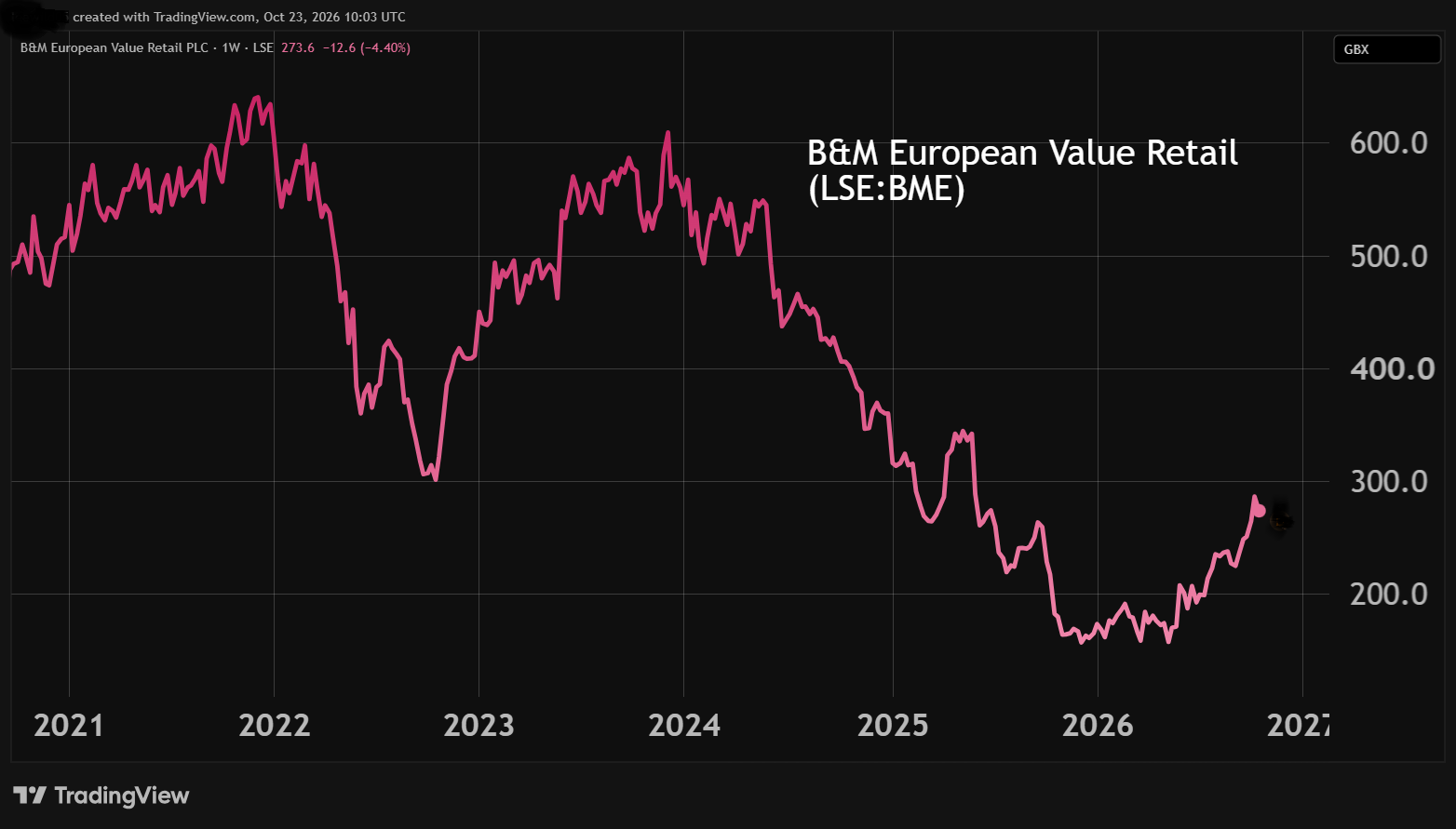
After a strong run from 157p last May, at 275p the FTSE 250 shares of B&M are 4% off a recent high but did look to be due some mean-reversion. The five-year chart seems open to question about whether a genuine bull trend has been established, although a capable new CEO from June 2025 raises the odds:
Source: TradingView. Past performance is not a guide to future performance.
The vigorous rally can seem curious given June’s annual results to 28 March were effectively flat, adjusting for inflation, and profit measures fell sharply “due to a challenging market and execution issues”.
I regard B&M’s competitiveness versus Home Bargains as a key issue going forward. A mixed first quarter saw France bail out a 2.3% decline in B&M UK like-for-like sales, hence the CEO heralding France’s operating model as the future.
The shares can appear fairly valued on a 12-month forward price/earnings (PE) ratio around 12x with 11% earnings per share (EPS) growth consensus for the current year, then 8.5% to March 2028. The prospective yield of 3.8% is covered 2.2x. Last April at 184p I re-iterated a “buy” stance amid a crowded short trade and suggested that “if profit warnings come in threes” then the low might be in and risk/reward tilt positively.
I temper my view to “hold”, but the 12 November half-year results will be axiomatic to define turnaround progress. Under capable execution, a more cost-conscious UK environment could aid B&M.
A near-term mean-reversion in Halfords
Halfords shares fell 8% to 255p despite affirming profit expectations for the year to 31 March 2027, and with market indices flat. Like-for-like sales rose 7.1% in the 26 weeks to 2 October, within which retail motoring-related sales rose 7.3% and cycling by 8.3%, while autocentres rose 6.1%. This all sounds amply ahead of inflation although cycling is responsive to weather.
Doing the damage was a caution at the end of the statement about how strong first-half-year performance combined with “accelerated investments in marketing and technology in the second half” means a first-half profit weighting. This is before any consideration about whether the macro context worsens.
- UK bank dividends boost full-year outlook for income seekers
- Shares for the future: reasons to be fearful about AIM star
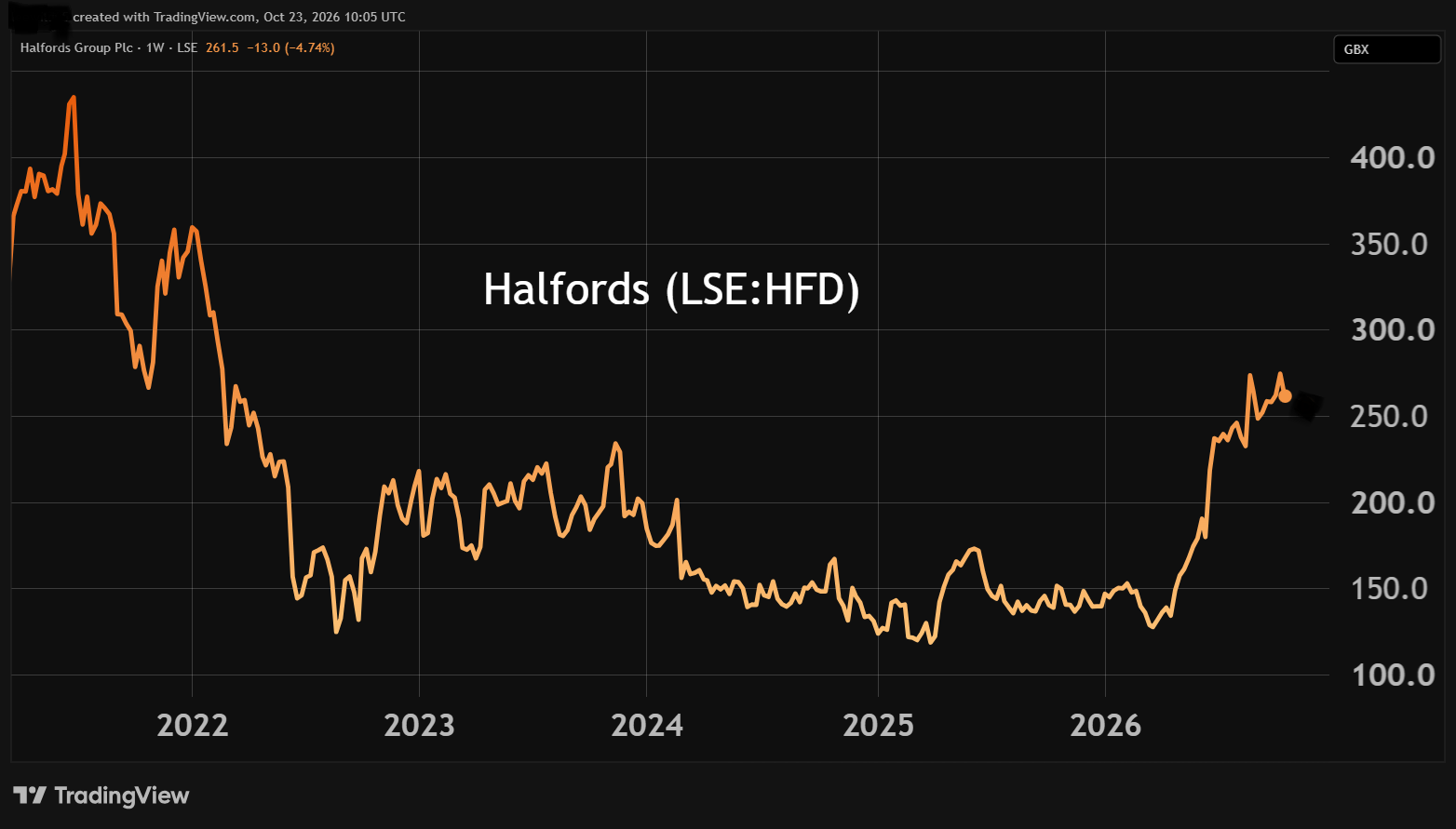
At 256p, the shares trade on 12.6x expected earnings for next March, but consensus anticipates a flat 2028 – EPS growth of barely 2% which might not even match inflation. Possibly this is a harsh view if investment aids momentum for the March 2028 year, albeit it is hard to predict macro-wise.
As yet, however, this is not making a difference to the bull trend since end-March constituting a firm breakout from the 2023 to early 2026 sideways trend:
Source: TradingView. Past performance is not a guide to future performance.
Last August I queried if Halfords was manifesting sustainable growth and retained a “buy” stance at 267p on a two-year view – albeit suggesting “a wet autumn could offer a bit lower prices”. That is now happening but unless the Budget removes uncertainty such that shares and confidence rallies, the consumer trajectory seems challenging. As with B&M, I temper to “hold”.
Wickes maintains uptrend after double bottom
In contrast with Halfords, Wickes has gained further momentum after a third-quarter 2026 trading update cited a 4.5% revenue rise, driven by a 6.0% rise in retail revenue and trade sales up 8.0% year-on-year. Unsurprisingly, with discretionary spending pressured, design & installation was flat. Further market share was gained and on a two-year basis like-for-like retail sales are up 11.5%.
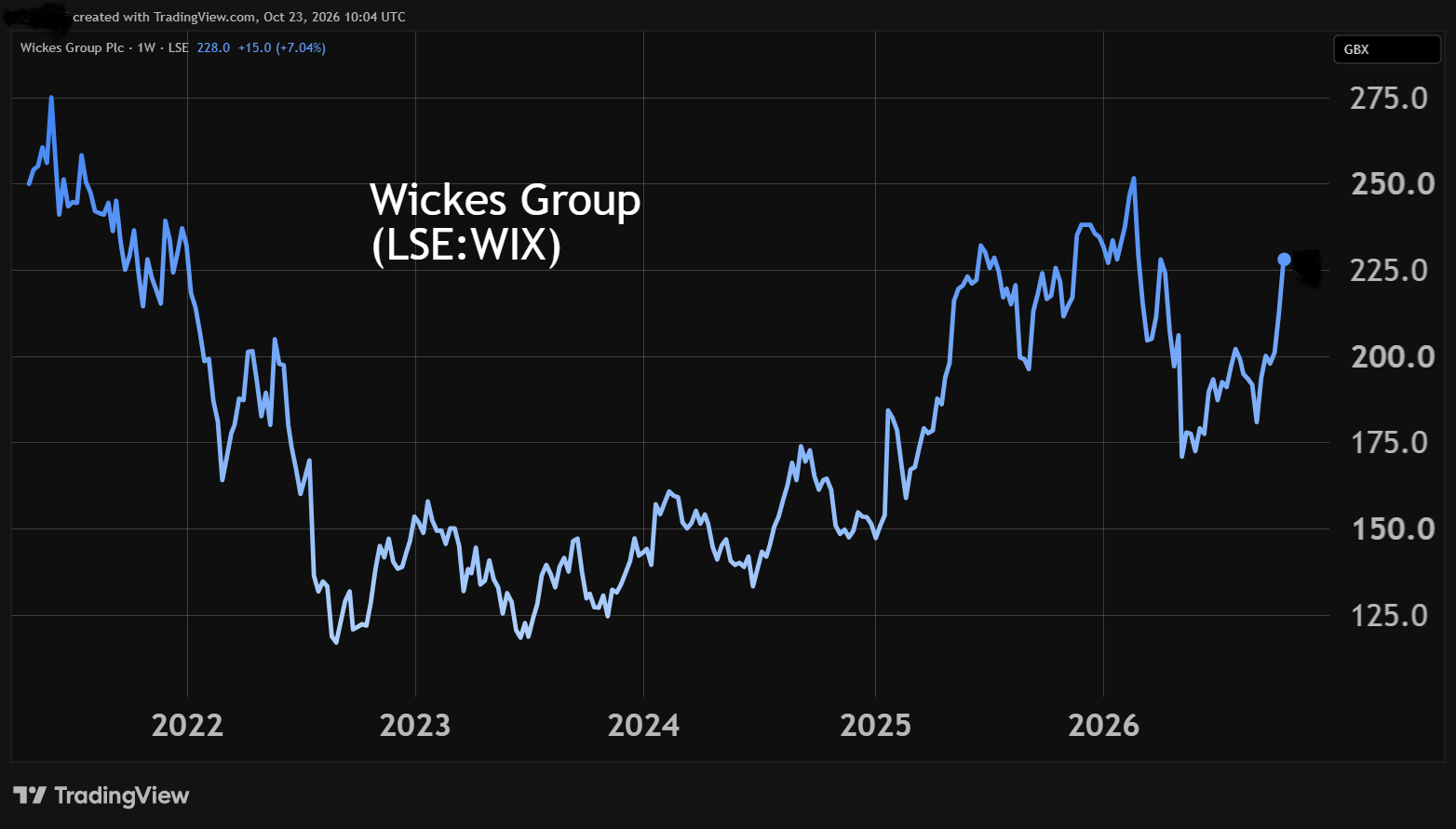
Despite no upgrade to profit guidance the various segments imply the group growth rate is improving, and the medium-term chart suggests a volatile uptrend is being sustained from September 2022 – despite the drop from February’s high of 251p to 171p in May.
Source: TradingView. Past performance is not a guide to future performance.
At 229p currently, the shares are on a 2026 prospective PE of 12.6x easing to 10.8x in 2027 if 17% earnings growth is achieved as expected. There is also a 5.2% prospective yield in support, covered about 1.8x.
Unsurprisingly, the retail side is doing better than design & installation – kitchens, bathrooms and solar – given smaller-scale discretionary spend involved. Fewer people moving house due to a weak market and costly stamp duty imply DIY could remain supported as people make improvements, possibly to put their house on the market come springtime.
Management says it is taking market share, as if affirming the Wickes formula. Last month I retained a “buy” stance at 192p having originally argued so at 152p in January 2025 on a 7.4% prospective yield. Despite the rally and risk, it could hit profit-taking should the sector fall, I marginally retain “buy”.
Pets at Home joins retail party
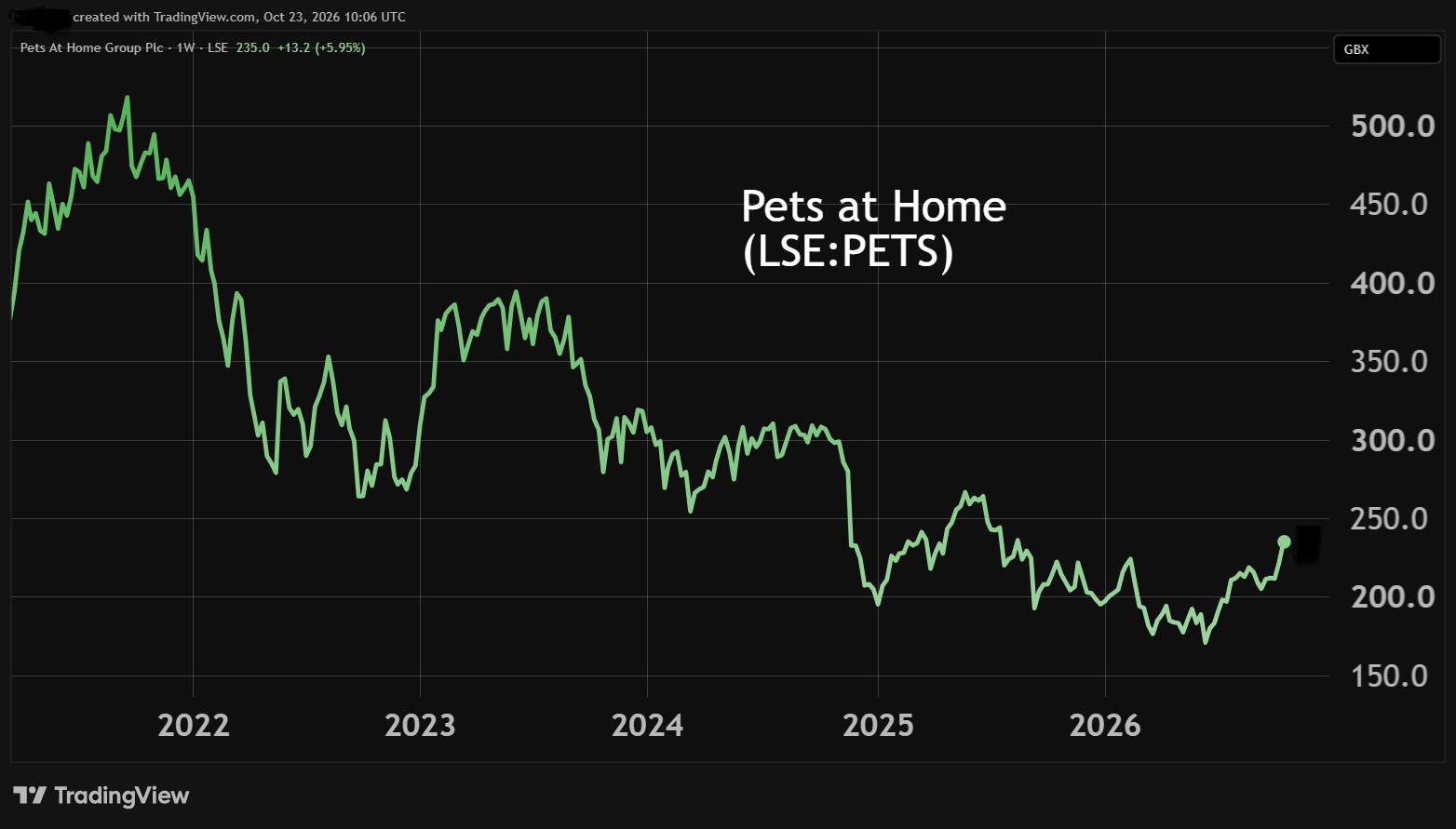
After a long fall from 500p in 2001 when the company had benefited from pet buying during the pandemic, its shares only appeared to bottom out at 177p four months ago.
Source: TradingView. Past performance is not a guide to future performance.
This followed annual results to 26 March that contained uninspiring figures, albeit a message of “building momentum through our retail turnaround plan and unique vets business”. A first-quarter update to 16 July then cited total consumer revenue up 3.9% to £614 million albeit no change to full-year guidance.
The shares rose 6% after a 19 October “buy” note from Peel Hunt, although that was a catch-up in the sense of raising the price target from 180p to 260p, ironically versus 275p now in the market. The accompanying stance is upgraded from “hold” to “buy” on a rationale of improved pricing and better service ratings. Ageing pets, acquired during Covid, should boost veterinary demand, and margin improvement assist double-digit EPS growth.
- Wild’s Winter Portfolios 2026-27: seeking a 10th year of profits
- Sign up to our free newsletter for investment ideas, latest news and award-winning analysis
I respect that Pets is the dominant UK retailer with a 24% market share, although I have been cautious to back its turnaround given discretionary spending pressures. As if dogs and cats are not expensive enough to buy, the cost of their food and insurance or vet bills make me wonder how anyone can be “hard up” if contemplating pets beyond goldfish.
There also has been a March-to-September Competition and Markets Authority (CMA) investigation into household pet vet services, requiring this and other providers to enforce strict transparency and formal estimates for any treatment over £500.
On a forward PE around 13x and 3.7% yield, Pets strikes me as rated fairly, but I respect its story can improve with ongoing initiatives. The shares may, however, have benefited from the retail party since mid-year, hence ahead of the Budget I can only muster a “hold” rating.
Edmond Jackson is a freelance contributor and not a direct employee of interactive investor.
These articles are provided for information purposes only. Occasionally, an opinion about whether to buy or sell a specific investment may be provided by third parties. The content is not intended to be a personal recommendation to buy or sell any financial instrument or product, or to adopt any investment strategy as it is not provided based on an assessment of your investing knowledge and experience, your financial situation or your investment objectives. The value of your investments, and the income derived from them, may go down as well as up. You may not get back all the money that you invest. The investments referred to in this article may not be suitable for all investors, and if in doubt, an investor should seek advice from a qualified investment adviser.
Full performance can be found on the company or index summary page on the interactive investor website. Simply click on the company's or index name highlighted in the article.
Disclosure
We use a combination of fundamental and technical analysis in forming our view as to the valuation and prospects of an investment. Where relevant we have set out those particular matters we think are important in the above article, but further detail can be found here.
Please note that our article on this investment should not be considered to be a regular publication.
Details of all recommendations issued by ii during the previous 12-month period can be found here.
ii adheres to a strict code of conduct. Contributors may hold shares or have other interests in companies included in these portfolios, which could create a conflict of interests. Contributors intending to write about any financial instruments in which they have an interest are required to disclose such interest to ii and in the article itself. ii will at all times consider whether such interest impairs the objectivity of the recommendation.
In addition, individuals involved in the production of investment articles are subject to a personal account dealing restriction, which prevents them from placing a transaction in the specified instrument(s) for a period before and for five working days after such publication. This is to avoid personal interests conflicting with the interests of the recipients of those investment articles.