Shares for the future: reasons to be fearful about AIM star
It’s quickly grown from nothing to a multi-billion company, but these are scary times and analyst Richard Beddard has been surprised by recent forecasts.
23rd October 2026 08:57
by Richard Beddard from interactive investor

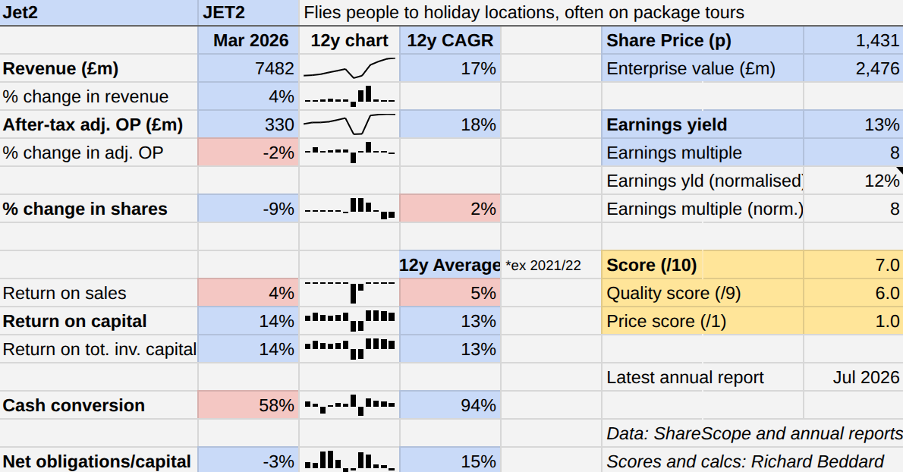
By Jet2 Ordinary Shares (LSE:JET2)’s high standards, the year to March 2026 was a difficult one.
Revenue grew 4%. Adjusted operating profit declined 2%. The company, currently the second-largest on the AIM market, achieved 4% after-tax profit margin, near the bottom end of the historic range that can in some years reach 6%.
- Invest with ii: SIPP Account | Stocks & Shares ISA | See all Investment Accounts
Jet2 flies people on holiday to the Mediterranean.
The company earns most of its revenue over the summer, which falls in the first half of the financial year (from March to September). Consequently, it has already booked most of its revenue for the year to March 2027, but we will not know for sure how it performed in the crucial summer season until it publishes its half-year results next month.
Uncertain outlook
The consensus of analyst forecasts anticipates a 7% rise in revenue to almost £8 billion in the full year to March 2027, but a 42% drop in operating profit from £446.5 million in 2026 to £258 million.
In its AGM statement in September, Jet2 reported sustained demand over the summer. But it also reported that customers are still booking closer to departure due to financial and geopolitical uncertainty. This has a negative impact on profitability and cash flow.
Jet2 has grown from nothing in 2002, when it flew its first passengers from Leeds Bradford airport to Amsterdam. It launched its package holiday business, Jet2holidays, in 2007.
Today Jet2holidays is the dominant contributor of passengers, revenue and profit. It accounts for 63% of passengers, and 80% of total revenue.
Last-minute customers are choosing discounted flight-only tickets though, which are cheaper and less profitable.
The falling passenger share of Jet2holidays from a high of 68% in 2024 to 63% in 2026, is one of the reasons for slowing growth. The company also increased capacity by 8%, but only recruited 5% more passengers in 2026, so it flew less profitably, with a greater proportion of empty seats.
Higher costs are also reducing the profitability of package holidays because Jet2 is not passing them on in full. Although prices improved by 3% in 2026, this was largely because holidaymakers booked higher-quality accommodation, which costs Jet2 more.
Unlike its fleet of planes, Jet2 does not own or operate hotels. Accommodation is its biggest cost, and accommodation costs grew by 7%, accounting for 42% of revenue in 2026.
- Wild’s Winter Portfolios 2026-27: seeking a 10th year of profits
- Jet2 joins AIM market exodus
- US midterms 2026: what election could mean for your portfolio
Looking ahead to March 2027, the war in Iran, which started in February, must have intensified the late booking trend this summer. Due to the closure of the Strait of Hormuz, the conflict has also increased jet fuel prices. Jet2 has fixed the price of 93% of its fuel for 2027 through hedges at an average price of $753 per tonne, which is pricey by historical standards but cheap compared to spot prices.
Jet2's new base at Gatwick is also weighing on profitability this year. Its first flight was in March and at the AGM, the company said Gatwick is performing ahead of expectations due to a higher-than-expected mix of package holidays. However, it does not expect the operation to be profitable until 2029.
Competition is also worrying me. easyJet (LSE:EZJ) relaunched easyJet holidays in 2019 when it brought more of the operation in-house. Over the last five years it has grown faster from a much smaller footprint than Jet2. Today it is the fourth-largest package holiday company by ATOL passenger licences. Above it is We Love Holidays, an online travel agency (OTA), TUI AG (XETRA:TUI1) and Jet2.
Jet2 has thrived alongside OTAs like We Love Holidays, which are an antithetical proposition. They have very little control over the customer's holiday experience, which is sourced through scheduled airlines and bed wholesalers. easyJet is a more similar proposition to Jet2 with an even larger seat capacity, although the bulk of its business remains flight-only.
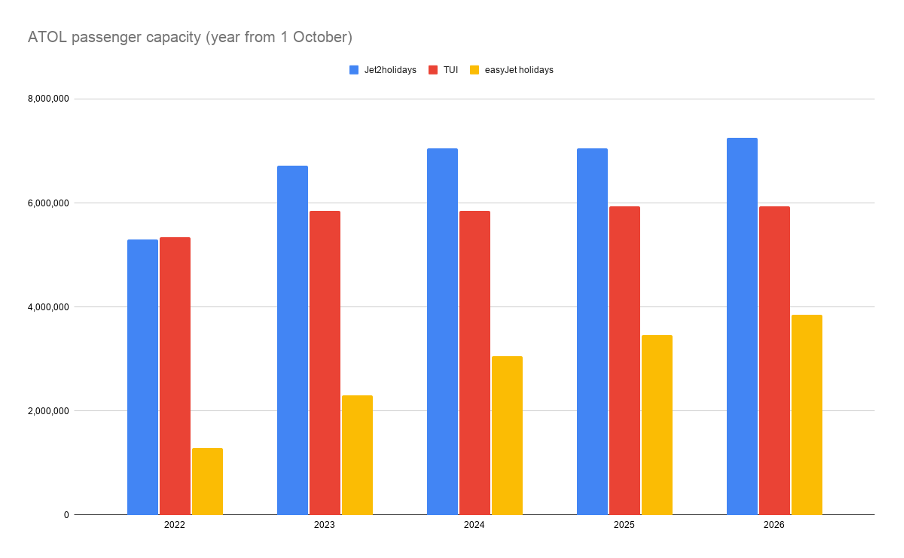
Since 2023, Tui has increased its number of licences by 2%, Jet2holidays has 8% more, and easyJet holidays 68% more passengers. In the year ahead it has licences to fly just over half as many passengers as Jet2.
With so many variables in play, I do not feel confident in the estimates either way for 2027 and forecast recovery in 2028 and 2029. I doubt the analysts are confident either as the spread between individual forecasts is wide. All moot a significant fall in profit for the current year though, which outside the pandemic, shareholders have not experienced in the last 12 years.
Expansion through adversity
Despite the uncertainty, Jet2 had 8% more capacity on sale this summer than it did in 2025, and it has increased capacity for the coming winter by 8% too, mostly at its new base, Gatwick.
Increasing capacity in such a difficult environment may look perverse, but I think Jet2 knows what it is doing. Most of the capacity increase is in the underserved South East, where until this year it had no capacity. The losses at Gatwick are the price of getting established in Britain's most populous corner (and, coincidentally, easyJet's biggest base).
I believe Jet2 is building from a position of strength. It is the UK's biggest package tour operator and third-largest airline. Its distinctive customer service ethos encourages customers to return.
- 200 episodes: 11 golden rules we keep coming back to
- Find out the latest UK Budget news here
- Older generations accelerate financial gifts as IHT changes bite
During the pandemic, Jet2 was the only UK airline to refund customers promptly for flight cancellations due to Covid restrictions and, in 2026, its cancellation rate was a market leading 0.06%. It routinely achieves Which? Recommended Provider status and customer net promoter scores (NPS) for Jet2 and Jet2holidays are in the mid-sixties, which is high. NPS are derived from a single question, whether or not the customer would recommend the company.
It achieves this level of service by controlling most aspects of the flight or holiday.
Jet2 owns most of its planes. It trains its own pilots, employs sizable ground crews and resort staff, and runs its own maintenance operations. It sources and supplies its own in-flight food and gifts. Now it flies from Gatwick, 90% of the UK population lives within 90 minutes drive from one of its 14 bases.
Scoring Jet2: reasons to be fearful
Nevertheless, these are scary times. If the forecasts turn into reality, in 2027 after-tax return on capital will fall beneath the arbitrary 10% level I use to define a company that profits through “thick and thin”.
Cash flow is under pressure as well as profit, because late booking means Jet2 holds on to advanced customer payments for less time. Yet, despite the headwinds, Jet2 is modestly gearing up, by buying back shares.
Climate change presents the biggest long-term risk. Flights are major emitters of greenhouse gases, and likely to come under increasing regulation to mitigate or neutralise the risk. The Mediterranean is also getting hotter. As yet, that does not seem to have diminished our appetite for holidays there, but it may.
Jet2 is doing what it can. It is replacing Boeings and expanding the fleet with new fuel-efficient Airbus A321neo aircraft, electrifying its ground fleet, lobbying for more efficient use of airspace, and using technology to fly more efficiently. Ultimately though, sustainable flight requires sustainable fuels, and their development is not in Jet2's control. It requires industry-wide coordination with governments.
Writing out the short-term and long-term risks, it is hard to imagine why anyone would want to run an airline. To buy and hold for the long term shareholders need to believe the company's very experienced chief executive and finance director and the customer focused ethos they helped to build will prevail. That's been a good bet for two decades.
| Jet2 | JET2 | Flies people to holiday locations, often on package tours | 21/10/2026 | 7/10 |
| How capably has Jet2 made money? | 2.0 | |||
| Jet2 has grown revenue and profit at double digit compound annual growth rates (CAGRs) by flying more people on holiday and selling more package tours. Its long-standing executives have largely self-funded growth by controlling much of the holiday experience, encouraging loyalty. Growth and profitability are under pressure. | ||||
| How big are the risks? | 1.5 | |||
| Like all airlines, Jet2 is vulnerable to events like war, pandemic and climate change. Its singular focus on family friendly holidays in the Med has seen off competitors, but a resurgent easyJet Holidays may be more potent. Despite diminished immediate prospects, Jet2 is gearing up modestly. | ||||
| How fair and coherent is its strategy? | 2.5 | |||
| The next stage in Jet2's expansion is Gatwick, a big opportunity. It is buying fuel efficient planes, electrifying the ground fleet and lobbying for more efficient routes. Radical progress will require wide collaboration though, and that feels a long way away. | ||||
| How low (high) is the share price compared to normalised profit? | 1.0 | |||
| Low. A share price of 1,431p values the enterprise at £2,476 million, about 8 times normalised profit. | ||||
| NB: Bold text indicates factors that reduce the score. Bold and italicised text doubly so. The maximum score is 3 for each criterion except price, which has a maximum of 1 (explained here). | ||||
| Previous score (December 2025): 7.9 | ||||
Most of the risks were identified by my last evaluation but the forecast extent of the downturn Jet2 faces in 2027 has surprised me. The business model may be less resilient than I thought, hence the score is lower this time.
30 Shares for the future
Here is the ranked list of Decision Engine shares. I review the scores at least once a year, soon after each company has published its annual report. The price scores are calculated using the share price prior to publication.
Generally, I consider shares that score more than 5 out of 10 to be worthy of long-term investment in sizes determined by the ideal holding size (ihs%).
Thorpe (F W) (LSE:TFW) and Renishaw (LSE:RSW) have published annual reports and are due to be re-scored.
| company | description | score | qual | price | ih% | |
| 1 | FW Thorpe | Makes lighting systems for commercial, industrial and public settings | 9.9 | 9.0 | 0.9 | 9.8% |
| 2 | Hollywood Bowl | Operates tenpin bowling centres | 9.0 | 8.0 | 1.0 | 8.0% |
| 3 | Cake Box | Cake shop (Cake Box) and sweet shop (Ambala) franchisor | 8.0 | 7.0 | 1.0 | 6.0% |
| 4 | James Latham | Distributes imported panel products, timber, and laminates | 8.0 | 7.0 | 1.0 | 6.0% |
| 5 | Solid State | Manufactures electronic systems and distributes components | 8.0 | 7.0 | 1.0 | 5.9% |
| 6 | Renew | Maintains and improves road, rail, water, and energy infrastructure | 7.9 | 7.5 | 0.4 | 5.8% |
| 7 | Howden Joinery | Supplies kitchens and joinery to builders and online to DIYers | 7.8 | 7.0 | 0.8 | 5.5% |
| 8 | Porvair | Manufactures filters and laboratory equipment | 7.5 | 8.0 | -0.5 | 5.0% |
| 9 | Anpario | Manufactures natural animal feed additives | 7.5 | 7.0 | 0.5 | 5.0% |
| 10 | Games Workshop | Designs, makes and distributes Warhammer. Licences IP | 7.4 | 9.0 | -1.6 | 4.7% |
| 11 | Oxford Instruments | Makes imaging and semiconductor manufacturing systems | 7.4 | 7.0 | 0.4 | 4.7% |
| 12 | Bunzl | Distributes essential everyday items consumed by businesses | 7.3 | 7.0 | 0.3 | 4.6% |
| 13 | Volution | Manufacturer of ventilation products | 7.0 | 8.5 | -1.5 | 4.1% |
| 14 | Auto Trader | Online marketplace for motor vehicles | 7.0 | 6.0 | 1.0 | 4.0% |
| 15 | Churchill China | Manufactures tableware for restaurants etc. | 7.0 | 6.0 | 1.0 | 4.0% |
| 16 | Jet2 | Flies people to holiday locations, often on package tours | 7.0 | 6.0 | 1.0 | 4.0% |
| 17 | Judges Scientific | Acquires and grows businesses that manufacture scientific instruments | 7.0 | 6.0 | 1.0 | 4.0% |
| 18 | YouGov | Surveys public opinion and conducts market research online | 6.8 | 6.0 | 0.8 | 3.6% |
| 19 | Bloomsbury Publishing | Publishes books and educational resources | 6.6 | 7.5 | -0.9 | 3.2% |
| 20 | Cohort | Manufactures/supplies defence tech, training, consultancy | 6.6 | 7.5 | -0.9 | 3.1% |
| 21 | Macfarlane | Distributes and manufactures protective packaging | 6.5 | 5.5 | 1.0 | 3.0% |
| 22 | Advanced Medical Solutions | Manufactures surgical adhesives, sutures and dressings | 6.2 | 6.5 | -0.3 | 2.5% |
| 23 | Focusrite | Designs recording equipment, synthesisers and sound systems | 6.0 | 5.0 | 1.0 | 2.5% |
| 24 | Tristel | Manufactures hospital disinfectant | 5.9 | 8.0 | -2.1 | 2.5% |
| 25 | Softcat | Sells software and hardware to businesses and public sector | 5.9 | 6.5 | -0.6 | 2.5% |
| 26 | 4Imprint | Customises and distributes promotional goods | 5.5 | 8.0 | -2.5 | 2.5% |
| 27 | Goodwin | Casts and machines steel and processes minerals for niche markets | 5.3 | 6.0 | -0.7 | 2.5% |
| 28 | Renishaw | Makes tools and systems for manufacturers | 4.5 | 6.5 | -2.0 | 2.5% |
| 29 | Quartix | Supplies vehicle tracking systems to small fleets | 4.0 | 7.0 | -3.0 | 2.5% |
| 30 | Keystone Law | Operates a network of self-employed lawyers | 4.0 | 7.0 | -3.0 | 2.5% |
Click on a share's score to see a breakdown (scores may have changed due to movements in share price). Key: qual is the share’s score out of 9 for the three quality factors (capabilities, risks, and strategy), price is the price score from -3 to +1, and ih% is the suggested ideal holding size as a percentage of the total value of a diversified portfolio.
Richard Beddard is a freelance contributor and not a direct employee of interactive investor.
Richard owns Jet2 and many shares in the Decision Engine. He weights his portfolio so it owns bigger holdings in the higher-scoring shares.
For more on the Decision Engine and Share Sleuth, please see Richard’s explainer.
Contact Richard Beddard by email: richard@beddard.net or on Twitter: @RichardBeddard
AIM stocks tend to be volatile high-risk/high-reward investments and are intended for people with an appropriate degree of equity trading knowledge and experience.
These articles are provided for information purposes only. Occasionally, an opinion about whether to buy or sell a specific investment may be provided by third parties. The content is not intended to be a personal recommendation to buy or sell any financial instrument or product, or to adopt any investment strategy as it is not provided based on an assessment of your investing knowledge and experience, your financial situation or your investment objectives. The value of your investments, and the income derived from them, may go down as well as up. You may not get back all the money that you invest. The investments referred to in this article may not be suitable for all investors, and if in doubt, an investor should seek advice from a qualified investment adviser.
Full performance can be found on the company or index summary page on the interactive investor website. Simply click on the company's or index name highlighted in the article.
Disclosure
We use a combination of fundamental and technical analysis in forming our view as to the valuation and prospects of an investment. Where relevant we have set out those particular matters we think are important in the above article, but further detail can be found here.
Please note that our article on this investment should not be considered to be a regular publication.
Details of all recommendations issued by ii during the previous 12-month period can be found here.
ii adheres to a strict code of conduct. Contributors may hold shares or have other interests in companies included in these portfolios, which could create a conflict of interests. Contributors intending to write about any financial instruments in which they have an interest are required to disclose such interest to ii and in the article itself. ii will at all times consider whether such interest impairs the objectivity of the recommendation.
In addition, individuals involved in the production of investment articles are subject to a personal account dealing restriction, which prevents them from placing a transaction in the specified instrument(s) for a period before and for five working days after such publication. This is to avoid personal interests conflicting with the interests of the recipients of those investment articles.