The UK’s 15 most-shorted stocks
Hedge funds have been betting against housing and construction businesses. A Kepler analyst looks at key themes running through the data.
29th September 2026 08:54

This content is provided by Kepler Trust Intelligence, an investment trust focused website for private and professional investors. Kepler Trust Intelligence is a third-party supplier and not part of interactive investor. It is provided for information only and does not constitute a personal recommendation.
Material produced by Kepler Trust Intelligence should be considered a marketing communication, and is not independent research.
There remains an interesting dichotomy within financial markets. That is, stock markets are broadly at or around record highs and global economic growth remains good, yet consumers don’t seem to be feeling the benefits.
Here in the UK, that’s certainly true. Indeed, the FTSE All-Share is less than 2% lower than the all-time high it hit in July, spurred on by impressive recent gains for the large-cap FTSE 100 index.
Despite this, consumer confidence remains sluggish. Indeed, sentiment towards the labour market is at its lowest level in three and a half years, while credit accessibility is more difficult than at any time since December 2023, according to S&P Global.
The answer, of course, is that artificial intelligence advances continue to push share price valuations higher around the world (and don’t forget that c. 70% of FTSE 100 revenues comes from overseas), while high gas and oil prices, tax rises and government debt levels are making life trickier for households.
It’s no surprise, then, that hedge funds are increasingly putting their chips on falling share prices for companies that are linked in any way, shape or form to the UK economy. As we round up below, the housing and construction market looks particularly ripe for the picking.
What is short-selling?
Before we dig into the data, a quick reminder that shorting a stock is, essentially, the act of betting that an individual company’s share price will fall, rather than rise (the opposite of what most investors will do).
As we commented last time, we absolutely do not think that ordinary investors can successfully run a book of short positions – and that’s especially true in choppy waters such as now.
However, we do think that it’s a good idea for investors to know which of the stocks in which they invest are being bet against. Exploring the bear case for all of one’s individual long positions can be a good way to play devil’s advocate and ensure you’re happy with your position, or if you think your initial investment thesis has run its course.
There’s been a change in the disclosure regulations around short-selling since the last time we reported the numbers. The Financial Conduct Authority (FCA) no longer provides individual details of which hedge fund is shorting which company, instead publishing only the aggregated short position for each company. It has also lowered the threshold for reporting short positions from 0.5% to 0.2%.
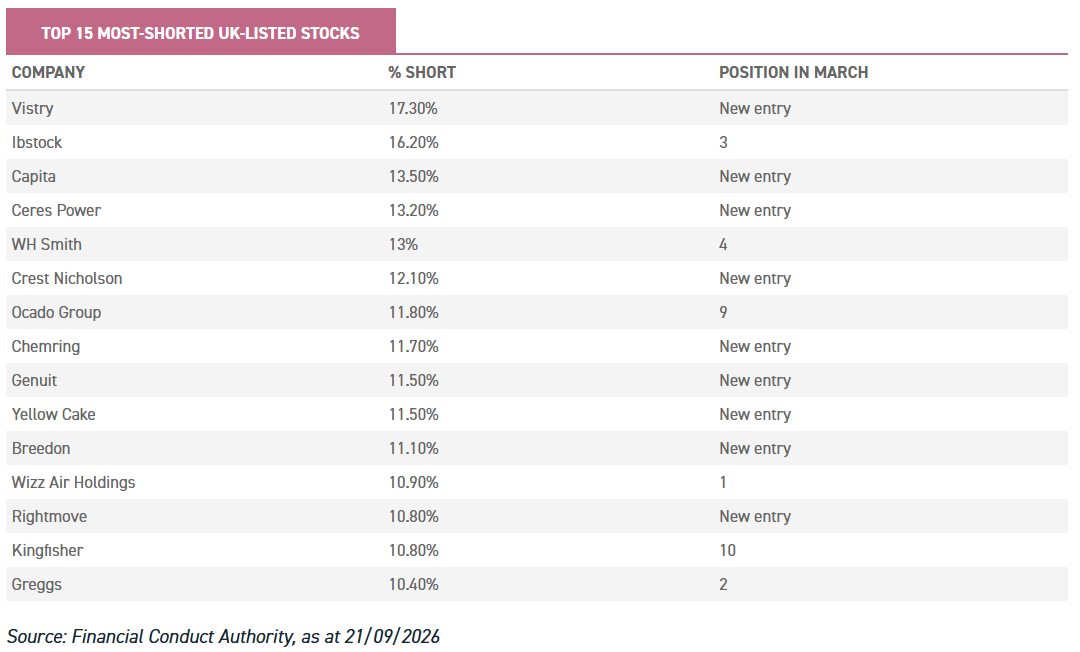
The UK’s most-shorted stocks
Housing pains
There’s one key theme that runs through the data and that is a loss of confidence in the UK housing and property market. Indeed, almost half (seven out of 15) of the companies on our list were in some way related to the housing or construction industry.
Building costs have been rising pretty much ever since the coronavirus pandemic and have surged further since the onset of the Iran war. In addition, rising long-term bond yields have translated into higher mortgage costs, leading to a slowdown in the housing market.
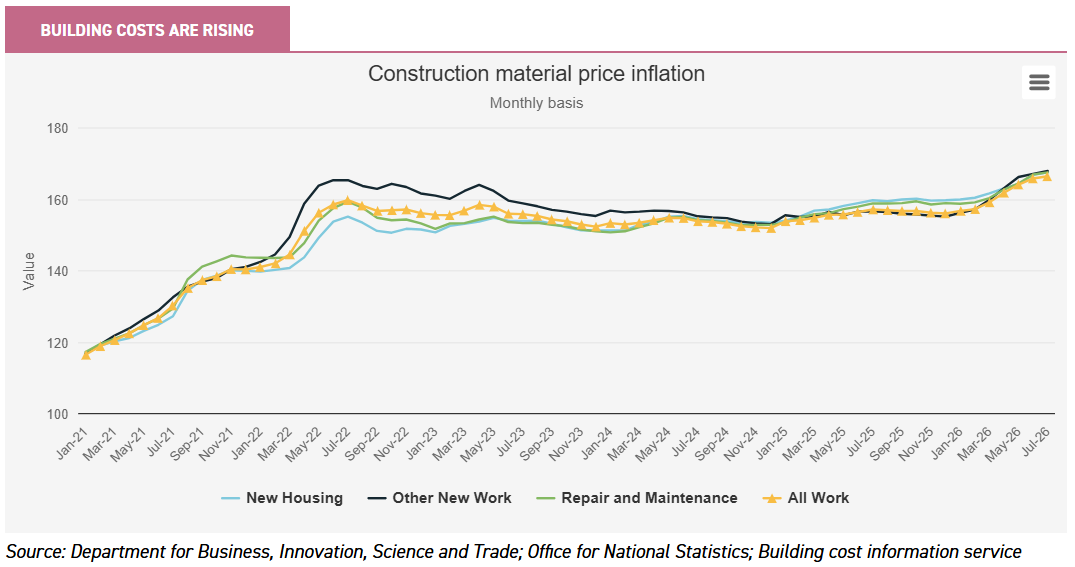
Margins within the housebuilding and construction sectors are under pressure, with eight profit warnings from such companies being posted in the first half of 2026, according to EY.
Two of those companies were Vistry Group (LSE:VTY)and Crest Nicholson Holdings (LSE:CRST), both of which are in the top 10 most-shorted UK stocks. For Vistry, its most recent profit warning was one in a string going back several years. The share price has fallen by more than 80% since mid-2024 and short interest in the company has exploded in recent months.
Vistry’s change in business model from building homes to sell on the open market to building affordable houses in partnership with housing associations and local authorities doesn’t seem to have worked. The firm has been flogging discounted houses to shift inventory and is struggling under c. £144m of debt.
Supply chain woes
It’s not only the housebuilders themselves that are struggling, though; many of the firms further down the supply chain are also being shorted.
Both Ibstock (LSE:IBST)and Breedon Group (LSE:BREE)are in a similar area. Ibstock is the world’s biggest maker of clay bricks. Breedon also makes clay bricks and both firms make concrete building products, too. Breedon also makes roof tiles as well as paving materials used for roads and pavements. Both firms have been hit by demand for their products in the UK being in long-term decline. In fact, Breedon said ready-mixed concrete volumes last year fell to their lowest level since 1963.
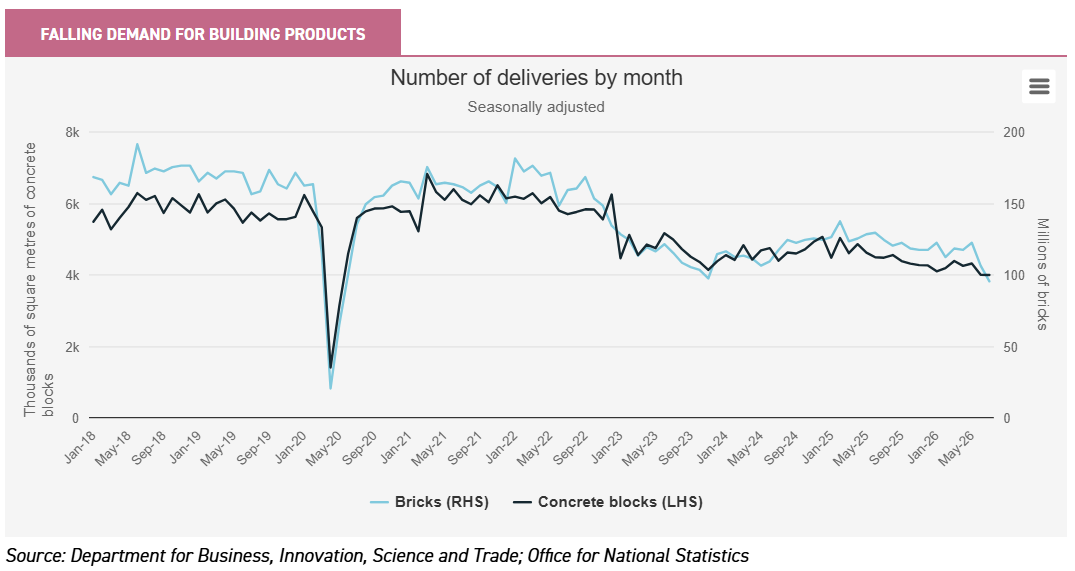
Ibstock warned on profits twice in 2025. It said in August that it had swung to a loss of £27m in the six months to the end of June 2026, versus a profit of £8m in the same period in 2025, as revenue fell 15%. Shares are down almost 50% so far in 2026 and 65% over the past five years.
Breedon’s shares have held up better, though the share price chart still looks rather ugly, down c. 6.4% over five years and 3% in the year to date. The firm remains profitable and revenue is growing, albeit slowly and margins remain soft. It has also been hit by an unscheduled cement mill shutdown in Ireland.
Teething problems
While building-related firms dominated the list, they aren’t the only companies being bet against. A trio of retailers – Kingfisher (LSE:KGF),WH Smith (LSE:SMWH)andGreggs (LSE:GRG) – were hanging around, albeit improvements at Greggs has seen it fall from second most-shorted to 15th.
An interesting new entrant was Yellow Cake Ordinary Shares (LSE:YCA), which buys and stores large quantities of physical uranium oxide concentrate, making it akin to a uranium exchange-traded fund. Shares have been volatile, as has the uranium price, suggesting the shorting could be somewhat tactical. The spot price of uranium has fallen c. 36% since its January 2024 peak, according to the miner Cameco.
YCA shares are up c. 68% over the past five years, with uranium in demand thanks to the proliferation of AI data centres, which will need all the power they can find to fulfil lofty promises.
In a world where defence spending is on the rise and companies with the potential to tap into this are seen as huge beneficiaries, it might be surprising to see a company with exposure to the defence and aerospace supply chain in this list.
Chemring Group (LSE:CHG)sells products and services like military explosives, cyber defence systems and biological warfare agent detection systems to both governments as well as blue-chip companies – an area that should be thriving.
However, while its half-year results struck an upbeat tone, profits were hit by an impairment charge for the retirement of its countermeasure operations in the US state of Tennessee as well as weakness in its sensors & information division.
Net debt also rose by c. 50% to £144.5m as it continues to invest in expanding its energetics production capacity, while the delayed publication of the UK’s Defence Investment Plan didn’t help, either.
How shorting works
Shorting is typically the domain of hedge funds. The process is that the shorter will borrow shares of a particular company from a stockbroker or an investment bank, then sell those shares at the current share price. If the share price falls as they expect, they can then buy the shares back at a lower price, return the shares they borrowed back to their original owner and pocket the difference.
As a worked example, let’s say you borrow 10,000 shares in a company whose share price is £1. You sell those for £10,000 and the share price then falls to 50p. You can buy shares in the open market for £5,000 and return them to whomever you borrowed them for and you have a £5,000 profit, minus the fee you paid to loan the shares and other trading costs.
The risk, of course, is that the share price actually rises. If the share price goes to £2, you’ll spend £20,000 buying them back, giving you a loss of £10,000.
Indeed, the biggest risk involved in short-selling is that your losses can be potentially unlimited: when going long, the most you can lose is 100% of your capital, but share prices can theoretically rise to infinity. Say the share price in our example went to £10, you’d then be facing a loss of £90,000. In percentage terms, that’s a 900% loss.
Kepler Partners is a third-party supplier and not part of interactive investor. Neither Kepler Partners or interactive investor will be responsible for any losses that may be incurred as a result of a trading idea.
These articles are provided for information purposes only. Occasionally, an opinion about whether to buy or sell a specific investment may be provided by third parties. The content is not intended to be a personal recommendation to buy or sell any financial instrument or product, or to adopt any investment strategy as it is not provided based on an assessment of your investing knowledge and experience, your financial situation or your investment objectives. The value of your investments, and the income derived from them, may go down as well as up. You may not get back all the money that you invest. The investments referred to in this article may not be suitable for all investors, and if in doubt, an investor should seek advice from a qualified investment adviser.
Full performance can be found on the company or index summary page on the interactive investor website. Simply click on the company's or index name highlighted in the article.
Important Information
Kepler Partners is not authorised to make recommendations to Retail Clients. This report is based on factual information only, and is solely for information purposes only and any views contained in it must not be construed as investment or tax advice or a recommendation to buy, sell or take any action in relation to any investment.
This report has been issued by Kepler Partners LLP solely for information purposes only and the views contained in it must not be construed as investment or tax advice or a recommendation to buy, sell or take any action in relation to any investment. If you are unclear about any of the information on this website or its suitability for you, please contact your financial or tax adviser, or an independent financial or tax adviser before making any investment or financial decisions.
The information provided on this website is not intended for distribution to, or use by, any person or entity in any jurisdiction or country where such distribution or use would be contrary to law or regulation or which would subject Kepler Partners LLP to any registration requirement within such jurisdiction or country. Persons who access this information are required to inform themselves and to comply with any such restrictions. In particular, this website is exclusively for non-US Persons. The information in this website is not for distribution to and does not constitute an offer to sell or the solicitation of any offer to buy any securities in the United States of America to or for the benefit of US Persons.
This is a marketing document, should be considered non-independent research and is subject to the rules in COBS 12.3 relating to such research. It has not been prepared in accordance with legal requirements designed to promote the independence of investment research.
No representation or warranty, express or implied, is given by any person as to the accuracy or completeness of the information and no responsibility or liability is accepted for the accuracy or sufficiency of any of the information, for any errors, omissions or misstatements, negligent or otherwise. Any views and opinions, whilst given in good faith, are subject to change without notice.
This is not an official confirmation of terms and is not to be taken as advice to take any action in relation to any investment mentioned herein. Any prices or quotations contained herein are indicative only.
Kepler Partners LLP (including its partners, employees and representatives) or a connected person may have positions in or options on the securities detailed in this report, and may buy, sell or offer to purchase or sell such securities from time to time, but will at all times be subject to restrictions imposed by the firm's internal rules. A copy of the firm's conflict of interest policy is available on request.
Past performance is not necessarily a guide to the future. The value of investments can fall as well as rise and you may get back less than you invested when you decide to sell your investments. It is strongly recommended that Independent financial advice should be taken before entering into any financial transaction.
PLEASE SEE ALSO OUR TERMS AND CONDITIONS
Kepler Partners LLP is a limited liability partnership registered in England and Wales at 9/10 Savile Row, London W1S 3PF with registered number OC334771.
Kepler Partners LLP is authorised and regulated by the Financial Conduct Authority.