Nick Train tops the fund leaderboard in October
Saltydog Investor looks at how fund sectors fared last month, while also crunching the numbers to reveal the top 10 overall performers.
3rd November 2026 10:42
by Douglas Chadwick from ii contributor

This content is provided by Saltydog Investor. It is a third-party supplier and not part of interactive investor. It is provided for information only and does not constitute a personal recommendation.
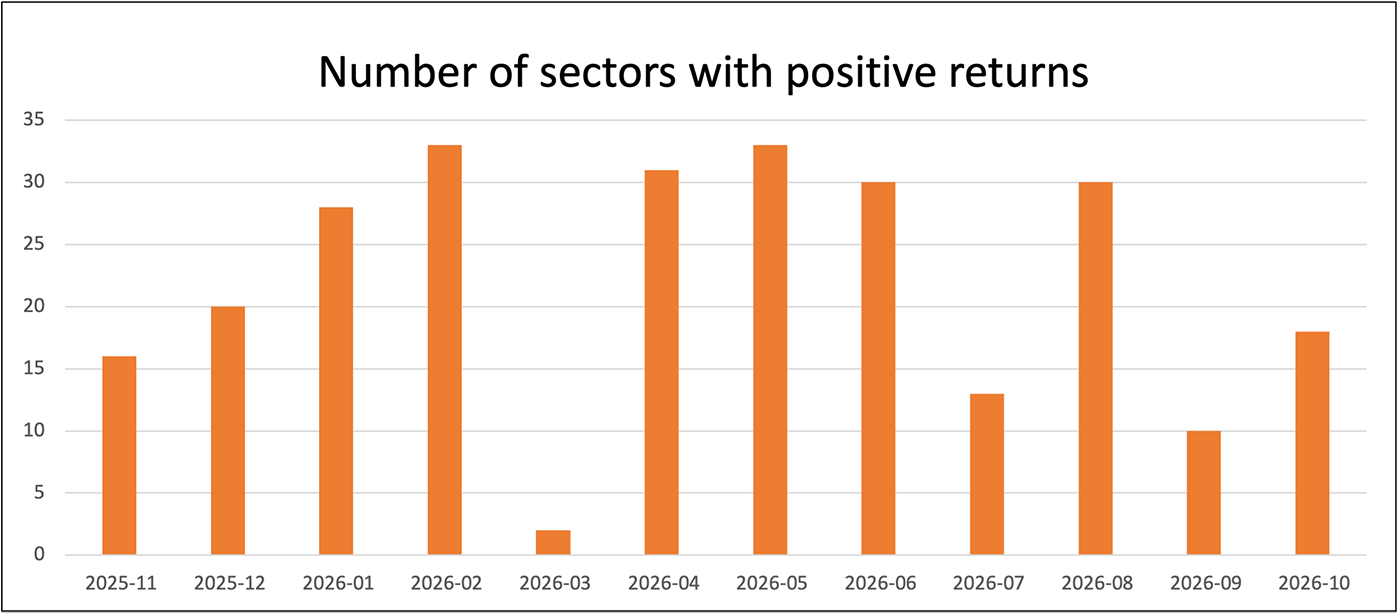
More of the Investment Association (IA) sectors made gains in October than in September, but the overall returns were no better.
Of the 35 sectors that we monitor at Saltydog Investor, 18 finished October in positive territory, compared with just 10 in September. However, the average return across all 35 sectors was a loss of 1.0%, exactly the same as the previous month.
- Our Services: SIPP Account | Stocks & Shares ISA | See all Investment Accounts
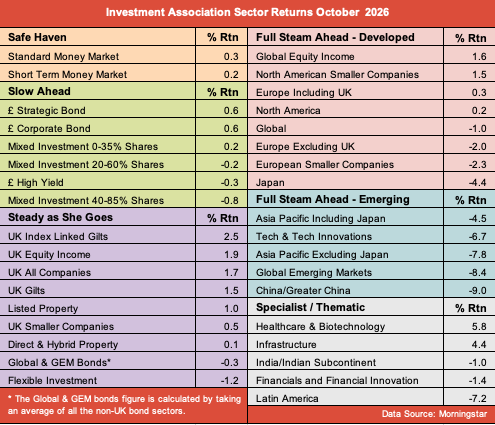
In September, the strongest sector rose 4.8%, while the weakest fell 4.3%. In October, the best-performing sector gained 5.8%, but the worst lost 9.0%.
The following chart shows how the number of sectors making headway has ebbed and flowed over the past year.
Data source: Morningstar. Past performance is not a guide to future performance.
Healthcare & Biotechnology was October’s best-performing sector, gaining 5.8%, followed by Infrastructure, up 4.4%. Several UK equity and bond sectors also performed reasonably well.
However, it was a very different story in Asia and the emerging markets. China/Greater China lost 9.0%, Global Emerging Markets fell 8.4%, and Asia Pacific Excluding Japan went down by 7.8%. Technology & Technology Innovation also had a difficult month, losing 6.7%.
There was an improvement last week, when 31 of our 35 sectors made gains. However, the average return was only 0.2%, partly because Latin America fell 12.9% following Brazil’s presidential election.
Past performance is not a guide to future performance.
October’s top-performing funds
Despite the disappointing average sector performance, as is often the case, some individual funds produced excellent returns.
Saltydog’s top 10 funds in October 2026
| Fund | Investment Association sector | Monthly return |
| WS Lindsell Train UK Equity Acc (B18B9X7) | UK All Companies | 10.8 |
| Schroder ISF Global Energy C Dis GBP AV (B2QM296) | Global | 10.3 |
| BGF World Energy D4 (B3Y9G49) | Commodities & Natural Resources | 10.0 |
| Polar Capital Global Ins I Acc (B5339C5) | Financials & Financial Innovation | 10.0 |
| WS Guinness Global Energy I Acc (B56FW07) | Commodities & Natural Resources | 8.3 |
| L&G Global Health & Pharma Index R Acc (0195553) | Healthcare & Biotechnology | 8.3 |
| Unicorn Outstanding British Co Instl (B1GGDH6) | UK All Companies | 7.6 |
| First Sentier Glb Lstd Infra B GBP Acc (B24HJL4) | Infrastructure | 6.9 |
| FTF ClearBridge UK Rising Div W Acc (B5MJ560) | UK All Companies | 6.8 |
| Liontrust UK Growth I Acc (BNGB8J2) | UK All Companies | 6.7 |
Data source: Morningstar. Past performance is not a guide to future performance.
Four of the 10 funds belong to the UK All Companies sector, despite its average return of just 1.7%. Traditional energy funds also featured prominently, taking three of the top five places.
However, it was the fund at the very top of the table that caught our attention.
A famous name returns to the top
WS Lindsell Train UK Equity Acc (B18B9X7) gained 10.8% in October, making it the strongest-performing fund in our analysis.
Nick Train built an impressive reputation by investing in a relatively small number of high-quality companies and holding them for the long term. His preferred businesses tend to have strong brands, valuable franchises and established competitive advantages.
For many years, this approach delivered excellent results. More recently, however, the fund has struggled, partly because of its limited exposure to sectors such as banking, traditional energy and defence, which have performed well.
- Top 10 most popular investments funds: October 2026
- Top 10 most popular investment trusts: October 2026
Some of its largest holdings, including London Stock Exchange Group (LSE:LSEG), RELX (LSE:REL), Experian (LSE:EXPN) and Sage Group (The) (LSE:SGE), have also faced challenges, including concerns about the potential impact of artificial intelligence (AI).
October’s impressive return will have been welcome news for longstanding investors. However, one good month does not necessarily mean that its fortunes have permanently changed.
An investment trust with a difference
Although Saltydog Investor tends to focus on open-ended funds, we also provide performance data on investment trusts and exchange-traded funds (ETFs).
Investment trusts have long been popular with private investors. They have various ‘bells and whistles’ that set them apart from funds, such as the ability to gear and a fixed pool of assets.
However, they can also be more complicated. Their shares may trade at a premium or discount to the value of their underlying investments, and some hold assets that are not regularly traded on stock markets, making their valuations more difficult to assess.
Lindsell Train was established in 2000 by Nick Train and Michael Lindsell. Nick Train is particularly associated with Finsbury Growth & Income Ord (LSE:FGT) trust, which he has managed since 2001, as well as the Lindsell Train UK Equity fund.
- FTSE 100 shares round-up: Nick Train has plenty to smile about
- Sign up to our free newsletter for investment ideas, latest news and award-winning analysis
However, there is another investment trust bearing the company’s name: the Lindsell Train Ord (LSE:LTI) investment trust. It differs from the fund and the Finsbury trust by owning a substantial stake in Lindsell Train Limited, the privately owned fund management business established by the two founders.
On 31 March 2026, the investment trust owned 23.3% of Lindsell Train Limited. That holding was valued at approximately £28.3 million and represented 19.7% of the trust’s net assets.
In other words, almost £20 of every £100 of the trust’s net assets was represented by an investment in the fund management company itself.
This creates an interesting situation. Lindsell Train Limited earns fees from managing investments, so its income is partly dependent on the amount of money it manages. If its funds attract more investment, the business may become more valuable. However, if performance disappoints and investors withdraw their money, its income and valuation can suffer.
Because Lindsell Train Limited is privately owned, its value is estimated rather than established by a daily stock market price.
When performance affects the business
The consequences have become apparent in recent years.
In the year to 31 March 2026, Lindsell Train Limited’s funds under management fell from approximately £11.4 billion to £7.0 billion.
Over the same period, the investment trust’s holding in the business declined in value from £49.6 million to £28.3 million, a fall of £21.3 million.
The trust’s net asset value total return for the year was a loss of 21.3%, compared with a gain of 16.4% for the MSCI World Index in sterling. Its share price total return was even worse, a loss of 29.2%.
One reason an investment trust’s share price can perform differently from its underlying assets is that its shares trade on the stock exchange, resulting in either a premium or discount to net asset value (NAV).
At 31 March 2026, The Lindsell Train Investment Trust’s shares were trading at a discount of 23.2%.
The substantial discount between the trust’s share price and its net asset value was also behind another interesting development during October.
Shareholders take the opportunity to sell
In September, the trust announced a tender offer allowing shareholders to sell some of their shares at 95% of NAV.
Although that meant accepting 5% less than the underlying asset value, it was considerably more attractive than selling on the stock market, where the shares had been trading at a discount of around 20%.
- New tax raid on your savings: what you need to do now
- Portfolio Dilemma: how do I build a ‘forever’ income portfolio?
The offer was initially limited to 20% of the trust’s issued share capital, but shareholders tendered approximately 32.5%. It was substantially oversubscribed, and the trust ultimately purchased four million shares at approximately 637.3p per share.
This doesn’t necessarily mean that shareholders had lost confidence in the trust. For many, it may simply have been an opportunity to realise a better price than the market was offering. Nevertheless, it suggests that there was considerable appetite to reduce holdings at a price closer to NAV.
Neither Nick Train nor Michael Lindsell, nor the trust’s independent directors, participated in the tender offer.
The trust also arranged to sell part of its holding in Lindsell Train Limited back to the management company. The intention was to maintain broadly the same proportion of the trust’s assets invested in the business, although its percentage ownership of Lindsell Train Limited would be reduced.
What can investors learn?
Even highly respected fund managers can experience prolonged periods of disappointing performance, and investments carrying similar names can have very different characteristics.
The Lindsell Train UK Equity fund, which topped our October performance table, is quite different from The Lindsell Train Investment Trust, given the latter’s substantial exposure to the fund management business itself.
October’s 10.8% gain may be an early indication that the UK Equity fund’s fortunes are improving, but it could also prove to be a temporary rebound. In contrast, The Lindsell Train Investment Trust’s share price rose just 0.7% in October.
At Saltydog Investor, we monitor the performance of investment sectors and individual funds over several time frames, looking for evidence of improving or deteriorating trends.
A famous name can attract attention, but it is no guarantee of future success. What matters is understanding what an investment owns, how it is performing and whether that performance is being sustained.
Our philosophy remains simple: follow the numbers, not the noise.
For more information about Saltydog, or to take the two-month free trial, go to www.saltydoginvestor.com
These articles are provided for information purposes only. Occasionally, an opinion about whether to buy or sell a specific investment may be provided by third parties. The content is not intended to be a personal recommendation to buy or sell any financial instrument or product, or to adopt any investment strategy as it is not provided based on an assessment of your investing knowledge and experience, your financial situation or your investment objectives. The value of your investments, and the income derived from them, may go down as well as up. You may not get back all the money that you invest. The investments referred to in this article may not be suitable for all investors, and if in doubt, an investor should seek advice from a qualified investment adviser.
Full performance can be found on the company or index summary page on the interactive investor website. Simply click on the company's or index name highlighted in the article.