Stockwatch: another oversold share due a recovery?
A lot of investors took a negative view on this stock, but analyst Edmond Jackson wonders whether the worst is over and if they have now reached an inflection point.
7th July 2026 10:42
by Edmond Jackson from interactive investor

Despite gloomy sentiment around the housebuilding sector, it is interesting to consider brick maker Ibstock (LSE:IBST), second only to Vistry Group (LSE:VTY) as the most-shorted share on the UK market.
As a small-cap priced at 94p giving a current value around £375 million, it is easier for a double-digit percentage of its issued share capital to get shorted. But equally and unless fundamentals deteriorate to the point of the company being in financial difficulties, a tighter market bakes in the prospect of a rebound, the question being when?
- Invest with ii: Top UK Shares | Share Tips & Ideas | Cashback Offers
A crowded trade can also generate a rally if enough short sellers start closing positions (buying back stock) as part of risk management. Ibstock’s short position has reduced from 15.3% as of 8 June, to 13.1% currently and, given this only includes positions over 0.5%, the true position could be higher.
It coincides with the near-term chart vaguely showing a double bottom in June – at least demonstrating near-term support – despite the five-year chart looking dire:
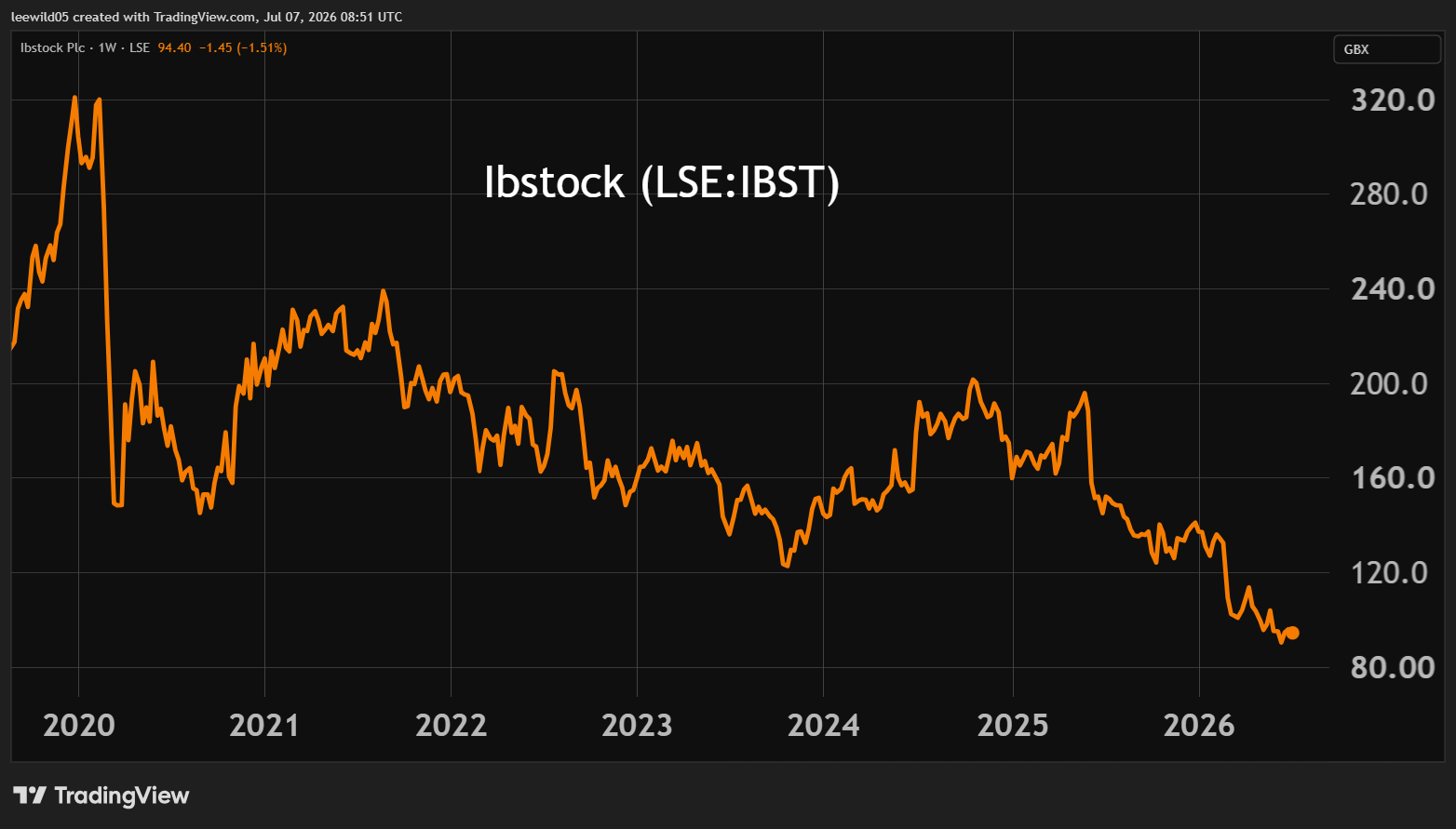
Source: TradingView. Past performance is not a guide to future performance.
The shares actually peaked above 300p in February 2020 just before Covid disrupted that year, and have never really recovered despite meaningful rallies.
While the technical position can appear weighted on the downside, I think it pays to examine such situations to judge risk/reward. You never know when things might turn, and when they do it helps to understand the dynamics involved.
High energy prices a key macro challenge
Ibstock is the UK’s largest supplier of clay and concrete building products – it sells over 450 types of brick as well as terracotta, arches, lintels and more. It should enjoy a long-term tailwind of UK housing shortages being met with supportive government policy, but faces a near-term headwind of high energy prices involved in the manufacturing process.
Energy prices took off from the Ukraine war in February 2022, which coincides with Ibstock’s chart downturn. UK brick deliveries have also slumped around 40% over the last two years as construction has become pressured by higher costs including labour. It has led to nearly a quarter of bricks used in UK construction being imported from Belgium and The Netherlands where gas is subsidised.
Net-zero standards are also a hurdle given that bricks are assessed heavily on front-end carbon expenditure required to fire the kilns.
The UK industry is therefore demanding targeted energy support including gas price relief and a re-evaluation of net-zero building standards.
- Insider: ex-Rolls boss backs one of AIM’s biggest stocks
- 10 hottest ISA shares, funds and trusts
- The most critical stock to watch
But are such fundamentals well-known to the extent of being priced into the shares, which now trade around net asset value? Behavioural economics would also note that 13 hedge funds over the 0.5% disclosure level for short positions implies a crowded trade such that if the company’s situation doesn’t worsen, there is a coiled spring.
AGM affirms consensus expectations
The AGM on 21 May cited “a promising improvement in sales volumes in our clay business”, with market share maintained after wet weather meant a challenging start to 2026. Confidence was expressed in achieving full-year consensus forecasts and “with a well invested, lower-cost, more efficient and sustainable manufacturing network, Ibstock is well positioned to deliver growth in the medium term”.
If that broadly has substance, then an inflection point exists versus the crowded short trade. The chief macro risk seems to be a lack of resolution in the US/Iran war such that economic uncertainty and high energy prices persist, even if military conflict has toned down.
Ibstock’s update did acknowledge that uncertainty is liable to persist for consumer confidence, while high energy prices will likely extend into the second half-year. But it said: “We have taken steps to mitigate this where possible, and are hedged for over 85% of energy requirements for the first three quarters of 2026, with around 80% cover for the full year.”
Group revenue splits between around 70% clay bricks and related masonry items, versus 30% concrete tiles and structural elements. Since concrete products tend to be more budget-friendly, it seems possible that builders might reduce use of clay in pursuit of margin, although concrete versus clay should chiefly rest on specifics of building need.
- eyeQ: BP, Reckitt Benckiser, Mastercard
- Stockwatch: why I’m upgrading this small-cap share to buy
- Shares for the future: a business transformed and positioned for growth?
I am inclined to let the company’s narrative on sales volumes do the talking and, while it’s too early to assert a recovery, it feels too late to join the short party. Recently, the number of increased short positions is similar to those being reduced.
Ibstock - financial summary
Year-end 31 Dec
| 2020 | 2021 | 2022 | 2023 | 2024 | 2025 | |
| Turnover (£ million) | 316 | 409 | 513 | 406 | 366 | 372 |
| Operating margin (%) | -6.3 | 17.1 | 20.9 | 8.6 | 7.4 | 2.7 |
| Operating profit (£m) | -20.0 | 69.9 | 107 | 35.0 | 27.1 | 10.0 |
| Net profit (£m) | -28.0 | 31.8 | 86.9 | 21.1 | 15.1 | 3.1 |
| EPS - reported (p) | -6.9 | 7.8 | 21.5 | 5.3 | 3.8 | 0.8 |
| EPS - normalised (p) | -1.2 | 6.9 | 20.3 | 10.4 | 5.7 | 3.6 |
| Operating cashflow/share (p) | 10.6 | 21.1 | 30.1 | 14.7 | 13.5 | 9.9 |
| Capital expenditure/share (p) | 5.9 | 7.6 | 15.8 | 17.2 | 11.4 | 11.7 |
| Free cashflow/share (p) | 4.7 | 13.4 | 14.3 | -2.5 | 2.1 | -1.8 |
| Dividends per share (p) | 1.6 | 7.5 | 8.8 | 7.0 | 4.0 | 3.0 |
| Covered by earnings (x) | -4.3 | 1.0 | 2.4 | 0.8 | 1.0 | 0.3 |
| Return on total capital (%) | -3.4 | 10.9 | 17.0 | 5.5 | 4.4 | 1.7 |
| Cash (£m) | 19.6 | 61.2 | 54.3 | 23.9 | 9.3 | 21.0 |
| Net debt (£m) | 98.3 | 66.1 | 79.0 | 144 | 157 | 150 |
| Net assets (£m) | 398 | 423 | 416 | 400 | 395 | 382 |
| Net assets per share (p) | 97.1 | 103 | 106 | 102 | 100 | 96.9 |
Source: company accounts.
Mixed but overall supportive valuation criteria
With Ibstock shares having fallen 70% since 2020, consensus forecasts imply a forward price/earnings (PE) ratio of 23x this year easing to 16x for 2027 – as if little to no room for misjudging the trend. Yet it is an acknowledged fact that companies strongly positioned in their markets, undergoing near-term challenges, do see their shares on apparently high PE’s given scope for subsequent recovery.
Ibstock achieved £107 million operating profit in 2022 and normalised earnings per share (EPS) of 20.3p, versus £10 million and 3.6p last year. A steady recovery scenario could see EPS grow from consensus for 4p this year and 6p next, possibly to around 10p which would give a single-figure PE.
The outstanding 2022 performance resulted from dynamic pricing that offset cost inflation and post-Covid there had been a strong recovery in UK residential construction and improvement markets. It at least set a precedent how, if the company is well-managed, investors could get lucky on a two-year view if markets improve and energy prices temper.
Meanwhile, the dividend yield is a less comforting 2.5%, rising to 3.2% assuming consensus for 2.4p per share rising to 3.1p in 2027, relative to 3.0p in 2025. The dividend had rebounded in 2021 but was uncovered from 2023 down to 0.3x in 2025.
- Five AIM share tips for 2026: first-half winners and losers
- Sign up to our free newsletter for investment ideas, latest news and award-winning analysis
The shares are well asset-backed, trading around the £382 million net asset value at end-December, or 1.2x net tangible value. Intangibles constituted 17% of net assets with no goodwill.
Of concern, however, is year-end total debt including leases of £171 million, offset by £21 million cash which generated a £9 million annual net interest charge and substantially wiped out 2025 operating profit. Net profit of £3 million benefited from a £2 million tax rebate. Short sellers are thus betting on a “higher for longer” interest rate scenario while the housing market continues to struggle.
Note 8 to the account cites EBITDA profit covenants with interest cover no more than 3x and at least 4x, tested mid and end-year, on £100 million private placement notes which constitute all long-term debt. Short-term debt – under a revolving credit facility – comprised 29% of total year-end bank debt under the same covenants.
While EBITDA is not the same as reported operating profit, ostensibly the situation looks tight with little scope for trading to deteriorate. The “going concern” section within the 2025 accounts did, however, state, as of 31 December, covenant requirements were met “with significant headroom”. Since they are also tested on 30 June, there should have been an announcement if there were any problems, given that the listing rules require this as soon as possible.
It therefore tilts me towards a “buy” stance given that I think housebuilders and their suppliers are more likely to muddle through than incur the worst-case scenario that short sellers anticipate. A prudent speculator might therefore consider a starter position and see what evolves.
Edmond Jackson is a freelance contributor and not a direct employee of interactive investor.
These articles are provided for information purposes only. Occasionally, an opinion about whether to buy or sell a specific investment may be provided by third parties. The content is not intended to be a personal recommendation to buy or sell any financial instrument or product, or to adopt any investment strategy as it is not provided based on an assessment of your investing knowledge and experience, your financial situation or your investment objectives. The value of your investments, and the income derived from them, may go down as well as up. You may not get back all the money that you invest. The investments referred to in this article may not be suitable for all investors, and if in doubt, an investor should seek advice from a qualified investment adviser.
Full performance can be found on the company or index summary page on the interactive investor website. Simply click on the company's or index name highlighted in the article.
Disclosure
We use a combination of fundamental and technical analysis in forming our view as to the valuation and prospects of an investment. Where relevant we have set out those particular matters we think are important in the above article, but further detail can be found here.
Please note that our article on this investment should not be considered to be a regular publication.
Details of all recommendations issued by ii during the previous 12-month period can be found here.
ii adheres to a strict code of conduct. Contributors may hold shares or have other interests in companies included in these portfolios, which could create a conflict of interests. Contributors intending to write about any financial instruments in which they have an interest are required to disclose such interest to ii and in the article itself. ii will at all times consider whether such interest impairs the objectivity of the recommendation.
In addition, individuals involved in the production of investment articles are subject to a personal account dealing restriction, which prevents them from placing a transaction in the specified instrument(s) for a period before and for five working days after such publication. This is to avoid personal interests conflicting with the interests of the recipients of those investment articles.