Stockwatch: is this sector now in a bull market?
Structural change is having a significant effect on this industry, but takeover activity is generating interest. Analyst Edmond Jackson considers his view on this FTSE 250 share.
3rd November 2026 11:31
by Edmond Jackson from interactive investor

Are the FTSE 250 shares in transport services operator FirstGroup (LSE:FGP) on a sustainable rally and, if so, why might that be?
Since early September the price has risen 37% from 169p to a one-year high of 233p, although the yield is nothing spectacular at 4.2% with 2.7x cover. Admittedly, a forward price/earnings (PE) ratio of 8.5x was modest and is now 11.6x.
- Invest with ii: Top UK Shares | How to Start Trading Stocks | Open a Trading Account
While it is easy to think that there has been overdue PE mean-reversion, transport groups involve a lot of moving parts – excuse the pun – especially in relation to government policy. Projections are complex and can easily be overtaken.
An aid to this re-rate has been Mobico Group (LSE:MCG) (formerly National Express) attracting takeover interest, which encouraged speculation until a 46p per share cash offer arrived on 30 October – representing a doubling of the shares since early last month. This, for a company with riskier finances including over £1.1 billion debt and negative net assets versus £725 million net debt for FirstGroup, at 1.7x net asset value, or 2.3x on a tangible basis.
FirstGroup’s five-year chart has been in a volatile uptrend as the market deciphers headwinds such as a Labour government less well-disposed to private operators plus rising fuel costs, albeit both contributing to good need for public transport.
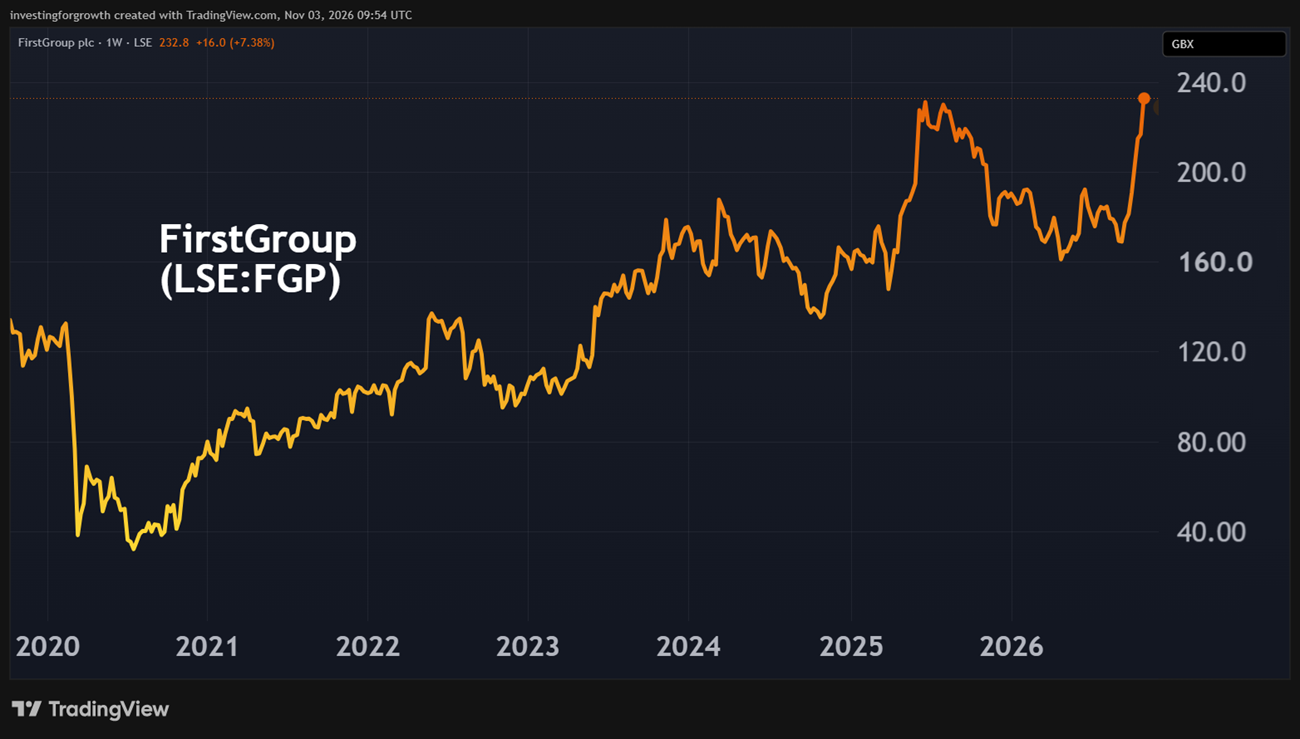
Source: TradingView. Past performance is not a guide to future performance.
A classic value/contrarian/recovery situation
I haven’t written about FirstGroup for three years having originally rated it “buy” at 96p in December 2021. The shares traded at only a small premium to net tangible assets for a business well-established in essential services as the second-largest regional bus operator in the UK and the largest rail operator. Then, in November 2023 at 165p, I adjusted to “hold” amid concern as to what a Labour government might do. Yet the last annual results to 28 March showed FirstGroup deftly adapting to challenges.
Adjusted revenue rose a remarkable 25% to £1.71 billion, with bus growth up 33% to over £1.4 billion fuelled by contract wins and adjacent service expansions. Bus adjusted operating profit also rose 7% to £103 million despite a £26 million decrease in passenger fare funding, lower passenger volumes and £15 million greater National Insurance contributions.
- What’s ahead for BP, Shell and smaller oil players?
- Insider: boss bets his firm's 16-year uptrend has legs
Mind, however, the big adjustments involved versus £4.8 billion reported revenue, amid structural changes affecting train operating companies and franchises such as South Western Railway returning to public ownership. Reported rail revenue fell 20% to £3.3 billion, but the results highlight “open access” revenue – services on the national network without subsidies – up 3% to £109 million. Profit levels slipped due to additional costs amid structural change, showing why one should be careful making any assumptions about PE’s, at least in the near term. Yet free cash flow of 63p per share – a multiple only 3.7x – shows very strong progress over a decade:
FirstGroup - financial summary
year-end 28 Mar
| 2016 | 2017 | 2018 | 2019 | 2020 | 2021 | 2022 | 2023 | 2024 | 2025 | 2026 | |
| Turnover (£ million) | 5,218 | 5,653 | 6,398 | 7,127 | 4,643 | 4,319 | 4,591 | 4,755 | 4,715 | 5,234 | 4,752 |
| Operating margin (%) | 4.7 | 5.0 | -3.1 | 0.1 | -4.6 | 4.0 | 2.7 | 3.2 | 1.0 | 4.3 | 4.6 |
| Operating profit (£m) | 246 | 284 | -196 | 9.8 | -215 | 171 | 123 | 154 | 46.5 | 223 | 219 |
| Net profit (£m) | 90.3 | 112 | -296 | -66.9 | -327 | 78.4 | 636 | 87.1 | -15.9 | 128 | 118 |
| Reported EPS (p) | 7.5 | 9.2 | -24.6 | -5.6 | -27.8 | 0.8 | -1.1 | 10.3 | -1.5 | 19.7 | 20.2 |
| Normalised EPS (p) | 7.7 | 10.7 | -1.6 | 4.6 | -15.6 | -13.2 | -4.9 | 19.8 | 12.8 | 19.7 | 19.1 |
| Return on total capital (%) | 6.2 | 6.5 | -5.6 | 0.2 | -3.9 | 3.3 | 7.0 | 6.4 | 2.6 | 11.4 | 13.4 |
| Operating cashflow/share (p) | 33.8 | 42.8 | 52.9 | 46.7 | 79.0 | 97.8 | 6.2 | 75.2 | 82.0 | 121 | 107 |
| Capex/share (p) | 33.4 | 33.2 | 35.1 | 35.7 | 27.3 | 34.2 | 23.8 | 23.3 | 33.1 | 25.1 | 44.0 |
| Free cashflow/share (p) | 0.4 | 9.6 | 17.8 | 11.1 | 51.7 | 63.6 | -17.6 | 51.9 | 48.9 | 95.9 | 63.0 |
| Cash (£m) | 360 | 401 | 556 | 693 | 969 | 1,439 | 788 | 791 | 497 | 487 | 432 |
| Net debt (£m) | 1,520 | 1,390 | 1,135 | 956 | 3,311 | 2,379 | 626 | 1,276 | 1,148 | 986 | 725 |
| Net assets (£m) | 1,609 | 2,055 | 1,481 | 1,555 | 1,210 | 1,178 | 877 | 740 | 633 | 697 | 710 |
Source: historic company REFS and company accounts.
Buses appear aided by cost-of-living crisis
I imply the shift to buses more for the medium to longer term in the sense of car ownership/running being increasingly out of reach for a segment of the population, unless cheap electric cars with longer range and more widespread charging evolves.
In the short to medium term, it concerns me how the high cost of rail tickets nowadays could make them even more sensitive to the economy beyond essential commuter travel.
Turning government policy challenge into opportunity
Labour’s core policy is to end private operation of passenger train services by bringing them into public ownership as contracts expire. A Great British Railways unified body will oversee Network Rail infrastructure and passenger services, effectively ending the privatised franchise model.
FirstGroup has therefore shifted strategy towards expanding open-access operations that are exempt from nationalisation. It is expanding its highly profitable Lumo and Hull Trains brands, where standard class-only seating enables more passengers per train, spreading operating costs across more travellers. There are also fewer stops and services.
Lumo famously pledges that about 60% of tickets are priced at £30 or less when booked in advance. Hence, if realistic, might this kind of travel help offset reduction in demand for higher-priced tickets if the economy weakens?
Track access has also been secured for new routes such as London to Stirling and South Wales, with applications filed for routes like London to Sheffield. FirstGroup also officially took over operation of the London Overground network in May.
- High-yielding stocks and big ideas in our income portfolio
- New tax raid on your savings: what you need to do now
Meanwhile, the Bus Services Act 2025 gives local transport authorities new powers to franchise services or set up and run their own publicly owned bus companies. Rather than contest this, First Bus has adjusted its model to co-operate with councils to secure long-term franchise operating contracts.
Obviously, proof will come from future financial performance, but the stock market appears to be picking up on the discount factor having been possibly excessive.
7% rise yesterday on sale and leaseback
Under a £109 million agreement in West Yorkshire, FirstGroup is selling its physical depots and fleet to the local authority, and will lease them back at nominal cost to run the newly franchised routes in Leeds and Huddersfield. This protects operational footprint while freeing up capital by way of a £30 million after-tax gain and £55 million cash inflows in the current year to March 2027.
There will also be a £10 million working capital benefit over two years, and a couple of agreed franchise contracts are expected to generate about £40 million combined annual revenue from May 2027. The news seemed a win on various fronts and company broker Panmure Liberum raised its target price to 280p.
- Wild’s Winter Portfolios 2026: winning stocks revealed
- Sign up to our free newsletter for investment ideas, latest news and award-winning analysis
Perhaps the market anticipates further moves like this contributing to overall positive news flow. I would still mind governmental headwinds, such as nationalisation of Avanti West Coast services from March 2027 and rejection of some West Coast open-access expansion proposals.
What of higher diesel and electricity costs?
High energy costs would seem able to at least temper, if not spoil, profits, in the scenario of a protracted Middle East war. FirstGroup has a two-year hedging programme applied to 88% of total fuel needs in the current financial year and 53% in the March 2028 year.
As electric bus operations are scaled up, targeting a fully zero-emission fleet by 2035, a 77% and 46% rate of hedging exists for respective years. It is hard to see what all this costs. Meanwhile, an historic circa £400 million annual diesel bill must be sharply higher for its unhedged element.
One key question for buyers is whether uncertainties like this return once the surprise element of the Mobico takeover ebbs. For now, the shares remain firm at 232p. The company has just completed a second tranche of a £100 million buyback programme, which began on 19 June albeit with no real effect, the market price only starting to rise three months later.
The consensus forecast for March 2028 is for marginally lower earnings per share (EPS) than 2027, albeit on revenue halved as FirstGroup navigates industry structural change. I find this, plus the energy cost variable, tricky to justify upgrading to “buy”, although with due credit to management I think it appropriate to retain a “hold” rating. Half-year results due 17 November could be influential on this stance.
Edmond Jackson is a freelance contributor and not a direct employee of interactive investor.
These articles are provided for information purposes only. Occasionally, an opinion about whether to buy or sell a specific investment may be provided by third parties. The content is not intended to be a personal recommendation to buy or sell any financial instrument or product, or to adopt any investment strategy as it is not provided based on an assessment of your investing knowledge and experience, your financial situation or your investment objectives. The value of your investments, and the income derived from them, may go down as well as up. You may not get back all the money that you invest. The investments referred to in this article may not be suitable for all investors, and if in doubt, an investor should seek advice from a qualified investment adviser.
Full performance can be found on the company or index summary page on the interactive investor website. Simply click on the company's or index name highlighted in the article.
Disclosure
We use a combination of fundamental and technical analysis in forming our view as to the valuation and prospects of an investment. Where relevant we have set out those particular matters we think are important in the above article, but further detail can be found here.
Please note that our article on this investment should not be considered to be a regular publication.
Details of all recommendations issued by ii during the previous 12-month period can be found here.
ii adheres to a strict code of conduct. Contributors may hold shares or have other interests in companies included in these portfolios, which could create a conflict of interests. Contributors intending to write about any financial instruments in which they have an interest are required to disclose such interest to ii and in the article itself. ii will at all times consider whether such interest impairs the objectivity of the recommendation.
In addition, individuals involved in the production of investment articles are subject to a personal account dealing restriction, which prevents them from placing a transaction in the specified instrument(s) for a period before and for five working days after such publication. This is to avoid personal interests conflicting with the interests of the recipients of those investment articles.