Stockwatch: time to buy the drop at this market leader
A very personal experience triggered an interest in this company, and analyst Edmond Jackson believes there’s a good reason to own the shares near a multi-year low.
6th October 2026 10:33
by Edmond Jackson from interactive investor

A plunge of over 30% this year in the shares of robotic-surgery machine maker Intuitive Surgical Inc (NASDAQ:ISRG) make it a lot more intriguing at $400 than nearer $600 in early 2025 and at the start of this year. A 4% rise yesterday to $406 rather affirms my sense of an opportunity.
- Invest with ii: Buy US Stocks from UK | Most-traded US Stocks | Cashback Offers
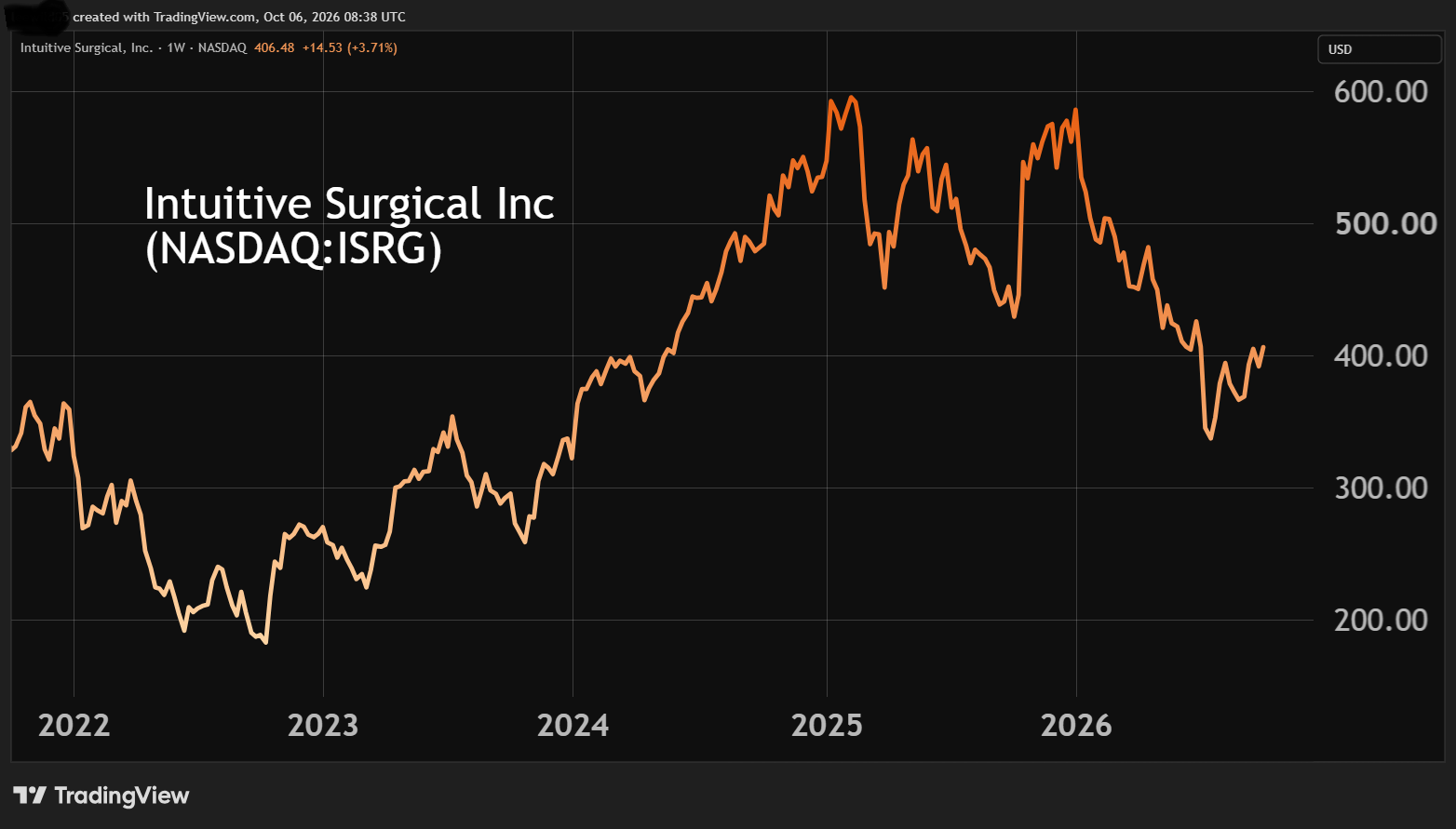
Source: TradingView. Past performance is not a guide to future performance.
I should declare an interest regarding the da Vinci robot that Intuitive is renowned for. A year ago, and despite no symptoms, a blood test led me on to a critical list of men with aggressive prostate cancer. An operation took place at Guildford’s NHS facility where these robots were introduced in 2009 for surgeons to work with.
Under open surgery my recovery period would have been two years. Instead, the da Vinci technology involves a series of tiny incisions through which robotic wrists bend and rotate – further than a human hand – enabling high precision in tight spaces. A 3D-magnified console offers the surgeon a high-definition view which aids, for example, nerve-sparing surgery. Less invasion is involved, there is a reduction in blood loss, and it means a quicker recovery.
Exactly four months later, in a gruelling 13-mile fell race with a near 5,000-feet ascent/descent, I achieved nearly the same time (just short of three hours) as at the end of April 2025, finishing in 21st position out of 59 finishers and first in my age group. I didn’t feel compromised or that I’d had surgery at all. So, I feel well disposed to the da Vinci robot and highly capable surgeon, both saving me from a grim few years to live.
Its advantages show how private hospitals need to proclaim it in their facilities for a wide range of operations, and governments will hardly please voters unless public hospitals keep up. Analysts in the US write of a hardware super-cycle of upgrading involving the da Vinci 5 system, which enables surgeons to feel tissue tension and resistance, and has 10,000 times the computing power of an older model.
- Shares for the future: growing with a tailwind
- Fund Focus: four questions to ask Scottish Mortgage
- Insider: director buys Aviva shares on the dip
After my operation, in the new year I examined Intuitive and saw its shares around $600 and on over 90x 2024 earnings, reflecting its global strength but seemingly overdone. I did not look again until Guildford hospital just recently invited me and other patients to view and experience using the da Vinci robots next month. And now I see that Intuitive shares plunged this year before finding support at around $330 by the end of July.
At $400, the price/earnings (PE) would be 45x consensus for $8.9 earnings per share (EPS) this year, easing to 37x if $10.8 EPS manifests in respect of 2027. That would be nearly twice the underlying earnings growth rate of 21%, with a 2027 PEG (PE/growth) ratio towards 1.8x, where ideally you seek sub-1.0 and might make exceptions up to 1.5x.
This is, however, a snapshot in time and US valuations are prone to overvalue arithmetically. Even a basic business like Walmart Inc (NASDAQ:WMT) is on a 40x forward PE. It would seem you either swallow this and take a view on the quality of a business or just avoid US shares.
Was the drop mean-reversion or genuine concern?
It looks like a mix of both in the sense that Intuitive looked expensive after a habit of upgrades stopped. A second-quarter earnings release projected da Vinci growth stabilising at 13.5% to 15.5%, with procedures involving it in the US slowing from 17% in Q1 to 12% in Q2. A near-term macro factor is involved: subsidies for the Affordable Care Act health plans in the US expire, which is affecting procedures.
With the robots costing from £1.2-£1.9 million equivalent, annual service contracts also involve £75,000 to near £150,000 expenditure, and single-use instruments add around £500 to £2,700 per procedure. Total ownership costs require high annual caseloads such as around 300 procedures annually over seven years, for a hospital to amortise the investment. The NHS at Guildford operates four such robots with over 30 surgeons across a wide range of operations, including the highest-volume prostate in the UK at over 1,500 annually.
Consequently, Intuitive’s 2025-26 first-half income statements show very good dynamics and margins: year-on-year growth is around 20% on a 32.3% operating margin, up from 28.2% in the first half of 2025. In a medium-term context, only a quarter of revenue derives from new robot sales; recurring revenue from instruments and accessories account for roughly 60% of group revenue and instrument revenue per procedure is apparently settled at over £1,350 equivalent, irrespective of hospital or geography.
Intuitive Surgical
Comparison of first-half annual income statements
$ million
| Six months ended 30 June | % growth | ||||
| Revenue: | 2025 | 2026 | |||
| Instruments and accessories | 2,842 | 3,421 | 20.4 | ||
| Systems | 1,097 | 1,336 | 21.8 | ||
| Services | 754 | 906 | 20.2 | ||
| Total revenue: | 4,693 | 5,663 | 20.7 | ||
| Cost of revenue: | |||||
| Product | 1,357 | 1,557 | 14.7 | ||
| Service | 261 | 315 | 20.7 | ||
| Total cost of revenue | 1,618 | 1,872 | 15.7 | ||
| Gross profit | 3,076 | 3,791 | 23.2 | ||
| Operating expenses | |||||
| Selling and administrative | 1,125 | 1,231 | 9.4 | ||
| Research and development | 630 | 732 | 16.2 | ||
| Total operating expenses | 1,754 | 1,964 | 12.0 | ||
| Operating income | 1,322 | 1,827 | 38.2 | ||
| Net interest | 179 | 168 | -6.5 | ||
| Pre-tax income | 1,501 | 1,995 | 32.9 | ||
| Taxation | 133 | 346 | 160 | ||
| Net income | 1,368 | 1,649 | 20.5 | ||
| Earnings per share | Basic | 3.79 | 4.63 | 22.2 | |
| Diluted | 3.72 | 4.57 | 22.8 |
As you would expect, global competition is therefore growing for Intuitive’s circa 20-year monopoly in soft-tissue robotic surgery. Other listed US companies include Medtronic (NYSE:MDT), Johnson & Johnson (NYSE:JNJ) and Stryker Corp (NYSE:SYK), plus CMR Surgical and Shanghai MicroPort MedBot (Group) Co Ltd Class H (SEHK:2252) in China, which is targeting emerging markets and Europe with significantly lower pricing and rapid advancements in 5G remote surgery.
Remarkably, Shanghai-based Medbot enables surgeons to perform operations thousands of miles away using digital signals over cellular and fibre networks. It certainly adds a new dimension to frustrations with wi-fi going down.
As early da Vinci patents expire, this has lowered barriers to entry. Also, while the older da Vinci robots involve a unified bulky cart structure, newcomers such as Hugo and Versius are more easily integrated into operating rooms. As the market extends globally, it becomes more cost-conscious and challengers are under-cutting Intuitive on price.
So, there are headwinds, yet Intuitive is hardly ex-growth. The issue is more whether this is “growth at a fair price”. Even versus Chinese competition, Intuitive’s Asian revenue rose 20% year-on-year in the second quarter.
The tailwinds are powerful including ageing demographics globally, plus an extension of procedures performed this way, with the advantages a “no-brainer” for patients. Medical insurers will want to promote their robotic surgery offering, those who can pay will, and surgeons will also drive adoption of da Vinci robots since many straddle the private and public sectors.
This, I believe, explains why the drop in Intuitive shares is being bought.
Should a disciplined value investor be involved?
The crux is whether a qualitative case for Intuitive overrides the quantitative one. Properly, we should not “count twice” for an attractive story - the forward PEG is near 1.8x relative to circa 20% growth dynamics, and periodically the headwinds could cause the shares a bit of a storm versus tailwinds. There is no margin of safety, at least arithmetically.
What tilts me towards a “buy” stance however is Intuitive’s growth rate being the fastest in years despite more competition arriving. This appears to reflect virtue of a circa 80% share of soft-tissue robotic surgery with the machines, plus related and recurring revenue layered on top. Even moderate loss of share over a decade or two as the international market expands, would still represent a strong company.
- eyeQ: the UK bank share to watch in run-up to Budget
- Sign up to our free newsletter for investment ideas, latest news and award-winning analysis
- The Analyst: investing in robotics and the funds to own
It is a risky buy in the sense that China has arrived in this industry, with domestic manufacturers strongly backed by the government, scaling a large hospital market. The competition must be difficult enough to compare by hospital procurers anywhere, let alone amateur investors. But if the likes of Medbot are seen mounting a serious global challenge to Intuitive, then it might challenge that rich share rating.
A position, therefore, seems justified, but take care as to the weighting in your portfolio and follow the story.
Edmond Jackson is a freelance contributor and not a direct employee of interactive investor.
These articles are provided for information purposes only. Occasionally, an opinion about whether to buy or sell a specific investment may be provided by third parties. The content is not intended to be a personal recommendation to buy or sell any financial instrument or product, or to adopt any investment strategy as it is not provided based on an assessment of your investing knowledge and experience, your financial situation or your investment objectives. The value of your investments, and the income derived from them, may go down as well as up. You may not get back all the money that you invest. The investments referred to in this article may not be suitable for all investors, and if in doubt, an investor should seek advice from a qualified investment adviser.
Full performance can be found on the company or index summary page on the interactive investor website. Simply click on the company's or index name highlighted in the article.
Disclosure
We use a combination of fundamental and technical analysis in forming our view as to the valuation and prospects of an investment. Where relevant we have set out those particular matters we think are important in the above article, but further detail can be found here.
Please note that our article on this investment should not be considered to be a regular publication.
Details of all recommendations issued by ii during the previous 12-month period can be found here.
ii adheres to a strict code of conduct. Contributors may hold shares or have other interests in companies included in these portfolios, which could create a conflict of interests. Contributors intending to write about any financial instruments in which they have an interest are required to disclose such interest to ii and in the article itself. ii will at all times consider whether such interest impairs the objectivity of the recommendation.
In addition, individuals involved in the production of investment articles are subject to a personal account dealing restriction, which prevents them from placing a transaction in the specified instrument(s) for a period before and for five working days after such publication. This is to avoid personal interests conflicting with the interests of the recipients of those investment articles.