Shares for the future: growing with a tailwind
Analyst Richard Beddard believes this complex company should benefit from an expected boom in government spending, so remains worthy of long-term investment.
2nd October 2026 15:00
by Richard Beddard from interactive investor

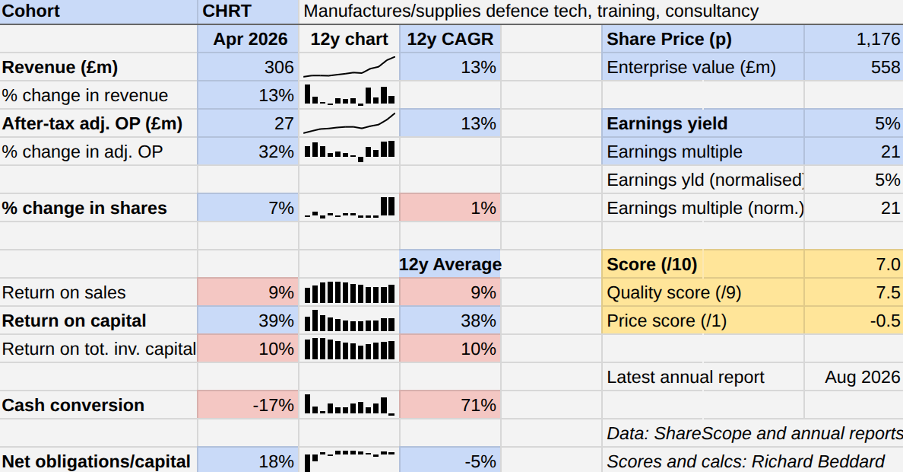
In the year to April 2026, revenue at Cohort (LSE:CHRT) increased 13% - bang on its long-term compound average growth rate (CAGR).
Despite a 32% surge in profit, the gaggle of seven defence technology businesses performed as they often do. Cohort’s best businesses performed very well; its more erratic subsidiaries performed less well.
- Invest with ii: Top UK Shares | Share Tips & Ideas | Open a Trading Account
A tale of two divisions
Acquired nearly two years ago, EM Solutions, an Australian manufacturer of satellite communications (SATCOM) systems, contributed three months revenue in 2025 and a full year in 2026. The injection of nine months of additional revenue pretty much accounted for all the group’s growth in 2026.
The pre-existing group of six companies had a flat year in 2026. This is probably not cause for concern.
MCL, an added value distributor of military hardware experienced a big contraction. In 2025, it had supplied large and urgent one-off orders to the UK Ministry of Defence (MOD), earning a windfall.
As a supplier of off-the-peg military hardware, MCL’s order book is particularly volatile, and the subsequent contraction was expected.
Typically, MCL earns modest profit margins compared to MASS, a defence IT consultancy, and newcomer EM Solutions, both of which sit with MCL in Communications and Intelligence, one of Cohort’s two divisions.
MASS has been Cohort’s highest-margin business since it was acquired in 2006, the year the group floated on the stock exchange. A 20% increase in MASS’ revenue goes some way to explaining Cohort’s profit surge in 2026. But EM Solutions’ profit margin eclipsed MASS’, which takes us the rest of the way.
The division also includes EID, a Portuguese manufacturer of communications systems. EID has been a somewhat patchy performer but in aggregate Communications & Intelligence achieved a 20% profit margin before central costs, above the 18% average and the 16% achieved in 2019, the first year we have data for.
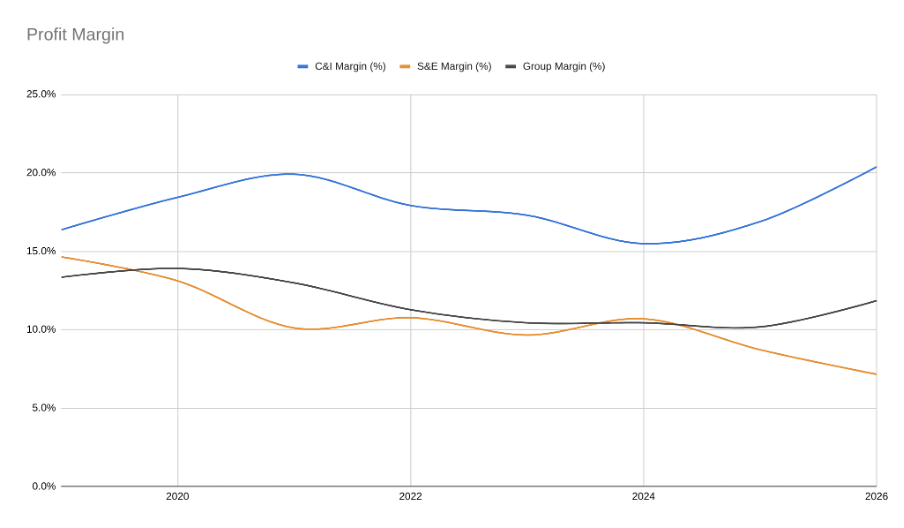
C&I is Communications and Intelligence, S&E is Sensors and Effectors. Source: Cohort annual reports
If only Sensors and Effectors was so profitable. Aggregate profit margin for the three subsidiaries in this division hit a new low of 7% for the decade.
SEA, a supplier of naval technology that has also been part of the group since 2006, lost revenue through the disposal of a small part of the business that operated in the civilian transport market. The company says it is also coming to the end of some low-margin contracts.
Chess makes surveillance and targeting systems. Acquired in 2018, Cohort has been turning Chess around for almost as long as it has owned it. The subsidiary made a small profit in 2026 after breaking even in 2025.
More management changes in 2026 and significant orders for counter-drone systems leads the company to expect further improvement in 2027. Chess is planning a new facility for its production line, currently split across 13 buildings.
- Can GSK shares outperform FTSE 100 index over the long run?
- Sign up to our free newsletter for investment ideas, latest news and award-winning analysis
Conservative accounting for costs is dragging on margins at ELAC Sonar, Cohort’s German subsidiary. ELAC is making sonar systems for Leonardo SpA Az nom Post raggruppamento (MTA:LDO), a defence contractor supplying another defence contractor, Fincantieri SpA (MTA:FCT), which is building submarines for the Italian navy.
ELAC may be able to release cost contingencies once the first systems are delivered, which would result in higher margins. Delivery is expected by the end of this calendar year.
It is tempting to believe the Sensors and Effectors division can be much more profitable, but I do not think we can take it for granted. Long-term contracts are difficult to price, and SEA and Chess have endured unprofitable contracts before.
Improved profitability at ELAC Sonar depends on the actual costs it incurs, so higher margins on the Italian submarine programme are not guaranteed either.
Plus ça change
As often happens at Cohort, the group’s aggregate performance was impressive. After-tax adjusted operating profit margin and return on capital in 2026 matched their historical averages of 9% and 38% respectively.
Cash conversion turned negative though, due primarily to a £34 million working capital cash outflow to fund the big sonar and satellite communications programs. Cohort also spent a record £20 million on capital expenditure, some of it on a new ELAC Sonar facility.
Big fluctuations in working capital are risky because they can dent a company’s finances. Since the half-year in 2026, working capital has improved. Back then the company’s net bank debt was £32.5 million, significant in my view.
The poor performance of some of Cohort’s acquisitions leads me to question their quality. Cohort’s after-tax return on total invested capital including the unamortised cost of acquisitions was 9%, which is not particularly distinguished.
- Shares round-up: an 8% dividend yield and Filtronic’s rally
- What are investors buying? Inside the top 20 index funds and ETFs
Each new acquisition brings new capabilities, customers and territories to the group, but it also increases complexity. Cohort’s business model requires it to give subsidiaries the freedom to be agile and entrepreneurial, but the cost of supervising them or the likelihood of mistakes may increase with time.
Scoring Cohort: growing with a tailwind
Despite these reservations, Cohort thrived when military spending was subdued. This decade, governments are under pressure to spend.
While the UK is dragging its feet compared to many of our allies, Cohort’s overseas diversifications and export focus have reduced its dependence on the MOD. Demand for its products and services should grow.
Managing the complexity is an enormously experienced board overseen by Cohort’s founding chair. Chief executive Andrew Thomis has been with the business from the start and was promoted to his current role in 2009. Cohort’s chief financial officer joined in its first year. Their careers in defence go back much further.
| Cohort | CHRT | Manufactures/supplies defence tech, training, consultancy | 29/09/2026 | 7/10 |
| How capably has Cohort made money? | 3.0 | |||
| Cohort has grown revenue and adjusted profit at double-digit CAGRs over the long term by acquiring niche manufacturers and integrators of defence equipment and investing in them. It has achieved high levels of profitability and cash generation while diversifying. | ||||
| How big are the risks? | 2.0 | |||
| A ROTIC of 9%, and the indifferent performance of some subsidiaries, leads me to question the quality of some acquisitions. Long-term fixed price contracts can be risky and even though Cohort has diversified, four large contracts comprise 32% of its order book. I scored 2.5 here last time. | ||||
| How fair and coherent is its strategy? | 2.5 | |||
| Cohort is reducing its dependence on the MOD by acquiring exporters and overseas businesses. This exposes it to more complexity and potentially a higher cost base, but also gives it more customers and know-how to share. Its experienced board has followed the same buy-and-build playbook for two decades. | ||||
| How low (high) is the share price compared to normalised profit? | -0.5 | |||
| High. A share price of 1,156p values the enterprise at £549 million, about 20 times normalised profit. | ||||
| NB: Bold text indicates factors that reduce the score. Bold and italicised text doubly so. The maximum score is 3 for each criterion except price, which has a maximum of 1 (explained here) | ||||
Cohort expects revenue growth from both divisions in the year to April 2027. At the annual general meeting (AGM) last week, the company said it was trading in line with analysts’ estimates. ShareScope reports an aggregate estimate of 6% revenue growth.
30 Shares for the future
Here is the ranked list of Decision Engine shares. I review the scores at least once a year, soon after each company has published its annual report. The price scores are calculated using the share price prior to publication.
Generally, I consider shares that score more than 5 out of 10 to be worthy of long-term investment in sizes determined by the ideal holding size (ihs%).
Jet2 Ordinary Shares (LSE:JET2) has published its annual report and is due to be re-scored. I am also planning to rescore Softcat (LSE:SCT) following a large acquisition, and Judges Scientific (LSE:JDG) following its half-year results.
| company | description | score | qual | price | ih% | |
| 1 | FW Thorpe | Makes lighting systems for commercial, industrial and public settings | 9.9 | 9.0 | 0.9 | 9.8% |
| 2 | Hollywood Bowl | Operates tenpin bowling centres | 8.6 | 8.0 | 0.6 | 7.3% |
| 3 | Jet2 | Flies people to holiday locations, often on package tours | 8.0 | 7.0 | 1.0 | 6.0% |
| 4 | James Latham | Distributes imported panel products, timber, and laminates | 8.0 | 7.0 | 1.0 | 6.0% |
| 5 | Solid State | Manufactures electronic systems and distributes components | 8.0 | 7.0 | 1.0 | 5.9% |
| 6 | Renew | Maintains and improves road, rail, water, and energy infrastructure | 7.9 | 7.5 | 0.4 | 5.8% |
| 7 | Howden Joinery | Supplies kitchens and joinery to builders and online to DIYers | 7.8 | 7.0 | 0.8 | 5.6% |
| 8 | Cake Box | Cake shop (Cake Box) and sweet shop (Ambala) franchisor | 7.8 | 7.0 | 0.8 | 5.5% |
| 9 | Anpario | Manufactures natural animal feed additives | 7.7 | 7.0 | 0.7 | 5.3% |
| 10 | Judges Scientific | Acquires and grows businesses that manufacture scientific instruments | 7.5 | 6.5 | 1.0 | 5.0% |
| 11 | Porvair | Manufactures filters and laboratory equipment | 7.5 | 8.0 | -0.5 | 5.0% |
| 12 | Bunzl | Distributes essential everyday items consumed by businesses | 7.4 | 7.0 | 0.4 | 4.8% |
| 13 | Games Workshop | Designs, makes and distributes Warhammer. Licenses IP | 7.3 | 9.0 | -1.7 | 4.6% |
| 14 | Quartix | Supplies vehicle tracking systems to small fleets | 7.1 | 7.0 | 0.1 | 4.1% |
| 15 | Churchill China | Manufactures tableware for restaurants etc. | 7.0 | 6.0 | 1.0 | 4.0% |
| 16 | Auto Trader | Online marketplace for motor vehicles | 7.0 | 6.0 | 1.0 | 4.0% |
| 17 | Cohort | Manufactures/supplies defence tech, training, consultancy | 7.0 | 7.5 | -0.5 | 3.9% |
| 18 | Volution | Manufacturer of ventilation products | 6.9 | 8.5 | -1.6 | 3.8% |
| 19 | Bloomsbury Publishing | Publishes books and educational resources | 6.9 | 7.5 | -0.6 | 3.8% |
| 20 | Oxford Instruments | Makes imaging and semiconductor manufacturing systems | 6.9 | 7.0 | -0.1 | 3.8% |
| 21 | YouGov | Surveys public opinion and conducts market research online | 6.8 | 6.0 | 0.8 | 3.7% |
| 22 | Macfarlane | Distributes and manufactures protective packaging | 6.5 | 5.5 | 1.0 | 3.0% |
| 23 | Keystone Law | Operates a network of self-employed lawyers | 6.5 | 7.0 | -0.5 | 2.9% |
| 24 | Advanced Medical Solutions | Manufactures surgical adhesives, sutures and dressings | 6.2 | 6.5 | -0.3 | 2.5% |
| 25 | Softcat | Sells software and hardware to businesses and public sector | 6.2 | 7.0 | -0.8 | 2.5% |
| 26 | Focusrite | Designs recording equipment, synthesisers and sound systems | 6.0 | 5.0 | 1.0 | 2.5% |
| 27 | Tristel | Manufactures hospital disinfectant | 5.9 | 8.0 | -2.1 | 2.5% |
| 28 | 4Imprint | Customises and distributes promotional goods | 5.6 | 8.0 | -2.4 | 2.5% |
| 29 | Goodwin | Casts and machines steel and processes minerals for niche markets | 5.3 | 6.0 | -0.7 | 2.5% |
| 30 | Renishaw | Makes tools and systems for manufacturers | 4.3 | 6.5 | -2.2 | 2.5% |
Click on a share’s score to see a breakdown (scores may have changed due to movements in share price). Key: qual is the share’s score out of 9 for the three quality factors (capabilities, risks, and strategy), price is the price score from -3 to +1, and ih% is the suggested ideal holding size as a percentage of the total value of a diversified portfolio.
Richard Beddard is a freelance contributor and not a direct employee of interactive investor.
Richard owns Cohort and many shares in the Decision Engine. He weights his portfolio so it owns bigger holdings in the higher-scoring shares.
For more on the Decision Engine and Share Sleuth, please see Richard’s explainer.
AIM stocks tend to be volatile high-risk/high-reward investments and are intended for people with an appropriate degree of equity trading knowledge and experience.
These articles are provided for information purposes only. Occasionally, an opinion about whether to buy or sell a specific investment may be provided by third parties. The content is not intended to be a personal recommendation to buy or sell any financial instrument or product, or to adopt any investment strategy as it is not provided based on an assessment of your investing knowledge and experience, your financial situation or your investment objectives. The value of your investments, and the income derived from them, may go down as well as up. You may not get back all the money that you invest. The investments referred to in this article may not be suitable for all investors, and if in doubt, an investor should seek advice from a qualified investment adviser.
Full performance can be found on the company or index summary page on the interactive investor website. Simply click on the company's or index name highlighted in the article.
Disclosure
We use a combination of fundamental and technical analysis in forming our view as to the valuation and prospects of an investment. Where relevant we have set out those particular matters we think are important in the above article, but further detail can be found here.
Please note that our article on this investment should not be considered to be a regular publication.
Details of all recommendations issued by ii during the previous 12-month period can be found here.
ii adheres to a strict code of conduct. Contributors may hold shares or have other interests in companies included in these portfolios, which could create a conflict of interests. Contributors intending to write about any financial instruments in which they have an interest are required to disclose such interest to ii and in the article itself. ii will at all times consider whether such interest impairs the objectivity of the recommendation.
In addition, individuals involved in the production of investment articles are subject to a personal account dealing restriction, which prevents them from placing a transaction in the specified instrument(s) for a period before and for five working days after such publication. This is to avoid personal interests conflicting with the interests of the recipients of those investment articles.