FTSE 100 round-up: Glencore, Rolls-Royce, HSBC, Prudential
While the FTSE 100 results season continues to deliver positive news for investors, today’s session was not without its challenges. Graeme Evans reports.
5th August 2026 13:33
by Graeme Evans from interactive investor
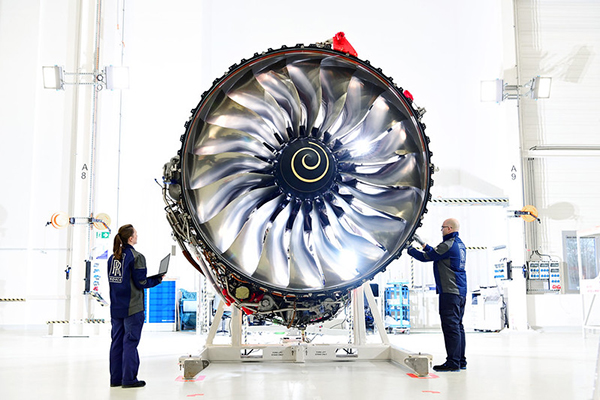
A Rolls-Royce Trent engine. Credit: Rolls-Royce via Flickr.
A fresh record for Rolls-Royce Holdings (LSE:RR.) shares and an income boost by Glencore (LSE:GLEN) today countered the drag of HSBC Holdings (LSE:HSBA) after the biggest stock in the FTSE 100 index suffered a post-results slump.
HSBC’s 6% slide and the heavy selling of Asia-focused Prudential (LSE:PRU) and Standard Chartered (LSE:STAN) on a report that China tax authorities have targeted the returns of offshore insurance policies weighed on the blue-chip benchmark, which slipped 36.10 points to 10,843.
- Invest with ii: Top UK Shares | Share Tips & Ideas | Open a Trading Account
This compares with last week’s intraday all-time high of 10,989.45 and today’s record level for Europe’s Stoxx600 and last night’s new peak for the S&P 500 index.
On the FTSE 100 risers board, Rolls-Royce rallied by as much as 2.5% to set another new record of 1,568.8p after Deutsche Bank improved its price target to 1,705p.
The bank revised its 2028 forecasts and said the story beyond that year “keeps getting better” after all divisions performed ahead of expectations in last week’s interim results.
In particular, the civil aerospace operating margin reached a record level of 25.3% compared with the company’s mid-term 2028 guidance of between 21%-23%.
This was the result of a stronger aftermarket performance, mainly driven by higher long-term service agreement (LTSA) margins and increased shop visit volumes. Deutsche Bank added that there appeared to be no major headwinds on the horizon.
The shares are up by 43% since the end of April and by 14% since the results on 30 July, when Rolls upgraded operating profit guidance for this year to between £4.7 billion and £4.9 billion and hiked its interim dividend by 33% to 6p a share.
Glencore shares are up 37% since January, including today’s rise of 18.3p to 568.9p after the mining giant doubled the value of its shareholder distribution planned for 18 September.
Alongside the 8.5 US cents previously announced with February’s results, Glencore said in today’s half-year figures that it now planned a special cash award of the same value.
The $1 billion (£742 million) top-up distribution and share buyback worth $500 million have been made possible by a reduction in net debt towards a through-the-cycle cap of $10 billion.
Glencore last paid the sterling equivalent of 6.29p a share on 3 June, which was the first of the two base instalments in relation to the 17 US cents share or $2 billion declared for 2025.
Today’s results showed an 86% jump in underlying earnings to $10.1 billion after the Middle East conflict led to the significant repricing of energy and closely related markets.
The Industrial segment’s earnings rose 72% to $6.5 billion as significantly higher prices for copper, cobalt, thermal coal and other key commodities offset a generally weaker US dollar and higher operating costs caused by supply chain disruption.
Against the backdrop of the geopolitical and market volatility, the part of Glencore focused on the sourcing, transport and delivery of energy and metals products to customers around the world lifted earnings by 142% to a near record $3.3 billion.
- Insider: ex-HSBC man backs recovery at this lender
- Sign up to our free newsletter for investment ideas, latest news and award-winning analysis
Glencore also announced plans for a secondary listing on the Australian Stock Exchange as it looks to boost liquidity and broaden its investor base. It is targeting an October admission.
Today’s advance for Glencore shares came during a strong session for the wider mining sector as Rio Tinto Ordinary Shares (LSE:RIO) lifted 121p to 7,434p and Endeavour Mining (LSE:EDV) added 58p to 3,694p.
Elsewhere on the results front, bottling company Coca-Cola HBC AG (LSE:CCH) rose 150p to 4,976p after it upgraded full-year guidance on the back of an acceleration of second-quarter volumes.
It now expects organic revenue growth around the top end of its 6% to 7% range, with underlying earnings now seen in the region of 8% to 10% compared with 7% to 10% previously.
HSBC weighed on the FTSE 100 index after the lender, which is the UK’s most valuable stock at £272 billion, suffered a bout of post-results profit taking and was also impacted by today’s Caixin report of a move by China to apply a 20% tax rate on offshore insurance policies.
The shares fell 103p to 1,482.6p, having rallied from 1,144p in mid-May to 1,576p at the start of this week. Prudential slid 120.4p to 974.6p and Standard Chartered reversed 148p to 2100p.
Yesterday’s stronger-than-expected figures included 26% profit growth in Hong Kong, as well as upsides of 13% in its International Wealth and Premier Banking division and 37% growth for Corporate and Institutional Banking.
- UK bank shares: new price targets for NatWest and Lloyds
- HSBC continues record run as results impress
HSBC upgraded its banking net interest income guidance and announced additional simplification savings, prompting an uplift in the City’s earnings forecasts of about 4-6%.
However, Shore Capital said the bank’s positive outlook was more than reflected in the current price as it switched to Sell and a target of 1,335p. Citigroup also removed its Buy stance.
Shore said: “While recent sentiment has been supported by rotation into large-cap financials, we believe HSBC’s valuation already discounts a highly favourable outcome.”
It added: “While HSBC remains a high-quality franchise, we see better value elsewhere in the sector, particularly among UK small and mid-cap banks trading at or below tangible book value.”
These articles are provided for information purposes only. Occasionally, an opinion about whether to buy or sell a specific investment may be provided by third parties. The content is not intended to be a personal recommendation to buy or sell any financial instrument or product, or to adopt any investment strategy as it is not provided based on an assessment of your investing knowledge and experience, your financial situation or your investment objectives. The value of your investments, and the income derived from them, may go down as well as up. You may not get back all the money that you invest. The investments referred to in this article may not be suitable for all investors, and if in doubt, an investor should seek advice from a qualified investment adviser.
Full performance can be found on the company or index summary page on the interactive investor website. Simply click on the company's or index name highlighted in the article.