Stockwatch: a high risk/reward bet on inflated oil prices
Amid doubts that America and Iran can fix the Strait of Hormuz issue, analyst Edmond Jackson assesses this risky play on stubbornly high oil prices.
2nd October 2026 11:05
by Edmond Jackson from interactive investor

As US and Iranian posturing persists with no apparent solution to the seven-month conflict in sight, the question grows as to what extent and how to position a portfolio in response.
- Invest with ii: Top UK Shares | Share Prices Today | Open a Trading Account
That it coincides with a general malaise in equities – as realities of high government bond yields finally sink in – making it a worrying start to October, as if this traditionally volatile period is suddenly rearing its head after a quiet September.
Yet at around $101 a barrel for Brent crude currently, it is way short of the “crunch point” experts predicted in May. Allegedly, some 40% of crude oil now bypasses the Strait of Hormuz, using pipelines, ship-to-ship transfers and other alternative routes, compared with 17% pre-war.
Despite an east-west Saudi Arabian pipeline being damaged by drone attacks, it was swiftly repaired to resume exports from the Red Sea port of Yanbu. Kpler, the global trade intelligence firm, estimates that at least 16.5 million barrels per day left the Middle East region during September, equalling the pre-war average and 10.5 million barrels higher than March’s average after war broke out.
While this sounds reassuring, in reality the price of diesel testing 200p a litre will push up costs widely, from farming to distribution, with knock-on effects for inflation. Unfortunately, flows remain constrained for refined products, especially diesel.
Yet within the FTSE 100, down 1.7% yesterday, BP (LSE:BP.) rose 1.4% to 557p and Shell (LSE:SHEL) by 0.6% to 3,589p, while in the FTSE 250, Harbour Energy (LSE:HBR) jumped 5.0% to 276p. Oil & gas shares are showing their defensive qualities.
In a medium-term context, since the latest Middle East conflict started in late February, BP is up 17% and Shell 24%, despite a volatile uptrend. Both companies are, however, expected to see 2027 earnings declines after a very strong 2026, which could imply upside if forecasts eventually need revising.
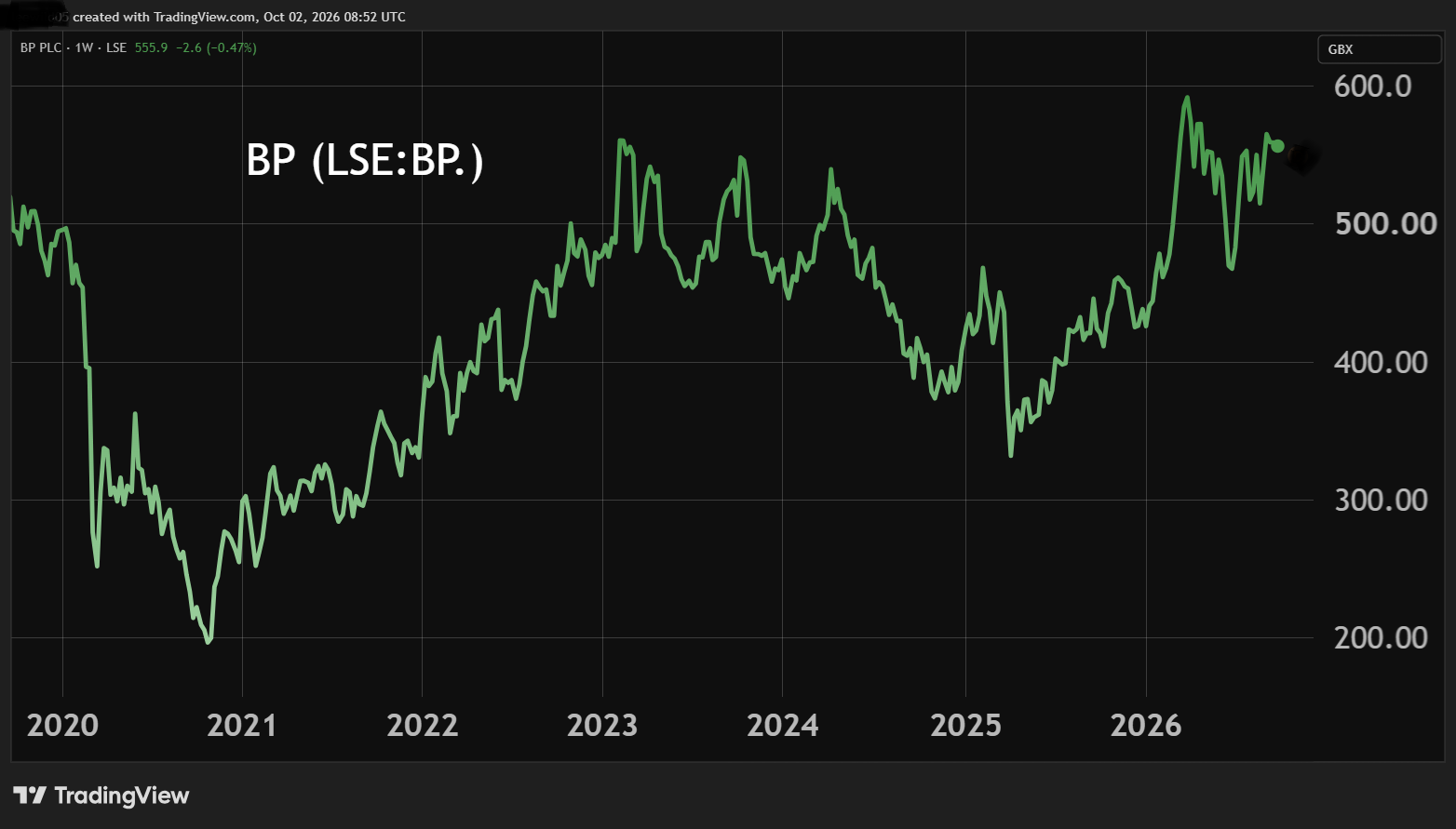
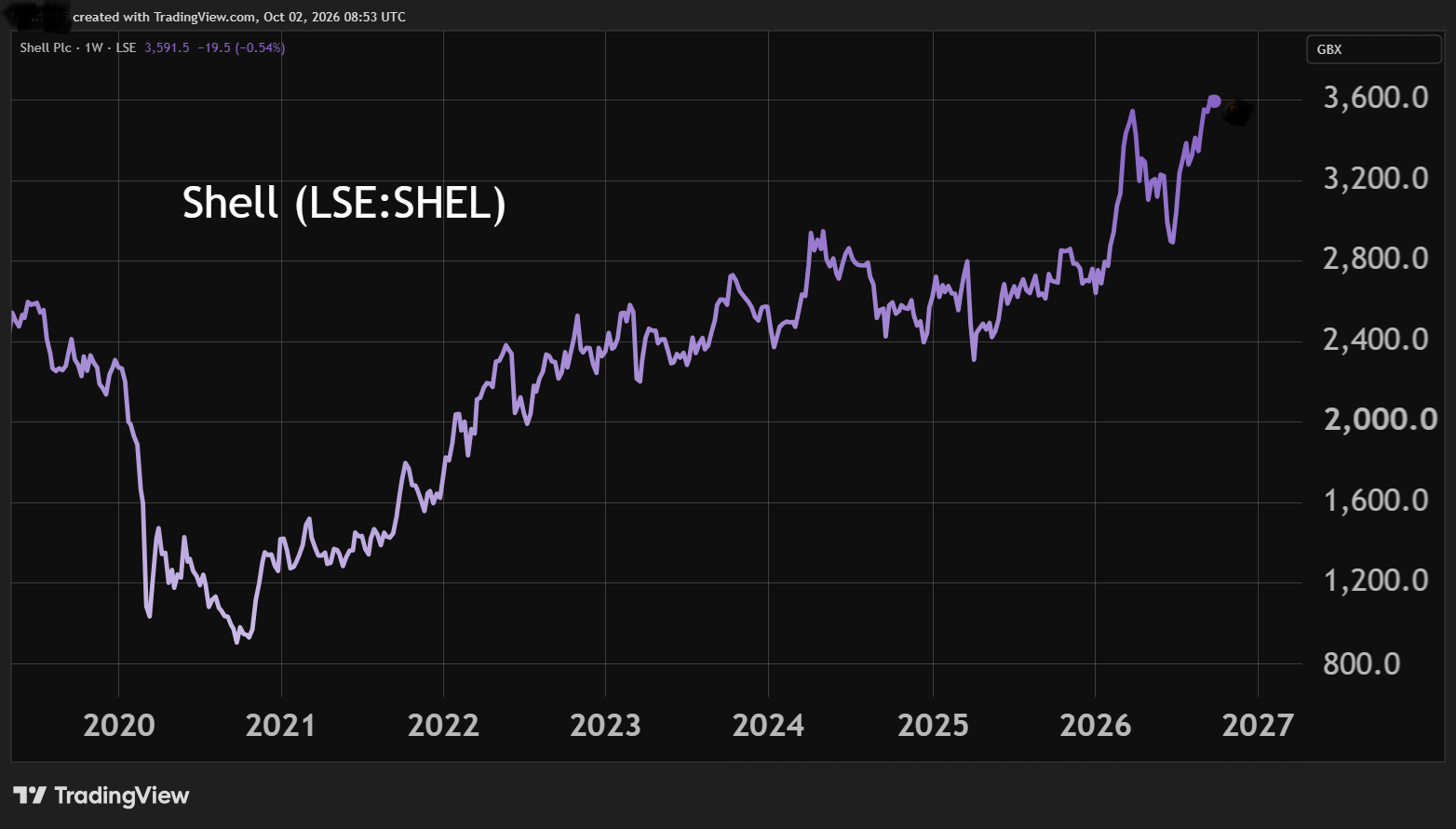
Source: TradingView. Past performance is not a guide to future performance.
Tullow Oil: best entertainment, but what fair value?
It was, however, small-cap Tullow Oil (LSE:TLW) that intrigued me most, halving to around 10p on Wednesday, wiping out its entire rise since February. The rally is explained by Tullow’s debts making this share highly sensitive to oil prices. It is a near-£160 million company carrying $1,356 million (£1,027 million) net debt.
In an overall chart context, however, the shares remain in an uptrend from a 3.9p low last November:
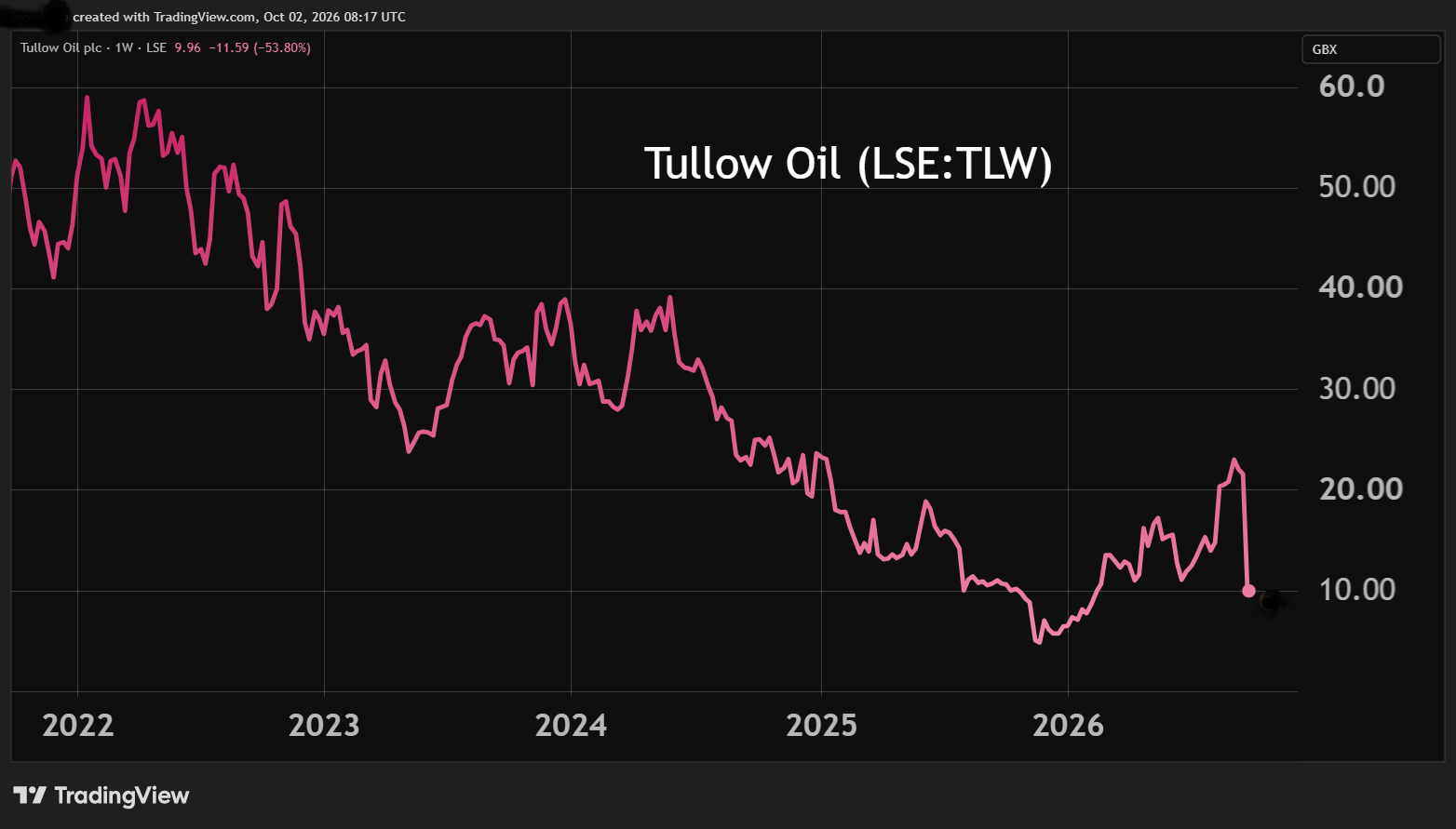
Source: TradingView. Past performance is not a guide to future performance.
The latest share price plunge is due to losing a $196.5 million tax dispute with Ghana, where a tribunal rejected the producer’s claim this breached petroleum agreements. Ghana’s ministry of finance said it would work closely with Tullow – as if pushing the company to its financial edge is in no one’s interests beyond restructuring adviser fees.
It underlines the risks of “frontier” oil & gas. Some would also say the inherent risks with Africa, where smaller companies in developing countries can end up at the behest of states. There have been serial tax disputes between Tullow and Ghana with a $190.5 million assessment over loan interest deductions to be heard next year.
Whether the shares have overreacted on the downside rests on whether Tullow’s cash flows can manage the situation through.
Encouragingly, the 28 September half-year results showed a robust cash flow statement despite net finance costs of $230 million swiping 90% of operating profit, and $127 million income tax extended the interim net loss to $101 million. A seemingly monstrous tax charge relates to West African production even when mitigated by UK deferred tax credits for decommissioning assets, exploration write-offs and impairments.
- Shares round-up: an 8% dividend yield and Filtronic’s rally
- M&G and Aviva among dozen FTSE 100 dividend payers in October
- Sign up to our free newsletter for investment ideas, latest news and award-winning analysis
Yet the Jubilee and TEN assets in Ghana involve low production costs of around $8 a barrel, enabling Tullow to possibly clear its financial hurdles if energy prices remain elevated. It is all highly speculative and high risk, but I cannot pass this by without noting the potentially high reward.
My base-case scenario is the US and Iran are locked in a war of attrition liable to last years, with neither side finding an off-ramp. In which case, it is interesting to be alert to what few shares could benefit.
Tullow already cites 2026 working interest production at the high end of a 34,000 to 42,000 barrels of oil equivalent per day range. Capital expenditure is expected to be around a hefty $200 million this year. But the interim cash flow statement shows how adding back $200 million depreciation/amortisation, despite the finance costs, helped operating cash flow before working capital movements rise 35% to $460 million.
Net cash from operations soared from $85 million to $277 million, aiding a $148 million repayment of borrowings - only by around 9%, mind, hence Tullow arguably also needs high oil prices to meaningfully reduce its debt burden.
‘Peter the cash flow statement’ supports “Paul the balance sheet’
In balance sheet terms, Tullow can be seen as having no intrinsic value. The table shows negative net assets persisting since 2020, and the 30 June balance sheet had $358 million negative net assets. While there were no capitalised intangible exploration and evaluation assets, $1,544 million borrowings (at least for now are all long term after restructuring the debt), compared with $187.5 million cash.
The balance sheet also had a slightly negative “current ratio” given $985 million current liabilities outweighed $957 million current assets.
Tullow Oil - financial summary
year end 31 Dec
reporting in US$
| 2015 | 2016 | 2017 | 2018 | 2019 | 2020 | 2021 | 2022 | 2023 | 2024 | 2025 | |
| Turnover ($ million) | 1,607 | 1,360 | 1,885 | 2,048 | 1,725 | 1,396 | 1,285 | 1,783 | 1,634 | 1,287 | 847 |
| Operating margin (%) | -68.1 | -55.5 | 1.2 | 25.8 | -80.3 | -72.9 | 41.0 | 41.2 | 23.4 | 34.9 | 23.6 |
| Operating profit ($m) | -1094 | -755 | 22.4 | 528 | -1,385 | -1,018 | 527 | 734 | 382 | 449 | 200 |
| Net profit ($m) | -1035 | -600 | -176 | 84.8 | -1694 | -1,221 | -80.7 | 49.1 | -110 | 54.6 | 6.5 |
| Reported EPS (cents) | -96.7 | -56.0 | -13.7 | 5.9 | -121 | -86.6 | -5.7 | 3.3 | -7.6 | -3.8 | -8.8 |
| Normalised EPS (cents) | -17.0 | 8.9 | 21.7 | 19.2 | -26.6 | -26.3 | -3.1 | 16.5 | 8.1 | 5.0 | -8.4 |
| Op cash flow/share (cents) | 91.4 | 47.9 | 95.1 | 83.7 | 89.8 | 49.5 | 55.5 | 72.6 | 60.8 | 52.1 | 22.9 |
| Capex/share (cents) | 163 | 96.3 | 23.9 | 30.6 | 37.1 | 30.5 | 16.7 | 20.6 | 20.3 | 15.4 | 13.4 |
| Free cash flow/share (cents) | -71.2 | -48.4 | 71.2 | 53.1 | 52.6 | 19.0 | 38.8 | 52.0 | 40.5 | 36.6 | 9.5 |
| Dividend per share ($) | 0.0 | 0.0 | 0.0 | 4.8 | 0.0 | 0.0 | 0.0 | 0.0 | 0.0 | 0.0 | 0.0 |
| Cash ($m) | 356 | 282 | 284 | 180 | 289 | 805 | 469 | 636 | 499 | 555 | 332 |
| Net debt ($m) | 3,982 | 4725 | 4,868 | 4,452 | 4,208 | 3,582 | 3,263 | 2,821 | 2,492 | 2,154 | 1,925 |
| Net asset value ($m) | 3,155 | 2,230 | 2,706 | 2,893 | 984 | -210 | -466 | -459 | -359 | -273 | -253 |
| Net assets/share (cents) | 295 | 208 | 195 | 208 | 69.9 | -14.9 | -32.5 | -31.9 | -24.7 | -18.7 | -17.1 |
Source: historic company REFS and company accounts.
The shares therefore represent option money in the sense that while a liquidation might not leave any value for shareholders, sustained high oil prices can transform profitability if cash flow meaningfully reduces debt on a multi-year view.
A chief risk, besides a fall back in oil prices, is if Ghana is resolved to keep Tullow “on the ropes” financially, exacting as much as it can from the various disputes, such that it gets its dues like other creditors but shareholders are left seeing no real value.
That, however, could be a jaundiced view given full-year free cash flow guidance has been upgraded to $170-250 million at $70-100 oil prices, reflecting production performance, high oil prices and recovery of Ghanaian receivables. Yet Brent is currently over $101 a barrel and possibly we are yet to see the full effects of the energy squeeze as emergency reserves dwindle.
Where energy prices will settle is the challenge
It is admittedly very hard to derive any likely scenario amid competing elements, including how US President Donald Trump is desperate for a way out of the conflict with Iran as US mid-term elections approach; how Iran is playing a smart long game and is strategically best-positioned; and how Gulf states are proving their adjustment to the oil transportation challenge.
Yet, overall, the disruptive aspects to energy transit – where the US appears to be shouldering most responsibility and cost in the Strait of Hormuz, which cannot be guaranteed long term – seem likely to keep fuel and liquefied natural gas (LNG) prices broadly elevated.
- Can GSK shares outperform FTSE 100 index over the long run?
- 20 hottest tech stocks: week ended 2 October 2026
At around 20p a share for Tullow just recently, hopes could be said to be broadly priced in, but I suggest 10p represents more the fears.
Be in no doubt how speculative this is, but I think it is interesting to consider the wider upshot for your portfolio when mulling energy prices, and whether even now one should make some adjustment to oil & gas. It’s the same for renewables which would benefit from elevated electricity prices?
It’s also worth bearing in mind that I’ve been wrong on Tullow before. I was encouraged by its chair from September 2018 to September 2021 saying on departure that the company was “well positioned for a positive and sustainable future”. That was with the shares trading at around 45p. In January 2023, I rated them a “buy” at 34p after a director with extensive African experience bought 1.85 million shares cumulatively from 26.7p in June 2022. I did, however, include a caveat “for those who appreciate inherent risks in oil & gas, and African political risk”.
Despite all this, consensus looks for earnings per share of 9 cents this year, equivalent to 6.8p and implying a price/earnings (PE) ratio below 1.5. Probably that normalises for depreciation/amortisation.
At 9.9p this morning, I retain a high-risk “buy” stance.
Edmond Jackson is a freelance contributor and not a direct employee of interactive investor.
These articles are provided for information purposes only. Occasionally, an opinion about whether to buy or sell a specific investment may be provided by third parties. The content is not intended to be a personal recommendation to buy or sell any financial instrument or product, or to adopt any investment strategy as it is not provided based on an assessment of your investing knowledge and experience, your financial situation or your investment objectives. The value of your investments, and the income derived from them, may go down as well as up. You may not get back all the money that you invest. The investments referred to in this article may not be suitable for all investors, and if in doubt, an investor should seek advice from a qualified investment adviser.
Full performance can be found on the company or index summary page on the interactive investor website. Simply click on the company's or index name highlighted in the article.
Disclosure
We use a combination of fundamental and technical analysis in forming our view as to the valuation and prospects of an investment. Where relevant we have set out those particular matters we think are important in the above article, but further detail can be found here.
Please note that our article on this investment should not be considered to be a regular publication.
Details of all recommendations issued by ii during the previous 12-month period can be found here.
ii adheres to a strict code of conduct. Contributors may hold shares or have other interests in companies included in these portfolios, which could create a conflict of interests. Contributors intending to write about any financial instruments in which they have an interest are required to disclose such interest to ii and in the article itself. ii will at all times consider whether such interest impairs the objectivity of the recommendation.
In addition, individuals involved in the production of investment articles are subject to a personal account dealing restriction, which prevents them from placing a transaction in the specified instrument(s) for a period before and for five working days after such publication. This is to avoid personal interests conflicting with the interests of the recipients of those investment articles.