SpaceX IPO: how records fell on market debut
It was easily the most hotly anticipated stock market float of the year, perhaps ever, and it didn’t disappoint. City writer Graeme Evans has all the facts, figures and performance data.
15th June 2026 12:48
by Graeme Evans from interactive investor
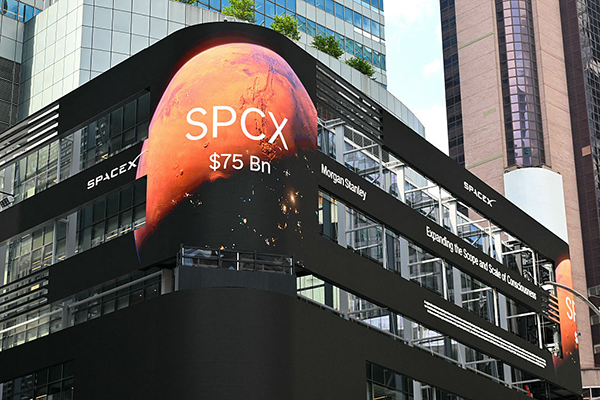
Advert in Times Square, New York, celebrating the launch of SpaceX’s IPO on Friday. Photo: ANGELA WEISS/AFP via Getty Images.
UK investors who took part in the Space Exploration Technologies Corp Class A (NASDAQ:SPCX) stock market debut got a collective first-day boost of £52 million after Elon Musk completed the largest initial public offering (IPO) in history, making him the world’s first trillionaire.
A record 20% of the IPO shares were allocated to retail investors worldwide, including about 100,000 in the UK who spent a total of £271 million at Friday’s opening price of $135.
- Invest with ii: Buy US Stocks from UK | Most-traded US Stocks | Cashback Offers
Those who applied for up to $2,700 (£2,013) received the full amount, meaning a first-day paper profit of more than £350 after the SpaceX share price closed on Friday up 19% at $160.95.
As it happened minute-by-minute
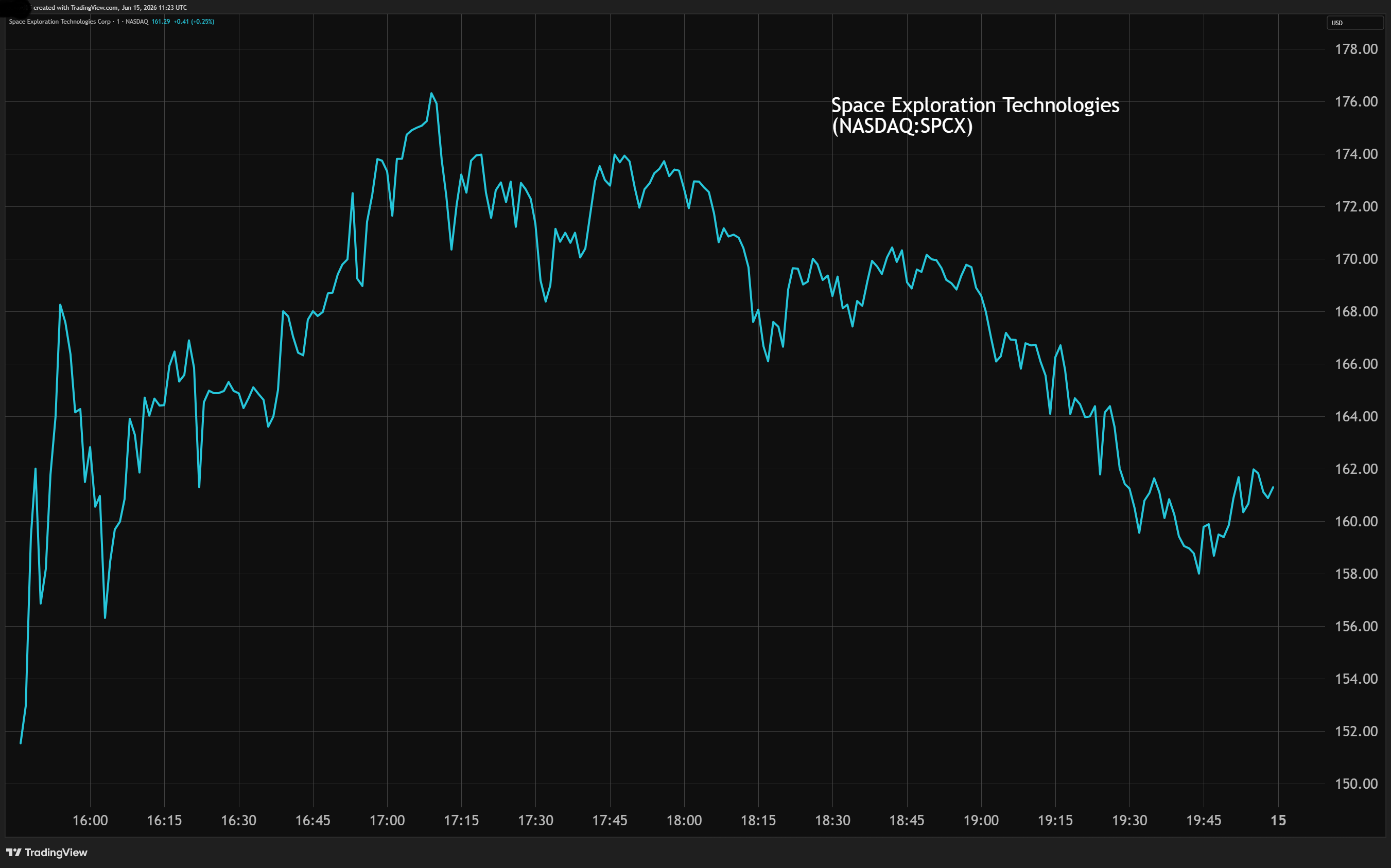
Source: TradingView. Past performance is not a guide to future performance.
Those who applied for more were scaled back to a maximum of 1,000 shares, which would have been worth $135,000 at the opening price. Broker Marex, which oversaw the IPO process in the UK, said 61% of investors in the retail offer got their full allocation.
Indirect beneficiaries of the launch include holders of the Scottish Mortgage Ord (LSE:SMT), Baillie Gifford US Growth Ord (LSE:USA), and Edinburgh Worldwide Ord (LSE:EWI) investment trusts after Baillie Gifford participated in a December 2018 funding round that valued SpaceX at $31 billion.
Musk’s company, which spans rocket launch services, Starlink broadband connectivity and social media and AI compute, ended Friday’s session with a valuation of $2.1 trillion, making it the seventh-largest stock in the Nasdaq index.
That’s considerably more than the market capitalisation of Magnificent Seven stocks Tesla Inc (NASDAQ:TSLA) and Meta Platforms Inc Class A (NASDAQ:META) and double JPMorgan Chase & Co (NYSE:JPM) and Warren Buffett’s Berkshire Hathaway Inc Class B (NYSE:BRK.B), even though SpaceX lost $4.9 billion in 2025 on revenues of $18.7 billion.
As recently as last December, a secondary sale of shares valued SpaceX at just $800 billion, which itself was double the $400 billion in the previous year.
- Investing in space: funds, trusts, and ETFs offering a route in
- Has tech sector sell-off called top of the market?
- How will SpaceX affect tracker funds?
While Starlink is building the predictable and profitable revenues enjoyed by software firms, the valuation depends on the ability of the fully reusable transportation system Starship to place compute infrastructure in orbit.
Broker Peel Hunt said before the IPO: “Connectivity is a genuine, high-margin, fast-growing business. Everything else is a more speculative exposure - to orbital AI compute, Grok, X monetisation, and eventually Mars.
“The price matters enormously. At the right valuation, the asymmetry is interesting. At the wrong one, you’re paying full price for a story that may take a decade to prove out.”
It’s an opportunity that has captured the imagination of younger investors in particular after 25% of Gen X or Millennial investors polled by market research firm Opinium said they had applied for shares in the IPO or intended to buy them on the first day. This compared with only 9% of Gen X and 2% of Boomer investors who stated they would invest early.
In the IPO, the reported demand of $250 billion far exceeded supply of $75 billion as SpaceX sold 555.5 million shares at £135 to beat Saudi Aramco’s 2019 record by nearly three times.
The biggest stock market debut in history also appeared to be one of the smoothest, with the strong first-day improvement leading The Wall Street Journal to describe it as a Goldilocks IPO.
The shares were $150 once dealings started just before midday on Friday and climbed as high as $176 within the following 90 minutes. They eventually closed at $160.95 or $2.1 trillion, with Wall Street futures pointing to a further rise at today’s opening bell.
Fresh support could come thanks to the company’s fast-track inclusion in the Nasdaq, which will mean investment funds tracking tech-focused benchmarks pick up shares.
The listing sets the scene for IPOs by Anthropic and Open AI, which have already fuelled speculation on social media that the Magnificent Seven could soon be superseded by the AI and space-focused MANGOS - Meta, Anthropic, NVIDIA Corp (NASDAQ:NVDA), Alphabet Inc Class A (NASDAQ:GOOGL), OpenAI and SpaceX.
However, this expected surge in equity supply will create a major test for the stock market.
SpaceX, Anthropic and OpenAI are reportedly set to raise a combined $200 billion, which should be enough to make 2026 a record year for US IPOs. This figure represents 0.35% of the S&P 500’s market cap, which is still well below the dotcom peak of 0.7%.
- The new space race: are private markets positioned for lift off?
- Ian Cowie: why I’ve bought Scottish Mortgage
- SpaceX IPO: priced for the stars – and beyond
But the success of these mega IPOs could entice many more companies to ride the wave of investor enthusiasm by going public.
Capital Economics said last week: “Recent history suggests surging share issuance tends to be a sign that the end to an equity boom is a matter of months not years away.
“After all, gross issuance surged towards the end of the last three major equity booms and peaked broadly in line with the stock market on those occasions. With share issuance booming once again, the AI-driven equity rally may well be entering its final stages.”
Only 4% of SpaceX’s shares were floated in its IPO and similar free floats at this level have been mooted for Anthropic and OpenAI.
Lock-up periods for pre-IPO investors typically expire after six months, although SpaceX has chosen a staggered approach which will allow some shares to be sold earlier.
If the free floats for these three firms were to rise to 25%, Capital Economics estimates that this could mean an additional $750 billion of equity supply.
SpaceX will use a staggered, tiered system tied to both earnings milestones and fixed time intervals that allow most pre-existing shareholders to sell portions of their stock before the standard 180-day window closes.
Some shares will be released when SpaceX announces its quarterly results for the first time as a listed company, which is likely to be in August or September.
According to the SpaceX prospectus, pre-existing shareholders can sell up to 20% of their locked-up shares – or 30% if the stock is at least 30% above the IPO price at that point.
A further 28% can be released at the time of third-quarter results in October or November, regardless of the share price.
Shares can also be released at 70, 90, 105, 120 and 135 days after the IPO, with 7% at each stage. Any shares still locked up will be fully freed at the six-month mark in December.
These restrictions will apply to Scottish Mortgage, which disclosed a fair value stake of £3 billion at the end of March compared with £151 million following the original 2018 investment.
It now accounts for 21% of Scottish Mortgage’s portfolio, having delivered a total return of 1,197% in the five years to the end of 2025 - bettered over the same period by Nvidia at 1,364%.
- Scottish Mortgage on SpaceX and running winners vs taking profits
- Have stock markets kept pace with World Cup final ticket boom?
- Sign up to our free newsletter for investment ideas, latest news and award-winning analysis
The portfolio of private companies also includes Anthropic, Databricks, ByteDance and Stripe, all of which are realistic candidates for public listings in the coming years.
Writing in its annual report and prior to the SpaceX IPO, the trust said the assumption that private holdings are early stage and speculative does not meet reality.
Scottish Mortgage added: “These are businesses operating at enormous scale, generating substantial revenues, and in several cases profits that would place them comfortably among the largest listed companies in the world.
“The closed-end trust structure means we are not forced to sell at the point of listing. We can hold through the transition and beyond. A listing changes the venue in which a company’s shares are traded. The opportunity and our reasons for owning it remain the same.”
Meanwhile, the SpaceX listing means investors will have indirect exposure to one of the larger cryptocurrency holdings among publicly traded companies.
SpaceX reportedly held 18,712 Bitcoin at the end of March, which is worth approximately $1.23 billion based on Monday’s price of about $65,800.
These articles are provided for information purposes only. Occasionally, an opinion about whether to buy or sell a specific investment may be provided by third parties. The content is not intended to be a personal recommendation to buy or sell any financial instrument or product, or to adopt any investment strategy as it is not provided based on an assessment of your investing knowledge and experience, your financial situation or your investment objectives. The value of your investments, and the income derived from them, may go down as well as up. You may not get back all the money that you invest. The investments referred to in this article may not be suitable for all investors, and if in doubt, an investor should seek advice from a qualified investment adviser.
Full performance can be found on the company or index summary page on the interactive investor website. Simply click on the company's or index name highlighted in the article.