Stockwatch: a blue-chip with long-term recovery potential
This company is the best example of quality in its sector, suggests analyst Edmond Jackson, who examines growth prospects and its dividend yield.
5th June 2026 11:59
by Edmond Jackson from interactive investor

A first choice among house-building shares to consider for long-term recovery potential is FTSE 100-listed Persimmon (LSE:PSN).
After de-rating from over 3,000p in 2021, a current price of around 1,080p is back to 2013 levels, but down a third in the last three months alone.
- Learn with ii: ISA Investment Ideas | Top ISA Funds | Buy US Shares in UK ISA
As a £3.6 billion company, it is exposed to volume house-building with around a third of sales to first-time buyers, hence it could benefit if Labour smoothes planning approvals to better deliver on its election pledges.
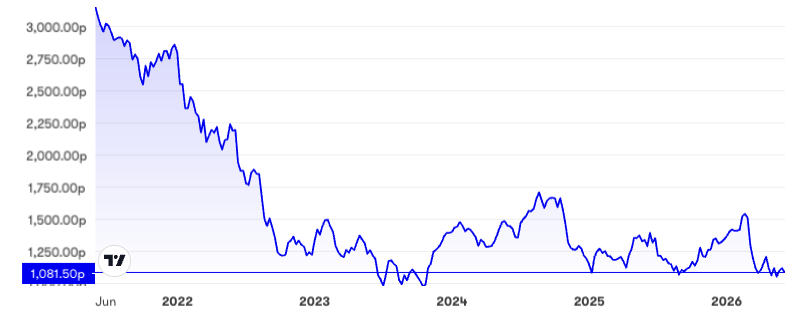
Source: interactive investor. Past performance is not a guide to future performance.
Plunged, despite relatively strong 2025 prelims and outlook
Numbers released last 10 March showed solid progress: new home completions up 12%, underlying pre-tax profit up 13% on revenue up 17%, likewise operating profit as the margin rose to 14.3%. For 2026, underlying operating profit was guided towards the upper end of consensus.
Yet there was a caveat on how overall growth in 2026 would depend on the Iran conflict and its effects being short.
The 30 April AGM statement cited a positive start to 2026 “building on our strong performance in 2025, with an improved sales rate and an increase in average selling prices. As a result, our private forward sales are up 7% on the prior year.” The Iran war had “not had any material impact on trading to date” but there were early signs of increased inflation in the supply chain driven by higher energy costs, and management was seeking to mitigate where possible.
I am wary given that Crest Nicholson Holdings (LSE:CRST), a small-cap builder pivoting away from mass-market builds to more bespoke homes, had to change its tune after its 25 March AGM statement, revising profit guidance down on 21 April due to macro uncertainty. But Persimmon has only minimal exposure to London and the South East, focusing its operations in more affordable areas such as the North of England.
It also trumpeted its strong land bank as a result of recent years’ investment, saying: “We continue to have good planning success with 3,080 plots receiving approval in the first quarter, up from 2,781 like for like in 2025.”
A surge in short selling bakes in a rebound at some point
Recently they have been all over house-builders allowing Persimmon no mercy despite its relatively strong results and outlook. In May, positions over 0.5% of the issued share capital rose from 1.3% to 5.0%. This would affirm my wariness as to quite when interest rate pressures will ease without a US/Iran settlement. It is also significant for a FTSE 100 share given the four hedge funds involved have assumed some specific risk given its capitalisation – and the total is probably bigger when including those below this threshold.
But if a US/Iran settlement does evolve then house-builders will rally as the market “sees through” to recovery even if that means 2027 onwards.
Contra the short-selling: on 8 May BlackRock (the world’s largest asset manager) raised its stake from 4.5% to 5.7%; although on 29 April it had trimmed from 5.1% to 4.5%. Probably this reflects different funds within BlackRock taking different views.
One can spend much time deciphering Persimmon’s fundamentals, but if market sentiment does shift to “risk-on” then short-closing and recovery buying could conflate for a share spike. Persimmon is one of the “big three” UK house-builders along with Taylor Wimpey (LSE:TW.) and Barratt Redrow (LSE:BTRW), hence will lead sentiment shifts.
But are the virtues priced-in given the shares trade around net asset value?
Discounts to net tangible assets (NTA) even, have soared to as much as 75% in the sector during recent months.
Yet from Persimmon’s end-2025 balance sheet, NTA of £3,431 million equates to 1,068p per share on the last count of those issued, hence the shares are currently at a slight 1% premium. If a worst-case scenario evolves for inflation and interest rates, how defensive is Persimmon relative to those on significant discounts?
Looking at note 9 on inventories - the key aspect to consider - they are up 15% to £4,492 million and comprise 58% land and 36% work in progress, the remainder buildings. There doesn’t appear to be an aspect of capitalised building costs as with Taylor Wimpey (despite Taylor being in line with accounting standards). Instead, Persimmon says that it conducted a further review of net realisable value where the effects totalled only £7.1 million – as if the 15% rise derives chiefly from adding land and building more homes.
We can therefore say that Persimmon is well asset-backed, but what “margin of safety” should market conditions deteriorate? Perhaps it makes overall sense in terms of risk/reward to diversify to some extent among house-builders to include those at a useful discount.
Obviously the market is not completely irrational; as with investment trusts, discounts or premiums to NTA usually exist for a reason. Persimmon’s slight premium reflects its quality reputation.
Double-digit EPS growth prospects and relatively reliable dividends
While operating margins have reduced from over 20% in 2020 and 2011, circa 11% in 2024, and 2025 is better than Taylor Wimpey but trails Berkeley Group Holdings (The) (LSE:BKG), consensus still expects near double-digit earnings per share (EPS) declines at Berkeley in its years to April 2026, also 2027.
Persimmon - financial summary
year-end 31 Dec
| 2016 | 2017 | 2018 | 2019 | 2020 | 2021 | 2022 | 2023 | 2024 | 2025 | |
| Turnover (£ million) | 3,137 | 3,598 | 3,738 | 3,649 | 3,328 | 3,611 | 3,816 | 2,773 | 3,201 | 3,751 |
| Operating margin (%) | 24.6 | 26.5 | 29.0 | 28.2 | 23.5 | 26.6 | 19.0 | 12.5 | 11.5 | 11.3 |
| Operating profit (£m) | 771 | 955 | 1,083 | 1,029 | 784 | 961 | 725 | 347 | 369 | 424 |
| Net profit (£m) | 625 | 787 | 886 | 849 | 638 | 787 | 561 | 255 | 267 | 286 |
| EPS - reported (p) | 197 | 243 | 281 | 266 | 200 | 246 | 174 | 79.6 | 82.7 | 88.2 |
| EPS - normalised (p) | 198 | 244 | 283 | 267 | 220 | 247 | 174 | 80.1 | 88.2 | 93.9 |
| Operating cashflow/share (p) | 220 | 255 | 207 | 194 | 239 | 245 | 125 | -40.4 | 26.3 | 9.1 |
| Capital expenditure/share (p) | 4.6 | 5.6 | 4.9 | 8.6 | 5.9 | 6.5 | 9.5 | 11.3 | 10.0 | 12.5 |
| Free cashflow/share (p) | 215 | 249 | 202 | 186 | 233 | 239 | 116 | -51.7 | 16.3 | -3.4 |
| Dividends per share (p) | 135 | 235 | 235 | 40.0 | 195 | 235 | 60.0 | 60.0 | 60.0 | 60.0 |
| Covered by earnings (x) | 1.5 | 1.0 | 1.2 | 6.7 | 1.0 | 1.1 | 2.9 | 1.3 | 1.4 | 1.5 |
| Return on total capital (%) | 24.6 | 26.8 | 30.7 | 29.5 | 20.9 | 24.6 | 18.4 | 9.0 | 9.4 | 10.3 |
| Cash (£m) | 913 | 1,303 | 1,048 | 844 | 1,234 | 1,247 | 862 | 420 | 259 | 117 |
| Net debt (£m) | -913 | -1,303 | -1,048 | -844 | -1,234 | -1,247 | -862 | -420 | -259 | -117 |
| Net assets (£m) | 2,737 | 3,202 | 3,195 | 3,258 | 3,518 | 3,625 | 3,439 | 3,419 | 3,507 | 3,614 |
| Net assets per share (p) | 887 | 1,037 | 1,006 | 1,022 | 1,103 | 1,136 | 1,077 | 1,070 | 1,096 | 1,127 |
Source: historic company REFS and company accounts.
For what estimates are worth in the current environment, Persimmon by contrast is expected to grow EPS by near double digits in its December 2026 and 2027 years. The benchmark 12-month forward price/earnings (PE) to June 2027 is implicitly 10.3x, which is arithmetically in line albeit a snapshot view.
Its dividend also looks sounder than Taylor Wimpey given (and assuming consensus forecasts) 1.6x earnings cover for 62.5p DPS this year and 67.4p next; where consensus for Taylor is just shy of cover. This equates to a 6.0% yield for Persimmon, which in principle constitutes support. Yet history has shown that house-builder yields go higher should industry prospects deteriorate, hence shares fall.
- How much do you need to secure a comfortable retirement?
- Sign up to our free newsletter for investment ideas, latest news and award-winning analysis
Mind how the 2025 results contained a caveat: “Our investment for growth at this point in the cycle will result in increased finance costs.” Net finance costs already did rise 162% to £26.5 million albeit covered 16x by operating profit. As yet the balance sheet shows no debt though.
I am also dubious that the UK will see a return of Help to Buy to stimulate the housing market. This Tory measure was criticised by Morgan Stanley and JP Morgan analysts for benefiting house-builders’ profits far more than home-buyers; hence Labour seems more likely to try to smooth planning approvals ahead of the next general election.
Barring an extended US/Iran conflict, I therefore rate Persimmon a “buy” and perhaps the best example of quality in the sector in terms of operations and overall financial strength.
However, this is already significantly reflected in the share price relative to builders on steep discounts to NTA, hence in a worst-case macro scenario (hedge funds are betting on) downside risk remains. Yet in a long-term context I believe the overall risk/reward offered by the sector weighs favourably to consider averaging in.
Edmond Jackson is a freelance contributor and not a direct employee of interactive investor.
These articles are provided for information purposes only. Occasionally, an opinion about whether to buy or sell a specific investment may be provided by third parties. The content is not intended to be a personal recommendation to buy or sell any financial instrument or product, or to adopt any investment strategy as it is not provided based on an assessment of your investing knowledge and experience, your financial situation or your investment objectives. The value of your investments, and the income derived from them, may go down as well as up. You may not get back all the money that you invest. The investments referred to in this article may not be suitable for all investors, and if in doubt, an investor should seek advice from a qualified investment adviser.
Full performance can be found on the company or index summary page on the interactive investor website. Simply click on the company's or index name highlighted in the article.
Disclosure
We use a combination of fundamental and technical analysis in forming our view as to the valuation and prospects of an investment. Where relevant we have set out those particular matters we think are important in the above article, but further detail can be found here.
Please note that our article on this investment should not be considered to be a regular publication.
Details of all recommendations issued by ii during the previous 12-month period can be found here.
ii adheres to a strict code of conduct. Contributors may hold shares or have other interests in companies included in these portfolios, which could create a conflict of interests. Contributors intending to write about any financial instruments in which they have an interest are required to disclose such interest to ii and in the article itself. ii will at all times consider whether such interest impairs the objectivity of the recommendation.
In addition, individuals involved in the production of investment articles are subject to a personal account dealing restriction, which prevents them from placing a transaction in the specified instrument(s) for a period before and for five working days after such publication. This is to avoid personal interests conflicting with the interests of the recipients of those investment articles.