These funds are soaring, but look under the bonnet
Saltydog Investor explains why funds specialising in this sector of the market fall into two groups. However, despite their differences, performance over the last 18 months has been surprisingly similar.
9th June 2026 08:38
by Douglas Chadwick from ii contributor

This content is provided by Saltydog Investor. It is a third-party supplier and not part of interactive investor. It is provided for information only and does not constitute a personal recommendation.
Until recently, we have tended to think of energy funds in two broad categories.
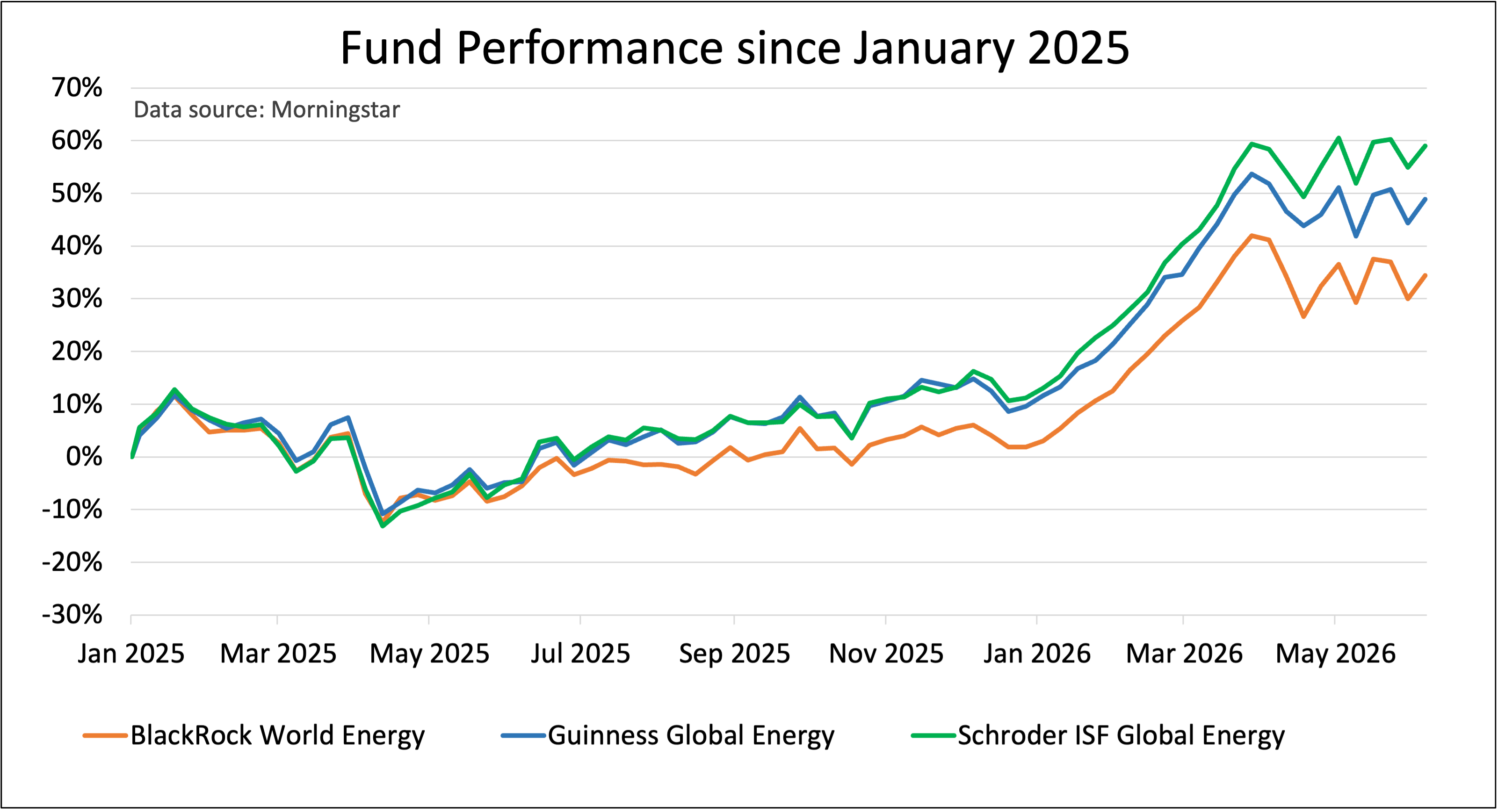
The first was the traditional fossil fuel-based funds. These funds invest mainly in large oil and gas companies, such as BP (LSE:BP.), Shell (LSE:SHEL), Exxon Mobil Corp (NYSE:XOM), Chevron Corp (NYSE:CVX), ConocoPhillips (NYSE:COP) and TotalEnergies SE (EURONEXT:TTE).
Examples include WS Guinness Global Energy I Acc (B56FW07), Schroder ISF Global Energy C Dis GBP AV (B2QM296) and BGF World Energy D4 (B3Y9G49). They tend to do well when oil and gas prices are rising, as higher energy prices can feed directly through to company revenues and profits.
- Invest with ii: Buy Global Funds | Top Investment Funds | Open a Trading Account
That has certainly been the case recently. The Russia–Ukraine war pushed crude prices higher, and more recent disruption risk around Iran and the Strait of Hormuz has kept energy markets on edge. Trump’s “Drill, baby, drill” mantra has also kept fossil fuels firmly in the political spotlight.
In March, traditional energy funds were among the strongest performers in our analysis. At the time, rising fuel prices and concerns about instability in the Middle East provided a strong tailwind for the sector.
More recently, there has been greater volatility as expectations of a deal between the US and Iran have ebbed and flowed.
Past performance is not a guide to future performance.
The second group is made up of green, clean, and sustainable energy funds.
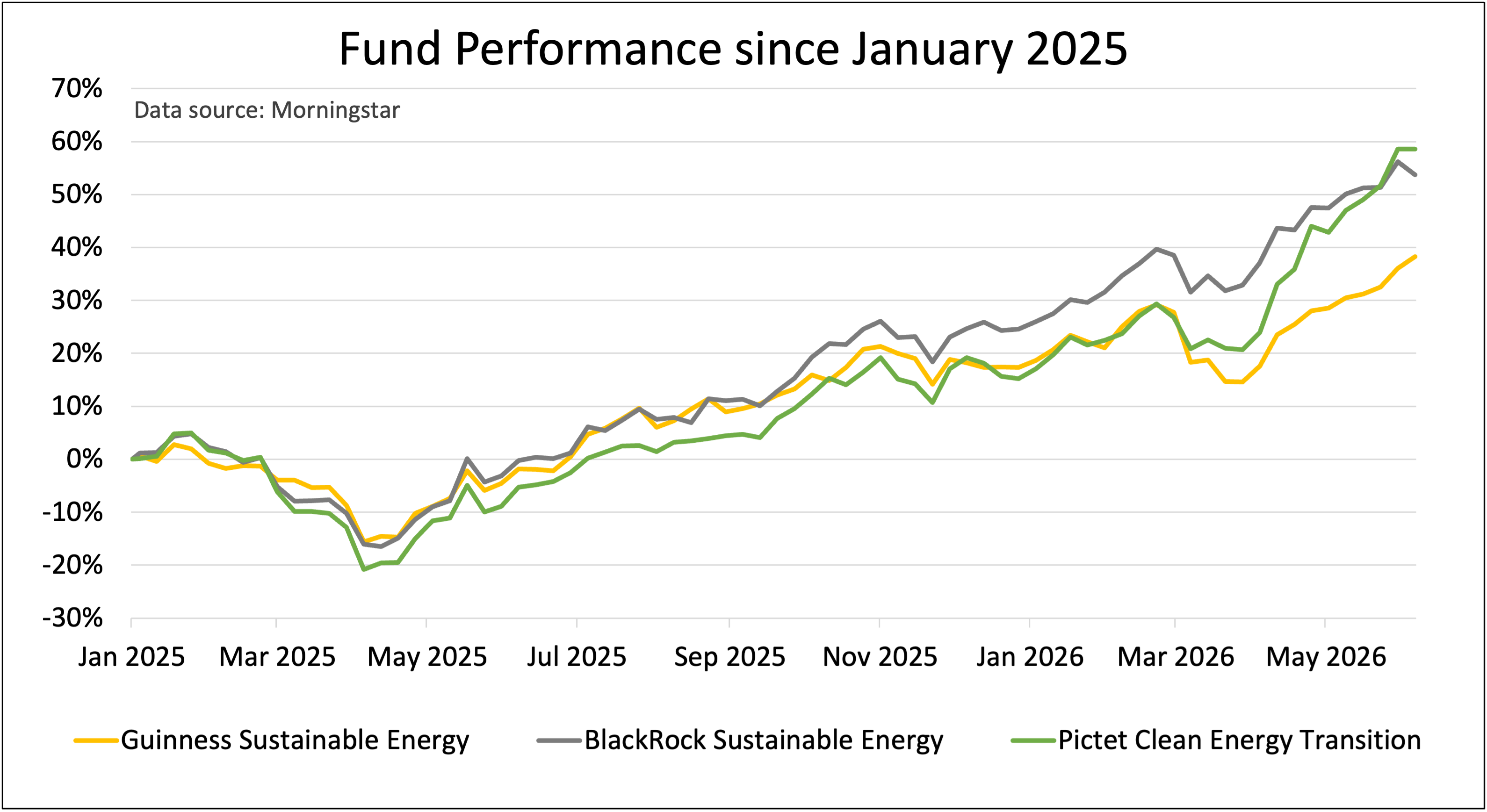
These include funds such as Pictet-Clean Energy Transition I dy GBP (B516829), Guinness Sustainable Energy Y GBP Acc (BFYV9L7) and BGF Sustainable EnergyD4 (B62H2K4). They typically invest in companies involved in renewable energy, energy storage, alternative energy, energy efficiency and related technologies.
At first glance, these funds appear quite different from traditional oil and gas funds. However, their performance over the last 18 months has been surprisingly similar.
Past performance is not a guide to future performance.
That is probably not a coincidence. Both types of funds are linked, directly or indirectly, to the broader cost of energy.
When oil and gas prices rise, traditional energy companies tend to benefit first. Their revenues are more directly linked to the price of fossil fuels, so their share prices can react quickly.
Clean energy companies may benefit more gradually. Higher energy prices can make renewable energy projects more attractive. They can also encourage governments, utilities and businesses to give more weight to energy security and diversification.
This gives clean energy funds both an environmental and a strategic appeal. They are not just about cutting carbon emissions. They are also about improving energy independence and reducing exposure to volatile global fuel markets.
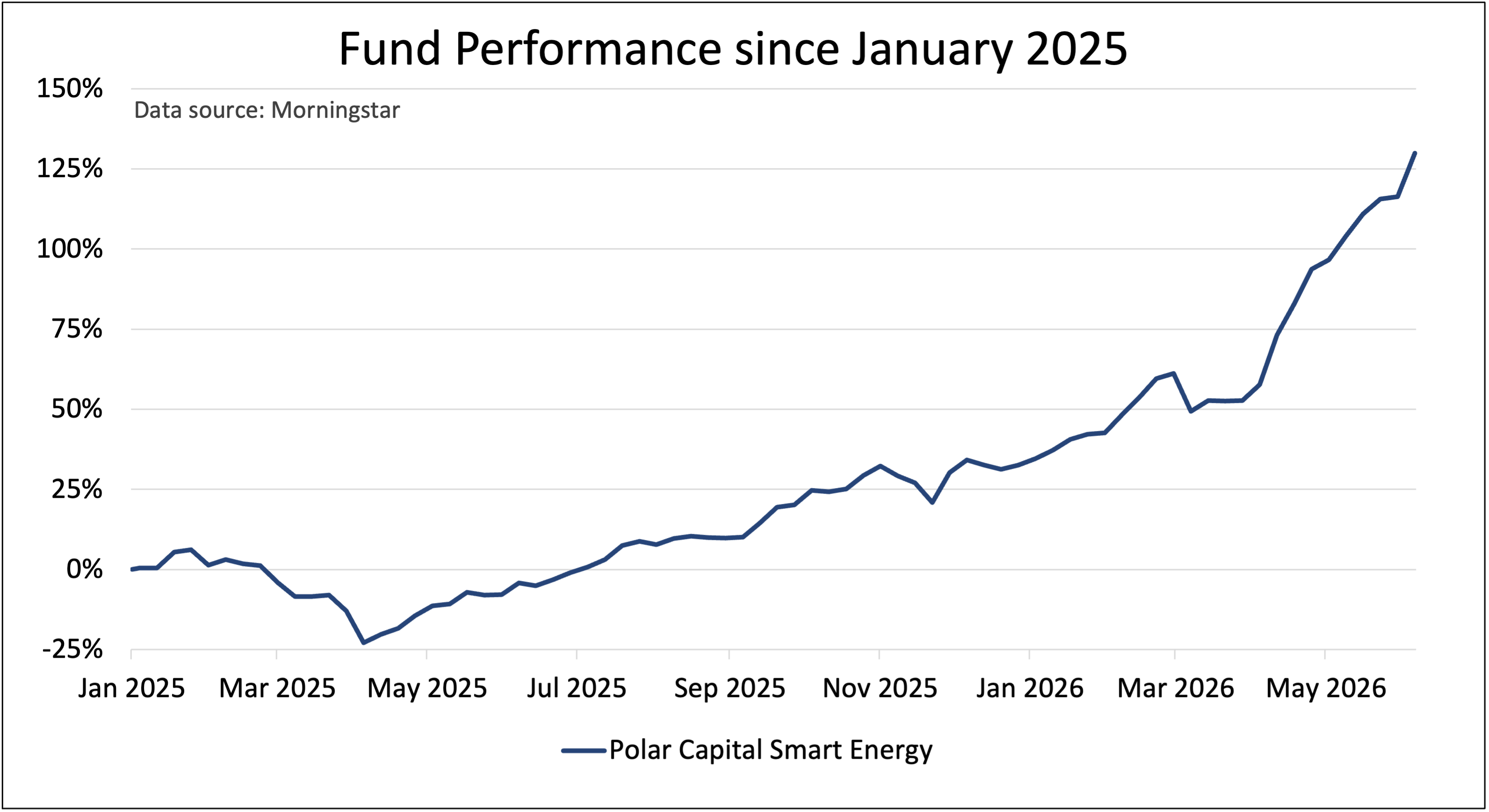
More recently, another energy fund has appeared near the top of our performance tables: Polar Capital Smart Energy I Acc GBP (BPF0PL5).
Past performance is not a guide to future performance.
Broadly speaking, it is a clean energy fund, but it is somewhat different.
Instead of focusing mainly on renewable energy generators, it invests across the wider smart-energy chain. That includes power semiconductors, grid infrastructure, energy efficiency, electrification, energy storage and related technologies.
In other words, it is doing more than just investing in companies that produce clean energy. It is also investing in the companies helping to make energy systems cleaner, smarter and more efficient.
Artificial intelligence (AI) requires huge amounts of computing power. That, in turn, creates demand for more electricity, better cooling, faster data transmission, more efficient chips and upgraded power infrastructure.
Some of Polar Capital Smart Energy’s recent holdings show this clearly. Coherent Corp (NYSE:COHR) and Lumentum Holdings Inc (NASDAQ:LITE) are involved in optical components used to move data quickly through data centres. Marvell Technology Inc (NASDAQ:MRVL), Marvell Technology Inc (NASDAQ:MRVL)s, Renesas and STMicroelectronics NV ADR (NYSE:STM) are linked to semiconductors, power management and industrial electronics.
- Fund Focus: an ETF portfolio to beat the market?
- Sign up to our free newsletter for investment ideas, latest news and award-winning analysis
Delta Electronics (Thailand) PCL SGDR (SGX:TDED) provides power and thermal management solutions, while Siemens Energy AG Ordinary Shares (XETRA:ENR) is exposed to grid infrastructure and power transmission.
This helps explain why Polar Capital Smart Energy has done so well recently.
It is now up by around 130% since the start of last year. That is more than twice the gain made by most of the other energy funds that we have looked at.
Traditional energy funds reacted strongly in March, when oil prices rose. Polar Capital Smart Energy accelerated later, particularly from April onwards.
Its recent strength appears to be less about the oil price and more about the growing demand for electricity, data-centre infrastructure, semiconductors, cooling, power management and grid upgrades.
Energy investing is no longer just about oil companies, gas producers, wind farms or solar panels. Increasingly, it is also about the infrastructure needed to power a more digital, electrified and energy-hungry world.
Polar Capital Smart Energy is one fund that is positioned to maximise this opportunity. It is a different kind of energy fund, and one that has recently benefited from two powerful themes coming together: the energy transition and the expansion of artificial intelligence.
We have recently added this fund to one of our demonstration portfolios.
For more information about Saltydog, or to take the two-month free trial, go to www.saltydoginvestor.com
These articles are provided for information purposes only. Occasionally, an opinion about whether to buy or sell a specific investment may be provided by third parties. The content is not intended to be a personal recommendation to buy or sell any financial instrument or product, or to adopt any investment strategy as it is not provided based on an assessment of your investing knowledge and experience, your financial situation or your investment objectives. The value of your investments, and the income derived from them, may go down as well as up. You may not get back all the money that you invest. The investments referred to in this article may not be suitable for all investors, and if in doubt, an investor should seek advice from a qualified investment adviser.
Full performance can be found on the company or index summary page on the interactive investor website. Simply click on the company's or index name highlighted in the article.