What global bond shock means for UK investors
Bond markets continue to price in the risk of higher inflation, higher interest rates and excess government debt. Analyst John Ficenec explains what this means for us.
2nd September 2026 10:56
by John Ficenec from interactive investor
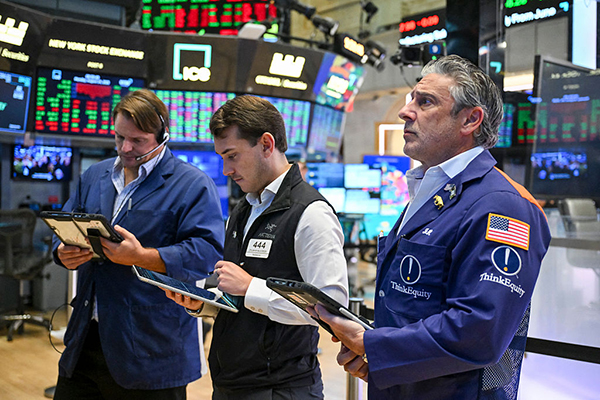
Traders on the floor of the New York Stock Exchange. Photo: ANGELA WEISS/AFP via Getty Images.
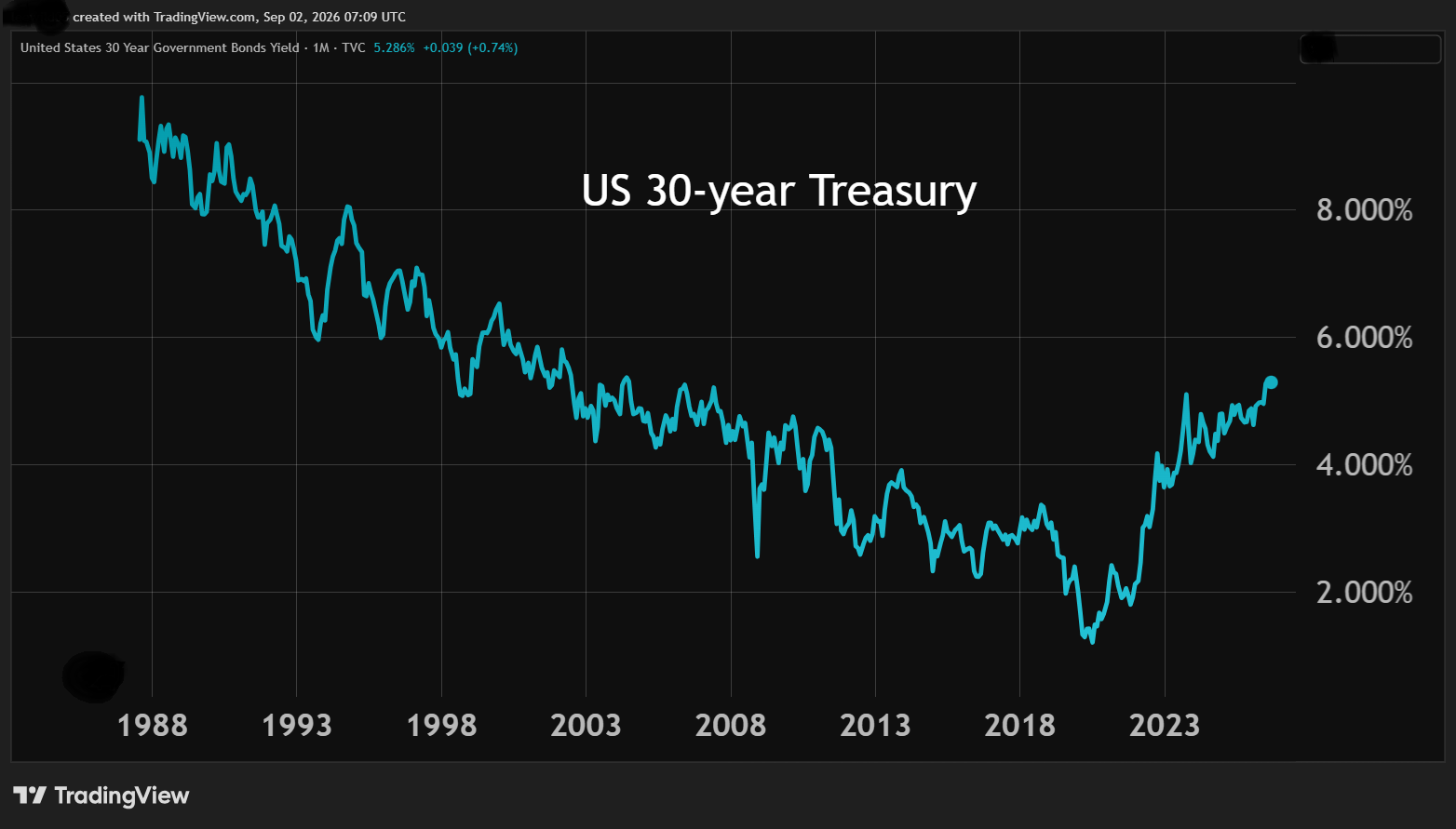
The rising debt pile in the US economy has caused borrowing costs for the world’s global reserve currency to hit the highest level in over 20 years. This is not just a problem for the Trump administration because US Treasuries form the basis for borrowing rates worldwide.
- Invest with ii: Buy US Stocks from UK | Most-traded US Stocks | Cashback Offers
Efforts by the Treasury department to calm investor nerves have sparked chaos in cryptocurrency and gold during the past weeks. As markets return from the summer holidays it could have important implications for investor portfolios this autumn.
Spending on the never-never
The US economy is spending a lot more than it earns from taxes. Right now, the budget deficit is expected to be around $1.9 trillion (£1.4 trillion) in 2026, or 5.5% of GDP, and keep rising to $2.7 trillion, or 6.1% of GDP by 2035, with seemingly no plans to reduce it. Trump’s latest Big Beautiful Bill was the exact opposite, a huge increase in spending through reduced tax for US companies.
The issue is that the American economy was already sitting on a debt mountain exceeding $40 trillion caused by government bailouts in 2001 after the dotcom crash, 2008 after the banking crisis, and 2020 after the Covid pandemic. It is the speed at which the debt is rising which is worrying, as it has doubled from $20 trillion during the past 10 years.
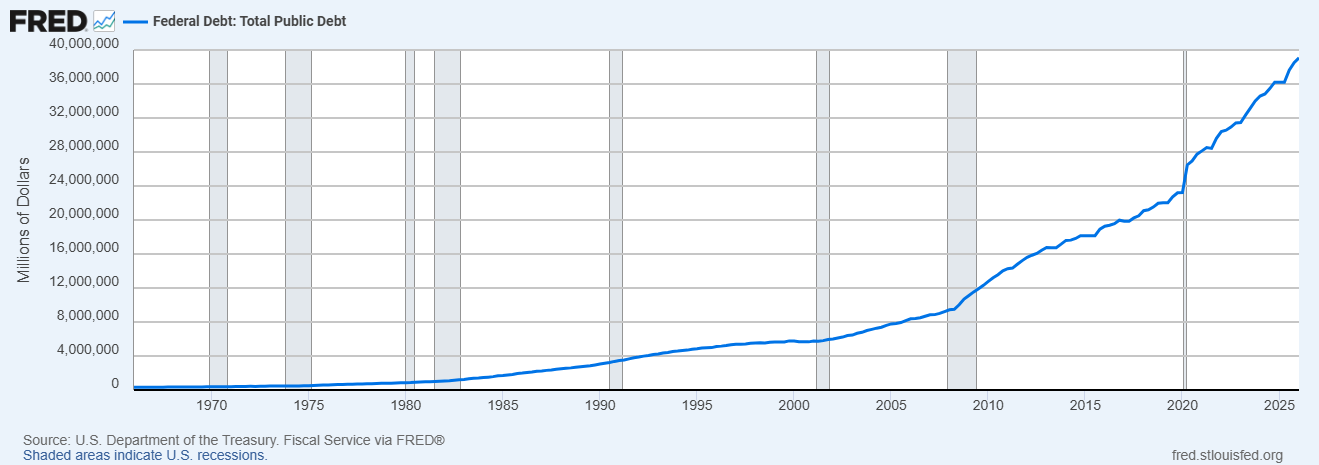
There is also the question of how sustainable those debt levels are and how they will ever be paid back. Ultimately it is the annual economic output of the US that determines how capable the country is of paying the interest and starting to repay some of that debt. Using the debt-to-gross domestic product (GDP) ratio, the US debt now stands at 125.8% of GD, according to analysis by the International Monetary Fund (IMF). In terms of developed economies, only Japan at 235% and Italy at 135% are carrying higher debt burdens. France is at 113% and the more fiscally conservative Germany at 64%.
Yields begin to hurt
The cost of servicing all this debt is beginning to increase sharply. The US must constantly issue new debt to replace treasuries that mature and to fund new spending. A sale of 30-year Treasury notes in early August hit 5.2%, the highest level since 2001. The benchmark 10-year Treasury now sits at around 4.7%, up sharply from around 4% at the start of this year.
Source: TradingView.
The other factor worrying bond markets is persistently high inflation driven by a prolonged war with Iran and high oil prices. Fixed income is so-called because the amount you receive from the bond is fixed at issue and doesn’t change. If inflation rises then bonds are less attractive as the value of the interest, or coupon, is eroded by inflation. So, investors have been selling US government bonds to buy other investments, causing their price to fall and yields to rise.
This is not just a problem for the US government because the rate of interest, or yield, on US Treasuries is the bedrock upon which the entirety of global finance sits. It is used as the basis to set 30-year mortgages which now cost 6.66% in the US, and as a reference point for corporate borrowing, car loans and debts around the world. If the cost of borrowing is going up for Uncle Sam, it will be going up for all of us too.
- Bond Watch: how big tech is reshaping the market
- Fund Focus: bond funds yielding more than the FTSE 100
The rising cost of borrowing can have a chilling effect on shareholder returns as well. Companies can raise funds for growth through issuing shares, borrowing from the bank or issuing bonds. When borrowing is cheap and debts are low more of the profits flow to the equity holders, sending share prices soaring. But when debts pile up and borrowing costs rise, a greater share of the profits must cover interest payments and repay debt, leaving less for the shareholders.
Bond buying begins
US Treasury Secretary Scott Bessent decided enough was enough, announcing that he would double the monthly repurchase of long-dated bonds between 10 years and 30 years from $2 billion to at least $4 billion. By increasing demand for long-dated bonds, their price starts to rise and the yield subsequently falls. But what spooked the market was the seemingly ad-hoc nature of the announcement, outside the usual calendar of communications which are carefully managed to ensure financial stability.
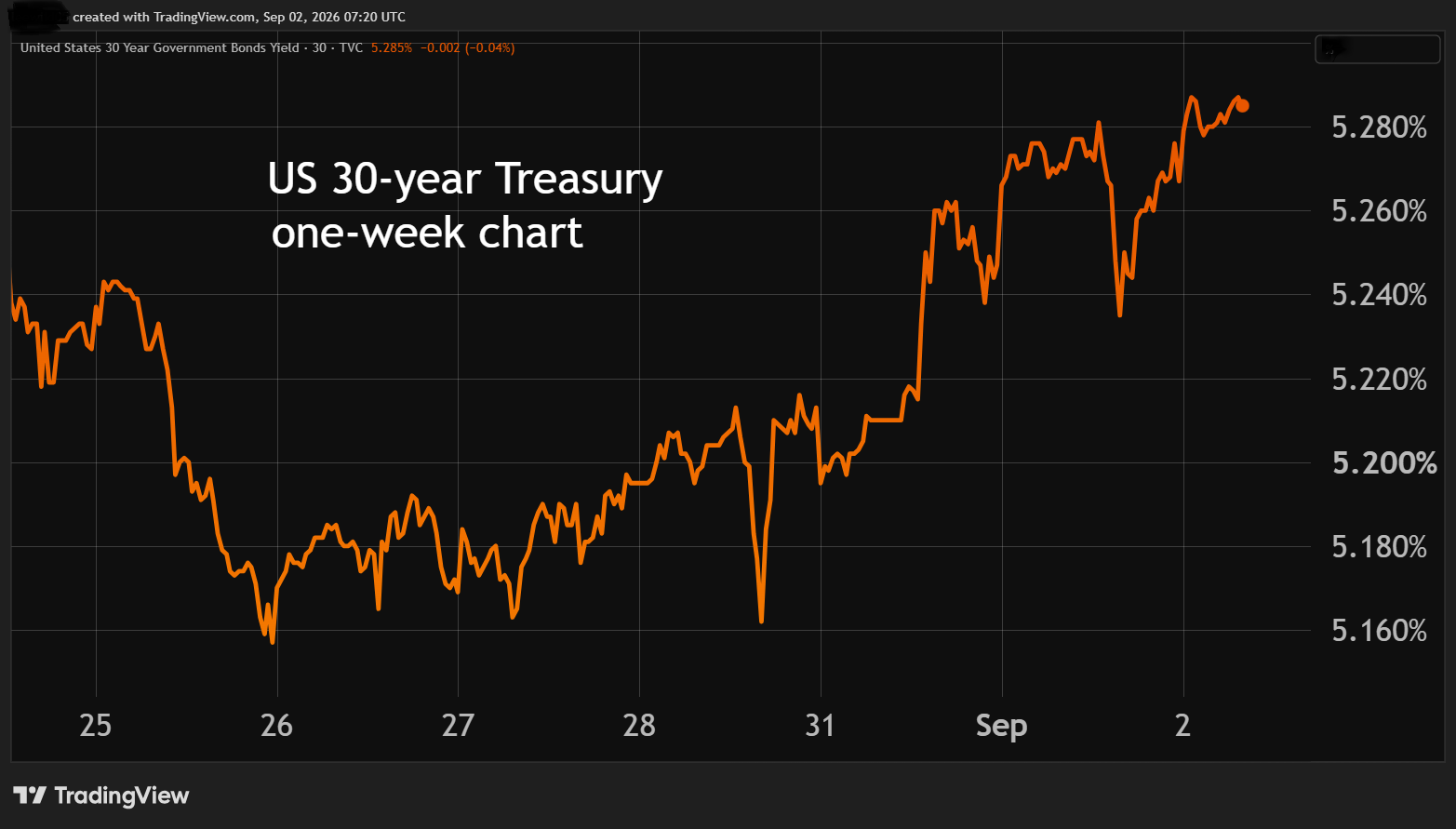
So far, the increased bond buying has had the desired effect, with the yield on 30-year Treasuries beginning to fall. To reassure markets of the level of support for this programme it is said to be funded by around $1 trillion from the Treasury General Account.
Source: TradingView.
Gold goes ballistic
With the US already at its highest debt levels on record, the Treasury surprising markets by launching a bond buying scheme was all the gold market needed to confirm all their suspicions about the debasement of the US dollar. Investors sold US assets, weakening the dollar and piled into gold, sending it up like a rocket. Having hovered around $4,000 an ounce for most of July, it rallied past $4,600 an ounce and currently trades above $4,300.
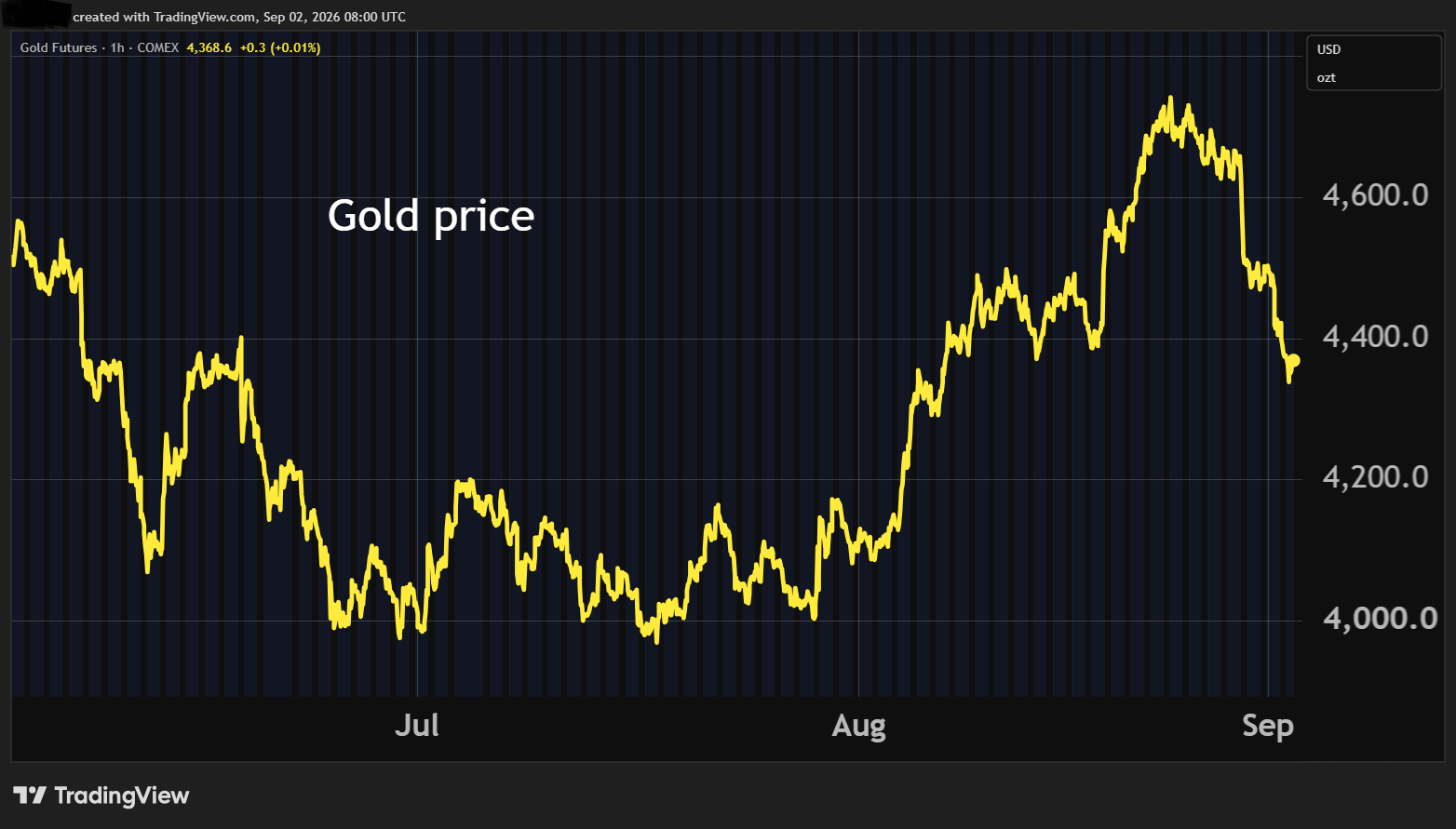
Source: TradingView.
Gold was already heading higher during early August as the Federal Reserve kept interest rates on hold at the end of July, and the latest jobs report was weaker than expected, which suggested interest rates will be held in September as well. Both these factors weakened the dollar, which was all the gold price needed to shoot back above the 200-day moving average, with the heaviest retail buying of gold backed exchange-traded funds (ETFs) since last year.
The US dollar had been steadily strengthening throughout the summer but a flurry of events such as the intervention to support the Japanese yen, interest rates staying on, and a surprise bond buying programme have sent it sharply lower during the past month.
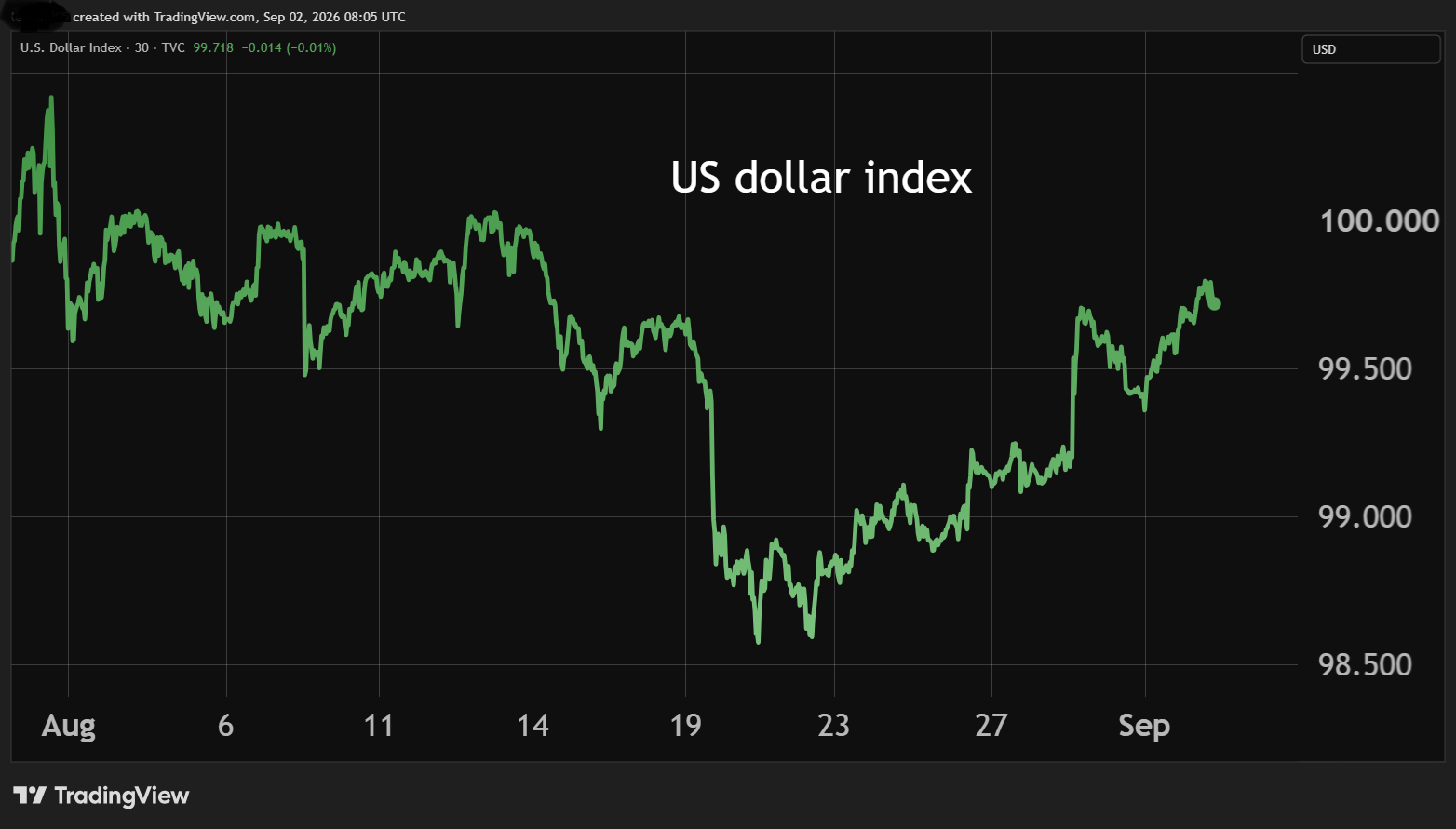
Source: TradingView.
Bitcoin booms
Another beneficiary of a weaker dollar has been the cryptocurrency bitcoin. Until the end of August, it was having a torrid time having fallen 27% from the start of this year and was down almost 50% from its peak at $120,000 last year.
This would have been a major embarrassment for President Donald Trump given his repeated support for cryptocurrency. Under his second presidency Trump has aimed to make the US the “crypto capital of the planet”. He established the US digital asset stockpile that holds bitcoin. He has also decreased regulation on cryptocurrency and dropped investigations into crypto companies.
- Wealth warning: when acting on rumours can cost you a fortune
- Sign up to our free newsletter for investment ideas, latest news and award-winning analysis
With all this in mind the timing of the White House crypto summit held on 19 August was clear. Trump invited senior executives from major crypto currency organisations to meet with senior Nasdaq, New York Stock Exchange, and Chicago Mercantile Exchange figures at the White House. Bitcoin has shot up in value by 27% from around $63,000 on 17 August to close at $80,100 on 27 August.
Ducks in a row
The direction of travel for the run-up to the US mid-term election and into the end of the year is now taking shape. Trump finally has his man in place as Chair of the Federal Reserve Kevin Warsh, and with Bessent at the Treasury he’s got his ducks in a row.
Many now expect interest rates to be held for the rest of the year, with Goldman Sachs chief economist Jan Hatzius adding: “A hike at the September meeting has become very unlikely, barring a dramatic shift in the tone of the August data due in early September (which we don’t expect).” Goldman economists now expect two rate cuts early next year.
While not yet on the scale of previous bond buying programmes, the intervention by Bessent makes it clear that this administration is not afraid to increase spending and debt levels to prop up various markets.
Of course, many others don’t agree. Recent comments from the Federal Reserve chair at Jackson Hole naming inflation as the top priority, mean the odds of a hike on 16 September are currently as high as 70%.
Technology jumps on bumper AI earnings
Huge AI spending plans in the technology sector have been funded by record levels of debt and, with the cost of borrowing rising sharply, it was beginning to unnerve some investors. Higher borrowing costs are more painful for growth shares like technology due to the higher borrowing and weaker cashflow in the early years.
A higher yield on US Treasuries also increases the discount rate on which company valuations are based. Those companies growing fast which pushes more earnings out into the future will see a greater discount on the valuation today.
However, with the interest rate now expected to remain steady and fall next year, combined with falling yields on long-term rates, it has greatly eased some of the anxiety. With debt now cheaper to fund the growth of AI it was further supported by a bumper second-quarter earnings season, with revenue more than doubling at chip maker NVIDIA Corp (NASDAQ:NVDA) and assuaging any fears of a slowdown in profit growth or data centre building.
- ii view: Nvidia guidance way better than Wall Street forecasts
- ii view monthly round-up: an AI August
The Nasdaq Composite index had shot up 8.5% between the Fed decision to hold rates on 29 July and the end of August, and as the bumper earnings lifted confidence further, outstripping the S&P 500 which had risen 5.5% over the same period.
To some extent when revenue is doubling every year then it swamps any concerns about rising debt costs or the theoretical value of future earnings. But it’s important to remember that while lower Federal funds rates, record earnings and bond buying is supporting prices now, the fundamental basis on which these companies are valued is becoming more difficult.
Outlook for the rest of 2026
Looking out to the rest of the year, there are some important implications for investors if the current conditions of lower interest rates, a weaker dollar, higher or sticky inflation and support for equity markets holds.
Financials are beginning to look a bit exposed as they have benefited from rising rates which increased the net interest margins and resulted in record profits, sending share prices soaring. With the US economy looking weaker and the next interest move likely to be lower, when combined with a weaker dollar weighing on earnings then it could prove to be a slow end to the year for names like Barclays (LSE:BARC), HSBC Holdings (LSE:HSBA), and Lloyds Banking Group (LSE:LLOY).
Miners have benefited from a recovery in key commodity prices like gold and silver, and copper jumping on US tariff fears. Names like Anglo American (LSE:AAL), Rio Tinto Ordinary Shares (LSE:RIO), and Antofagasta (LSE:ANTO) have all had a strong August and should be supported into the year end.
- UK stock market winners and losers: August 2026
- Stockwatch: a rare growth share and possible takeover target
Emerging markets exposure has been a theme this year that seems set to continue. A weaker dollar and stronger commodity prices have resulted in a strong recovery of emerging market economies and currencies. Consumer goods giant Unilever (LSE:ULVR) flagged that it was the driving factor behind sales growth in its first quarter, and there seems every reason for this to continue into next year. The backdrop for consumer staples and defensive names has improved.
The US has also been throwing the kitchen sink at keeping oil prices lower despite the closure of the Strait of Hormuz. The US strategic oil reserve has been drained to its lowest level since 1983. Given the motivation to keep oil prices lower, then majors like Shell (LSE:SHEL) and BP (LSE:BP.) could probably drift sideways.
UK vs the world
The UK now stands alone as one of the few economies in the world making an effort to tackle its debt pile by raising taxes. While still running a deficit of 4.3% of GDP, it is forecast to fall to 3.1% of GDP in the future. The debt to GDP ratio that currently sits at 94% is set to peak at 96% in 2028, before beginning to fall again by the end of the decade.
The UK economy should also benefit from lower oil prices and could get a small benefit from a weaker dollar helping inflation figures. This is beginning to translate into decent returns, with the more UK focused FTSE 250 index up almost 9% so far this year, compared to the more international and commodity leaning FTSE 100 index nearer 8%.
To some extent it doesn’t matter whether you agree with the big spending US strategy, or the more fiscally conservative model in the UK. What is important is that it gives investors the choice to allocate between the two depending on their own risk appetite and what they want to achieve from their savings.
John Ficenec is a freelance contributor and not a direct employee of interactive investor.
These articles are provided for information purposes only. Occasionally, an opinion about whether to buy or sell a specific investment may be provided by third parties. The content is not intended to be a personal recommendation to buy or sell any financial instrument or product, or to adopt any investment strategy as it is not provided based on an assessment of your investing knowledge and experience, your financial situation or your investment objectives. The value of your investments, and the income derived from them, may go down as well as up. You may not get back all the money that you invest. The investments referred to in this article may not be suitable for all investors, and if in doubt, an investor should seek advice from a qualified investment adviser.
Full performance can be found on the company or index summary page on the interactive investor website. Simply click on the company's or index name highlighted in the article.