Investment trusts vs Saba: pressure and progress
A Kepler analyst looks at what activist investors achieved in 2026, and how the responses from investment trust boards led to a stronger sector.
9th October 2026 14:00

This content is provided by Kepler Trust Intelligence, an investment trust focused website for private and professional investors. Kepler Trust Intelligence is a third-party supplier and not part of interactive investor. It is provided for information only and does not constitute a personal recommendation.
Material produced by Kepler Trust Intelligence should be considered a marketing communication, and is not independent research.
When Saba Capital went after the boards of seven UK investment trusts in December 2024, having built stakes of between 19% and 29% in each, the reaction was close to alarm as the verdict on the New York hedge fund and its founder, Boaz Weinstein, was largely that it was acting in its own short-term interest.
Nearly two years on, that criticism has not gone away. Some of Saba’s approaches still look designed to serve its own interests more obviously than those of fellow shareholders. Its campaign at Baillie Gifford US Growth Ord (LSE:USA), a trust making full use of the closed-ended structure and with a style that seems to be coming back into favour, is a case in point. Elsewhere, the signposts were clearer: stubbornly wide discounts, lagging performance or trusts shrinking to the point that their future was in question. There, activists were often pushing on an open door.
Either way, we note that boards have become far more active: buying back shares, offering tenders, merging for scale, cutting fees and rethinking dividend policies, often with no activist on the register at all. There is more to do. But the result, we would argue, is a sector that is more resilient and more competitive, with boards more proactive than ever on shareholders’ behalf, and discounts help illustrate that progress.
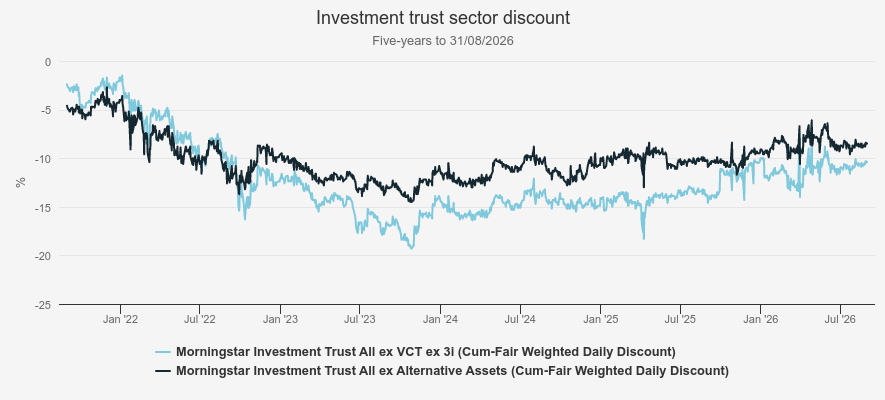
The chart below tracks average discounts using Morningstar’s sector classifications. One line covers all trusts excluding VCTs and 3i, while the other strips out alternatives to focus on equity-oriented strategies. Across the full universe, the discount widened from low single digits in 2021 to almost 20% in late 2023, as higher interest rates, the cost disclosure saga and the dominance of US mega-caps took their toll. It has since roughly halved, to around 10% at the end of August, with equity-focussed trusts back in single digits.
INVESTMENT TRUST SECTOR DISCOUNT MOVEMENTS
Source: Morningstar
So, what has closed the gap? Performance has done a lot of the work. We would argue that much of the earlier widening reflected sentiment rather than portfolios failing to deliver, and as sentiment has turned, share prices have recovered strongly. Professional buyers have noticed too. In the AIC's latest survey, a net 19% of wealth managers expect to write more investment trust business, close to the record high. Among those planning to use trusts more, 51% cited strong performance, up from 39%, while the share citing discounts fell from 68% to 56%. Investors are increasingly buying trusts for what they aim to deliver, not simply because they are cheap.
Performance has not done it alone; boards have played their part too. According to the AIC, trusts bought back a record £10.2 billion of their own shares in 2025, up 36% on the previous record of £7.5 billion set in 2024. A record 27 were merged, acquired or liquidated, beating the 24 of the year before. Boards also sharpened their fee structures, with a record 41 trusts changing fees to benefit shareholders. In 18 cases this meant basing charges on the lower of NAV and market capitalisation, so that managers share the pain of a wide discount. In our view, some of this was prompted, at least in part, by activist pressure. The result is a sector of larger, more liquid and cheaper-to-own vehicles, as well as the past few years showcasing the strengths of the closed-ended structure, including the ability to hold private companies such as Space Exploration Technologies Corp Class A (NASDAQ:SPCX) through to listing and riding out volatility without being forced sellers, reinforcing demand.
The recovery has not been even, though. Parts of private equity and alternatives remain on discounts of 20% or more, and that is where much of the recent activist attention has moved, although some equity trusts remain firmly in Saba’s sights. So, what has this year held, both from the activists and from the boards?
What has Saba been up to?
Saba’s case for approach typically spans wide discounts, stretches of weak performance and questions over valuations, governance and boards it believes have been too slow to act. Its argument is that shareholders are trapped and deserve an exit at or close to NAV. Its critics point out that Saba profits handsomely from that exit and, in some cases, would like the management contract too. Both can be true.
How each campaign plays out has varied. In some cases, Saba has pushed for control, and this year it secured that at Edinburgh Worldwide Ord (LSE:EWI)and Impax Environmental Markets Ord (LSE:IEM). In these two cases it looks likely the sector will lose two differentiated strategies which we believe had a lot to offer. The FCA is tightening the rules by the end of the year so that directors nominated by a large shareholder cannot decide whether that shareholder becomes the manager, which we think is a sensible safeguard.
We’d argue that Pantheon International Ord (LSE:PIN) shows the constructive side. Like much of listed private equity, it traded on one of the widest discounts in the sector, amid doubts over whether its valuations would hold up in a sale. The board was already acting, committing a share of distributions to buybacks and reshaping the portfolio. Saba pushed it to go further, selling fund interests to finance buybacks and prove its valuations. In May the board sold around a tenth of the portfolio, and the discount narrowed sharply before drifting wider again. In our view, this is activism reinforcing a board already heading in the right direction, and a reminder that returning capital helps but does not close the gap on its own.
At Gore Street Energy Storage Fund Ord (LSE:GSF), the concerns were partly fair. A difficult market had hit the NAV hard, the dividend was not covered by cash flow and the sale of two projects to another fund run by the same manager raised governance questions. Saba, the largest shareholder, called for a wind-down. The board argued that selling in today’s market would crystallise losses, that its recovery plan needed time, and that the asset sales had been independently valued. Shareholders backed the board, but more than four in 10 voted with Saba. The board won the vote, then, but remains on notice. Contrast that with SDCL Efficiency Income Trust plc. (LSE:SEIT), where shareholders chose a wind-down and Saba is now helping to deliver it, with Boaz set to join the board as an unpaid director.
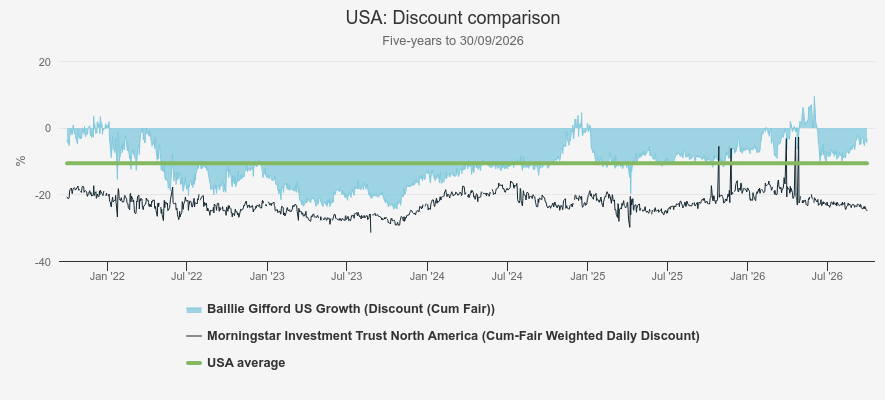
USA is one of the harder campaigns to explain. Saba points to five-year underperformance against the S&P 500, a window dominated by the 2021 and 2022 sell-off in long-duration growth stocks, and one that largely predates its own stake. Volatility comes with a strategy of this kind, but the board and managers responded to the sell-off by strengthening the process and risk controls delivering NAV and share price total returns of 107% and 157% over three years (to 30 September 2026) compared to the S&P 500’s 70%. Further, the discount is now much narrower than its own average and North American sector peers, although Saba will claim their buying has had a hand in this. USA is also using the flexibility of the closed-ended structure well, with private companies such as Anthropic and OpenAI making up almost half its assets.
USA DISCOUNT
Source: Morningstar
On top of this, the board says Saba has already turned down an exit close to NAV. Yet at the AGM on 23 October 2026, Saba will try for a third time to install its own nominees, with no clear plan for the manager, strategy or governance. With no real discount to close and an exit already offered, this looks less like fixing a problem than seeking control. Saba has lifted its stake to 29.9%, just below the level that would oblige it to bid for the company, and a second New York hedge fund, Sessa Capital, now holds 7.7%. At EWI, other US hedge funds tipped the balance, which makes turnout from USA’s other shareholders decisive and more information about how to vote can be viewed here.
Taken together, Saba’s year shows both sides of activism. It has been a useful catalyst where trusts were genuinely stuck, but has had a far harder case to make where boards have acted or trusts are already using the structure well.
Beyond Saba
Beyond the sometimes-exhaustive headlines about Saba’s next move, other forms of activism are worth highlighting. Asset Value Investors (AVI) is a case in point. It has managed what is now AVI Global Trust Ord (LSE:AGT) since 1985. Its chief executive, Joe Bauernfreund, and team actively engage with companies: their influence and expertise applied through private dialogue and practical proposals first, with public pressure used only where needed.
HarbourVest Global Priv Equity Ord (LSE:HVPE), held by AGT, shows how that works. Its board had already enlarged its buyback pool and introduced a continuation vote. In January, AVI published an open letter commending those steps but arguing that further significant initiatives were needed. In April, following discussions with a range of shareholders, the board committed to a $400 million tender offer this autumn and committed to returning around 5% to 10% of NAV a year, implying approximately $1 billion by the next continuation vote in 2029. In July, 98.2% of votes backed continuation, with the shares close to an all-time high. In our view, that is engagement at its best: a proactive and receptive board, leaving shareholders with a trust they want to keep.
AVI also applies the same engagement-led approach as an investment strategy through AVI Japan Opportunity Ord (LSE:AJOT). It buys over-capitalised Japanese smaller companies and works with management to put surplus cash, property and cross-shareholdings to better use. This summer’s 55.8% premium bid for its largest holding, Sharing technology, showed how quickly patient engagement can crystallise value.
Newer activist names are appearing in alternatives areas, like battery storage. Last year, Harmony Energy Income ran a sale process and was sold at around NAV, having traded on a deep discount beforehand. PrimeStone Capital, a Harmony investor at the time, is now pressing Gresham House Energy Storage Ord (LSE:GRID)to follow suit. The board has declined, pointing to strong NAV growth as new projects move into construction. Both sides have a point. The real question is not whether the value exists, but who captures it: today's shareholders through a sale, or the same shareholders later if the board delivers. With Saba pressing the same question at Gore Street, the sub-sector's boards are firmly on notice, and in our view that pressure could help produce a healthy outcome for shareholders.
Boards on the front foot
Interestingly, we think some of the most encouraging developments this year have come from boards acting on their own initiative, often with no activist on the register. Perhaps this is the prospect of one appearing on the register in the future or a genuine focus on addressing a longer-term issue. But whatever the trigger, the result has been a better set of trusts to choose from.
Consolidation is one example. Aberdeen UK Smaller Cos Growth Trust plc (LSE:AUSC) had bought back more than half its shares since 2021, protecting shareholders but leaving the trust smaller and less liquid. Rather than keep shrinking, the board ran a competitive review and agreed to combine with JPMorgan UK Small Cap Growth & Income (LSE:JUGI), creating the second-largest trust in the sector, with lower fees. AUSC shareholders can take a capped cash exit or roll into a trust run by the long-standing team of Georgina Brittain and Katen Patel, with an enhanced dividend that pays considerably more. In our view, this is consolidation done well, giving shareholders choice, lower costs and greater liquidity.
Tender offers have also become more thoughtful. Baillie Gifford Shin Nippon Ord (LSE:BGS) shows how a board can offer what activists typically demand, an exit close to NAV, without completely abandoning the strategy. Brian Lum and Jared Anderson have been reshaping the portfolio since taking over in May 2025, and the existing three-year performance test would largely have judged their predecessor. So the board brought forward a 15% tender, completed in March and more than three times oversubscribed. It then replaced it with a full exit opportunity if the trust fails to beat its index over the five years to 2030, a clear show of confidence in the new managers’ efforts. Overall, shareholders who wanted liquidity got it, those who stayed have a stronger backstop through managers who have evolved the process and improved the performance profile, with NAV and share price total returns ahead of the benchmark under their tenure.
Aberdeen took a different, and more debated, route. Alongside the deal that brought Herald Ord (LSE:HRI) under its management, Aberdeen paid Saba an undisclosed sum for a three-year standstill that seven of its trusts’ boards chose to join. The Herald deal itself kept the team and strategy intact and gave shareholders a tender for up to two-thirds of their shares. Many of the trusts in the standstill were unlikely targets in the first place, for instance, Aberdeen Equity Income Trust (LSE:AEI), has grown its dividend for 25 consecutive years, offers a premium yield, outpaced the index over the last three years and traded at a premium for much of the past year. None of Aberdeen's trusts had Saba on the register at the time, and the price was reportedly agreed below market rate for that reason.
That raises an obvious question: why pay at all? Critics see an uncomfortable precedent in a manager paying an activist to stand aside, and note that it does nothing to ease the pressure on boards to manage discounts. Supporters would argue that it costs shareholders nothing and that each board chose to opt in. In our view, it is best seen as an insurance policy rather than a substitute for discount discipline. Paid for by the manager, it removes the risk of a costly distraction, so managers can stay focussed on delivering for shareholders.
Final thoughts
On balance, we think activism has been good for the sector. Not every campaign has been well judged, but the pressure has raised the bar for boards, made them more accountable and pushed the sector to compete harder for investors’ money, often before an activist has appeared on the register at all. Activists differ in kind as well as in tone, though, and where activism falls short, the answer lies with boards and shareholders as much as with regulation. Boards that act early leave activists little to work with. That means giving investors a reason to stay: strong performance, competitive fees, a dividend worth having, enough scale to trade and an exit when one is genuinely needed, as AUSC and BGS have shown. Shareholders have a role too. Campaigns are decided by those who vote, and USA will be a test of that.
Stepping back, the direction of travel has shifted, and with it the opportunity set. The result is a more competitive sector than it has been for some time. Equity trusts, more broadly, trade at tighter discounts, reflecting renewed confidence in what they deliver. Meanwhile, the wider discounts in private equity and alternatives have become the battleground, with asset sales, tenders and engagement all working to close the gap. Pockets of the market still trade on wide discounts despite strong underlying performance, and where the investment case remains intact, that gap between price and value may offer an additional source of return. The question for boards may no longer be whether an activist might turn up, but whether it would find anything to fix.
Kepler Partners is a third-party supplier and not part of interactive investor. Neither Kepler Partners or interactive investor will be responsible for any losses that may be incurred as a result of a trading idea.
These articles are provided for information purposes only. Occasionally, an opinion about whether to buy or sell a specific investment may be provided by third parties. The content is not intended to be a personal recommendation to buy or sell any financial instrument or product, or to adopt any investment strategy as it is not provided based on an assessment of your investing knowledge and experience, your financial situation or your investment objectives. The value of your investments, and the income derived from them, may go down as well as up. You may not get back all the money that you invest. The investments referred to in this article may not be suitable for all investors, and if in doubt, an investor should seek advice from a qualified investment adviser.
Full performance can be found on the company or index summary page on the interactive investor website. Simply click on the company's or index name highlighted in the article.
Important Information
Kepler Partners is not authorised to make recommendations to Retail Clients. This report is based on factual information only, and is solely for information purposes only and any views contained in it must not be construed as investment or tax advice or a recommendation to buy, sell or take any action in relation to any investment.
This report has been issued by Kepler Partners LLP solely for information purposes only and the views contained in it must not be construed as investment or tax advice or a recommendation to buy, sell or take any action in relation to any investment. If you are unclear about any of the information on this website or its suitability for you, please contact your financial or tax adviser, or an independent financial or tax adviser before making any investment or financial decisions.
The information provided on this website is not intended for distribution to, or use by, any person or entity in any jurisdiction or country where such distribution or use would be contrary to law or regulation or which would subject Kepler Partners LLP to any registration requirement within such jurisdiction or country. Persons who access this information are required to inform themselves and to comply with any such restrictions. In particular, this website is exclusively for non-US Persons. The information in this website is not for distribution to and does not constitute an offer to sell or the solicitation of any offer to buy any securities in the United States of America to or for the benefit of US Persons.
This is a marketing document, should be considered non-independent research and is subject to the rules in COBS 12.3 relating to such research. It has not been prepared in accordance with legal requirements designed to promote the independence of investment research.
No representation or warranty, express or implied, is given by any person as to the accuracy or completeness of the information and no responsibility or liability is accepted for the accuracy or sufficiency of any of the information, for any errors, omissions or misstatements, negligent or otherwise. Any views and opinions, whilst given in good faith, are subject to change without notice.
This is not an official confirmation of terms and is not to be taken as advice to take any action in relation to any investment mentioned herein. Any prices or quotations contained herein are indicative only.
Kepler Partners LLP (including its partners, employees and representatives) or a connected person may have positions in or options on the securities detailed in this report, and may buy, sell or offer to purchase or sell such securities from time to time, but will at all times be subject to restrictions imposed by the firm's internal rules. A copy of the firm's conflict of interest policy is available on request.
Past performance is not necessarily a guide to the future. The value of investments can fall as well as rise and you may get back less than you invested when you decide to sell your investments. It is strongly recommended that Independent financial advice should be taken before entering into any financial transaction.
PLEASE SEE ALSO OUR TERMS AND CONDITIONS
Kepler Partners LLP is a limited liability partnership registered in England and Wales at 9/10 Savile Row, London W1S 3PF with registered number OC334771.
Kepler Partners LLP is authorised and regulated by the Financial Conduct Authority.