The funds I chose for my partner, trusts I like, and an ETF warning
What would you pick for your other half’s money? A Kepler analyst discusses the three-fund portfolio, flags the ‘value’ ETFs that leave him cold, and names the small-cap and value trusts on his radar.
6th November 2026 14:01

This content is provided by Kepler Trust Intelligence, an investment trust focused website for private and professional investors. Kepler Trust Intelligence is a third-party supplier and not part of interactive investor. It is provided for information only and does not constitute a personal recommendation.
Material produced by Kepler Trust Intelligence should be considered a marketing communication, and is not independent research.
Index funds have done wonderful things in raising awareness of investing, particularly with young Britons, and making building wealth more affordable and accessible than ever before. No longer does one have to call up a broker and pay well over the odds to share in the fruits of capitalism.
In my view, the real beauty of passive investing is in its simplicity. My partner, Dani’s, portfolio consists of three funds: the Vanguard FTSE All-World UCITS ETF GBP (LSE:VWRL), which gives her exposure to the world’s biggest firms; the iShares S&P SmallCap 600 ETF USD Dist GBP (LSE:ISP6), which covers off US smaller companies and may soon be replaced by a global offering; and Scottish Mortgage Ord (LSE:SMT), for some spice.
I suggested mainly passive funds, not because I dislike active fund management, as you can see from the appearance of SMT; but because owning three funds is low maintenance and easy to understand.
I’m happy to back active management myself because I like the challenge and hope I’m good at it. For others, the investment case for index funds in my view is that the average actively managed fund underperforms broad indices after costs and it’s hard to predict which ones will do well. Taking broad exposure makes sense when you look at it like that.
Today, though, it seems most passive advocates’ case for index fund investing is that active management is some kind of con that continues to rip consumers off. That, clearly, isn’t true, as proven by the fact that SMT is the best-performing fund in Dani’s portfolio.
Indeed, passive investing isn’t without its own pitfalls. As it grows in popularity, more exchange-traded funds (ETFs) are being launched in evermore niche, thematic areas (and that’s not to mention the leveraged single-stock ETF nonsense). Even many of the ETFs that should be more mainstream turn out to be questionable, at best; misleading at worst.
Mr Chips
Take value investing. Along with investing in smaller companies, investing in cheap stocks is one of the two best ways of outperforming over time. The annual value premium in the US stock market between 1927 and 2025 was circa 4.2%, according to the Fama-French Three Factor Model. Value stocks have outperformed growth stocks almost 60% of the time (in 59 of the past 99 years).
The difficulty with this data point is that it’s not possible to track in a fund: the data is very much bespoke. It establishes the returns from large-cap value and small-cap value stocks, as judged by book-to-market ratios and takes away the returns of large-cap growth and small-cap growth stocks. If the final number is positive, value stocks outperformed and vice versa.
The value premium
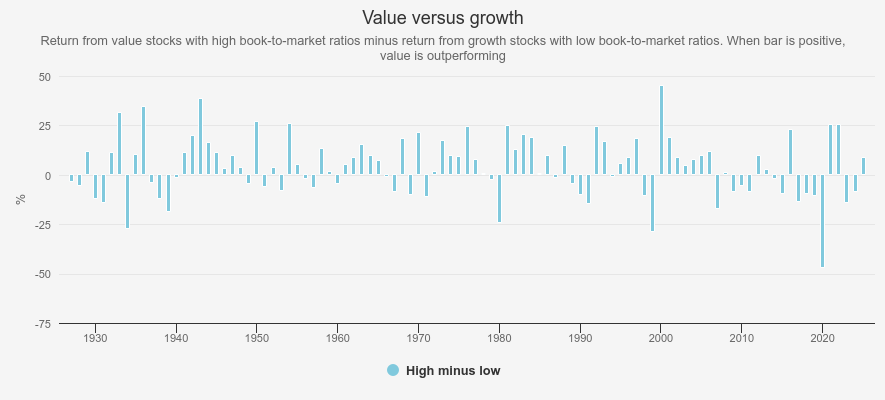
Source: Kenneth R. French, Dartmouth University. Past performance is not a reliable indicator of future results
Still, I think it’s important to have some exposure to value stocks, given these findings. Yet, a browse through the largest global value ETFs, using the website JustETF.com, shows something rather odd. The MSCI World Enhanced Value Index is more concentrated than its broad, market-cap-weighted counterpart.
The iShares Edge MSCI Wld Val Fctr ETF $Acc GBP (LSE:IWFV) has 14% of its circa £5.5 billion assets invested in Micron Technology Inc (NASDAQ:MU), the memory chip maker that I’ve long thought represented one of the biggest bubbles of the artificial intelligence trade. MU’s shares are up a staggering 333% in the space of 12 months. The US version of the iShares ETF has 21% in MU and a further circa 3% in Cisco Systems Inc (NASDAQ:CSCO).
Both MU and CSCO have book-to-market ratios of c. 0.12x, according to Bloomberg. That’s lower than the S&P 500’s average of 0.18x and doesn’t smack of value stocks to me.
Most other value ETFs allow MU in thanks to its low forward price-to-earnings ratio, which is predicated on a massive and enduring spike in earnings that may or may not materialise. They also have exposure to the likes of Applied Materials Inc (NASDAQ:AMAT), Lam Research Corp (NASDAQ:LRCX), Apple Inc (NASDAQ:AAPL), Alphabet Inc Class A (NASDAQ:GOOGL), Amazon.com Inc (NASDAQ:AMZN) and Microsoft Corp (NASDAQ:MSFT). Value is, of course, subjective, but these aren’t what I’m looking for.
Fertile ground
The global value funds I invest in tend to be open-ended, but I do have some good value investment trust options. I mentioned the two factors that outperform over the long term are small-caps and value, so you can guess that small-cap value has a place in my portfolio.
The UK is a good hunting ground here. Aberforth Smaller Companies Ord (LSE:ASL), which was recently awarded Kepler’s Growth rating for 2026 thanks to strong performance, is a mainstay of my portfolio thanks to management’s rigorous value approach.
That’s supplemented by allocations to Rockwood Strategic Ord (LSE:RKW)and Odyssean Investment Trust Ord (LSE:OIT), which both take a private equity-like approach to appraising and engaging with micro-cap companies and have some of the best performance records of all UK equity trusts.
Sticking with the UK, Temple Bar Ord (LSE:TMPL) remains a key component of many-a portfolio, as does Fidelity Special Values Ord (LSE:FSV), which takes an all-cap approach, blending large caps with smaller companies.
A recent addition wasBlackRock Latin American Ord (LSE:BRLA), after an overreaction to Lula’s shock presidential election win that saw the BOVESPA (and BRLA) slump circa 17% on the news. Still, stock returns have been impressive during Lula’s tenure(s) in power, and the likelihood is he won’t be overly market-unfriendly – and Brazilian stocks look cheap, anyway.
We’ve seen a real uptick in popularity for value investment trusts in recent years, buoyed by improving performance. OIT, TMPL, Murray International Ord (LSE:MYI), BlackRock American Income Trust Ord (LSE:BRAI)and City of London Ord (LSE:CTY) are trading at premiums at the time of writing, with RKW, FSV and North American Income Trust Ord (LSE:NAIT) not far behind.
With the ETF industry becoming more growth heavy, even in their supposedly value-focused offerings, the investment trust universe could be beneficiaries if and when we see wobbles in the AI trade.
Kepler Partners is a third-party supplier and not part of interactive investor. Neither Kepler Partners or interactive investor will be responsible for any losses that may be incurred as a result of a trading idea.
These articles are provided for information purposes only. Occasionally, an opinion about whether to buy or sell a specific investment may be provided by third parties. The content is not intended to be a personal recommendation to buy or sell any financial instrument or product, or to adopt any investment strategy as it is not provided based on an assessment of your investing knowledge and experience, your financial situation or your investment objectives. The value of your investments, and the income derived from them, may go down as well as up. You may not get back all the money that you invest. The investments referred to in this article may not be suitable for all investors, and if in doubt, an investor should seek advice from a qualified investment adviser.
Full performance can be found on the company or index summary page on the interactive investor website. Simply click on the company's or index name highlighted in the article.
Important Information
Kepler Partners is not authorised to make recommendations to Retail Clients. This report is based on factual information only, and is solely for information purposes only and any views contained in it must not be construed as investment or tax advice or a recommendation to buy, sell or take any action in relation to any investment.
This report has been issued by Kepler Partners LLP solely for information purposes only and the views contained in it must not be construed as investment or tax advice or a recommendation to buy, sell or take any action in relation to any investment. If you are unclear about any of the information on this website or its suitability for you, please contact your financial or tax adviser, or an independent financial or tax adviser before making any investment or financial decisions.
The information provided on this website is not intended for distribution to, or use by, any person or entity in any jurisdiction or country where such distribution or use would be contrary to law or regulation or which would subject Kepler Partners LLP to any registration requirement within such jurisdiction or country. Persons who access this information are required to inform themselves and to comply with any such restrictions. In particular, this website is exclusively for non-US Persons. The information in this website is not for distribution to and does not constitute an offer to sell or the solicitation of any offer to buy any securities in the United States of America to or for the benefit of US Persons.
This is a marketing document, should be considered non-independent research and is subject to the rules in COBS 12.3 relating to such research. It has not been prepared in accordance with legal requirements designed to promote the independence of investment research.
No representation or warranty, express or implied, is given by any person as to the accuracy or completeness of the information and no responsibility or liability is accepted for the accuracy or sufficiency of any of the information, for any errors, omissions or misstatements, negligent or otherwise. Any views and opinions, whilst given in good faith, are subject to change without notice.
This is not an official confirmation of terms and is not to be taken as advice to take any action in relation to any investment mentioned herein. Any prices or quotations contained herein are indicative only.
Kepler Partners LLP (including its partners, employees and representatives) or a connected person may have positions in or options on the securities detailed in this report, and may buy, sell or offer to purchase or sell such securities from time to time, but will at all times be subject to restrictions imposed by the firm's internal rules. A copy of the firm's conflict of interest policy is available on request.
Past performance is not necessarily a guide to the future. The value of investments can fall as well as rise and you may get back less than you invested when you decide to sell your investments. It is strongly recommended that Independent financial advice should be taken before entering into any financial transaction.
PLEASE SEE ALSO OUR TERMS AND CONDITIONS
Kepler Partners LLP is a limited liability partnership registered in England and Wales at 9/10 Savile Row, London W1S 3PF with registered number OC334771.
Kepler Partners LLP is authorised and regulated by the Financial Conduct Authority.