Stockwatch: why US/Iran deal looks a boon for growth
After nearly four months of waiting, it looks like we have a deal to fix the Middle East problem. Analyst Edmond Jackson gives his view on this, tax, politics and bank stocks.
16th June 2026 11:02
by Edmond Jackson from interactive investor
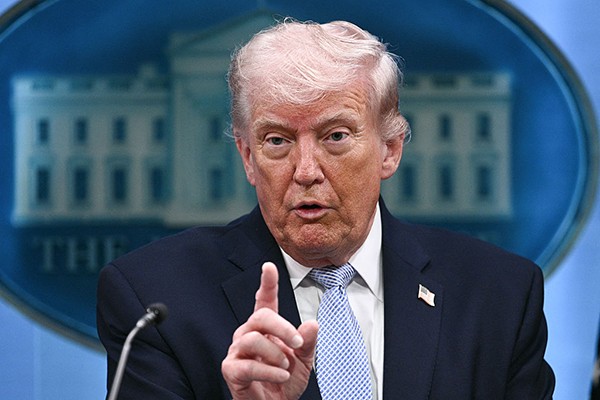
US President Donald Trump pictured at the White House. Photo: Brendan SMIALOWSKI/AFP via Getty Images.
Well, that was something quite out the blue, Sunday evening heralding substance to US President Donald Trump’s frequent teases of “a deal” with Iran. Last week, we’d seen a rise in military skirmishes involving Israel, the US and Iran in a war edging towards four months.
- Our Services: SIPP Account | Stocks & Shares ISA | See all Investment Accounts
Political analysts are roundly mocking Trump for achieving none of his war aims, arguing that if this memorandum of understanding (MOU) proceeds to a signed deal it will be no better than what President Barack Obama achieved with Iran in 2015 and which Trump proceeded to rip up.
But two key aspects – assuming they manifest and are sustained – look bullish from a purely economic perspective. It’s why US indices are in one sense right to hit record highs despite London’s muted response.
Removing sanctions on Iran – particularly oil – and restoring the flow of shipping through the Strait of Hormuz, could deliver a significant de-rating to energy prices over the medium term, and it is why London was right to mark and sell down BP (LSE:BP.) 3.3% to 517p and Shell (LSE:SHEL) 4.4% to 3,080p by Monday’s close. Holders of oil & gas shares need to consider the implications for portfolio weighting.
Indeed, Israel could spoil a fragile truce given its existential struggle with Iran, and one should remember how it triggered this war in late February when Israeli Prime Minister Benjamin Netanyahu reportedly egged Trump into a regime-change attempt with operation Epic Fury. Israel may now be in a worse position given Iran’s military looks in stronger control of the country, sanctions relief will boost Iran’s economy and Iran has woken up to exercising control over the US and its allies via the Strait of Hormuz.
It looks messy, but overall it reflects how the US and Iran both want respite from outright war, hence are coming together with a formula for moving on.
- Insider: big buying at Rolls-Royce as UK tech bosses net £2.4m
- SpaceX IPO: how records fell on market debut
Lower oil & gas prices would be among the top drivers for economic growth given that there is still a way to go to ditch reliance on fossil fuels. Not surprisingly, International Consolidated Airlines Group SA (LSE:IAG) rose 2.8% and Jet2 Ordinary Shares (LSE:JET2) by 2.7% yesterday, both shares potentially now in a multi-year uptrend.
While Jet2 has only recovered to late 2023 levels at around 1,315p, International Consolidated Airlines is nearly back to 2018 highs of around 450p. Yet ratings are a contrast: Jet2 on a forward price/earnings (PE) ratio near 11x and a 1.2% prospective yield, while IAG is on 7.5x and 2.1% respectively.
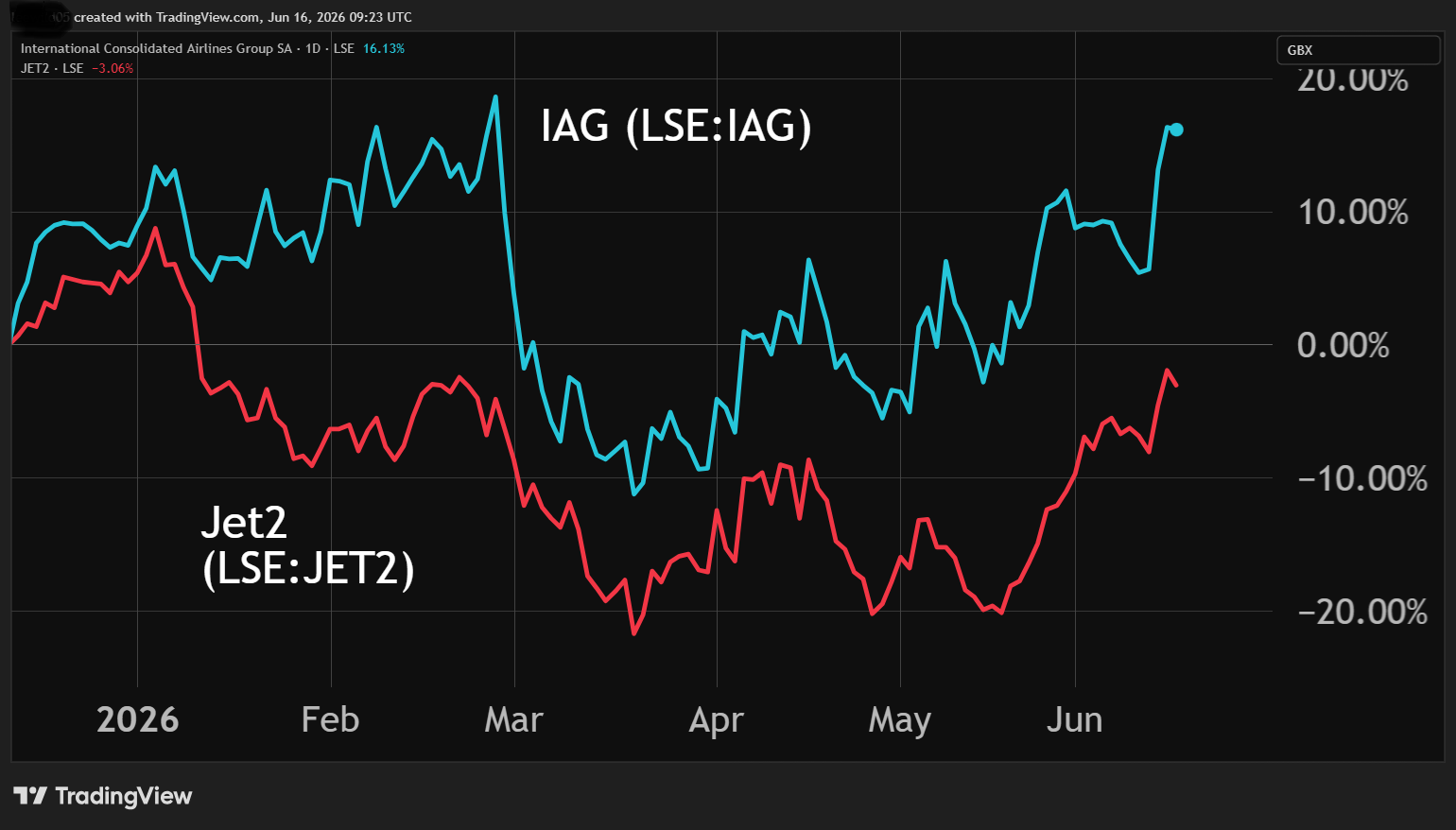
Source: TradingView. Past performance is not a guide to future performance.
That oil prices shrugged off political risk and fell – now down to around $82 a barrel for Brent – is thus proven canny versus end-April predictions from economists of $150 oil come June. A supply crunch was supposed to happen right now as strategic reserves dwindle, extending widely among other commodities and goods with the key shipping lane shut.
Will there be a genuine free flow of shipping?
This looks like the MOU’s key niggle. The US stock market has swallowed Trump’s assertion about how the Strait will be “completely opened” this Friday with no tolling like Iran previously insisted to help pay for post-war reconstruction.
It contrasts with Iran’s foreign ministry spokesman saying yesterday: “Under the MOU, Iran will ensure the security and safe passage of ships in the key shipping lane in co-operation with Oman and in consultation with stakeholders. Tolls will be charged.”
Perhaps we can discount this a little if both sides are making declarations for domestic consumption, each to present victory. But with Iran continuing to assert that the Strait will be under its management, such a caveat is critical for shipowners. Unless they get real assurance that ships will not be attacked if sailing without Iranian permission, most will not sail.
As for tolling, it would be a nuisance that added to inflationary pressures, albeit potentially offset (and by more) if the release of Iranian-sanctioned oil brings down global energy prices. Iran is thus playing its cards well.
- Shares for the future: this AIM share breaks into my top 10
- Investing in space: funds, trusts, and ETFs offering a route in
- Sign up to our free newsletter for investment ideas, latest news and award-winning analysis
Mind you, scope exists for all this to break down given that the MOU includes, according to Tehran, the “unfreezing of Iran’s assets and war reparations as two important economic priorities...the US commits to their implementation [but] “if the US fails to deliver its commitments, Tehran will take reciprocal measures.”
Neither side has actually published a text of the agreement.
Does UK political risk explain London’s absence from global party?
Yesterday’s FTSE 100 was a mixed affair because oil & gas significantly offset strength in miners where rising gold and copper prices helped Anglo American (LSE:AAL) up 2.1% to 4,088p and Antofagasta (LSE:ANTO) up 6.1% to 4,290p.
Yet the more domestic-focused FTSE 250 edged up barely 0.2% when logic suggests that more cyclical “risk-on” shares should benefit.
Coincidentally, and ahead of Thursday’s Makerfield by-election, Andy Burnham has touted robustly left-wing policies such as bringing utilities like water, energy grids and transport back under state control. The foreign exchange and government bond (gilt) markets have already been edgy over stretched UK public finances, although gilt prices rose yesterday (hence yields fell) as if part of a modest relief rally following the US/Iran MOU.
According to the gilt/equity yield ratio – which some would say is critical for equity prices – concern over long-term borrowing pushes up gilt yields where currently the 10-year is fluctuating around 4.8% and the 30-year around 5.5%. Rising gilt yields put downward pressure on equity prices whose yields need to rise in tandem.
Keir Starmer has urged Burnham not to destabilise the country with a leadership challenge and pledged to fight any challenge, which besides Burnham’s agenda, underlines UK assets as deserving a higher political risk premium. Whether causal or coincidental, this justifies global caution towards London equities right now.
I have, however, just recently noted in pieces on housebuilders, that these heavily shorted shares would be sensitive to any change in expectations for interest rates, hence Persimmon (LSE:PSN) rose 4% to 1,053p yesterday, Taylor Wimpey (LSE:TW.) 2.5% to 77p and Crest Nicholson Holdings (LSE:CRST) 2% to 72p.
- Stockwatch: should Taylor Wimpey shares be in your portfolio?
- Stockwatch: this share’s discount is simply too steep
- Stockwatch: a blue-chip with long-term recovery potential
Housebuilders are being helped by the prospect of the Bank of England maintaining its lending rate at 3.75% at Thursday’s meeting, with lower oil prices reducing medium-term inflationary pressure. If a Middle East peace-of-sorts is sustained, the risk of further rate rises is mitigated, and mortgage rates may even fall due to falling swap rates currently.
Interest rate swaps are used by lenders when they borrow from wholesale markets to fund mortgages – locking in a fixed rate rather than facing variable rates in wholesale markets. This inevitably assists housing demand.
I am still steeled for volatility in UK financial assets given the prospect of a Labour win on Thursday. In an interesting parallel with financial markets anticipating a net positive outcome to the US/Iran war, betting odds have consistently favoured Burnham versus commentators intrigued by Reform UK unseating Labour councillors in England.
Yet heading into the Makerfield’s vote, Reform’s local plumber candidate doesn’t seem to be cutting a great impression in media appearances – for what that is worth.
Banks exposed to radical new Labour leadership
Assuming a change in chancellor, banks could be targeted for higher taxes having been unaffected by Rachel Reeves’ twin tax-raising Budgets. A Burnham government would need to raise taxes in pursuit of a leftist agenda without triggering the “bond vigilantes” – traders who rebel against fiscal irresponsibility by selling gilts down.
After Reeves tilted positively towards banks – with a series of reforms such as improving the ring-fencing regime – the sector has traded volatile-sideways this year given that financials are sensitive to shifts in global macro events. Bank PE’s and yields appear to imply “hold” but be mindful of market reaction to a Burnham win.
Edmond Jackson is a freelance contributor and not a direct employee of interactive investor.
These articles are provided for information purposes only. Occasionally, an opinion about whether to buy or sell a specific investment may be provided by third parties. The content is not intended to be a personal recommendation to buy or sell any financial instrument or product, or to adopt any investment strategy as it is not provided based on an assessment of your investing knowledge and experience, your financial situation or your investment objectives. The value of your investments, and the income derived from them, may go down as well as up. You may not get back all the money that you invest. The investments referred to in this article may not be suitable for all investors, and if in doubt, an investor should seek advice from a qualified investment adviser.
Full performance can be found on the company or index summary page on the interactive investor website. Simply click on the company's or index name highlighted in the article.
Disclosure
We use a combination of fundamental and technical analysis in forming our view as to the valuation and prospects of an investment. Where relevant we have set out those particular matters we think are important in the above article, but further detail can be found here.
Please note that our article on this investment should not be considered to be a regular publication.
Details of all recommendations issued by ii during the previous 12-month period can be found here.
ii adheres to a strict code of conduct. Contributors may hold shares or have other interests in companies included in these portfolios, which could create a conflict of interests. Contributors intending to write about any financial instruments in which they have an interest are required to disclose such interest to ii and in the article itself. ii will at all times consider whether such interest impairs the objectivity of the recommendation.
In addition, individuals involved in the production of investment articles are subject to a personal account dealing restriction, which prevents them from placing a transaction in the specified instrument(s) for a period before and for five working days after such publication. This is to avoid personal interests conflicting with the interests of the recipients of those investment articles.