Stockwatch: should Taylor Wimpey shares be in your portfolio?
A dividend yield of 9% and share price at a 13-year low have caught the eye of analyst Edmond Jackson, who decides whether it’s time to take the plunge.
29th May 2026 10:27
by Edmond Jackson from interactive investor

In my last piece I explained how US inflation risks currently make me wary of “buy” stances on quality US tech shares such as Alphabet Inc Class C and Microsoft Corp – despite long-term appeal as international growth shares.
Let us consider UK housebuilders as exemplifying an opposite contrarian trade. I consider the essential case here, together with Taylor Wimpey, as one example and will look at more in the weeks ahead.
- Our Services: SIPP Account | Stocks & Shares ISA | See all Investment Accounts
The London stock market is supposedly dying, as the best businesses either seek private equity or shift their listings to the US if they have operations there. Furthermore, UK macro prospects are weak given the disaster of Brexit (say left-wing economists), and high taxation to support Labour’s benefits programme (the right-wing argues) helps explain young talent heading abroad.
For UK housebuilders, it means a dilemma where younger buyers – first-timers being essential to the health of the overall housing market – are compromised. There is also record UK youth unemployment after Labour raised employment costs not income tax (a general election pledge) to pay for benefits.
And this is before consideration of the Iran war leading to higher mortgage rates and fuel prices. Inflation had previously already become a dilemma for builders as their costs advanced over house price inflation, hence it was justified to see a de-rating of price/earnings (PE) multiples.
Housebuilders saw their shares fall in the region of 25-30% in response to the Iran war but have also been among those most actively shorted by hedge funds.
This may have skewed prices and baked in recovery potential if the Strait of Hormuz reopens soon, thereby soothing inflation fears, yet weeks go by with hopes regularly dashed.
Why should investors take housebuilders seriously?
Certainly, I would concede that if the UK faces recession, then cyclical “value” shares are higher risk than their PE’s and yields currently look.
But if you believe this war will be settled rather than drag on for years, such “risk assets” will rally if a significant downturn is averted.
Discounts to net tangible assets (NTA) – at least as shown by databases – appear to have become very significant, albeit in a big range where Persimmon at around 1,120p actually trades at a 5% premium whereas Crest Nicholson Holdings is at a 74% discount. That is some disruption to an historic sense how housebuilder shares rally from a 20-30% discount.
- Don’t miss the next big IPO: get the latest IPO news and updates straight to your inbox
- The Income Investor: prospects for Taylor Wimpey and Persimmon
Past rallies have, however, involved falling interest rates and first-time buyer stimuli such as the Help to Buy programme. Yet the Labour government is fiscally constrained, and analysis shows this Tory measure chiefly benefited housebuilders’ profits.
Labour is, however, supposedly committed to building 1.5 million homes by 2029; a target they will at least want to show some progress made towards by the next general election. This requires co-operation with volume housebuilders such as Barratt Redrow, Berkeley Group Holdings (The), Persimmon and Taylor Wimpey on planning consents.
Are Taylor Wimpey’s ‘discount to assets’ and fat yield justified?
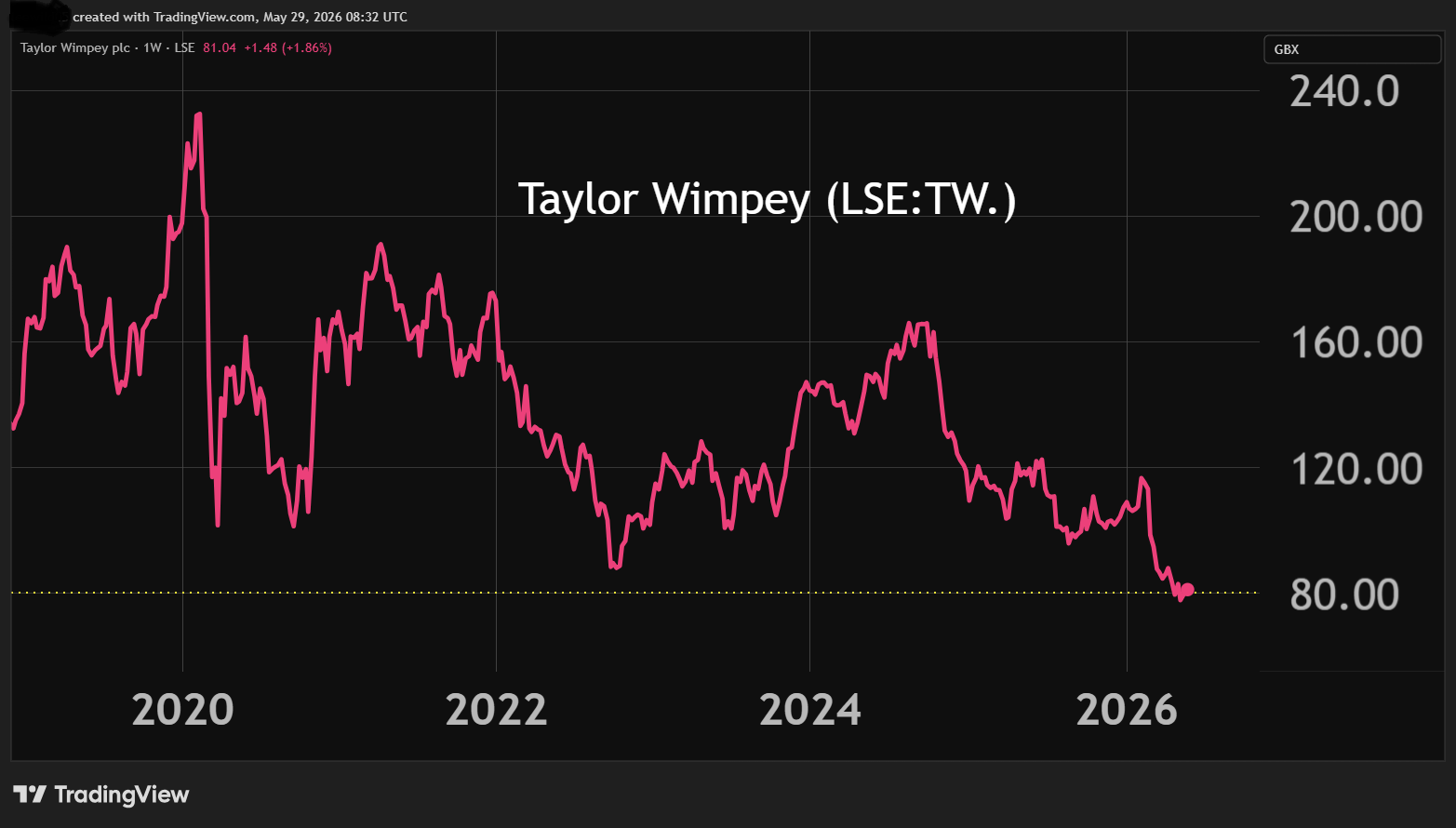
Source: TradingView. Past performance is not a guide to future performance.
I kick off with Taylor Wimpey at 81p, partly due to a near 9% yield (assuming consensus for a dividend of 7.0p to 7.3p per share to be paid in respect of 2027), albeit barely covered by earnings.
In terms of NTA, the end-2025 balance sheet had only £2.7 million of intangibles and no goodwill, leaving chiefly any risks with the value of £5,271 million inventories (down 2% on end-2024).
Note 9 of the annual accounts clarifies this as £3,200 million land (down 5.5% on 2024) and adds £2,020 million for development and construction costs, due to accounting standard IAS2 requiring inventory to be valued at the lower of cost and net realisable value, hence costs being capitalised. But is it justified to regard NTA as “bare bones” value if nearly 40% of inventories (126% of NTA) involve capitalised costs? One should at least be aware.
Subtract these costs and end-2025 NTA falls to £2,167 million, or 62p per share, hence on this terser view the de-rating from around 115p last February is not necessarily irrational.
It has counterbalance though, by way of intangible strength in Taylor’s significant extent of land yet to get planning permission. So, if you believe Labour will deliver on its promises, Taylor has asset appeal in this respect.
However, the dividend still looks exposed should the Iran war drag on and prompt international rises in interest rates versus inflation.
Anyway, the market may be conditioned to price Taylor Wimpey for a supposed high yield given its current share price tallies with that in 1993. You would have had to trade the unsustainable bull run from 2003 to 2007, or after the price plunged to as low as 10p in late 2008 and the next cyclical run to over 200p by mid-2016. Both do at least raise intrigue as to whether and when another run could happen, especially after the shares have been keenly shorted.
A circa 7p dividend assumes no further deterioration in the housing market as, at a cost of £240 million, this would be ahead of net cash generated from operations of £133 million in 2025 and £165 million in 2024. The financial summary table below shows cash reducing from £952 million at end-2022 to £430 million at end-2025.
Taylor Wimpey - financial summary
year-end 31 Dec
| 2016 | 2017 | 2018 | 2019 | 2020 | 2021 | 2022 | 2023 | 2024 | 2025 | |
| Turnover (£ million) | 3,676 | 3,965 | 4,082 | 4,341 | 2,790 | 4,285 | 4,420 | 3,515 | 3,401 | 3,845 |
| Operating margin (%) | 20.7 | 17.7 | 20.3 | 19.7 | 10.1 | 16.3 | 18.7 | 13.3 | 9.4 | 4.4 |
| Operating profit (£m) | 763 | 704 | 829 | 857 | 282 | 698 | 828 | 468 | 318 | 171 |
| Net profit (£m) | 589 | 555 | 657 | 674 | 217 | 556 | 644 | 349 | 220 | 100 |
| EPS - reported (p) | 17.9 | 16.9 | 20.0 | 20.6 | 6.3 | 15.2 | 18.0 | 9.9 | 6.2 | 2.8 |
| EPS - normalised (p) | 18.0 | 21.7 | 21.7 | 20.1 | 8.4 | 19.3 | 20.7 | 9.9 | 9.5 | 12 |
| Operating cashflow/share (p) | 16.4 | 18.4 | 19.6 | 15.6 | -8.7 | 11.8 | 13.4 | 3.7 | 4.6 | 3.8 |
| Capital expenditure/share (p) | 0.2 | 0.2 | 0.1 | 0.4 | 0.2 | 0.1 | 0.1 | 0.2 | 0.1 | 0.2 |
| Free cashflow/share (p) | 16.2 | 18.2 | 19.5 | 15.2 | -8.9 | 11.7 | 13.3 | 3.5 | 4.5 | 3.6 |
| Dividends per share (p) | 2.8 | 4.7 | 6.2 | 3.8 | 4.1 | 8.6 | 9.4 | 9.6 | 9.5 | 7.6 |
| Covered by earnings (x) | 6.4 | 3.6 | 3.2 | 5.4 | 1.5 | 1.8 | 1.9 | 1.0 | 0.7 | 0.4 |
| Return on total capital (%) | 20.8 | 18.5 | 20.4 | 21.1 | 6.0 | 13.4 | 16.1 | 9.1 | 6.3 | 3.5 |
| Cash (£m) | 450 | 601 | 734 | 630 | 823 | 921 | 952 | 765 | 647 | 430 |
| Net debt (£m) | -365 | -512 | -617 | -518 | -691 | -810 | -837 | -638 | -526 | -306 |
| Net assets (£m) | 2,900 | 3,137 | 3,227 | 3,308 | 4,017 | 4,314 | 4,502 | 4,523 | 4,405 | 4,187 |
| Net assets per share (p) | 88.7 | 95.8 | 98.4 | 101 | 110 | 118 | 127 | 128 | 124 | 118 |
Source: historic company REFS and company accounts.
A mixed trading statement on 28 April
In conjunction with the AGM, the company cited “steady” sales in the year to date “against ongoing affordability challenges and an increasingly uncertain macro backdrop”, which could be cautiously interpreted as a like-for-like decline, were it not for an increase in operational outlets of over 5%.
Build cost inflation is expected to be low to mid-single-digit for 2026 “as a result of rising energy costs...with cost pressure and surcharges starting to come through from our supply chain”.
I am cautious since this has a feeling of downtrend and yet consensus anticipates 2026 net profit of £217 million. With similar revenues projected, it implies an operating margin recovery from 4.4% last year, yet build costs are rising.
- Three problems with taxing cash inside investment ISAs
- Sign up to our free newsletter for investment ideas, latest news and award-winning analysis
However, the shares actually rose slightly in response, despite six disclosed short sellers (over the 0.5% disclosure threshold) raising their down-bets since the update and only one trimming very slightly.
Notionally, it implies those who have wanted to sell probably have already. Further downside requires worse news on fundamentals. Note that 6.34% of Taylor’s issued share capital is shorted, making it number 14 on London’s most-shorted list albeit behind Crest Nicholson at 9, Barratt Redrow at 8 and Vistry Group at 4.
A Middle East peace deal finally in the offing?
Housebuilding shares mostly fell yesterday amid reports of skirmishes threatening the Middle East ceasefire and scuppering any deal. US President Donald Trump then circulated a draft peace agreement among US allies albeit not radically different from one made public recently – under which the Strait of Hormuz would be reopened to commercial shipping, the US blockade of Iranian ports would be lifted and Iran given access to as much as £9 billion equivalent in frozen assets. They would also begin to address the future of Iran’s nuclear programme.
It might seem an odd conclusion to a piece on UK housebuilders, but I believe it is axiomatic to the sector. A case exists to start averaging in if you believe a settlement will ultimately be found, hence I conclude with a long-term “buy” on Taylor Wimpey. But do appreciate how real risks remain and that this stance could prove premature.
Edmond Jackson is a freelance contributor and not a direct employee of interactive investor.
These articles are provided for information purposes only. Occasionally, an opinion about whether to buy or sell a specific investment may be provided by third parties. The content is not intended to be a personal recommendation to buy or sell any financial instrument or product, or to adopt any investment strategy as it is not provided based on an assessment of your investing knowledge and experience, your financial situation or your investment objectives. The value of your investments, and the income derived from them, may go down as well as up. You may not get back all the money that you invest. The investments referred to in this article may not be suitable for all investors, and if in doubt, an investor should seek advice from a qualified investment adviser.
Full performance can be found on the company or index summary page on the interactive investor website. Simply click on the company's or index name highlighted in the article.
Disclosure
We use a combination of fundamental and technical analysis in forming our view as to the valuation and prospects of an investment. Where relevant we have set out those particular matters we think are important in the above article, but further detail can be found here.
Please note that our article on this investment should not be considered to be a regular publication.
Details of all recommendations issued by ii during the previous 12-month period can be found here.
ii adheres to a strict code of conduct. Contributors may hold shares or have other interests in companies included in these portfolios, which could create a conflict of interests. Contributors intending to write about any financial instruments in which they have an interest are required to disclose such interest to ii and in the article itself. ii will at all times consider whether such interest impairs the objectivity of the recommendation.
In addition, individuals involved in the production of investment articles are subject to a personal account dealing restriction, which prevents them from placing a transaction in the specified instrument(s) for a period before and for five working days after such publication. This is to avoid personal interests conflicting with the interests of the recipients of those investment articles.