Great British Retirement Survey 2026: Chapter 8
Financial advice and education
Chapter 8 of the Great British Retirement Survey reveals where we’re turning to for retirement advice in an era of Artificial Intelligence (AI) and social media.

Important information: As investment values can go down as well as up, you may not get back all of the money you invest. Currency changes affect international investments, and this can decrease their value in sterling. If you’re unsure if an investment account is right for you, please speak to an authorised financial adviser. Tax treatment depends on your individual circumstances and may be subject to change in the future.
We don’t just use AI, we follow the advice given
A quarter of respondents now use AI for financial advice, and of those who do, 7 out of 10 follow the advice given.
AI is particularly popular among younger generations, with 45% of Gen Z (18-28) using it to help make financial decisions.
Common uses include advice for investing, accessing pensions and taking a tax-free lump sum.
However, only 17% of those who follow AI-generated advice check it with a qualified financial adviser, raising questions about whether people are relying too heavily on technology for complex financial decisions.

Key findings
- AI is becoming a go-to for financial decisions, especially among younger people
- 7 in 10 people who use AI for financial help follow its advice
- Social media is now a major source of pension information for young people
- Too many people are leaving school without the financial knowledge they need
Who do we turn to for retirement advice?
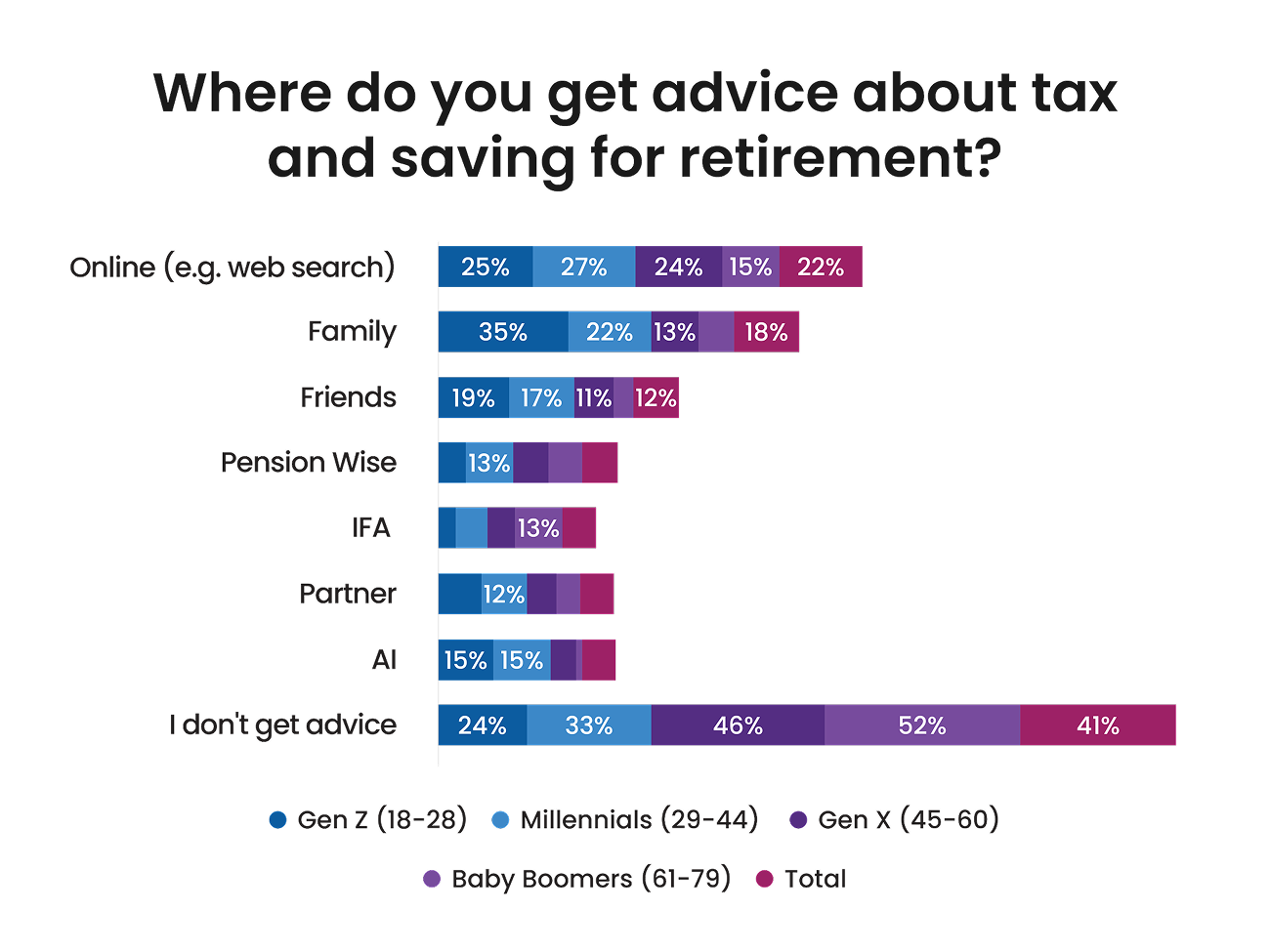
Worryingly, most people don't seek professional financial advice when making retirement decisions.
And, although it's one of the most significant financial events of our lives, more than 4 in 10 respondents (41%) say they don't get financial advice at all.
Instead, they're more likely to turn to online sources, family and friends for guidance.
Among younger generations, AI is becoming an increasingly important source of information. Gen Z and Millennials are now more likely to use AI for retirement-related decisions than a financial adviser, while only 9% of people overall use one for help with retirement and tax planning.
Financial advice shouldn’t be generalised
“While we can’t avoid the reality that AI is increasingly becoming part of our everyday lives, it shouldn’t be used as the sole basis when it comes to financial advice and guidance – especially when it comes to retirement planning.
Seeing people use AI for things like accessing their pension and taking their tax-free lump sum is alarming, even more so as a large majority tend to follow the advice given.
When it comes to your retirement and securing your financial future, especially when things get complex, it’s always worth talking to a regulated financial adviser to ensure you’re making the right decisions for you – there isn’t a one-size-fits-all answer.”
Fraser Kerr, Head of ii Advice

ii recommends
AI can make financial information more accessible, but it can't give tailored responses without knowing the full picture. Here are some practical changes that could help make personalised, regulated financial advice more accessible:
Financial education should be a core part of the national curriculum so that every young person leaves school with the skills needed to manage money confidently. Lessons could cover saving, investing, tax, debt, pensions, scams and the risks of relying on unverified information from social media or AI. The goal is to help young people understand not only how money works, but also how to identify trustworthy sources of financial guidance.
Wake-up packs would provide people with clear, timely information at key stages of life, helping them make better financial decisions before retirement. Rather than only receiving information close to retirement, people could be sent simple guidance when they start work, have their first child, reach age 40 or 50, and at important retirement milestones. Each pack could include a concise summary of options available at that stage of life, such as reviewing investments, increasing contributions or bringing savings together, making it easier to stay on track.
Complex language can make pensions and investing feel intimidating and difficult to understand, discouraging people from engaging with their finances. By using clearer, more straightforward language, the industry can help more people understand their options, compare products and make informed decisions with confidence.
Thinking about a Self-Invested Personal Pension?
Our free Essential Guide to SIPPs has everything you need to know to help you get started. It covers what a SIPP is, how it works and whether it’s right for you.
What about social media?
Social media is also a popular way for people to find information about retirement.
74% of Gen Z (18-28) use social media
Almost three quarters of Gen Z use social media for information about pensions and retirement, followed by half (54%) of Millennials (29-44).
YouTube is the most popular platform
YouTube is the most widely used social media platform for retirement information across all generations. Around 34% of Gen Z , 28% of Millennials (29-44) and 15% of Gen X (45-60) use it.
The retirement information divide
While social media is growing as a source of financial information, 88% of Baby Boomers (61-79) and 71% of Gen X say they don't use social media for information about retirement.