Great British Retirement Survey 2026: Chapter 7
Consolidation, fees and cash savings
Chapter 7 of the Great British Retirement Survey looks at how we invest our savings, from pensions and ISAs to cash and investments.

Important information: As investment values can go down as well as up, you may not get back all of the money you invest. Currency changes affect international investments, and this can decrease their value in sterling. If you’re unsure if an investment account is right for you, please speak to an authorised financial adviser. Tax treatment depends on your individual circumstances and may be subject to change in the future.
Are we saving too much in cash?
Cash savings can play an important role in a retirement plan, providing a buffer for short-term spending and unexpected costs.
But our research suggests many people may be relying on cash too heavily.
Just over one third (35%) of people saving for retirement outside a pension are using cash savings, compared with just 20% who are investing through a Stocks and Shares ISA.
We also found that many people who take a tax-free pension lump sum move the money into cash, with 27% placing it in a bank account and 20% in a Cash ISA.
While cash can provide security, it is unlikely to deliver the long-term growth potential of investments. With retirement often lasting decades, balancing cash with investments could help improve retirement outcomes.
Key findings
- Pension consolidation is becoming more popular
- Most savers still don't know what fees they're paying
- Many keep retirement savings in cash
- Tax-free pension withdrawals often end up sitting in bank accounts or Cash ISAs
Have you consolidated your pension?
If you have one or more pension, consolidating your pot could have some benefits. Uptake seems to be on the rise too.

Gen Z (18-28)
Many Gen Zers have already built up multiple pensions through auto-enrolment and changing jobs. Almost 22% of them with more than a single pension have consolidated their pots, while around half still hold multiple pensions.
Millennials (29-44)
Pension consolidation is most common among Millennials. More than 1 in 4 (28%) have consolidated their pensions, up from 21% a year ago, helping them keep track of their retirement savings more easily.
Gen X (45-60)
As retirement moves closer, many Gen X savers are simplifying their finances. Nearly 1 in 4 have already consolidated their pensions pots, while around 40% still have more than a single pension.
Baby Boomers (61-79)
Baby Boomers are less likely to have multiple pensions than younger generations, with around 27% holding more than a single pension. Even so, 21% have chosen to consolidate their retirement savings.
Few pension savers know their fees
Pension fees tend to be small in comparison to the size of your pension, but over time they can be add up and make a difference to the size of your pension.
Yet many of us don’t know what we’re being charged.
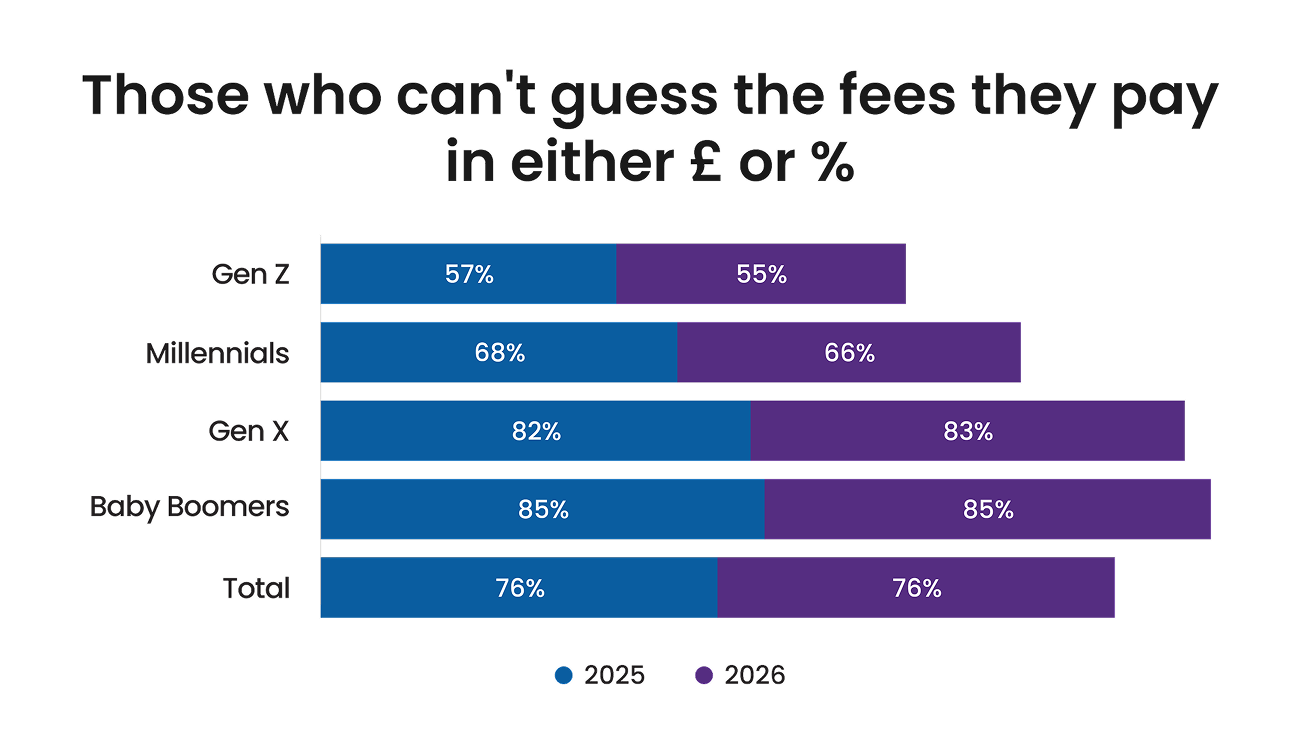
Among those approaching retirement, like Gen X (45-60), only 17% could guess the pension fees they pay to their provider, either in pounds or percentage terms.
Younger pension savers are more likely to know roughly what they are paying – 45% of Gen Z (18-28) could guess their pension fees, compared with 44% of Millennials (29-44), 17% of Gen X (45-60) and 15% of Baby Boomers (61-79).
Don't overlook the details
“Encouragingly, more pension savers are taking steps to consolidate old workplace pensions in the run up to retirement.
With fewer pensions to manage, this can make retirement planning easier.
However, they are still unlikely to check ‘under the bonnet’ of their pension scheme when it comes to fees.
And a large proportion of pension savers are saving for retirement using cash, which is unlikely to match investment returns over time.”

ii recommends
Pension consolidation is on the rise, but but more should be done to encourage it. Here are some practical changes that could help ease those concerns:
Most people see pension charges as a percentage, making it difficult to understand what they're really paying. To improve transparency, every pension statement and online account should show the total amount paid in charges each year in pounds and pence, alongside the percentage charge and an illustration of how those costs could affect savings over the next 10 years.
A lifetime provider model would give workers the option to choose a pension that stays with them throughout their career, rather than building up a new pot every time they move jobs. The aim is to reduce the number of small, forgotten pots and make retirement savings easier to track and manage in one place.
Thinking about a Self-Invested Personal Pension?
Our free Essential Guide to SIPPs has everything you need to know to help you get started. It covers what a SIPP is, how it works and whether it’s right for you.