The pension age is changing: Normal Minimum Pension Age (NMPA) is rising to 57 in 2028
In April 2028 the minimum age you can access your pension will rise from 55 to 57. Find out what’s happening and how it could affect your retirement plans.
Author: Rachel Lacey
Last updated: 6 July 2026
Reading time: 10 mins
Important information: The ii SIPP is for people who want to make their own decisions when investing for retirement. As investment values can go down as well as up, you may end up with a retirement fund that’s worth less than what you invested. Usually, you won’t be able to withdraw your money until age 55 (57 from 2028). Before transferring your pension, check if you’ll be charged any exit fees and make sure you don't lose any valuable benefits such as guaranteed annuity rates, lower protected pension age or matching employer contributions. Tax treatment depends on your individual circumstances and may be subject to change in the future. If you’re unsure about opening a SIPP or transferring your pension(s), please speak to an authorised financial adviser.
Key Takeaways
- What the changes are and how it affects you
- Whether you qualify for exemptions or a protected pension age
- How to plan ahead
What is the Normal Minimum Pension Age (NMPA)?
The Normal Minimum Pension Age (NMPA) is the youngest age that you can start withdrawing from your workplace or personal pension.
Currently, it is set at 55.
While some people access their pension at this age, you don’t need to dip into your pension if you don't need to. In fact, once you do start taking an income from your pension, your annual allowance may be reduced. This is known as triggering the Money Purchase Annual Allowance (MPAA), which is why you need to carefully consider how this will affect your pension contributions as you approach retirement.
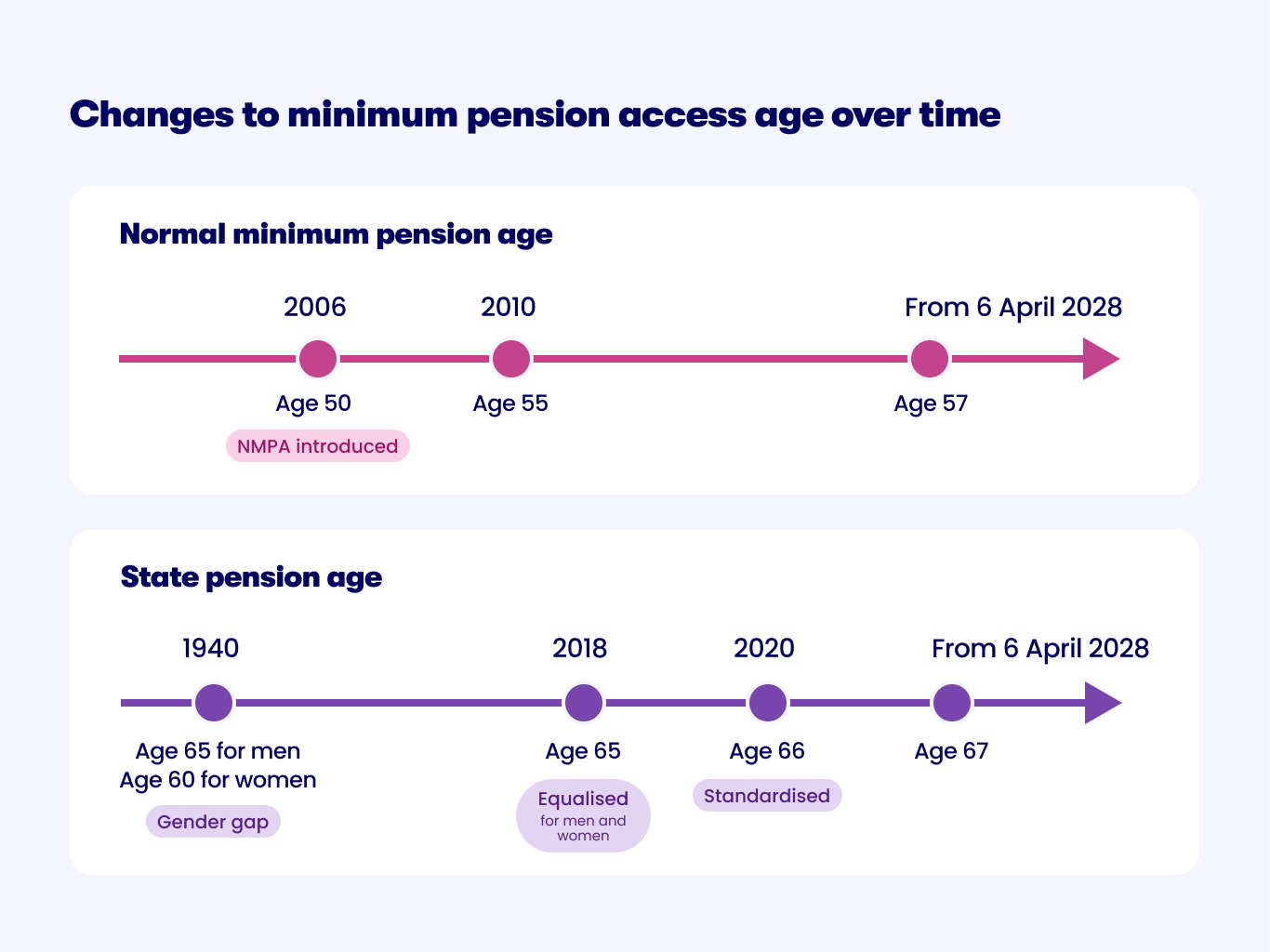
The NMPA isn’t to be confused with the State Pension age. That’s the age at which you can claim a State Pension and is currently set at 66.
What’s changing in 2028?
On 6 April 2028, the NMPA will rise from 55 to 57.
The NMPA was originally set at age 50 when it was introduced in 2006. It then rose to 55 in 2010, and in 2014 the government announced plans to increase it to 57 in 2028.
This latest increase is designed to align with the State Pension age, which is set to rise to 67 on the same day.
The new NMPA won’t affect Uniformed Services Pension Schemes, including the firefighter and police pension schemes.
What’s behind the pension age increase?
Life expectancy in the UK is on the rise, and because we’re living longer, pensions are expected to cover a longer period.
By delaying access to savings by two years, the government hopes to encourage people to put off retirement and preserve more of their pension for later life.
It said the increase is also expected to bring “indirect benefits” to the economy by having people in work for longer.
Who will be affected?
Whether you’ll be affected by the increase to the pension age will largely depend on your date of birth.
Born before 6 April 1971
You won’t be affected and will be able to access your pension as soon as you turn 55.
Born between 6 April 1971 and 5 April 1973
Until 6 April 2028, you will be able to access your pension as long as you’re 55 or older. After this date, if you haven’t accessed your pension, you will need to wait until your 57th birthday to access your pension.
Born on or after 6 April 1973
You will have to wait until your 57th birthday to access your pension.
How the NMPA change will work in practice
Tina was born on 29 March 1971, so she’ll be unaffected by the pension age increase.
By the time the NMPA rises in April 2028, she’ll already be 57.
Currently, Tina doesn’t have any plans to dip into her retirement savings, but she’s relieved that she will be able to get to her money if she needs it.
Beth turns 55 on 2 February 2028 – that means she’ll have just a short period to access her pot before the pension age increases to 57 on the 6 April 2028. If she doesn’t, then she will need to wait until 2 February 2030 before she’ll be able to access it.
This puts Beth in a tricky position. She wanted to start working part-time at age 55 so that she could spend more time helping her mum and use her pension to top up her income.
Beth now needs to consider her options. She could delay her plans for two years, or take enough money out of her pension as soon as she turns 55, to support her until she’s 57.
There’s been some uncertainty about whether someone who started taking some of their pension at 55, but won’t be 57 by 6 April 2028, will be able to keep doing so uninterrupted. HMRC has recently published guidance confirming it intends for savers in this position to be able to keep taking income from funds they’ve already ‘crystallised’ (such as through drawdown), so Beth might want to consider this too. The regulations to ensure this haven’t been finalised yet.
Beth would likely benefit from speaking to a financial adviser to help decide what’s best for her.
Ash – who is self-employed – was born on 1 May 1973, so he’ll have to wait until his 57th birthday to touch his pension.
Ash wants to have a gradual wind down from work, reducing his clients over time. He’d rather not wait until he’s 57 before he starts scaling back, so he’s now exploring whether he could use his stocks and shares ISA to top up his income instead.
Are there any other exceptions?
There will be some people who can start taking pension benefits before they reach the NMPA.
For example, if you have health problems that force you to retire early, or you are diagnosed with a terminal illness and have less than 12 months to live.
Others might benefit from a ‘protected pension age’.
What is a protected pension age?
If your pension has a protected pension age, you’ll be able to start withdrawing from your pension before you reach the official NMPA. But it’s important to be aware that these are likely to be the exception rather than the rule.
Currently, there are two types of protected pension age:
A protected pension age below 55
Some pensions will let you take money out of your pension before you reach the current NMPA of 55.
This mainly applies to older occupational and public service schemes. You could have been eligible if:
- You were a member of a pension scheme that had a protected pension age on 5 April 2006
- Your pension rules give you an ‘unqualified right’ to benefits before age 55
- The scheme rules included this right on 10 December 2003. You could also have a protected retirement age of under 50 if, on 5 April 2006, you had a personal pension or retirement annuity contract and worked in an eligible line of work - like professional football
If you’re unsure whether you have a protected pension age, check with the administrator of your pension scheme.
To use a protected pension age of less than 55, you’ll need to ‘crystallise’ your whole pension - for example, by moving it into drawdown.
Be aware that this protection can be lost if you return to some forms of work after accessing your pension. It can also be lost if you’re changing providers and you don’t transfer your pension as part of a block transfer.
A block transfer is where two or more members of the same pension scheme transfer simultaneously to the same new pension scheme. This means you can’t transfer to your new scheme by yourself and keep your protected pension age. Another person in your scheme will need to transfer to the same new scheme at the same time as you.
Your whole pension must be transferred as part of a block transfer. To keep a protected pension age of less than 55 using a block transfer, you also must not have been a member of the pension scheme you’re transferring to for more than 12 months.
A protected pension age below 57
Once the NMPA has increased to age 57 in April 2028, some schemes will offer a protected pension age that continues to let you access your pot from age 55 or 56.
To get this new protection, you’ll need to meet the following criteria:
- You were in a personal or occupational pension on 3 November 2021, like a final salary scheme
- The pension rules give you an ‘unqualified right’ to take money out of your pension before age 57
- The rules were in force on 11 February 2021
If you have a protected pension age below 57, you may still be able to transfer your pension into a new scheme, without losing the benefit. But you’ll need to check with your new pension provider and find out if their systems are set up to facilitate withdrawals before the NMPA increase.
This new protection is more flexible than its predecessor. There’s no requirement to take your whole pension and you can just dip into it if you wish. You also won’t need to stop working for your employer.
How will the pension age increase affect your retirement planning?
The change to the NMPA will mainly affect those planning to retire early. If you were hoping to access your pension at 55, and you’re now required to wait a further two years, you’ll need to look at other ways to bridge the gap in your income.
That could be mean working a little longer or using other savings. If you still have a few years before NMPA, it can help to factor the change into your plans, and to keep any major expenses in your 50s funded outside your pension - either in a savings or investment account.
One option worth considering is a Stocks and Shares ISA - you can access your money whenever you wish, and all withdrawals are tax-free.
Use our tools to see how the change might affect your timeline, or explore how an ISA could help bridge the gap.

Important information: As investment values can go down as well as up, you may not get back all the money you invest. If you're unsure about investing, please speak to an authorised financial adviser. Tax treatment depends on your individual circumstances and may be subject to change in the future.
What should you do?
The pension age rise might seem like a while away but a quick review now can help you avoid any surprises and protect your plans.
Next steps
- Check your date of birth against the new rules to see if you’re affected
- Find out if any of your pensions offer a protected pension age
- If you are affected, review your savings, investments and pensions
- Consider whether your plans need to change
- Make use of our pension guides and calculators

We're here to help
Wherever you are on your pension journey, with ii you'll have:
- Easy to understand pension and retirement guides
- SIPP and drawdown calculators to help you see if you are saving enough and how long your pot will last
- Expert guidance and support
The five-time Which? recommended ii SIPP also offers low flat-fee investing with drawdown at no extra cost, letting you take complete control of your retirement income.
How can Pension Wise help?
If you’re thinking about retiring soon and want to understand your options, make sure you speak to someone at Pension Wise.
Pension Wise is part of the government’s Money Helper service, offering free and impartial pension guidance to the over-50s. They can also help you decide if transferring your pension is the right choice for you.

Normal Minimum Pension Age FAQs
As the rules stand, you’ll be able to access your pension when you turn 55 in March, but will lose that right from 6 April 2028, giving you just a narrow window to make a withdrawal.
There has been some uncertainty about whether people who have started taking pension benefits before 6 April 2028 will be able to continue doing so once the NMPA increases to 57. HMRC has confirmed that if you're born between 6 April 1971 and 5 April 1973 you can continue to take an income from the funds you have "crystallised". These are funds you have already accessed, like one of your pension pots in drawdown.
You may be able to access your pension early if you’re suffering from a serious health condition. This would normally be if you’re unable to work because of ill health, or you’ve been diagnosed with a terminal illness and have less than 12 months to live. Check the rules with your scheme.
The pension age increase is a legislative change that will impact all UK pension providers.
Only schemes for uniformed workers (such as the police) and those with a protected pension age will be exempt from the increase to age 57 (unless the pension is being paid early on medical grounds).
Protected pension ages aren’t common. To have a protected pension age of 55 or 56, one of the requirements is that the rules of your scheme would need to include an ‘unqualified right’ to access your pot at that age. Check with the administrator of your pension scheme if you’re unsure whether you have a protected pension age.
You’ll likely have the same pension age across all your pensions - the only exception would be if any particular scheme offered a protected pension age.
Taking your 25% tax-free lump sum is affected in the same way as any other pension withdrawal. If the increase to the Normal Minimum Pension Age applies to you, you may need to wait up to two more years before you can access your pension benefits.
Sources
- Increasing Normal Minimum Pension Age HM Revenue & Customs GOV.UK. Published 4 November 2021
- Minimum pension age House of Commons Library. Published 10 July 2024
- Minimum pension age rise confirmed Techzone aberdeen adviser. Published 15 November 2021
- Minimum pension age rise confirmed - Losing a protected pension age Techzone aberdeen adviser. Published 15 November 2021
Learn more about pensions