Shares for the future: new score for riskier FTSE 250 stock
This business is a trusted partner for other companies, but has become more complex, which increases risk. Analyst Richard Beddard explains tweaks to his latest score.
10th April 2026 15:16
by Richard Beddard from interactive investor

Rescoring Softcat (LSE:SCT) has been tricky. On one hand, it is making hay as customers spend on artificial intelligence (AI). On the other hand, there is speculation AI could undermine the business model of intermediaries such as IT resellers.
- Invest with ii: Open an ISA | Top ISA Funds | Transfer an ISA to ii
Here’s a first from me, a short-term chart. It shows the loss of confidence in February that afflicted many shares thought to be at risk from AI:
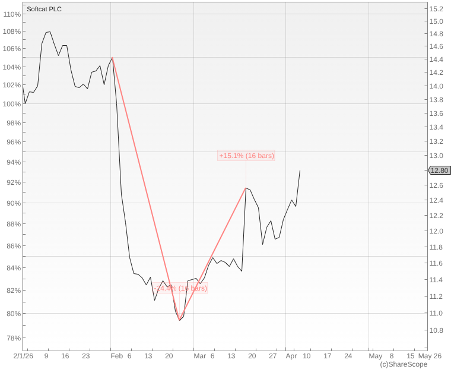
Softcat returned to favour somewhat in March, when the half-year results showed that currently it is a beneficiary of heavy AI spending.
Half-year heroics
Softcat published results for the half-year to 31 January on 18 March. The company reported a 33% increase in gross invoiced income (GII) compared to the same period the previous year. GII is Softcat’s own sales measure. It puts software and hardware revenue on the same accounting footing. Adjusted operating profit increased 27%.
The company says growth was helped by “larger solutions projects”, which are lumpier and associated with customers building AI capabilities like data centres. Customers were also stockpiling memory due to shortages.
The adjusted profit figure excludes £8.5 million of investment in Softcat’s IT systems, including AI capabilities. If we include this cost, Softcat still reported 16% growth in operating profit.
- Insider: heavy buying of FTSE 100 stock at nine-year low
- Stockwatch: I’m backing this share’s rebound from historic low
Over the full year, Softcat expects high single-digit growth in adjusted operating profit. Previously it expected low single-digit growth.
The rapid half-year growth will not be sustained because growth in the second half of the last financial year was already flattered by large projects, so the comparison becomes harder. Memory will come back on stream and demand will fall, perhaps significantly if customers are left holding too much.
The surge in demand also reflected a period of relative stability, with moderating interest rates and inflation unleashing pent-up investment in IT. That too may have been nixed by the Iran war.
Short-term AI tailwind, long-term headwind?
Softcat says customers are building the data, infrastructure and security capabilities they need to deploy artificial intelligence. In practice, they are buying computing power, hardware in the form of processors and memory, and computing power as a service from so-called hyperscalers such as Amazon Web Services, Google Cloud Platform and Microsoft Azure. They are also building more secure networks.
Softcat’s customers need help deciding which software and hardware to buy and on what terms, designing and integrating complex multi-vendor solutions, and technical support. It says increased complexity means manufacturers are relying on resellers “more than ever”.
The company says we are just at the beginning of AI adoption and, since it has relationships with most of the big vendors of equipment and services and a huge UK customer base, it stands to gain for years to come.
AI is also making things easier for Softcat’s sales and support teams, for example by helping them to navigate the “overwhelming breadth” of its product range.
- 10 hottest ISA shares, funds and trusts
- Sign up to our free newsletter for investment ideas, latest news and award-winning analysis
The problem that prompted this rescore is that if AI is making things easier for Softcat now, it might make things easier for its customers eventually.
In its annual report for the year to July 2024, Softcat raised the threat level for one of its principal risks: “Failing to respond to market changes”. By market changes Softcat means changes in its technology offering (what it sells), channel disintermediation (who sells it), competitor landscape (who sells it), and customer needs (what it needs to sell).
Its increased vigilance stemmed from “the ongoing rapid evolution of technology, including AI and potential changes in customer purchasing behaviours”.
Re-scoring Softcat
To my mind that gives us two things to worry about: how the adoption of AI will change the business, which became prosperous by focusing on developing salespeople rather than technology. And whether AI will make it easier for customers to buy directly from vendors and technology platforms.
I do not have good answers to these questions, but can at least be more specific about the risk in my score. I find enterprise software bewildering, so I believe the role of trusted partner that Softcat fulfils will remain relevant.
I think humans will remain in the sales loop and Softcat could excel because it is independent and has built its business around the recruitment and retention of salespeople.
Software companies, though, have seized on cloud computing and AI to enable customers to buy and configure software directly.
To add to the uncertainty, AI in the currently fashionable form of Large Language Models (LLMs), is a novel technology. Opinions on what it will and will not be able to do may be of little value.
AI has already forced change at Softcat. As well as upgrading its IT systems, in 2025 it made its first acquisition, a small data and AI consultancy. It has used the increasing complexity of the business to justify higher executive pay.
To my mind, complexity almost always goes hand in hand with more risk.
Softcat | SCT | Sells software and hardware to businesses and public sector | 08/04/2026 | 7.8/10 |
How capably has Softcat made money? | 3.0 | |||
Under a succession of overlapping leaders, Softcat has grown profit at 17% compound annual growth rate (CAGR) since it floated nine years ago by motivating employees to sell more IT to more customers. It has earned high returns on capital and strong cash flows. Its scale gives it a broad range and wide expertise. | ||||
How big are the risks? | 2.0 | |||
Softcat says we are only at the early stage, but widespread adoption of AI may be temporarily boosting revenue and profit. Cloud computing and AI are making it easier for customers to buy and configure software directly from vendors or technology platforms. | ||||
How fair and coherent is its strategy? | 2.0 | |||
Softcat’s strategy puts employees first, who put customers first. The company is adopting AI to enable its own employees and offer consultancy to customers. As Softcat adjusts, it is becoming more complex and its successful people-first strategy may become less relevant. | ||||
How low (high) is the share price compared to normalised profit? | 0.8 | |||
Low. A share price of 1,232p values the enterprise at £2,300 million, about 14 times normalised profit. | ||||
NB: Bold text indicates factors that reduce the score. Bold and italicised text doubly so. The maximum score is 3 for each criterion except price, which has a maximum of 1 (explainedhere) | ||||
30 Shares for the future
Here is the ranked list of Decision Engine shares. I review the scores at least once a year, soon after each company has published its annual report. The price scores are calculated using the share price prior to publication.
Generally, I consider shares that score more than 5 out of 10 to be worthy of long-term investment in sizes determined by the ideal holding size (ihs%).
Bunzl (LSE:BNZL) has published its annual report and is due to be re-scored.
I also plan to rescore Autotrader Group (LSE:AUTO).
company | description | score | qual | price | ih% | |
1 | FW Thorpe | Makes lighting systems for commercial, industrial and public settings | 9.0 | 0.9 | 9.9% | |
2 | Hollywood Bowl | Operates tenpin bowling centres | 8.0 | 0.6 | 7.3% | |
3 | James Latham | Distributes imported panel products, timber, and laminates | 7.5 | 1.0 | 7.0% | |
4 | Porvair | Manufactures filters and laboratory equipment | 8.0 | 0.3 | 6.7% | |
5 | Renew | Maintains and improves road, rail, water, and energy infrastructure | 7.5 | 0.6 | 6.1% | |
6 | Bunzl | Distributes essential everyday items consumed by organisations | 7.5 | 0.5 | 6.0% | |
7 | Jet2 | Flies people to holiday locations, often on package tours | 7.0 | 1.0 | 6.0% | |
8 | Solid State | Manufactures electronic systems and distributes components | 7.0 | 1.0 | 6.0% | |
9 | Auto Trader | Online marketplace for motor vehicles | 7.0 | 0.9 | 5.8% | |
10 | Softcat | Sells software and hardware to businesses and public sector | 7.8 | 7.0 | 0.8 | 5.6% |
11 | Goodwin | Casts and machines steel and processes minerals for niche markets | 7.5 | 0.3 | 5.6% | |
12 | Howden Joinery | Supplies kitchens and joinery products to builders | 7.0 | 0.8 | 5.6% | |
13 | Judges Scientific | Manufactures scientific instruments | 7.0 | 0.6 | 5.3% | |
14 | Churchill China | Manufactures tableware for restaurants etc. | 6.5 | 1.0 | 5.0% | |
15 | Oxford Instruments | Makes imaging and semiconductor manufacturing systems | 6.5 | 0.9 | 4.8% | |
16 | Volution | Manufacturer of ventilation products | 8.5 | -1.2 | 4.6% | |
17 | Anpario | Manufactures natural animal feed additives | 7.0 | 0.3 | 4.6% | |
18 | Advanced Medical Solutions | Manufactures surgical adhesives, sutures and dressings | 6.5 | 0.7 | 4.5% | |
19 | Cake Box | Cake shop franchise and sweet manufacturer | 7.0 | 0.2 | 4.4% | |
20 | Focusrite | Designs recording equipment, synthesisers and sound systems | 6.0 | 1.0 | 4.0% | |
21 | Macfarlane | Distributes and manufactures protective packaging | 6.0 | 1.0 | 4.0% | |
22 | YouGov | Surveys public opinion and conducts market research online | 6.0 | 1.0 | 4.0% | |
23 | Keystone Law | Operates a network of self-employed lawyers | 6.5 | 0.4 | 3.8% | |
24 | Games Workshop | Designs, makes and distributes Warhammer. Licences IP | 8.5 | -1.7 | 3.6% | |
25 | Bloomsbury Publishing | Publishes books and educational resources | 7.5 | -0.7 | 3.5% | |
26 | Quartix | Supplies vehicle tracking systems to small fleets | 7.5 | -0.9 | 3.1% | |
27 | Cohort | Manufactures/supplies defence tech, training, consultancy | 8.0 | -1.6 | 2.8% | |
28 | Tristel | Manufactures hospital disinfectant | 8.0 | -1.9 | 2.5% | |
29 | Renishaw | Makes tools and systems for manufacturers | 6.5 | -0.5 | 2.5% | |
30 | 4Imprint | Customises and distributes promotional goods | 8.0 | -2.2 | 2.5% |
Click on a share's score to see a breakdown (scores may have changed due to movements in share price). Key: qual is the share’s score out of 9 for the three quality factors (capabilities, risks, and strategy), price is the price score from -3 to +1, and ih% is the suggested ideal holding size as a percentage of the total value of a diversified portfolio.
Richard Beddard is a freelance contributor and not a direct employee of interactive investor.
Richard owns many shares in the Decision Engine. He weights his portfolio so it owns bigger holdings in the higher-scoring shares.
For more on the Decision Engine and Share Sleuth, please see Richard’s explainer.
Contact Richard Beddard by email: richard@beddard.net or on Twitter: @RichardBeddard
These articles are provided for information purposes only. Occasionally, an opinion about whether to buy or sell a specific investment may be provided by third parties. The content is not intended to be a personal recommendation to buy or sell any financial instrument or product, or to adopt any investment strategy as it is not provided based on an assessment of your investing knowledge and experience, your financial situation or your investment objectives. The value of your investments, and the income derived from them, may go down as well as up. You may not get back all the money that you invest. The investments referred to in this article may not be suitable for all investors, and if in doubt, an investor should seek advice from a qualified investment adviser.
Full performance can be found on the company or index summary page on the interactive investor website. Simply click on the company's or index name highlighted in the article.
Disclosure
We use a combination of fundamental and technical analysis in forming our view as to the valuation and prospects of an investment. Where relevant we have set out those particular matters we think are important in the above article, but further detail can be found here.
Please note that our article on this investment should not be considered to be a regular publication.
Details of all recommendations issued by ii during the previous 12-month period can be found here.
ii adheres to a strict code of conduct. Contributors may hold shares or have other interests in companies included in these portfolios, which could create a conflict of interests. Contributors intending to write about any financial instruments in which they have an interest are required to disclose such interest to ii and in the article itself. ii will at all times consider whether such interest impairs the objectivity of the recommendation.
In addition, individuals involved in the production of investment articles are subject to a personal account dealing restriction, which prevents them from placing a transaction in the specified instrument(s) for a period before and for five working days after such publication. This is to avoid personal interests conflicting with the interests of the recipients of those investment articles.