Shares for the future: a new chapter in this growth story
With newly streamlined operations, this FTSE 250 company is having a great year. Analyst Richard Beddard looks at the odds of further growth blips.
24th July 2026 15:00
by Richard Beddard from interactive investor
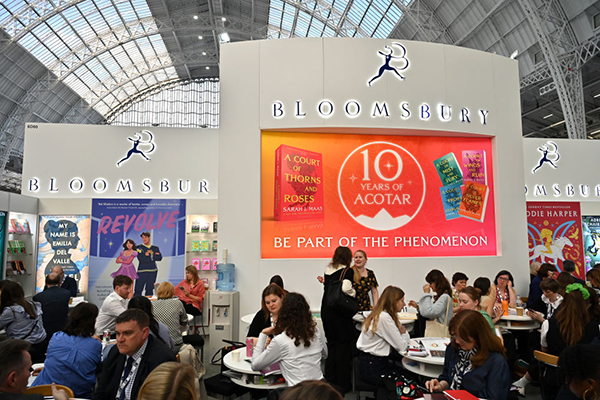
The Bloomsbury stand during the London Book Fair at Olympia in 2025. Photo: John Keeble/Getty Images.
Led by founder and chief executive Nigel Newton for 40 years, Bloomsbury Publishing (LSE:BMY)’s guiding principle is to publish works of excellence and originality.
The company has long pursued diversification, building up an Academic & Professional (A&P) division as a counterweight to its volatile Consumer division.
- Invest with ii: Top UK Shares | Share Tips & Ideas | Open a Trading Account
Not for the first time, the results for the year to February 2026 vindicated that policy. Income from a new source, Artificial Intelligence (AI), boosted A&P in a year short of a massive blockbuster novel.
Diversification matters
Having streamlined its operations in 2026, Bloomsbury now consists of just two divisions. Special interest titles have joined children’s and adult fiction in Consumer.
A&P publishes textbooks, reference works, and monographs in the humanities and social sciences. Bloomsbury digitises these resources and organises them into online collections, which university libraries subscribe to or buy.
Overall, revenue fell 10% and adjusted operating profit increased 7% but these figures mask much bigger moves in each of the two divisions. Consumer revenue fell 20%, which was offset by a 33% rise in A&P revenue.
We can ascribe most, if not all, the decline in Consumer to the Sarah J. Maas effect, a hugely popular author of romantic fantasy fiction (aka romantasy). Bloomsbury published chart-topping Crescent City: House of Flame and Shadow in January 2024, one month before the end of Bloomsbury’s financial year end. This lifted Consumer revenue in 2024 and 2025 but not so much in 2026.
- Where to invest in Q3 2026? Four experts have their say
- Pension age to rise? How you can still retire on your terms
Bloomsbury says the growth in A&P revenue was driven by a new licensing deal with an AI company that is using Bloomsbury works to train Large Language Models (aka LLMs. Think ChatGPT, Anthropic and Google Gemini; it hasn’t named names). The division also benefited from the first full-year contribution from Rowman & Littlefield, its biggest-ever acquisition early in the prior financial year.
It looks as though the AI licensing deal helped to catapult A&P’s profit margins from 15% to 24%. For the first time, A&P contributed more adjusted operating profit (55%) than Consumer, from just a third of total revenue.
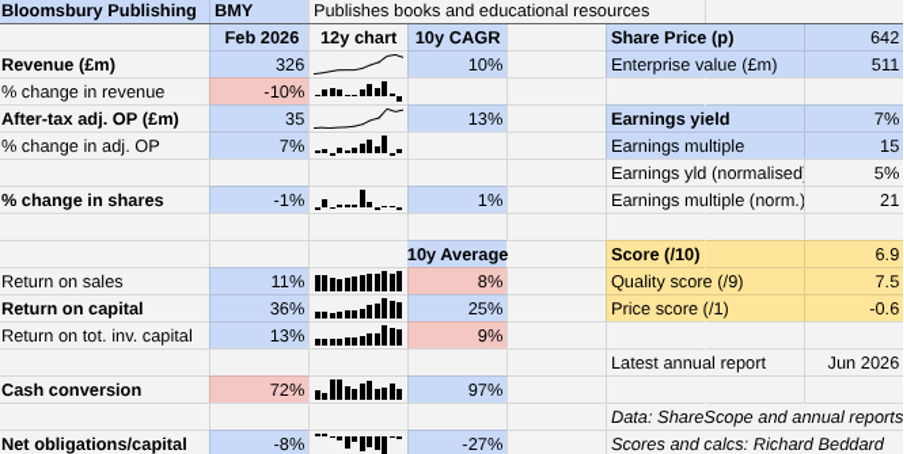
At its Annual General Meeting last week, Bloomsbury said it expected to achieve the consensus of analyst forecasts for the year to February 2027. This would deliver revenue of about £354 million and record adjusted (pre-tax) profit of about £50 million. It would be a 9% increase in revenue on 2025 and an 11% increase in profit.
We must be careful not to get carried away. The results for the current year and probably the next one will be lifted by the publication of two new books by the Sarah J. Maas phenomenon in October and January. Bloomsbury reports record pre-orders and an “entire country” (the US) gearing up for midnight release parties hosted by retailers.
Blockbuster book launches produce growth blips and subsequent hangovers. The forecasts are somewhat less impressive compared to 2024, the last year Bloomsbury published a new Sarah J. Maas book when she was the biggest-selling author in the US. Revenue in 2027 should be 3% higher and adjusted profit 2% higher than they were then.
Judging by the forecasts, Bloomsbury’s growth in 2027 is likely to be close to, but slightly below, its 10-year compound annual growth rates (CAGR) of 10% for revenue and 13% for profit.
Many moving parts
Bloomsbury has not grown more because the underlying A&P division contracted in 2025 and the first half of 2026, due to government funding cuts and budgetary squeezes at US and UK universities, although the company says it is growing again now.
Meanwhile, A&P’s new source of revenue growth, AI training, may not be sustainable. Bloomsbury earns a fee each time it licenses a book with the permission of the author (authors reportedly receive 20% of the fee). It receives ongoing revenue when a new author opts into the programme or Bloomsbury licenses a new book from an author that is already signed up.
The deal is not exclusive and time limited, so Bloomsbury could license works to other LLMs. Eventually its existing licensee may negotiate a new contract. But we do not know when the contract ends, how much of the potential licence income from the current deal has already been earned, or whether other AI companies are inclined to strike deals.
Bloomsbury hopes a mature market for training data will emerge. That might have taken a step closer with the court approval of a $1.5 billion (£1.13 billion) settlement between Anthropic and publishers in the US on Thursday.
The settlement resolves publishers’ claims that the AI company trained its LLMs on works without paying for them. If my maths is correct, Bloomsbury’s share could be worth nearly £15 million at current exchange rates, net of lawyer fees, expenses, and half of the settlement that goes to more than 14,000 Bloomsbury authors affected. Stage payments are expected to start in the second half of the financial year.
- Don't miss these key summer investing events
- Sign up to our free newsletter for investment ideas, latest news and award-winning analysis
- Insider: boss buys Vistry plus £500k deal at UK tech stock
With university funding still under pressure, and A&P benefiting from an experimental source of revenue, it feels like Bloomsbury may be the sum total of two volatile and unpredictable divisions. That works both ways, of course, but it is unsettling.
In addition to digitising academic publications and providing material for AI training, Bloomsbury’s strategy is to seek growth in Asia, which, with the Middle East, only accounted for 6% of total revenue in 2026. It expects a new office in Singapore to capitalise on growing student populations there.
In Consumer, Bloomsbury continues to recruit and nurture authors in the expectation that some of them will be future bestsellers. Its “standout” bestseller in 2026 was Want by Gillian Anderson. Anderson, whose books describe the sexual fantasies and inner lives of women, is following Want up with More later this summer.
The company treats its bestselling authors as brands. As well as J.K. Rowling, an author synonymous with an earlier phase of Bloomsbury’s growth, and Sarah J. Maas, Bloomsbury singles out Katherine Rundell.
Like Bloomsbury’s big-two, Rundell’s books appeal to children and young adult readers. She is due to publish the third in the five-book Impossible Creatures series later this summer.
The Rundell brand will get a boost at Christmas too. All Year 6 pupils (P6 in Scotland) in the UK will receive “The Queen’s Christmas Present”, a copy of the first book in the series, Impossible Creatures, from the National Literary Trust and its patron, Queen Camilla.
The continued presence of Rowling’s Harry Potter books in bestseller lists 29 years after the first book’s publication shows how blockbusters can become long-lived annuities as new generations discover the backlist.
A new Harry Potter TV series starting this Christmas on HBO is expected to stoke the company’s still considerable Harry Potter revenue. The network is planning a series for each of the seven books.
Scoring Bloomsbury: in Nigel we trust
Bloomsbury has made 34 acquisitions in 40 years, many of them financed by the extraordinary profits from blockbuster novels. The acquisitions did not initially generate sufficient collective returns to justify their cost, but they do now. After tax Return on Capital (ROTIC) has been above 8%, my threshold, for the last five years.
While it might not always be clear where Bloomsbury is going, so far, at least, its own story has been a growth story.
| Bloomsbury Publishing | BMY | Publishes books and educational resources | 22/07/2026 | 6.9/10 |
| How capably has Bloomsbury Publishing made money? | 3.0 | |||
| Under co-founder and chief executive Nigel Newton, Bloomsbury has developed blockbuster book franchises and acquired a second income stream in academic publishing. Double-digit revenue and profit CAGRs and high returns on capital have rewarded its pursuit of excellence and originality. | ||||
| How big are the risks? | 1.5 | |||
| Revenue growth from Consumer publishing is dependent on blockbuster book launches, which are unpredictable. A second division, Academic & Professional, earns most of its income from universities in the US and UK, which are strapped for cash. I worry that revenue from training AI may not be sustainable. | ||||
| How fair and coherent is its strategy? | 3.0 | |||
| Bloomsbury’s reputation for excellence and originality attracts good publishers and authors. The A&P division is digitising, internationalising, exploring non-government funding for open access publications, and exploring deals with AI firms. 91% of employees say they are proud to work for Bloomsbury. | ||||
| How low (high) is the share price compared to normalised profit? | -0.6 | |||
| High. A share price of 642p values the enterprise at £511 million, about 21 times normalised profit. | ||||
| NB: Bold text indicates factors that reduce the score. Bold and italicised text doubly so. The maximum score is 3 for each criterion except price, which has a maximum of 1 (explained here) | ||||
30 Shares for the future
Here is the ranked list of Decision Engine shares. I review the scores at least once a year, soon after each company has published its annual report. The price scores are calculated using the share price prior to publication.
Generally, I consider shares that score more than 5 out of 10 to be worthy of long-term investment in sizes determined by the ideal holding size (ihs%).
Focusrite (LSE:TUNE) and Solid State (LSE:SOLI) have published annual reports and are due to be re-scored.
| 0 | company | description | score | qual | price | ih% |
| 1 | FW Thorpe | Makes lighting systems for commercial, industrial and public settings | 9.9 | 9.0 | 0.9 | 9.8% |
| 2 | James Latham | Distributes imported panel products, timber, and laminates | 8.5 | 7.5 | 1.0 | 7.0% |
| 3 | Hollywood Bowl | Operates tenpin bowling centres | 8.3 | 8.0 | 0.3 | 6.7% |
| 4 | Jet2 | Flies people to holiday locations, often on package tours | 8.0 | 7.0 | 1.0 | 5.9% |
| 5 | Renew | Maintains and improves road, rail, water, and energy infrastructure | 7.9 | 7.5 | 0.4 | 5.9% |
| 6 | Howden Joinery | Supplies kitchens and joinery to builders and online to DIYers | 7.8 | 7.0 | 0.8 | 5.6% |
| 7 | Solid State | Manufactures electronic systems and distributes components | 7.8 | 7.0 | 0.8 | 5.6% |
| 8 | Porvair | Manufactures filters and laboratory equipment | 7.7 | 8.0 | -0.3 | 5.5% |
| 9 | Judges Scientific | Acquires and grows businesses that manufacture scientific instruments | 7.5 | 6.5 | 1.0 | 4.9% |
| 10 | Keystone Law | Operates a network of self-employed lawyers | 7.4 | 7.0 | 0.4 | 4.9% |
| 11 | Anpario | Manufactures natural animal feed additives | 7.3 | 7.0 | 0.3 | 4.5% |
| 12 | Bunzl | Distributes essential everyday items consumed by businesses | 7.2 | 7.0 | 0.2 | 4.5% |
| 13 | Quartix | Supplies vehicle tracking systems to small fleets | 7.1 | 7.0 | 0.1 | 4.2% |
| 14 | Cake Box | Cake shop franchise and sweet manufacturer | 7.1 | 7.0 | 0.1 | 4.2% |
| 15 | Volution | Manufacturer of ventilation products | 7.0 | 8.5 | -1.5 | 4.1% |
| 16 | Oxford Instruments | Makes imaging and semiconductor manufacturing systems | 7.0 | 7.0 | 0.0 | 4.0% |
| 17 | Churchill China | Manufactures tableware for restaurants etc. | 7.0 | 6.0 | 1.0 | 4.0% |
| 18 | Auto Trader | Online marketplace for motor vehicles | 7.0 | 6.0 | 1.0 | 3.9% |
| 19 | YouGov | Surveys public opinion and conducts market research online | 6.9 | 6.0 | 0.9 | 3.8% |
| 20 | Bloomsbury Publishing | Publishes books and educational resources | 6.9 | 7.5 | -0.6 | 3.7% |
| 21 | Games Workshop | Designs, makes and distributes Warhammer. Licenses IP | 6.7 | 8.5 | -1.8 | 3.5% |
| 22 | Focusrite | Designs recording equipment, synthesisers and sound systems | 6.5 | 5.5 | 1.0 | 3.0% |
| 23 | Macfarlane | Distributes and manufactures protective packaging | 6.5 | 5.5 | 1.0 | 3.0% |
| 24 | Softcat | Sells software and hardware to businesses and public sector | 6.5 | 7.0 | -0.5 | 2.9% |
| 25 | Cohort | Manufactures/supplies defence tech, training, consultancy | 6.4 | 8.0 | -1.6 | 2.8% |
| 26 | Advanced Medical Solutions | Manufactures surgical adhesives, sutures and dressings | 6.2 | 6.5 | -0.3 | 2.5% |
| 27 | Goodwin | Casts and machines steel and processes minerals for niche markets | 6.1 | 7.5 | -1.4 | 2.5% |
| 28 | Tristel | Manufactures hospital disinfectant | 6.0 | 8.0 | -2.0 | 2.5% |
| 29 | 4Imprint | Customises and distributes promotional goods | 5.7 | 8.0 | -2.3 | 2.5% |
| 30 | Renishaw | Makes tools and systems for manufacturers | 4.7 | 6.5 | -1.8 | 2.5% |
Click on a share's score to see a breakdown (scores may have changed due to movements in share price). Key: qual is the share’s score out of 9 for the three quality factors (capabilities, risks, and strategy), price is the price score from -3 to +1, and ih% is the suggested ideal holding size as a percentage of the total value of a diversified portfolio.
Richard Beddard is a freelance contributor and not a direct employee of interactive investor.
Richard owns Bloomsbury and many shares in the Decision Engine. He weights his portfolio so it owns bigger holdings in the higher-scoring shares.
For more on the Decision Engine and Share Sleuth, please see Richard’s explainer.
Contact Richard Beddard by email: richard@beddard.net or on Twitter: @RichardBeddard
These articles are provided for information purposes only. Occasionally, an opinion about whether to buy or sell a specific investment may be provided by third parties. The content is not intended to be a personal recommendation to buy or sell any financial instrument or product, or to adopt any investment strategy as it is not provided based on an assessment of your investing knowledge and experience, your financial situation or your investment objectives. The value of your investments, and the income derived from them, may go down as well as up. You may not get back all the money that you invest. The investments referred to in this article may not be suitable for all investors, and if in doubt, an investor should seek advice from a qualified investment adviser.
Full performance can be found on the company or index summary page on the interactive investor website. Simply click on the company's or index name highlighted in the article.
Disclosure
We use a combination of fundamental and technical analysis in forming our view as to the valuation and prospects of an investment. Where relevant we have set out those particular matters we think are important in the above article, but further detail can be found here.
Please note that our article on this investment should not be considered to be a regular publication.
Details of all recommendations issued by ii during the previous 12-month period can be found here.
ii adheres to a strict code of conduct. Contributors may hold shares or have other interests in companies included in these portfolios, which could create a conflict of interests. Contributors intending to write about any financial instruments in which they have an interest are required to disclose such interest to ii and in the article itself. ii will at all times consider whether such interest impairs the objectivity of the recommendation.
In addition, individuals involved in the production of investment articles are subject to a personal account dealing restriction, which prevents them from placing a transaction in the specified instrument(s) for a period before and for five working days after such publication. This is to avoid personal interests conflicting with the interests of the recipients of those investment articles.