Shares for the future: can this small-cap deliver another slice of strong growth?
After a transformational year, Richard Beddard examines a company that has added a layer of complexity yet boasts rising revenue.
21st August 2026 15:01
by Richard Beddard from interactive investor

Fast-growing cake shop franchisor Cake Box Holdings Ordinary Shares (LSE:CBOX) changed shape a year and a half ago, when it acquired Ambala, an Indian sweet (mithai) maker and retailer.
- Our Services: SIPP Account | Stocks & Shares ISA | See all Investment Accounts
Transformational year
The acquisition contributed a one-off boost to revenue and adjusted profit in the year to March 2026. They grew 40% and 38% respectively.
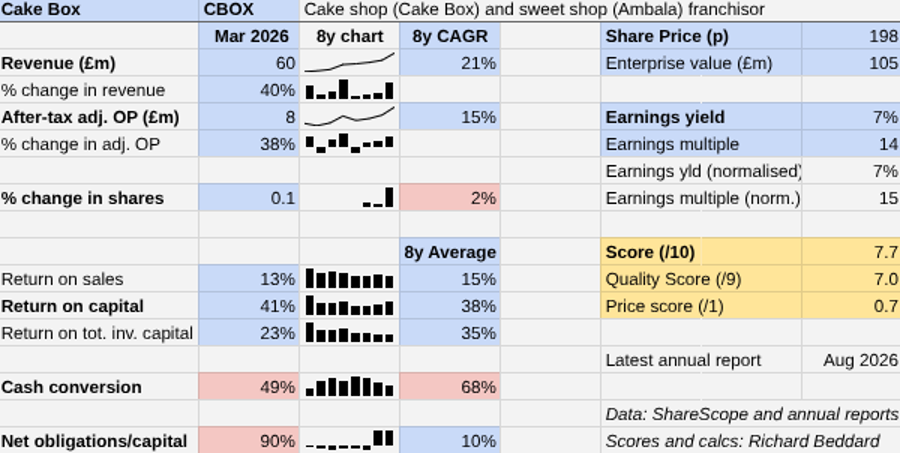
Most of the increase in revenue was injected by Ambala, which contributed 24% of total revenue, and 9% of adjusted operating profit in its first full year as part of the business.
Revenue from Cake Box franchises increased by 9%, about half the compound annual growth rate achieved by the company since it floated in 2018.
Profit wise, the Cake Box side of the business had a very good year. Adjusted operating profit grew by 27%, which is faster than usual. This was because overheads grew 3%, significantly less than revenue growth.
Weak cash conversion of 49% is mostly explained by £6 million capital expenditure, twice the level of 2025, which itself was double 2024.
- Earnings cheer as FTSE 100 heavyweights beat hopes
- Stockwatch: ‘unpopular big blue-chip’ looks to offer value
The biggest single capital expense in the year was a new depot in Bradford, which will be completed by the end of 2027. The company is also upgrading its computer systems and website to cope with its increased scale and complexity since Ambala joined it.
Because these are lumpy projects, capital expenditure may moderate for a while once they are complete, although in its current form Ambala is probably a more capital-intensive business and may make greater demands on cash flow in future.
The company is now growing two franchises. ShareScope only has one forecast for 2027 anticipating revenue growth of 14%.
Maturing business
Ambala saddled Cake Box with debt for the first time since it floated.
The company’s net financial obligations (leases and debt) are considerable. They amount to 90% of operating capital. That’s partly because Cake Box is predominantly a franchisor and doesn’t require much capital to operate.
Were the company to pay off the obligations as fast as possible, it would take four years of cash flow at the level achieved in 2026. Since it also pays a dividend, it would take longer than that. Cake Box only plans to reduce its borrowings by £2 million a year.
Borrowings increased modestly in 2026, though, due to the heavy capital expenditure.
Essentially Cake Box earns most of its revenue by making and selling sponge, and distributing fresh cream and other items to franchisees. It supports them by marketing the brand, training and quality audits, and by sending franchisees online orders.
- Sector Screener: the blue-chip giant to buy for the long term
- What you need to know about ISAs and how they’ll soon change
Cake Box says it is the largest UK eggless cream cake franchise. Its 276 branches contrasts with the 24 I count for The Eggless Cake Shop, founded in 2011 (three years after Cake Box).
Scale is both evidence of prior growth and suggestive of competitive advantages. It means the cost of IT and the online store, which now brings in about 25% of store sales, is defrayed over many branches. Cake Box’s buying power, improved since Ambala joined it, means it can source ingredients relatively cheaply.
Judging by the company’s 400-shop target, the Cake Box roll-out has about five years to go at the current rate of about 25 stores a year. The company could raise this target as it approaches, but eventually the UK and Northern Ireland will have enough shops.
We cannot assume Cake Box will grow as fast over the next 10 years as it has over the past eight.
Sweet taste of success?
Somewhat comfortingly it also has Ambala, which it plans to grow to a 100-store chain by franchising. But Ambala is less profitable and less proven as a franchise concept than Cake Box.
The sweet maker’s adjusted operating profit margin was 7% in 2026, which compares unfavourably to Cake Box’s 20% margin. This will in part be because of the higher overheads associated with operating a factory and company-owned shops.
It may also be because the franchise stores are immature and the business has yet to scale up. Cake Box added 12 franchised Ambala stores to the three it acquired in 2026, taking the number of franchised stores to 15 and the total number of stores to 34. The other 19 stores are owned and operated by Ambala.
Cake Box is generating more revenue from the combination by introducing Ambala sweets into its shops and co-locating hybrid shops.
Although one Cake Box franchise operates a store in Paris, international expansion is not part of the company’s stated strategy. More acquisitions may be. Hopefully that would happen after the company has paid off its Ambala debt.
Scoring CBOX: having our cake and eating it
I like the idea of investing in Cake Box. Cake is unhealthy but it has its place in our culture and it would be misanthropic to deny people celebrations.
Cake Box’s speciality, egg-free cakes, taste good and can be eaten by more of us than eggy cakes. Like the family of the company’s founder, many people of South Asian heritage are lacto-vegetarians and do not eat eggs. Egg-allergies, like cake eating, are common in babies and young children.
- eyeQ: L&G - time to buy this income play?
- Sign up to our free newsletter for investment ideas, latest news and award-winning analysis
The company’s environmental, social and governance (ESG) report this year shows that 82% of franchisees recommend Cake Box and 73% of Ambala franchisees recommend Ambala. Employee satisfaction is 90% or more at both subsidiaries. Judging by the Trustpilot scores though, Cake Box (4.5) has something to teach Ambala about customer satisfaction (3.9).
Founder, Sukh Chamdal, owns over 23% of the business, and as chief executive he has overseen its many ups and occasional downs.
| Cake Box | CBOX | Cake shop (Cake Box) and sweet shop (Ambala) franchisor | 19/08/2026 | 7.7/10 |
| How capably has Cake Box made money? | 3.0 | |||
| Since it floated in 2018, Cake Box has grown revenue strongly and achieved double-digit revenue and profit CAGRs by rolling out an egg-free cake shop franchise under the leadership of its founder and major shareholder (23%). The first Cake Box opened in 2008, and in March there were 276. | ||||
| How big are the risks? | 1.5 | |||
| Cake Box has scale and a virile franchise model on its side, but it has incurred substantial debt due to the acquisition of Asian sweet maker Ambala. Unlike Cake Box, Ambala is a manufacturer and retailer, which complicates the business. | ||||
| How fair and coherent is its strategy? | 2.5 | |||
| At the current rate, Cake Box has five years of store growth ahead before it reaches its target of 400. It plans to grow Ambala to 100 stores, but Ambala is a less tried and tested franchise opportunity. Other acquisitions may follow. Employee, franchisee, and customer satisfaction is high | ||||
| How low (high) is the share price compared to normalised profit? | 0.7 | |||
| Low. A share price of 198p values the enterprise at £105 million, about 15 times normalised profit. | ||||
| NB: Bold text indicates factors that reduce the score. Bold and italicised text doubly so. The maximum score is 3 for each criterion except price, which has a maximum of 1 (explained here) | ||||
Traders lost confidence in the company in 2022 when demand for cake slumped. We had pigged out on cake during the pandemic lockdowns, and slimmed down after.
Largely inconsequential errors in the company’s financial reporting also frayed our nerves.
I think these were growing pains. The collapse of the share price then had as much to do with traders’ earlier exuberance, as it did errors at the business.
Since 2022, Cake Box has beefed-up its finance function and recruited a chief financial officer with a capable CV. An accountant, he was commercial director at Domino’s Pizza. a very large franchisor, and subsequently chief financial officer of one of its largest franchise groups.
30 Shares for the future
Here is the ranked list of Decision Engine shares. I review the scores at least once a year, soon after each company has published its annual report. The price scores are calculated using the share price prior to publication.
Generally, I consider shares that score more than 5 out of 10 to be worthy of long-term investment in sizes determined by the ideal holding size (ihs%).
Games Workshop Group (LSE:GAW), Latham (James) (LSE:LTHM), Jet2 Ordinary Shares (LSE:JET2) and Solid State (LSE:SOLI) have published annual reports and are due to be re-scored.
| 0 | company | description | score | qual | price | ih% |
| 1 | FW Thorpe | Makes lighting systems for commercial, industrial and public settings | 9.9 | 9.0 | 0.9 | 9.8% |
| 2 | James Latham | Distributes imported panel products, timber, and laminates | 8.5 | 7.5 | 1.0 | 7.0% |
| 3 | Hollywood Bowl | Operates tenpin bowling centres | 8.4 | 8.0 | 0.4 | 6.9% |
| 4 | Renew | Maintains and improves road, rail, water, and energy infrastructure | 8.0 | 7.5 | 0.5 | 5.9% |
| 5 | Jet2 | Flies people to holiday locations, often on package tours | 7.9 | 7.0 | 0.9 | 5.9% |
| 6 | Solid State | Manufactures electronic systems and distributes components | 7.9 | 7.0 | 0.9 | 5.8% |
| 7 | Howden Joinery | Supplies kitchens and joinery to builders and online to DIYers | 7.8 | 7.0 | 0.8 | 5.5% |
| 8 | Cake Box | Cake shop (Cake Box) and sweet shop (Ambala) franchisor | 7.7 | 7.0 | 0.7 | 5.3% |
| 9 | Porvair | Manufactures filters and laboratory equipment | 7.5 | 8.0 | -0.5 | 5.1% |
| 10 | Judges Scientific | Acquires and grows businesses that manufacture scientific instruments | 7.5 | 6.5 | 1.0 | 5.0% |
| 11 | Anpario | Manufactures natural animal feed additives | 7.5 | 7.0 | 0.5 | 5.0% |
| 12 | Keystone Law | Operates a network of self-employed lawyers | 7.2 | 7.0 | 0.2 | 4.4% |
| 13 | Bunzl | Distributes essential everyday items consumed by businesses | 7.2 | 7.0 | 0.2 | 4.4% |
| 14 | Quartix | Supplies vehicle tracking systems to small fleets | 7.1 | 7.0 | 0.1 | 4.2% |
| 15 | Oxford Instruments | Makes imaging and semiconductor manufacturing systems | 7.1 | 7.0 | 0.1 | 4.1% |
| 16 | Churchill China | Manufactures tableware for restaurants etc. | 7.0 | 6.0 | 1.0 | 4.0% |
| 17 | Volution | Manufacturer of ventilation products | 6.9 | 8.5 | -1.6 | 3.9% |
| 18 | Auto Trader | Online marketplace for motor vehicles | 6.9 | 6.0 | 0.9 | 3.9% |
| 19 | YouGov | Surveys public opinion and conducts market research online | 6.9 | 6.0 | 0.9 | 3.7% |
| 20 | Bloomsbury Publishing | Publishes books and educational resources | 6.8 | 7.5 | -0.7 | 3.7% |
| 21 | Games Workshop | Designs, makes and distributes Warhammer. Licences IP | 6.8 | 8.5 | -1.7 | 3.6% |
| 22 | Macfarlane | Distributes and manufactures protective packaging | 6.5 | 5.5 | 1.0 | 3.0% |
| 23 | Cohort | Manufactures/supplies defence tech, training, consultancy | 6.2 | 8.0 | -1.8 | 2.5% |
| 24 | Advanced Medical Solutions | Manufactures surgical adhesives, sutures and dressings | 6.2 | 6.5 | -0.3 | 2.5% |
| 25 | Softcat | Sells software and hardware to businesses and public sector | 6.1 | 7.0 | -0.9 | 2.5% |
| 26 | Focusrite | Designs recording equipment, synthesisers and sound systems | 6.0 | 5.0 | 1.0 | 2.5% |
| 27 | Goodwin | Casts and machines steel and processes minerals for niche markets | 6.0 | 7.5 | -1.5 | 2.5% |
| 28 | Tristel | Manufactures hospital disinfectant | 5.8 | 8.0 | -2.2 | 2.5% |
| 29 | 4Imprint | Customises and distributes promotional goods | 5.5 | 8.0 | -2.5 | 2.5% |
| 30 | Renishaw | Makes tools and systems for manufacturers | 4.6 | 6.5 | -1.9 | 2.5% |
Click on a share’s score to see a breakdown (scores may have changed due to movements in share price). Key: qual is the share’s score out of 9 for the three quality factors (capabilities, risks, and strategy), price is the price score from -3 to +1, and ih% is the suggested ideal holding size as a percentage of the total value of a diversified portfolio.
Richard Beddard is a freelance contributor and not a direct employee of interactive investor.
Richard owns many shares in the Decision Engine. He weights his portfolio so it owns bigger holdings in the higher-scoring shares.
For more on the Decision Engine and Share Sleuth, please see Richard’s explainer.
Contact Richard Beddard by email: richard@beddard.net or on Twitter: @RichardBeddard
AIM stocks tend to be volatile high-risk/high-reward investments and are intended for people with an appropriate degree of equity trading knowledge and experience.
These articles are provided for information purposes only. Occasionally, an opinion about whether to buy or sell a specific investment may be provided by third parties. The content is not intended to be a personal recommendation to buy or sell any financial instrument or product, or to adopt any investment strategy as it is not provided based on an assessment of your investing knowledge and experience, your financial situation or your investment objectives. The value of your investments, and the income derived from them, may go down as well as up. You may not get back all the money that you invest. The investments referred to in this article may not be suitable for all investors, and if in doubt, an investor should seek advice from a qualified investment adviser.
Full performance can be found on the company or index summary page on the interactive investor website. Simply click on the company's or index name highlighted in the article.
Disclosure
We use a combination of fundamental and technical analysis in forming our view as to the valuation and prospects of an investment. Where relevant we have set out those particular matters we think are important in the above article, but further detail can be found here.
Please note that our article on this investment should not be considered to be a regular publication.
Details of all recommendations issued by ii during the previous 12-month period can be found here.
ii adheres to a strict code of conduct. Contributors may hold shares or have other interests in companies included in these portfolios, which could create a conflict of interests. Contributors intending to write about any financial instruments in which they have an interest are required to disclose such interest to ii and in the article itself. ii will at all times consider whether such interest impairs the objectivity of the recommendation.
In addition, individuals involved in the production of investment articles are subject to a personal account dealing restriction, which prevents them from placing a transaction in the specified instrument(s) for a period before and for five working days after such publication. This is to avoid personal interests conflicting with the interests of the recipients of those investment articles.