Autumn Budget 2025: impact on your pensions, savings and investments
Craig Rickman runs through the key policies announced at Rachel Reeves’ ‘make or break’ Budget.
26th November 2025 15:19
by Craig Rickman from interactive investor
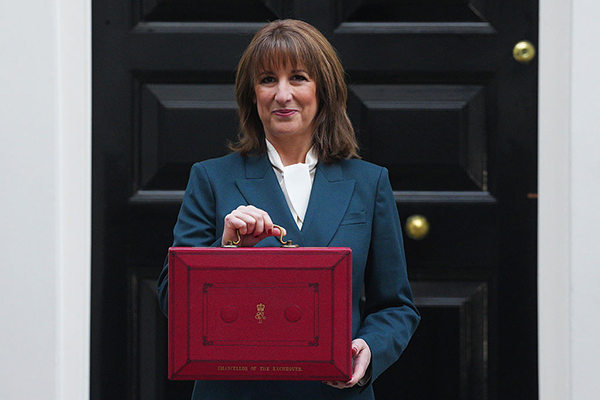
Chancellor Rachel Reeves with the red box as she leaves 11 Downing Street to deliver the Budget on 26 November. Photo: Carl Court/Getty Images.
Rachel Reeves’ Autumn Budget 2025 started in extraordinary circumstances after the Office for Budget Responsibility (OBR) accidentally published its economic and fiscal outlook roughly half an hour before the chancellor’s speech.
Reeves immediately addressed the matter amid a rowdy Commons’ crowd, describing it as “deeply disappointing and a serious error on their part” and said the OBR had apologised for the breach.
- Invest with ii: SIPP Account | Stocks & Shares ISA | See all Investment Accounts
This development merely chimed with the circus that had preceded it. Rumours and leaks of tax reforms ahead of the Budget were a recurring feature, surpassing the remarkable levels we witnessed before last year’s event.
A “smorgasbord” of tax hikes was predicted for Reeves’ second Budget as chancellor – and indeed that’s what we got. As a result of today’s £26 billion package of hikes, including £15 billion in personal taxes, few people and businesses will escape higher tax bills over the coming years. The OBR predicts that UK tax receipts will reach a fresh all-time high of 38% of GDP in 2030-31.
Let’s take a look some of the key reforms affecting your pensions, savings, investments and income.
Cash ISA limit cut from April 2027
Pre-Budget rumours that the cash individual savings account (ISA) limit will reduce proved on the mark as Reeves announced it will fall to £12,000 from 6 April 2027. Importantly, it will only impact savers aged under 65.
A deeper round-up of this significant change can be found here.
The full £20,000 ISA allowance remains, meaning those who wish to maximise their tax-free amount every year will have to place at least £8,000 into the stocks and shares or innovative finance versions.
That doesn’t necessarily mean you have to invest in the stock market – cash-like alternatives such as money market funds are available in stocks and shares ISAs. A sticking point is the lack of awareness of these assets among consumers, although we can expect this to improve over time, especially for those with the financial muscle to maximise their ISA allowance but who prefer to keep risk low.
Elsewhere, the red pages unearthed a significant development with the lifetime ISA (LISA). “The government will publish a consultation in early 2026 on the implementation of a new, simpler ISA product to support first-time buyers to buy a home. Once available, this new product will be offered in place of the Lifetime ISA,” the document said.
£2,000 cap on salary sacrifice
In a move that will impact businesses and savers, the chancellor unveiled a £2,000 cap on pension salary sacrifice contributions, despite fierce pre-Budget resistance flagging the potential implications on future retirement outcomes. The change will be introduced in 2029.
Explaining her reasoning, Reeves said that the cost of salary sacrifice will almost triple to £8 billion in 2030.
With salary sacrifice, employees agree to swap a portion of their earnings for an equivalent pension payment, which leads to lower national insurance (NI) bills for employees and employers alike. Workers pay 8% NI on earnings between £12,570 and £50,270 and 2% on anything above, while businesses pay a flat 15% on staff earnings above £5,000. Essentially, it’s a way for workers to boost take-home pay and businesses to trim tax bills.
But from 2029, pension contributions above the £2,000 cap will suffer NI, making them less tax efficient for both workplaces and their staff, which could have negative consequences for the labour market and the wider economy. Employers may be less inclined to offer generous pensions to staff as the tax benefits for doing so will become weaker. We must note that businesses are already paying bigger NI bills due to the reforms delivered at last year’s Budget.
- Autumn Budget 2025: UK stock market reaction
- Sign up to our free newsletter for investment ideas, latest news and award-winning analysis
Fiscal drag to continue until 2031
In blow to workers across all income levels, the chancellor extended the deep freeze on income tax thresholds by three further years until 2031, despite announcing at last year’s Budget that they will rise again from 2028. This means income tax and NI thresholds will have remained at the same level for 10 years.
The government may have decided this was the more palatable option versus hiking the basic rate of income tax, but you can still argue that prolonging fiscal drag, as its known, breaks the government’s manifesto pledge not to raise taxes on working people.
That’s because the three-year extended freeze is expected to create 780,000 more basic-rate income taxpayers, pull 920,000 more people into the 40% rate, and drag a further 4,000 into the additional rate in 2029-30.

Dividend tax increase
Investors and small business owners will feel the pinch after the chancellor jacked up dividend tax rates by two percentage points, taking effect in April 2026. This is expected to generate £1.2 billion a year on average from 2027-28.
The basic rate, charged on dividends (when added to other income) between £12,570 and £50,270 will rise from 8.75% to 10.75%. The higher rate, charged on dividends that land above £50,270 and below £125,140, will hike from 33.75% to 35.75%. The additional rate remains unchanged at 39.35%.
The biggest losers here are owners of private limited companies, who draw a small salary and the rest in dividends as a tax-efficient tactic. Many business owners could pay hundreds or even thousands of pounds more in tax every year due to these reforms. We must also remember that the dividend allowance, the value of dividends you can earn annually tax free, has faced swingeing cuts in recent years, standing at just £500 today.
Investors are already losing more of their profits after capital gains tax rates (CGT) on sales of shares increased at last year’s set-piece fiscal event. The combination of these two tax grabs strengthen the case for using tax wrappers such as ISAs and pensions where suitable as these shield dividends and gains from HMRC.
- 10 hottest ISA shares, funds and trusts: week ended 21 November 2025
- Is it possible to give away my pension savings to avoid IHT?
Savings and property tax increase
In an unexpected development, the chancellor announced that the rates on savings interest and property income will hike by two percentage points from April 2027, in a blow to savers and landlords. Together with the hikes to dividend tax, this is expected to raise around £2.1 billion a year.
The rates for basic, higher and additional rate taxpayers will be 22%, 42% and 47%, respectively. Reeves claimed that 90% of taxpayers will still pay no tax on their savings.
This may add to insult to injury to some savers who, as noted above, will also see the amount they can shovel into cash ISAs every year fall to £12,000 from April 2027. It will also bring further pain for landlords who've been on the wrong side of heavy tax reforms in recent years.
Mansion tax
As widely expected, Reeves announced a so-called Mansion Tax, which will impact somewhere between 100,000 and 200,000 properties and is expected to raise around £400 million.
If you live in a home worth more than £2 million, you’ll face an annual surcharge from April 2028, collected through the council tax system. There will be four price bands, with charges rising from £2,500 for properties in the £2 million to £2.5 million bracket, to £7,500 on homes valued above £5 million.
Stamp duty holiday on new UK listings
In an effort to stimulate investment on these shores, Reeves unveiled a three-year stamp duty holiday on newly listed company shares. Investors will be exempt from the current 0.5% stamp charge for up to three years after listing.
While many have welcomed this reform, there is a sense that the government should go further and scrap stamp duty on UK shares entirely.
Richard Wilson, chief executive at interactive investor, says: “If the government thinks that retail investors are the answer to boost the UK stock market, then it seriously needs to look at scrapping stamp duty. It’s an outdated and irrational tax that is bad for liquidity and bad for growth. It is suffocating investment in British businesses, and it has to go.”
State pension increase confirmed
Earlier this week, retirees received a boost after it was revealed that the government will honour the triple lock. As a result, the state pension will rise an inflation-beating 4.8% from April 2026, driven by wage increases for the third year running. Given that the government has committed to the triple lock for this parliament, the decision was widely expected.
This means the annual full state pension will increase from £11,973 to £12,547, while the old state pension, paid to those who reached state pension age before 6 April 2016, will hike from £9,175 to £9,616 a year.
Two-child benefit cap lifted
The government has lifted the two-child benefit cap, which prevents parents from claiming universal credit for any third or subsequent children. This means households will receive an extra £3,500 for each additional child in a policy set to cost the Treasury around £3.5 billion.
National living wage increase
In-keeping with previous fiscal events, the national living wage hikes were revealed the day before the Budget.
The hourly rate for over 21 and over rises 4.1% from £12.21 to £12.71, taking effect in April 2026. Workers aged 18 to 20 get an 85p increase to £10.85, while the rate for under-18s and apprentices vaults to £8 an hour, a 6% uptick.
These will deliver a welcome boost to the incomes of the lowest-paid workers in the fight against the ongoing cost-of-living crisis.
These articles are provided for information purposes only. Occasionally, an opinion about whether to buy or sell a specific investment may be provided by third parties. The content is not intended to be a personal recommendation to buy or sell any financial instrument or product, or to adopt any investment strategy as it is not provided based on an assessment of your investing knowledge and experience, your financial situation or your investment objectives. The value of your investments, and the income derived from them, may go down as well as up. You may not get back all the money that you invest. The investments referred to in this article may not be suitable for all investors, and if in doubt, an investor should seek advice from a qualified investment adviser.
Full performance can be found on the company or index summary page on the interactive investor website. Simply click on the company's or index name highlighted in the article.
Important information: Please remember, investment values can go up or down and you could get back less than you invest. If you’re in any doubt about the suitability of a Stocks & Shares ISA, you should seek independent financial advice. The tax treatment of this product depends on your individual circumstances and may change in future. If you are uncertain about the tax treatment of the product you should contact HMRC or seek independent tax advice.