Stockwatch: is gold ‘bubble’ chance to sell mining shares?
After making a 60% profit on this gold miner, analyst Edmond Jackson decides whether to hang on or sell up. He also assesses new comment from the ‘central bank for central banks’.
16th December 2025 12:55
by Edmond Jackson from interactive investor

With gold prices up over 60% this year – at around $4,300/ounce currently, ahead of JP Morgan’s prediction in June for $4,000 in the second quarter of 2026 – it has powered mining shares much higher, yet begun to invite questions as to whether a parabolic chart is representative of a bubble.
- Invest with ii: Top UK Shares | Share Tips & Ideas | Cashback Offers
In last April’s Greatland piece I included a gold chart from 2003.
Notably, on 8 December, the Bank for International Settlements (BIS) released a paper by three of its economists – “Bubble conditions in US and gold?” – which effectively blames retail investor exuberance for causing “explosive territory” in the pricing of both assets lately.
The BIS is notable for being drawn into this debate given its role as “a central bank for central banks”, hence you might assume that it bears a sober appraisal of the situation rather than bull-on-bear contrasts that the media loves. That said, I tend to regard its economic view as conservative to the extent that investors heeding its publications would have ceded gains in past years by selling down or avoiding equities. There remains an adage about how “the role of central bankers is to remove the party punch bowl”, so we should not be dismissive if the BIS implies midnight is approaching.
Its definition of a bubble is “rapid and accelerating price surges followed by sharp corrections”, which can sound like mean-reversion working as it should in “semi-strong efficient” markets. Yet it leaves the door open to further advances given that it admits “there is no reliable evidence that price declines following strong increases are predictable”.
- Where next for one of 2025’s best-performing investments?
- Gold investing: what, why and how to invest
It notes how gold corrected in 1980 after a bubble during the 1970s due to “the great inflation” (originating in the 1973 oil crisis) and then the bursting of the dotcom bubble. Such corrections did, however, happen over a variable, sometimes lengthy, time frame, hence it’s impossible to say when bubbles may burst.
Notably, the past few quarters represent the only time in the last 50 years when gold and equities have entered this territory simultaneously. The “bursting of a bubble is typically followed by a sharp and swift correction, then periods of negative or subdued returns.” This is the downside risk to be aware of regarding assets in vogue, potentially left subject to stale bulls selling.
A cyclical or secular bull market?
From my perspective, it is the crux question around a cyclical or secular bull market that the BIS does not pose. Bulls can argue that major stock market drops such as in 2008, 2020 and early 2025 were cyclical within a long-term secular uptrend.
Even the bursting of the late 1990s tech stock bubble created exceptional long-term buying opportunities in big-name US tech that has gone from strength to strength, the bust winnowing out flaky companies.
“This time around, there is also evidence that retail investor exuberance and appetite for seemingly easy capital gains have spilled over into a traditional safe haven such as gold.”
This would appear consistent with a medium-term cyclical view. From early 2025, gold exchange-traded funds (ETFs) have traded at a premium to net asset value. The BIS says that fund flow data suggests this “was mostly retail investors” also piling into US equities while institutions took money out and maintained flat positions in gold.
I disagree. Central bank buying has been a very significant driver of gold prices and, according to the World Gold Council, picked up pace in recent months to continue a strong trend throughout the year. In October, central banks bought a net 53 tons of gold, 36% higher than September and the highest monthly net demand this year. Regular buyers led by the National Bank of Poland were involved.
The BIS notes how gold prices rose with other risk assets earlier this year, contradicting the normal assumption that they are inversely correlated and gold is often held in portfolios as a hedge. This does square with central bank buying, I believe, in response to heightened geopolitical uncertainties, plus ongoing record global debt that could potentially reach a crunch point.
Unfortunately, there seems no certainty whether profit-taking now will prove astute, say in six months’ time, if uncertainties and debt have ingrained a secular bull market in gold. Any major price drop may get bought.
For what the World Gold Council is worth (a vested interest?) it proclaims prices could rise a further 15% to 30% in 2026, with investment demand, particularly from gold ETFs, a key driver offsetting weakness in areas such as jewellery or technology.
Even so, given wealth protection is a first rule when investing, the BIS’s perspective on US equity valuations and gold are relevant to year-end portfolio reviews, as to what extent of risk you can bear.
‘So far, so good’ for Greatland Resources
Belief in gold’s bull market was chiefly why I drew attention last April to what was then called Greatland Gold, now Greatland Resources Ltd (LSE:GGP), with an Australian Stock Exchange listing besides AIM.
Its shares were then 284p (adjusting for June’s 20 for 1 share consolidation) and I reiterated “buy” at around 400p last October when a mid-month plunge in gold tested nerves. Now 454p per share, it is a near £3.2 billion company, so no junior miner.
The chart is effectively a substantial “bowl” from mid-2021, but notice how plenty are significantly shaped by macro influences rather than wholly company-related catalysts. That said, if gold prices dodge a major correction, then miners’ operational gearing could mean a trend of profit upgrades.
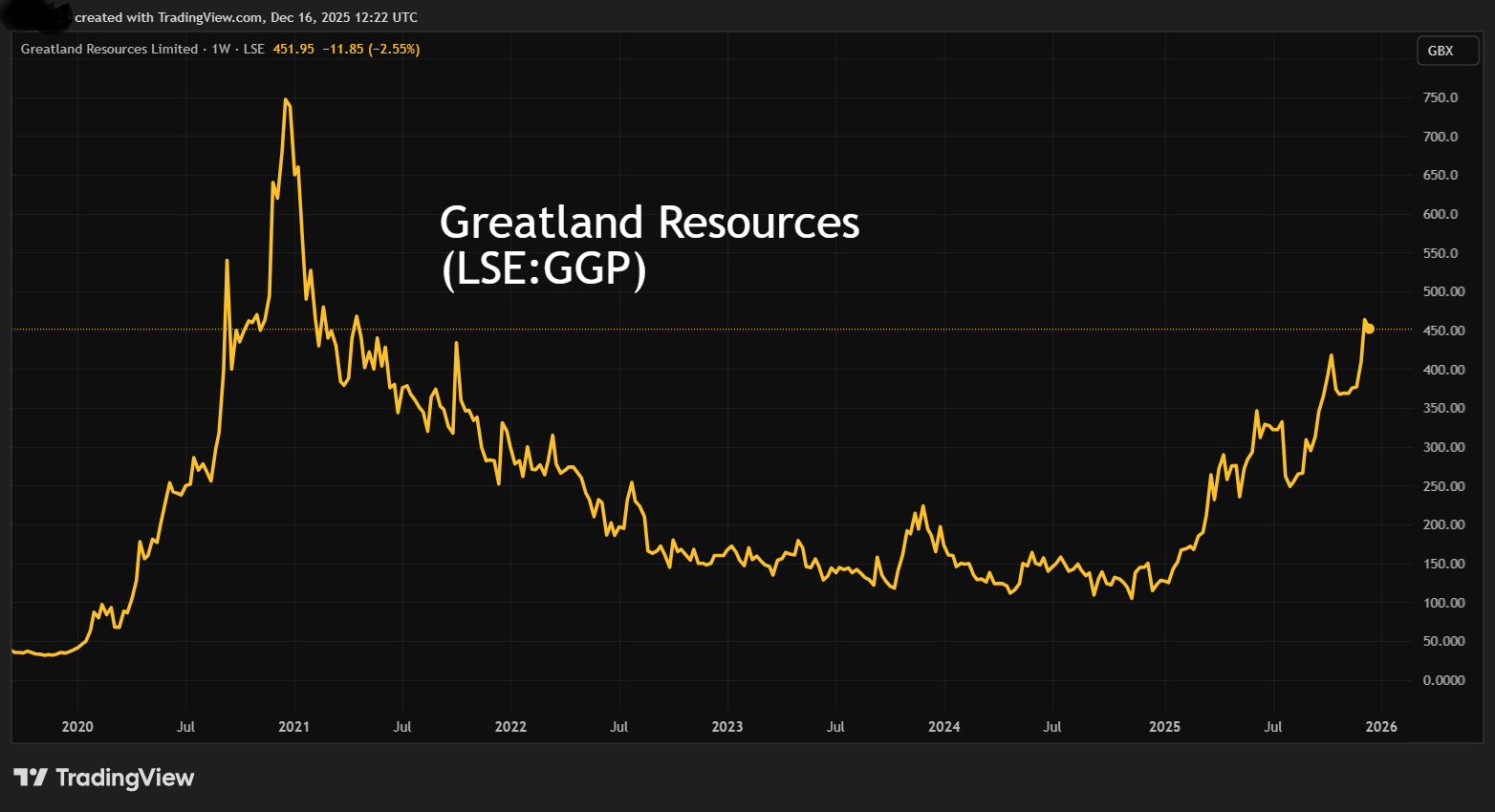
Source: TradingView. Past performance is not a guide to future performance.
After a record of losses, Greatland broke into substantial profit in its last year to 30 June, although net profit versus earnings per share (EPS) projections are volatile for the next two financial years. I would take these with a pinch of salt anyway given that gold price volatility can swiftly disrupt forecasts. A mining share like this tends to take its cue from the underlying commodity and its operations narrative, which does appear medium-term promising.
Greatland’s rise to over 450p can make its investment ratios look demanding: near 19x expectations for June 2026 EPS of around 24p sterling-equivalent, falling to 13x if 35p is achieved in the June 2027 year. There is no yield despite a £3.2 billion market value well over 3x sales, but enterprising miners do tend to focus on capital growth.
If gold remains broadly elevated, then such a valuation is justified as operational gearing kicks in to transform Greatland’s numbers.
Greatland Resources - financial summary
Year-end 30 Jun
| 2019 | 2020 | 2021 | 2022 | 2023 | 2024 | 2025 | |
| Operating profit (£m) | -3.3 | -5.2 | -5.7 | -8.4 | -20.8 | -14.9 | 191 |
| Net profit (£m) | -3.3 | -5.1 | -5.5 | -11.4 | -21.1 | -14.9 | 163 |
| Reported EPS (p) | -0.1 | -0.1 | -0.1 | -0.3 | -0.4 | -0.3 | 30.5 |
| Normalised EPS (p) | -0.1 | -0.1 | -0.1 | -0.3 | -0.4 | -0.3 | 32.0 |
| Operating cashflow/share (p) | -0.09 | -0.13 | -0.07 | -0.15 | -0.24 | -0.24 | 54.7 |
| Capital expenditure/share (p) | 0.02 | 0.00 | 0.35 | 0.46 | 0.30 | 0.24 | 15.3 |
| Free cashflow/share (p) | -0.12 | -0.13 | -0.42 | -0.60 | -0.54 | -0.48 | 39.4 |
| Dividend/share (p) | 0.0 | 0.0 | 0.0 | 0.0 | 0.0 | 0.0 | 0.0 |
| Return on capital (%) | -141 | -90.9 | -27.7 | -16.6 | -21.6 | -17.6 | 21.9 |
| Cash (£m) | 2.8 | 6.0 | 10.4 | 18.8 | 43.7 | 6.3 | 278 |
| Net debt (£m) | -2.8 | -5.6 | 2.1 | 24.6 | -1.8 | 35.5 | -263 |
| Net asset value (£m) | 2.3 | 5.3 | 4.2 | 5.7 | 52.5 | 41.0 | 648 |
| Net asset value/share (p) | 0.1 | 0.1 | 0.1 | 0.1 | 1.0 | 0.8 | 96.8 |
Source: company accounts.
Notice two examples of how those close to the action are preserving some gains. On 3 December, the CFO exercised 141,213 options, selling 75% of shares arising which goes well beyond any taxation that may have been due. With 315,285 shares held, this could be viewed as a 31% reduction in equity exposure, although further option awards might be forthcoming. On the same day, Tembo Capital Holdings reduced its stake from near 6% to 5%, a near 17% reduction around current price levels.
It accords with my sense to temper my stance on Greatland to “hold”, with the possibility of locking in gains according to your risk preference. Ultimately, this is chiefly about whether bubble-behaviour pops in due course, or essentially creates another buying opportunity in a secular bull market driven by US dollar weakness and global debt.
Edmond Jackson is a freelance contributor and not a direct employee of interactive investor.
AIM stocks tend to be volatile high-risk/high-reward investments and are intended for people with an appropriate degree of equity trading knowledge and experience.
These articles are provided for information purposes only. Occasionally, an opinion about whether to buy or sell a specific investment may be provided by third parties. The content is not intended to be a personal recommendation to buy or sell any financial instrument or product, or to adopt any investment strategy as it is not provided based on an assessment of your investing knowledge and experience, your financial situation or your investment objectives. The value of your investments, and the income derived from them, may go down as well as up. You may not get back all the money that you invest. The investments referred to in this article may not be suitable for all investors, and if in doubt, an investor should seek advice from a qualified investment adviser.
Full performance can be found on the company or index summary page on the interactive investor website. Simply click on the company's or index name highlighted in the article.
Disclosure
We use a combination of fundamental and technical analysis in forming our view as to the valuation and prospects of an investment. Where relevant we have set out those particular matters we think are important in the above article, but further detail can be found here.
Please note that our article on this investment should not be considered to be a regular publication.
Details of all recommendations issued by ii during the previous 12-month period can be found here.
ii adheres to a strict code of conduct. Contributors may hold shares or have other interests in companies included in these portfolios, which could create a conflict of interests. Contributors intending to write about any financial instruments in which they have an interest are required to disclose such interest to ii and in the article itself. ii will at all times consider whether such interest impairs the objectivity of the recommendation.
In addition, individuals involved in the production of investment articles are subject to a personal account dealing restriction, which prevents them from placing a transaction in the specified instrument(s) for a period before and for five working days after such publication. This is to avoid personal interests conflicting with the interests of the recipients of those investment articles.